
Summary
Ethical AI in SEO now underpins sustainable rankings as Google’s March 2025 Core Update and related 2025 algorithm changes elevate user intent, authenticity, and value while penalizing manipulative AI content. A leading e commerce retailer was penalized in January 2025 and lost 78% of organic traffic after programmatic AI generated pages failed engagement signals like dwell time and bounce rate. Durable growth comes from transparent algorithms, privacy compliance, bias safeguards, human oversight, clear AI attribution, and predictive analytics that improve UX and search performance.
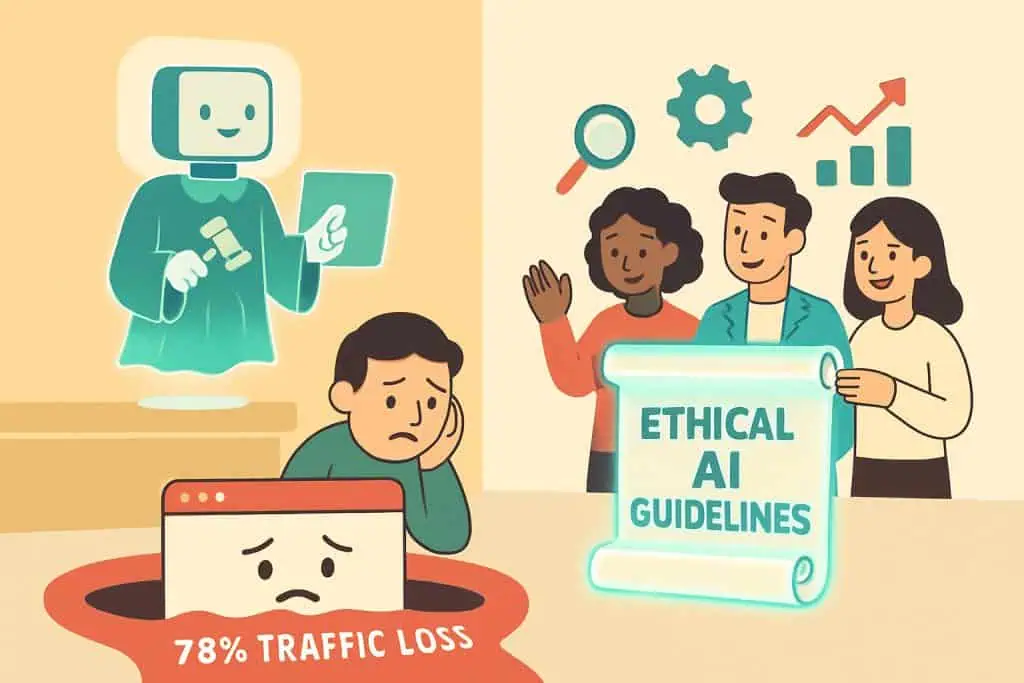
In January 2025, a leading e-commerce retailer faced a severe penalty from Google. Their reliance on manipulative AI-generated content, designed only to climb Search rankings, backfired. Overnight, they lost 78% of their organic traffic. Revenue evaporated, and the brand’s reputation was left in ruins.
This case highlights a hard truth: Ethical AI in SEO is no longer optional. It’s now the difference between visibility and disappearance.
What Ethical AI in SEO Means Today
Artificial intelligence is now embedded in keyword research, predictive analytics, and large-scale content generation. Yet Search engines have become equally adept at spotting manipulation. They evaluate not just the words on a page but also intent, authenticity, and user value.
This makes Ethical AI in SEO the guiding principle for every serious brand. The practice is about balancing automation with integrity: transparent methods, accurate use of data, and content that respects both algorithms and audiences.
From Keywords to User Intent
The2023 SEO playbook feels outdated. Back then, keyword stuffing still worked in some niches. By 2025, the focus shifted toward meeting user intent across platforms. Google’s March 2025 Core Update reinforced that shift. Sites relying on programmatic content without substance lost ground—those prioritising ethical approaches gained.
The outcome is clear: Ethical AI in SEO is the baseline for stability. Anything less is short-term noise that collapses under algorithm updates.
The Broader Digital Impact
Beyond rankings, the ethical use of AI influences the health of the web itself. Spammy tactics flood Search results with noise. Transparent, responsible practices strengthen trust in information online. That’s why Ethical AI in SEO matters to users and to the credibility of the internet.
Original research, unique insights, and accountable content are now rewarded. AI can still assist, but when used ethically, it enhances rather than replaces human expertise.
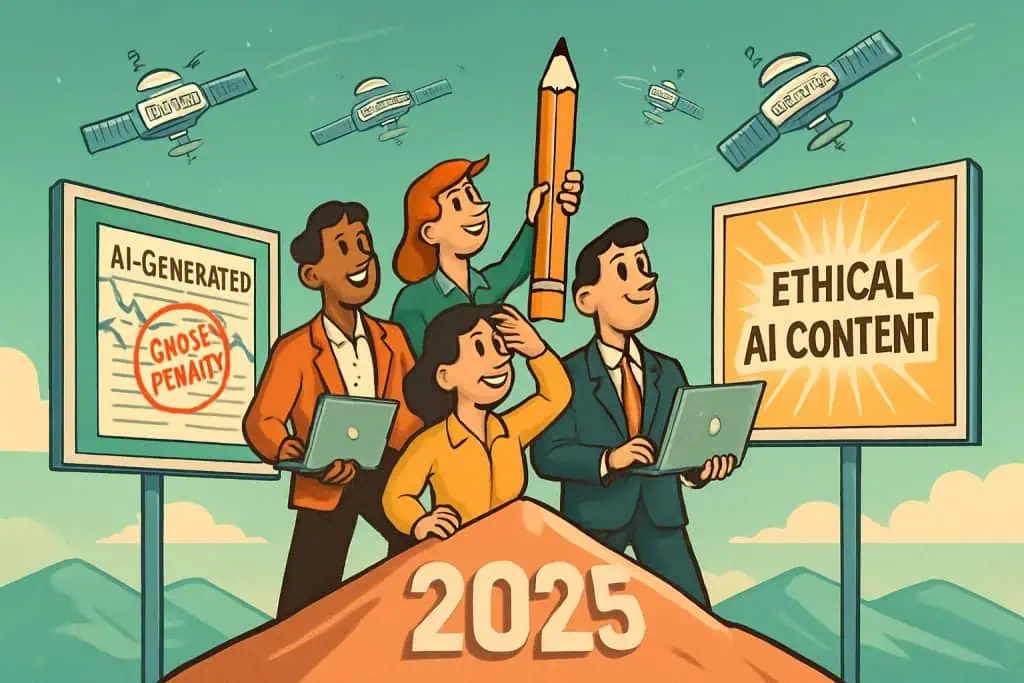
Google’s 2025 Algorithm Updates: Rewarding Ethical AI Practices
Google’s algorithm updates in 2025 have introduced major shifts in website ranking, with several key changes directly related to AI-generated content and ethical practices. The Search engine now places greater emphasis on Search intent, user experience, and AI-driven content evaluation.
The 2025 updates reinforce Google’s long-term commitment to improving Search relevance and preventing manipulation through outdated SEO tactics. Major shifts include:
- Enhanced AI evaluation of content quality and authenticity
- More sophisticated analysis of user engagement metrics to determine content value
- Stricter penalties for manipulative AI-generated content
- Increased rewards for transparent, ethical AI implementation
Google now evaluates whether content accurately answers user queries by analysing dwell time, bounce rate, and user interactions. This means websites must focus on delivering value-driven content that genuinely satisfies Search intent rather than simply incorporating keywords or manipulating on-page factors. Understanding and optimising for these user engagement metrics is crucial for creating content that meets user needs and satisfies Search intent.
These algorithm changes have directly impacted how ethical AI influences SEO rankings in 2025. Sites demonstrating transparent, responsible AI use in content creation and optimisation are experiencing significant ranking improvements, while those employing AI purely to manipulate Search results face unprecedented penalties.
Key Ethical Considerations in AI-Powered SEO
While AI unlocks powerful capabilities for SEO professionals, it also introduces significant ethical concerns that must be addressed to maintain ranking performance and brand integrity.
Data Privacy and Security
Data privacy has become a top concern, given the vast amounts of personal information processed when companies deploy AI for SEO and marketing. Data breaches and misuse of personal information can lead to substantial harm to individuals and devastating reputational damage to businesses.
The EU’s General Data Protection Regulation and the California Consumer Privacy Act mandate strict data protection measures and transparent data practices. Even without legal obligations, businesses that implement ethical AI in SEO follow best practices, including anonymising data, using robust encryption, and regularly auditing data security protocols.
Algorithm Bias and Fairness
Algorithmic bias in AI can result in unfair and discriminatory outcomes that disproportionately affect marginalised groups. In SEO applications, this bias can manifest in content recommendations, audience targeting, and even keyword prioritisation – potentially excluding essential segments of your audience without your knowledge.
Ethical AI implementation requires addressing these biases through strategies, including:
- Ensuring diverse, representative data sets for algorithm training
- Regular bias audits and corrections
- Implementing fairness constraints in AI systems
- Building diverse development teams to provide broader perspectives
Transparency and Accountability
The third crucial ethical consideration is transparency in how AI is used in SEs. This primarily means clearly identifying what content is AI-generated versus human-created. By maintaining this transparency, brands can build trust with their audiences, reassuring them about the ethical use of AI in their digital marketing strategies.
A 2024 study found that 63% of consumers want to know when engaging with AI-generated content. This doesn’t mean content can never leverage AI – in fact, many consumers reported preferring AI content for specific applications, but transparency about AI involvement remains essential.
Organisations must clearly communicate how their AI systems make decisions, the data sources they utilise, and the accountability mechanisms they implement, such as independent audits and clear governance frameworks.
What Makes an AI-Powered SEO Tool Ethically Compliant?
As AI-powered SEO tools multiply, deciding which ones respect ethical standards is now central to responsible marketing. For companies seeking to build long-term trust, the benchmark is clear: tools must align with the principles of Ethical AI in SEO. By 2025, that’s the baseline.
Essential Features of Ethical AI Tools
Ethically compliant tools share several characteristics that separate them from the flood of questionable products:
Algorithmic transparency. A tool committed to Ethical AI in SEO doesn’t hide behind black boxes. It explains how recommendations are generated so teams understand the reasoning.
Data privacy. Tools that respect user consent and minimise data collection support the ethical foundation of SEO. They go beyond regulations, treating privacy as part of the trust contract.
Bias safeguards. If an algorithm carries bias, rankings and visibility are distorted. Tools built with an Ethical AI mindset in SEO detect and mitigate these distortions before they reach the user.
Human oversight. Machines don’t decide everything. The most trustworthy platforms embed checkpoints for human editors to review and adjust, preserving judgment and accountability.
Content attribution. A clear distinction between human and machine output is a hallmark of Ethical AI in SEO. Transparency is required to keep audiences informed.
Standards and Certifications
The demand for responsible systems has led to standards designed to guide Ethical AI in SEO. Certifications introduced since 2024 include independent audits and compliance frameworks like Responsible AI Governance. Companies that care about credibility now use these markers as filters before adopting new tools.
By holding products accountable, these frameworks make sure ethical compliance isn’t just a marketing claim but something verifiable.
Balance Between Automation and Human Oversight
Automation is powerful, but can’t replace judgment. Neil Patel’s 2025 Digital Guide emphasised that content creation should remain layered: AI assists with research, drafting, and optimisation, while humans preserve brand voice and ethical integrity.
This model captures the essence of Ethical AI in SEO: collaboration, not substitution. A compliant tool doesn’t seek to erase human input but to strengthen it.
Predictive Analytics in Ethical SEO: Balancing Insights and Privacy
Predictive analytics has emerged as one of the most powerful applications of AI in SEO, offering an unprecedented ability to identify future trends and proactively optimise strategies. However, using these capabilities ethically requires striking a delicate balance between leveraging valuable insights and protecting user privacy.
How Predictive Analytics Enhances SEO Strategy
Predictive analytics in SEO uses data, statistical algorithms, and machine learning to estimate future outcomes from historical data. When implemented ethically, these capabilities deliver significant advantages:
Keyword Performance Prediction: By analysing Search volume trends and patterns across industries, predictive analytics tools can forecast future demand for specific keywords, allowing SEO professionals to optimise content strategy ahead of changing user interests.
Content Impact Forecasting: Predictive models analyse historical performance of content types and formats to predict how new content will perform, enabling more strategic resource allocation.
User Experience Optimisation: Predictive tools can analyse past user behaviours and engagement patterns to forecast how website changes might impact user behaviour, allowing preemptive UX improvements.
Several businesses have already demonstrated the power of ethical predictive analytics in SEO. A leading online retailer, using predictive analytics to refine its SEO strategy, analysed historical traffic data, customer interactions, and Search trends to anticipate upcoming product interests. By optimising pages for these predicted trends, they achieved a 30% increase in organic traffic within months.
Ethical Considerations in Predictive SEO
Using predictive analytics responsibly requires addressing several key ethical considerations:
Data collection transparency: Users must understand what data is being collected and how it will be used for predictions. Ethical implementations provide clear disclosures and consent mechanisms.
Minimising personal data use: Ethical predictive systems prioritise aggregated and anonymised data over individual user profiles whenever possible.
Avoiding manipulation: While prediction enables optimisation, ethical implementations avoid manipulative tactics that exploit identified user vulnerabilities or create artificial urgency.
Equitable application: Predictive systems must be designed to serve diverse user populations equitably, without reinforcing existing biases or digital divides.
Organisations that implement predictive analytics in SEO ethically have seen benefits beyond improved rankings, including enhanced content relevance, optimised marketing budgets, and increased user satisfaction.
CapstonAI: A Case Study in Ethical SEO Optimisation
CapstonAI has emerged as a leading example of how SEO tools can integrate advanced AI capabilities while maintaining strict ethical standards. Examining its approach provides valuable insights into how AI-powered SEO tools can align with emerging ethical frameworks in 2025.
Key Ethical Features of CapstonAI
CapstonAI distinguishes itself through several features specifically designed to address ethical concerns in AI-powered SEO:
Transparent algorithm explanations: unlike many competitors that offer “black box” recommendations, CapstonAI provides detailed descriptions of how its algorithms reach specific conclusions and recommendations, allowing users to evaluate the reasoning behind its suggestions.
Customisable ethical guardrails: the platform enables organisations to define ethical parameters aligned with their values and industry requirements, creating tailored guardrails for AI operations.
Bias detection and correction: regular algorithmic audits identify potential biases in recommendations and implement corrective mechanisms to prevent the perpetuation of unfair advantages or disadvantages across content topics or audience segments.
Integrated human review workflows: CCapstonAI’sarchitecture integrates seamless human review points for critical decisions, particularly for sensitive topics or significant strategic shifts.
Privacy-preserving predictive analytics: the platform’s predictive capabilities primarily operate on aggregated, anonymised datasets rather than individual user profiles, balancing performance with privacy protection.
CapstonAI and Predictive SEO Standards
CapstonAI’s approach to predictive analytics exemplifies how ethical standards can be maintained while delivering powerful forecasting capabilities. The platform aligns with emerging ethical standards in predictive SEO optimisation through several mechanisms:
- Offering transparent documentation of data sources used in predictive models
- Providing confidence intervals alongside predictions to prevent overreliance on forecasts
- Implementing automated checks to prevent potentially manipulative optimisation suggestions
- Regular third-party audits of predictive algorithms to identify and address bias
This balanced approach benefits organisations from advanced predictive capabilities while maintaining ethical standards and building long-term audience trust.
Implementing Ethical Content Optimisation Strategies
Creating ethically optimised content requires more than avoiding questionable practices—it demands a proactive approach to balancing AI efficiency with authentic human expertise and values.
Guidelines for Ethical AI-Assisted Content
Organisations implementing ethical content optimisation should follow these core guidelines:
Establish clear AI usage policies: Develop explicit guidelines on when and how AI tools can be used for content creation and optimisation.
Maintain transparency with audiences: Clearly disclose AI involvement in content creation where appropriate, particularly for sensitive topics or when AI generates substantial portions of content.
Implement layered human oversight: Create a tiered review system in which more sensitive or high-stakes content receives a proportionally higher level of human review and refinement.
Diversify data sources: Ensure AI tools are trained on diverse, representative datasets to prevent the perpetuation of biases or the narrowing of content perspectives.
Regular ethical audits: Conduct periodic reviews of AI-assisted content to identify potential ethical issues, biases, or areas for improvement.
NP DDigital’sGuide for 2025 emphasises following “a layered, ethical process that integrates AI at key stages of content creation while maintaining human control. This balanced approach ensures AI enhances rather than compromises content integrity.
Balancing AI Efficiency with Human Expertise
While AI offers significant efficiency gains, ethical content optimisation requires balancing automation and human judgment. Effective strategies include:
Define appropriate AI use cases: identify which content-creation and optimisation aspects are best suited to AI assistance rather than human expertise.
Preserve brand voice and values: ensure AI-assisted content consistently reflects your organisation’s authentic voice, tone, and core values.
Focus AI on research and analysis: use AI primarily for data collection and analysis, while reserving core messaging and strategic decisions to human teams.
Create a collaborative workflow: design processes in which AI and human teams work interactively rather than sequentially, with continuous feedback loops.
Organisations that successfully implement these balanced approaches experience significant benefits, including increased content production capacity, improved SEO performance, and maintained brand authenticity.
Responsible AI in Digital Marketing
Looking past 2025, responsible use of artificial intelligence in digital marketing is no longer just a vision—it’s a structural necessity. Trends emerging now will decide how brands approach Ethical AI in SEO and broader marketing practices for the next decade.
Emerging Trends and Technologies
Regulation on the rise. Laws around AI in marketing are set to expand, much like data privacy rules did in the 2010s. Companies already using Ethical AI in SEO frameworks will find compliance less burdensome.
Consumer awareness. People now understand AI better. They question how content is produced and whether it respects privacy and fairness. Brands that embed Ethical AI into SEO principles earn trust rather than scepticism.
Agentic AI optimisation. With systems capable of acting independently across platforms, a new type of optimisation emerges: AAIO (Agentic AI Optimisation). Without ethical guardrails, this could spiral into manipulative automation. Integrating Ethical AI in SEO principles ensures these tools strengthen relationships rather than erode them.
Federated learning. Training models across devices without centralising data preserves privacy while delivering powerful results. This approach reinforces the value of Ethical AI in SEO by protecting users while improving performance.
Long-Term Benefits of Ethical AI Adoption
Organisations that integrate Ethical AI in SEO strategies don’t just avoid penalties—they gain durable advantages:
- Brand trust. Ethical practices build deeper loyalty in markets where transparency influences purchase behaviour.
- Regulatory safety. Companies that go beyond minimum compliance are shielded from sudden policy shifts.
- Sustainable performance. Aligning with real user needs delivers rankings that last longer than manipulative tactics.
- Future readiness. Frameworks grounded in Ethical AI in SEO allow faster adaptation to new tools and rules.
A Strategic Advantage of Ethical AI in SEO
The pattern is clear: organisations that prioritise responsible practices see their rankings and reputations grow. Search algorithms increasingly reward content that reflects authenticity, fairness, and value. Those who ignore these shifts face penalties or lose visibility.
By applying Ethical AI in SEO, companies protect user data, ensure algorithmic fairness, and communicate transparently. It’s not about replacing humans but reinforcing oversight where it matters. Tools like CapstonAI demonstrate how predictive analytics can thrive when guided by responsibility, not shortcuts.
The future doesn’t belong to the most complex AI. It belongs to the brands that understand this truth: the strongest SEO strategies are built on Ethical AI, not exploitation.
Sources
-
- https://www.ncbi.nlm.nih.gov/pmc/articles/PMC11893894/
- https://arxiv.org/abs/2504.12482
- https://www.searchenginejournal.com/google-completes-march-2025-core-update-rollout/543063/
- https://searchengineland.com/evolving-seo-for-2025-what-needs-to-change-450911
- https://www.searchenginejournal.com/google-completes-march-2025-core-update-rollout/543063/
- https://screpy.com/predictive-analytics-and-seo-a-perfect-match/
- https://customerthink.com/the-future-of-seo-ethical-practices-and-ai-integration-in-2024/
- https://www.linkedin.com/pulse/how-ai-revolutionizing-seo-2025-comprehensive-guide-baig–fd7af
- https://www.linkedin.com/pulse/ai-marketing-bridging-trust-gap-ethical-responsible-b2b-techfluencer-0dxnf
- https://marketingdr.co/seo-trends-in-2025/
- https://www.linkedin.com/pulse/key-principles-practices-ethical-seo-include-marajul-islam
- https://developers.google.com/search/docs/fundamentals/seo-starter-guide
- https://www.enworld.org/threads/whats-in-a-capstone.681685/
- https://www.quantifimedia.com/google-s-april-2025-updates-what-you-need-to-know-how-to-adapt
Q&A
Q1: What is Ethical AI in SEO in 2025?
A1: Transparent AI use aligned to user intent and authentic value, with privacy compliance, bias mitigation, and human review.
Q2: How did Google’s March 2025 Core Update change rankings?
A2: It rewarded intent-matched, value-driven content and penalised programmatic, low-substance AI output using engagement signals like dwell time and bounce rate.
Q3: What features make an AI-powered SEO tool ethically compliant?
A3: Algorithmic transparency, data minimisation and consent, bias detection and correction, human oversight checkpoints, and transparent AI vs human attribution.
Q4: How does CapstonAI implement Ethical AI in SEO?
A4: Transparent algorithm explanations, customisable ethical guardrails, recurring bias audits, integrated human review workflows, and privacy-preserving predictive analytics.