Summary
A client’s e-commerce traffic dropped by 30% because of poorly optimised meta tags that failed to capture Search intent and drive clicks. After implementing AI-powered meta tag optimisation across more than 500 product pages, click-through rates increased by 42% within three weeks. Meta tags are HTML elements, with title tags and meta descriptions being the most crucial for SEO since they appear as snippets in Search engine results pages and influence user clicks.
AI meta tag optimisation can be a game-changer. Last week, a client called us in a panic. Despite excellent content, their e-commerce site’s traffic had dropped by 30% due to poorly optimised meta tags that failed to capture Search intent and drive clicks. After implementing AI-powered meta tag optimisation across their 500+ product pages, click-through rates increased by 42% within three weeks, bringing the client relief and satisfaction.
This success story is a testament to the transformative power of AI meta-tag optimisation that can be harnessed for your SEO strategies.
This real-world transformation, from a crisis to a success story, illustrates the transformative power of AI meta-tag optimisation that has become critical to successful SEO strategies in 2025.
What Are Meta Tags and Why They’re Critical for SEO Success
Meta tags are HTML elements that provide information about a webpage to Search engines and website visitors. The most crucial SEO meta tags are title tags and meta descriptions, which are the snippets users see in Search engine results pages (SERPs).
They serve as your website’s first impression and directly influence whether users click through to your site.
Recent studies show that well-optimised meta tags can drive organic traffic, improve user engagement, and enhance Search engine rankings. Ahrefs research shows that 25.02% of top-ranking pages lack a meta description, yet those that do and are well-optimised tend to have higher CTRs. Without relevant and well-crafted meta tags, even the best content may fail to reach its target audience.
Meta tags bridge your content and its discoverability, making them essential to any comprehensive SEO strategy.
From Manual to AI-Powered Meta Tag Creation
Traditional Manual Meta Tag Writing
Traditionally, SEO specialists would craft meta descriptions and title tags manually, a process that requires:
- Deep understanding of SEO best practices
- Knowledge of character limitations
- Ability to create compelling copy that drives clicks
- Integration of relevant keywords naturally
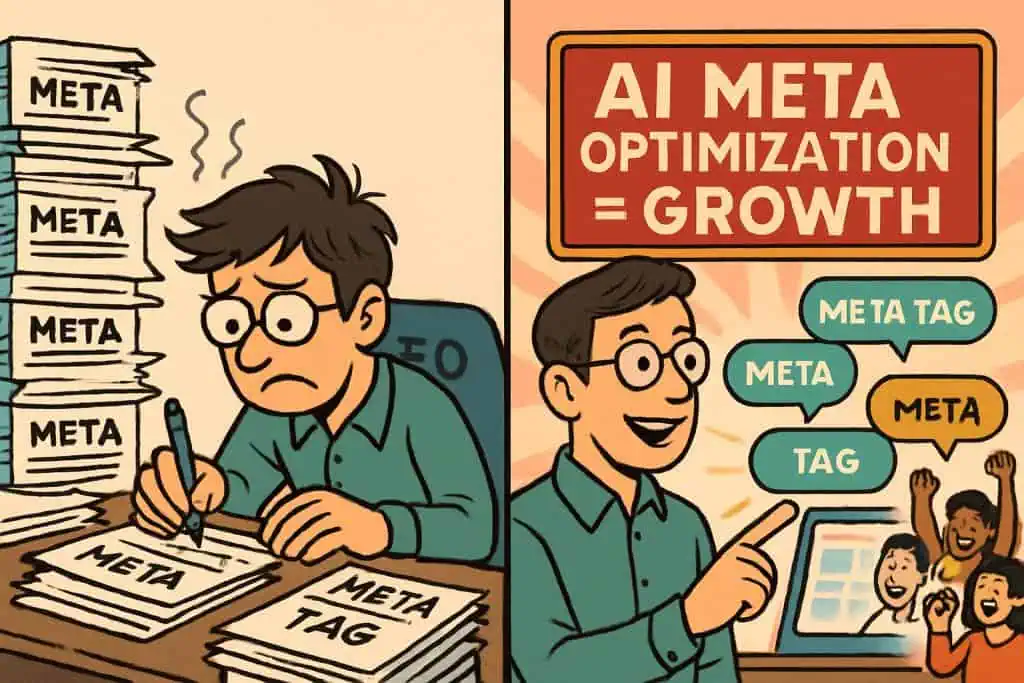
While this approach provides creative control and brand voice consistency, it poses significant challenges for websites with hundreds or thousands of pages. The manual process is time-consuming, error-prone, and difficult to scale.
The AI Revolution in Meta Tag Creation
The introduction of AI tools has revolutionised how digital marketers approach meta-tag optimisation. Advanced algorithms now analyse page content through Natural Language Processing, ensuring meta tags align with user Search intent. AI tools can generate meta descriptions up to 6 times faster than manual writing. This efficiency and scalability let SEO teams focus more on strategy and other high-impact activities, saving time and resources.
How AI Enhances Meta Tag Optimisation
Speed and Efficiency Advantages
One of the main benefits of AI meta tag optimisation is the dramatic improvement in creation speed. A comparative study found that ChatGPT-4 enabled teams to complete meta descriptions more than 6 times faster than manual writing, at 2.5 minutes per page versus 19 minutes. This efficiency lets SEO teams focus on strategy and other high-impact activities.
Unparalleled Scalability for Large Websites
AI excels at handling metadata creation for sites with many pages. E-commerce sites with thousands of product pages or content-rich sites with large blog archives benefit from automated meta-tag generation. The technology maintains consistency across the site while adapting to individual page content.
Personalisation Based on User Intent
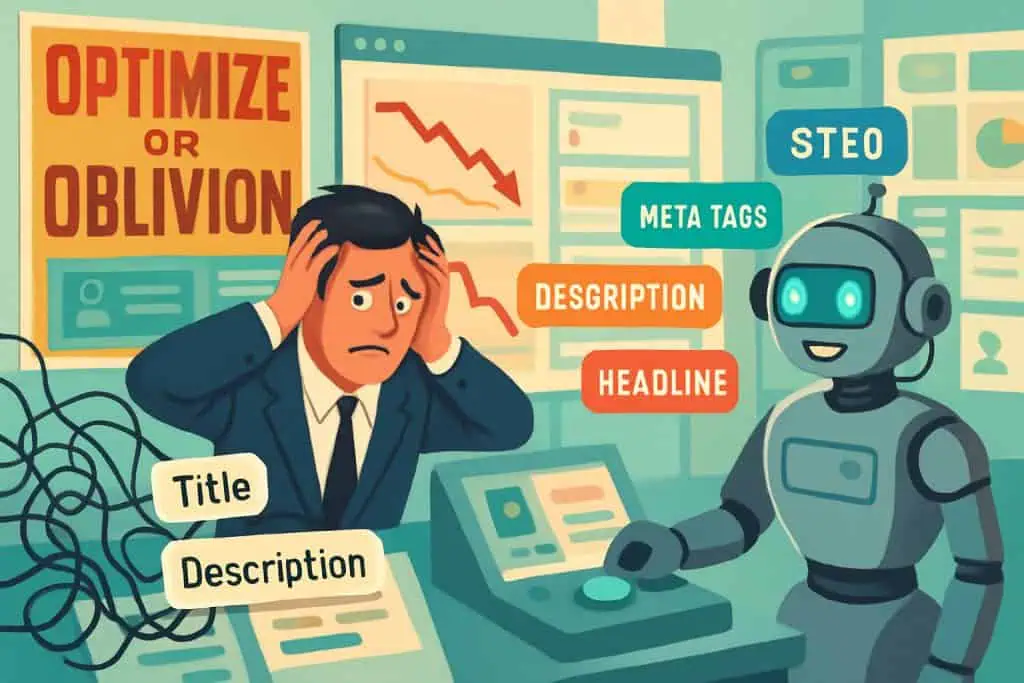
AI algorithms analyse large amounts of data and recognise patterns in Search behaviour, creating meta-descriptions that better match current Search queries. These capabilities improve visibility by aligning meta content with user Search intent. Advanced AI systems can customise meta tags based on high-conversion keywords, seasonal trends, geographic and demographic factors, and user device preferences.
This personalised approach ensures your content is more relevant and engaging for your target audience.
Advanced AI systems can even customise meta tags based on:
- Keywords with the highest conversion potential
- Seasonal Search trends
- Geographic and demographic factors
- User device preferences
Measurable SEO Improvements from AI Meta Tag Optimisation
Impact on Click-Through Rates
The main objective of AI Meta Tag Optimisation is higher click-through rates. Tests show that titles and descriptions tuned for intent outperform generic text. One large-scale study found that human-written descriptions achieved a 176% higher CTR than machine-generated content. This does not discredit automation but highlights the need for a hybrid approach: draft at scale with automation, then refine with brand expertise.
Including structured details compounds the effect. A test inserting prices directly into titles, such as “Men’s Leather Wallet $49.99,” drove a 23% lift in CTR. Well-trained AI Meta Tag Optimisation systems can apply these proven elements consistently across catalogues, turning best practices into repeatable rules.
Error Reduction and Consistency
Human workflows often introduce duplication or over-optimisation. AI Meta Tag Optimisation minimises these issues through controlled generation. Duplicate tags, keyword stuffing, and inconsistent phrasing decline when tags are produced under fixed logic. Search engines interpret uniform structures more effectively, improving clarity and ranking signals.
Spelling and formatting inconsistencies also decrease. With AI Meta Tag Optimisation, thousands of pages receive titles and descriptions with the same baseline quality. The result is less noise for crawlers and a more coherent site structure.
Dynamic Optimisation for Changing Content
Static metadata quickly loses relevance. AI Meta Tag Optimisation systems can track shifts in product data, seasonal topics, or trending queries and update tags in real time. This keeps a site aligned with current demand without relying on manual interventions that come too late.
As content expands and evolves, AI Meta Tag Optimisation ensures that descriptions remain current, accurate, and aligned with users’ active Search queries. This dynamic capability bridges the gap between scale and adaptability.
Best AI Tools for Meta Tag Optimisation in 2025
ChatGPT and Advanced Language Models
ChatGPT has emerged as the Swiss Army Knife of AI SEO tools. It can generate optimised title tags and meta descriptions for Web pages in seconds. The quality of the results depends significantly on the prompts provided, with specific directions yielding better outcomes.
Pros:
- Versatile for various SEO tasks
- No specialised knowledge required
- Continuous improvements with each new model
Cons:
- Results vary based on prompt quality.
- It may require human refinement.
- Limited contextual understanding of business goals
Dedicated Meta Description Generators
Several purpose-built tools have emerged that specifically focus on meta tag creation:
- Grammarly’s AI Meta Description Generator – Creates SEO-friendly, engaging meta descriptions effortlessly with keyword optimisation features
- Copy.ai’s GTM AI – Generates meta descriptions that attract organic traffic while optimising for Search engines in seconds
- Semrush – Offers customised SEO insights that can be applied to meta tag creation
Pros:
- Purpose-built for meta tag optimisation
- Often includes SEO best practices automatically
- Many offer free versions to test the effectiveness
Cons:
- May lack the contextual awareness of broader AI systems
- Limited customisation options in some tools
- Potential for generic outputs without proper guidance
Enterprise-Level AI SEO Solutions
For larger organisations, comprehensive AI platforms provide integrated meta-tag optimisation:
- MarketMuse – Focuses on content strategy with meta tag recommendations that align with broader content goals
- Frase – Specialises in content optimisation, including meta elements
Pros:
- Comprehensive SEO integration
- Advanced analytics and performance tracking
- Often includes competitive analysis features
Cons:
- Higher cost than standalone tools
- Steeper learning curve
- It may require dedicated SEO personnel tomaximisee the value.
How to Avoid “Spammy” AI-Generated Meta Tags?
The efficiency of AI tools doesn’t guarantee quality output. To avoid creating meta tags that appear automated or spammy:
While AI generates meta descriptions at scale, implementing a review workflow ensures the final output maintains brand voice and emotional appeal. This hybrid approach delivers the best results, combining AI’s analytical power with human understanding of context and nuance.
When using AI tools for meta tag generation, include detailed information about:
- Target audience demographic
- Brand voice guidelines
- Specific value propositions
- Key differentiators from competitors
Train AI systems to prioritise communicating value to users rather than simply incorporating keywords. The most effective meta descriptions clearly articulate what the user will gain by clicking through to your page.
Best Practices for AI Meta Tag Implementation
Optimal Meta Description Length and Structure
To ensure they display correctly in Search results, keep meta descriptions to 150-160 characters. AI tools can be set to stay within these limits while still conveying key information automatically.
The most effective structure typically includes the following:
- A hook or question that captures attention
- The primary keyword is naturally integrated.
- A clear value proposition
- A subtle call to action
A/B Testing for Continuous Improvement
Implement a systematic approach to testing AI-generated meta tags:
- Track click-through rate using Google Search Console to identify pages with lower-than-expected CTR for their position
- A/B test critical pages by creating variations of your title and description tags to determine which combinations drive the highest CTR
- Monitor impressions in AI Overviews to track when your content is cited and measure the impact on direct traffic and brand awareness.
Balancing AI Efficiency with Brand Voice
The key to successful implementation is finding the right balance between AI efficiency and human creativity. While AI tools provide speed and consistency, human review ensures meta tags maintain brand voice and emotional appeal.
Since AI continues to evolve, we can expect even more sophisticated meta-tag optimisation capabilities.
Upcoming trends include:
- Personalised meta descriptions that dynamically change based on user Search history and preferences
- Voice Search optimisation for meta tags that improve discovery through voice assistants
- Integration with visual Search to optimise not just text but also image metadata
- Predictive optimisation that anticipates Search trend changes before they occur
Key Metrics for AI Meta Tag Optimisation
Click-through rate remains the clearest signal of success in AI Meta Tag Optimisation. Track CTR shifts before and after adjustments, and benchmark them against competitors to determine whether your meta tags genuinely drive more clicks.
Bounce rate indicates whether your meta descriptions match the on-page promise. When AI Meta Tag Optimisation is done well, the description attracts exemplary visitors, not just any visitors. Mismatched expectations usually inflate exits.
For e-commerce or lead-driven sites, connect meta tag changes directly to conversions. AI Meta Tag Optimisation is not just about more traffic, but about drawing the kind of traffic that buys or signs up.
Finding the Right Balance in AI Meta Tag Optimisation
The speed advantage of automated generation is undeniable. AI Meta Tag Optimisation can draft hundreds of descriptions in minutes, far beyond human capacity. Yet raw output often lacks nuance or brand fit. That is where editorial input ensures tone, clarity, and persuasion.
Studies show that AI Meta Tag Optimisation-generated descriptions are up to six times faster than manually created ones. But speed alone cannot guarantee performance. A human layer of review transforms those drafts into effective Search snippets that genuinely represent the business.
SEO is not static. Search intent, algorithms, and click behaviour change. Blending automation with strategy ensures that AI Meta TagOptimisation evolves continuously rather than remaining static.
The Long-Term Role of AI Meta Tag Optimisation
Over time, scaling efforts with AI Meta Tag Optimisation means a more consistent library of meta titles and descriptions across large sites. This consistency reduces missed opportunities and strengthens branding in Search results.
Where manual processes often fail to cover older pages, AI Meta Tag Optimisation enables systematic archiving, breathing new life into pages that would otherwise stagnate.
When applied thoughtfully, AI Meta Tag Optimisation turns the meta tag from a neglected technical detail into a controlled lever for visibility, clicks, and conversions.
Practical Takeaway
Use automation to accelerate, but never remove human review. AI Meta Tag Optimisation thrives when paired with critical editing. That balance is what keeps snippets both accurate and persuasive.
Done correctly, AI Meta Tag Optimisation is not just about faster output. It is about consistent, scalable, and measurable gains that connect Search visibility with business results.
Sources
-
- https://www.copy.ai/tools/meta-description-generator
- https://writesonic.com/blog/ai-agents-for-meta-tag-optimization
- https://backlinko.com/ai-seo-tools
- https://www.octopai.com/questions/why-is-automated-metadata-tagging-better-than-manual-tagging/
- https://www.grammarly.com/ai/ai-writing-tools/meta-description-generator
- https://practicalprogrammatic.com/tools/meta-description-generator
- https://www.seerinteractive.com/insights/ai-vs-human-written-metadata
- https://www.ryrob.com/meta-description-generator/