
AI search is quickly becoming the first stop for “what should I buy?” and “who’s best for this?” questions. Instead of sending users to ten blue links, systems like ChatGPT, Gemini, Claude, Perplexity, and Google’s AI experiences often synthesize an answer, then cite a handful of sources (or mention brands directly).
That shift changes the goal from “rank higher” to “be the brand the model trusts enough to mention, recommend, and cite.” This guide breaks down AI search engine optimization into a practical, starter-friendly GEO playbook you can implement in weeks, not quarters.
What is AI search engine optimization (and why GEO matters)
AI search engine optimization is the practice of improving how often, how accurately, and in what context AI systems mention your brand when users ask high-intent questions.
You’ll also hear the term Generative Engine Optimization (GEO). In practice, GEO focuses on earning:
- Mentions (your brand appears in the response)
- Citations (your pages or third-party pages are referenced)
- Recommendations (your brand is suggested as a best option for a use case)
Traditional SEO still matters, because AI systems frequently ground answers in web content. But GEO adds a new layer: you are optimizing for retrieval, extractability, and trust, not only rankings and clicks.
How AI answer engines typically decide what to mention
Different platforms behave differently, but many modern answer engines share a similar pattern:
- The system interprets the question and intent.
- It retrieves supporting sources (your site, marketplaces, reviews, Wikipedia-style sources, news, forums, partner pages).
- It generates a summary, often citing sources.
- It may rank or recommend options based on perceived fit and credibility.
This is why GEO is not a single “hack.” You are building a footprint that is easy to retrieve, consistent to interpret, and credible to repeat.
SEO vs AI search engine optimization: what actually changes
The easiest way to start is to keep your existing SEO program, then add GEO-specific checks and KPIs.
| Area | Traditional SEO focus | AI search engine optimization focus |
|---|---|---|
| Primary outcome | Rankings, traffic, clicks | Mentions, citations, recommendations |
| Content format | Optimized pages for SERPs | Extractable answers, Q&A, entity clarity |
| Trust signals | Links, topical authority, UX | Entity consistency, corroboration across sources |
| Measurement | Rankings, CTR, conversions | AI share of voice, prompt coverage, citation quality |
| Failure mode | You drop positions | You are omitted, misrepresented, or replaced by competitors |
If you only do classic SEO, you can still win, but you may miss visibility where the decision now happens: inside the answer.
A practical GEO starter framework (7 steps)
1) Lock down your entity basics (your brand “source of truth”)
AI systems are much more confident when your brand is an unambiguous entity with consistent attributes.
Start by auditing these basics across your site:
- A clear “About” page that states what you do, who you serve, where you operate, and what makes you different
- Consistent brand name usage (avoid switching between variants)
- Contact details and location info that match everywhere (especially if you have multiple locations)
- A single canonical description of your products and categories (avoid contradictions across pages)
Then support it with structured data.
If you want official implementation references, Google’s structured data docs and Schema.org are the safest starting points: Google Search Central: structured data and Schema.org.
2) Make key pages “extractable” (write for answer blocks, not just scrolling)
Answer engines love content that can be lifted cleanly into a response.
On your highest-intent pages (core product, category, service, location, pricing or quote pages), add:
- A 2 to 3 sentence definition near the top that answers “What is this?” and “Who is it for?”
- Scannable sections with descriptive headings (avoid clever headings that hide meaning)
- Concrete specs, constraints, and comparisons where relevant
- A short FAQ section that mirrors how customers actually ask questions
A useful pattern is:
- Definition (plain language)
- Use cases (who it helps)
- Proof (process, certifications, policies, case studies, reviews)
- FAQ (objections and edge cases)
This is not about dumbing content down. It’s about making your expertise easy to quote.
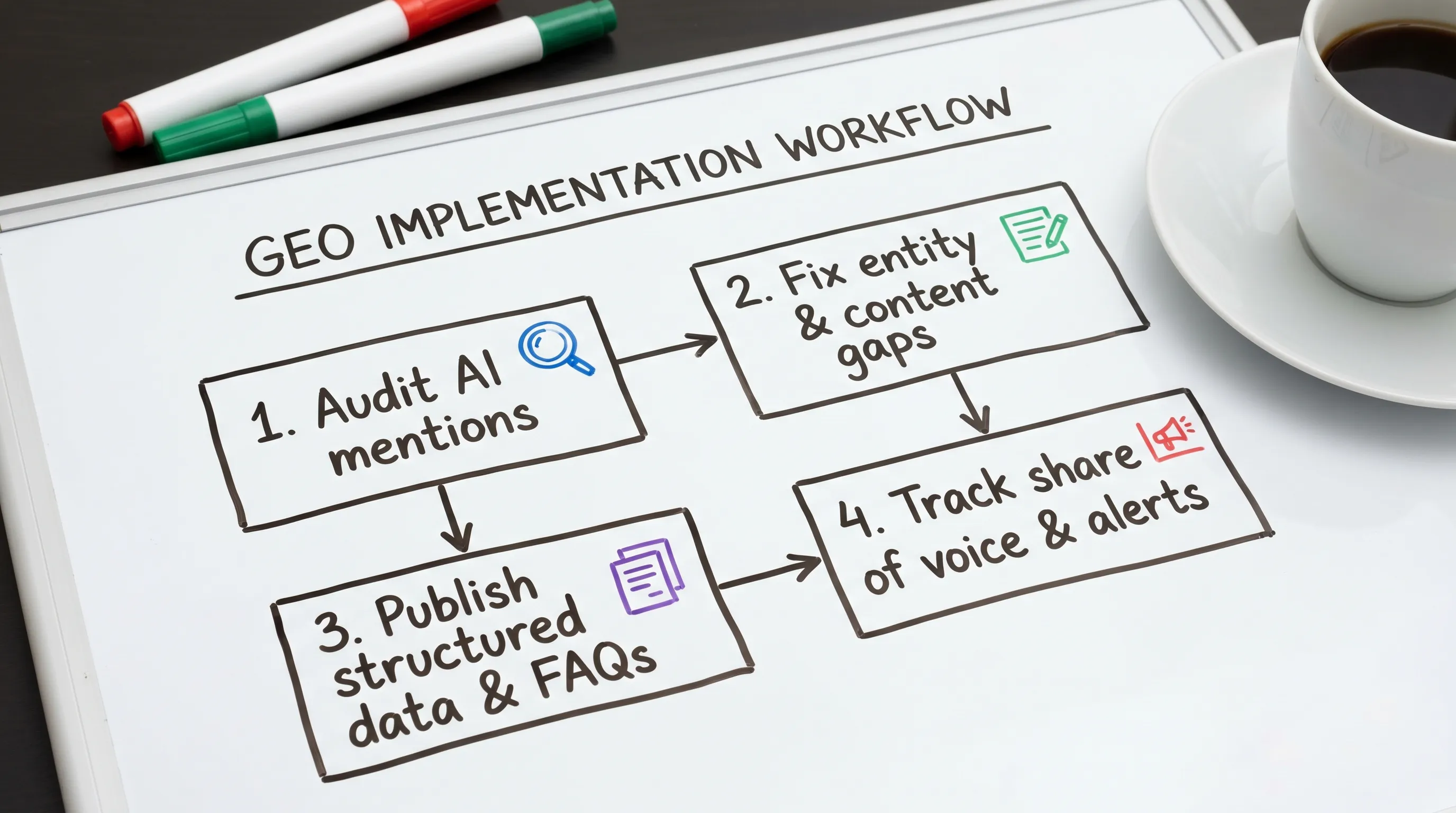
3) Add “AI-ready” metadata and schema by page type
Schema does not guarantee AI mentions, but it improves clarity and reduces ambiguity, especially for products, organizations, locations, and FAQs.
Use a page-type approach instead of random markup.
| Page type | Minimum structured data to consider | Why it helps |
|---|---|---|
| Homepage | Organization (or LocalBusiness) | Defines the entity and core attributes |
| Product pages | Product + Offer (where accurate) | Clarifies what you sell and key attributes |
| Location pages | LocalBusiness + geo details | Supports local intent and multi-location clarity |
| Articles/guides | Article | Reinforces authorship and topical relevance |
| FAQ sections | FAQPage (only for real FAQs) | Matches conversational queries and objections |
Implementation notes:
- Keep schema accurate and consistent with visible content.
- Avoid marking up content users cannot see.
- Use one primary schema strategy sitewide to prevent conflicts.
4) Build “corroboration” across trusted third-party sources
One of the biggest GEO blind spots is assuming your website alone is enough.
AI systems often cross-check claims. If your brand is only described on your own site, you are easier to omit or mistrust.
You do not need spammy link building. You need consistent references in places the model already trusts, such as:
- Industry directories and associations
- Major review platforms relevant to your category
- Partner pages, reseller pages, integration listings
- Credible PR and expert commentary
Your goal is to make it easy for the model to confirm:
- You exist
- You do what you say
- Others describe you similarly
5) Map prompts to pages (stop guessing what AI users ask)
GEO is prompt-driven. If you do not know which prompts trigger your category, you cannot systematically win.
Create a simple prompt map:
- “Best” prompts: best {product} for {use case}
- Comparison prompts: {your brand} vs {competitor}
- Alternative prompts: alternatives to {competitor}
- Local prompts: best {service} in {city}
- Objection prompts: is {brand} good for {constraint}
Then assign each prompt group to a page you control.
If you do not have a clear destination for a prompt, that is a content gap. If the destination exists but fails to earn mentions, that is a quality, credibility, or clarity gap.
6) Defend against AI misinformation (monitor and respond)
Unlike classic SEO, you can “rank” in AI answers with the wrong information attached to your brand.
Common issues:
- Wrong pricing ranges
- Incorrect location coverage
- Confused brand category (you get described as the wrong type of business)
- Outdated policies or discontinued products
A practical response loop:
- Identify the prompt that triggers the error
- Find which sources the system is relying on (if citations are shown)
- Update your source-of-truth pages with clearer statements
- Add an FAQ that explicitly resolves the ambiguity
- Strengthen corroboration on third-party profiles
This is where continuous tracking becomes a competitive advantage.
7) Measure what matters: GEO starter KPIs
If you only measure organic traffic, you will miss most AI visibility.
Start with a lightweight KPI set:
| KPI | What it tells you | Starter target |
|---|---|---|
| AI share of voice | How often you appear vs competitors for your prompt set | Increase steadily month over month |
| Prompt coverage | % of priority prompts where you show up at least once | Identify and close gaps |
| Citation rate | How often your site is cited when you are mentioned | Improve with better source pages |
| Mention accuracy | Whether the answer describes you correctly | Drive errors toward zero |
| Time to first mention | How quickly new pages or updates start showing up | Shorten over time |
To connect GEO to revenue, pair it with operational signals like branded search lift, direct traffic, demo requests, store locator actions, and assisted conversions.
A 30-day AI search engine optimization starter plan
Week 1: Baseline and entity cleanup
Pick 20 to 50 high-intent prompts that matter commercially. Check how often you appear across major AI engines and note:
- Whether you are mentioned
- Whether you are cited
- Whether the description is accurate
- Which competitors repeatedly show up
Then fix your entity basics (About, contact, location consistency, key product definitions).
Week 2: On-site extractability upgrades
Update your top 5 to 10 “money pages”:
- Add clear definitions and use cases
- Add FAQs based on real objections
- Tighten headings so sections can be quoted cleanly
Week 3: Structured data and metadata pass
Implement or validate Organization, Product, LocalBusiness, and Article schema where relevant. Ensure titles and descriptions match the real intent of the page, not just keyword variations.
Week 4: Corroboration and monitoring
Prioritize a handful of high-trust third-party profiles and partner listings to update for consistency. Set up a tracking cadence so you can detect new mentions, new competitors, and new errors early.
Where CapstonAI fits (without changing your whole stack)
If you want to operationalize this beyond a one-time project, you need repeatable visibility scans, prompt mapping, competitor tracking, and a way to publish fixes quickly.
CapstonAI is built for that workflow: it helps brands, retailers, and agencies track how major AI engines mention your brand, diagnose blind spots, publish AI-ready FAQs and metadata, and monitor share of voice over time.
You can also start with a free AI visibility audit to get a baseline and a prioritized fix list.
Frequently Asked Questions
Is AI search engine optimization the same as SEO? Not exactly. SEO focuses on ranking in traditional search results. AI search engine optimization (often called GEO) focuses on being mentioned and cited inside AI-generated answers.
What pages should I optimize first for GEO? Start with pages that represent your entity and buying intent: homepage, core product or service pages, location pages (if relevant), and a handful of high-converting guides that answer “best,” “vs,” and “how to choose” prompts.
Do I need schema markup to show up in AI answers? It’s not a guarantee, but it helps reduce ambiguity and improves machine readability. Prioritize accurate Organization, Product, LocalBusiness, and Article markup.
How do I know which prompts matter? Use sales and support logs, site search queries, PPC search terms, and competitor comparisons. Then validate by testing those prompts in the AI engines your customers actually use.
How long does it take to see results from GEO changes? It varies by platform and crawl frequency. Some changes can influence mentions quickly, while others require weeks of corroboration and repeated retrieval before they stick.
Get your AI visibility baseline (free)
If you want to stop guessing and start measuring, get a baseline first. CapstonAI offers a free AI visibility audit so you can see how ChatGPT, Gemini, Claude, and Perplexity currently mention your brand, where competitors are winning, and which fixes are most likely to move the needle.
Explore CapstonAI here: capston.ai