Summary
AI WordPress SEO tools in 2025 automate metadata, schema, internal linking, and content optimization via machine learning and NLP, cutting manual workload from 15 to 2 hours weekly while driving up to 300% ranking gains. Leading plugins like Capston.ai, AIOSEO, Rank Math, WP Automatic, and others deliver one-click optimization, predictive SEO analytics, and real-time content scoring that adapt to algorithm updates. Businesses report fast ROI through time savings, improved CTR from AI titles and descriptions, automated schema-rich results, and proactive keyword planning with predictive analysis.
When Sarah, the owner of a digital marketing agency, discovered that her team was spending 15 hours per week manually optimising WordPress websites for clients, she knew something had to change. After implementing AI WordPress SEO tools, her team reduced that time to just 2 hours while achieving 300% better ranking results. This transformation is becoming the new standard for WordPress optimisation in 2025.
AI WordPress SEO represents the evolution of search engine optimisation, where artificial intelligence automates complex tasks that previously required extensive manual effort. From automated metadata generation to predictive SEO analytics, these intelligent systems are revolutionising how WordPress websites achieve and maintain top search rankings.
The integration of machine learning and natural language processing into WordPress SEO tools has created unprecedented opportunities for website owners to outperform competitors while reducing optimisation workload. This comprehensive guide explores the most effective AI SEO plugins for WordPress, demonstrates how one-click WordPress optimisation works, and reveals the machine learning techniques that are transforming keyword research and content optimisation.
Revolutionary Impact of AI SEO Plugins for WordPress
The landscape of WordPress SEO automation has transformed dramatically with the introduction of artificial intelligence. Traditional SEO plugins required extensive manual configuration and constant monitoring, but AI SEO plugins for WordPress now handle these tasks autonomously, delivering superior results with minimal human intervention.
Modern AI WordPress SEO solutions leverage sophisticated algorithms to analyse content context, user behaviour patterns, and search engine preferences simultaneously. These systems can identify optimisation opportunities that human analysts might miss and implement changes that align with current algorithm requirements while predicting future ranking factors.
The most significant advantage of AI WordPress SEO lies in its ability to process vast amounts of data instantaneously. While a human SEO specialist might analyse keyword density, readability scores, and competitor content separately, AI systems evaluate hundreds of ranking factors simultaneously, creating optimisation strategies that address multiple SEO elements cohesively.
Leading AI WordPress SEO Tools for Automated Success
All in One SEO (AIOSEO): ChatGPT Integration Pioneer
AIOSEO leads the AI WordPress SEO revolution with its native ChatGPT integration, enabling automated title and meta description generation directly within the WordPress editor. This AI SEO plugin for WordPress processes content context to suggest optimised titles that balance keyword placement with emotional appeal, significantly improving click-through rates.
The plugin’s AI-powered Link Assistant represents a breakthrough in WordPress SEO automation, automatically suggesting relevant internal links based on content analysis. This feature eliminates the time-consuming manual link-building process while ensuring optimal site architecture for search engines and users.
AIOSEO’s TruSEO scoring system incorporates machine learning algorithms that adapt to Google’s evolving ranking criteria. The system provides real-time content optimisation suggestions, ensuring that every post and page meets current SEO best practices without requiring extensive technical knowledge.
Rank Math: Advanced Content AI Technology
Rank Math’s Content AI feature transforms the content creation process by providing real-time keyword suggestions, heading optimisations, and content structure recommendations. This machine learning SEO WordPress solution analyses top-ranking competitors to identify content gaps and optimisation opportunities.
The plugin’s automated schema markup generation utilises NLP content optimisation to understand content context and apply appropriate structured data automatically. This ensures WordPress websites benefit from rich snippets and enhanced search results without manual schema configuration.
Rank Math’s Google Analytics 4 integration provides predictive SEO analytics that forecast ranking potential based on historical performance data. This feature enables proactive optimisation adjustments before algorithm updates impact rankings.
Capston.ai: The Plugin That Actually Delivers
Capston.ai stands out for delivering on its promises. What impressed me most is how it handles tedious tasks automatically: titles, meta descriptions, internal links, and image optimisation all happen in the background while you focus on creating content.
The plugin automatically stays up to date with Google’s changes, reducing the risk of algorithm updates affecting your rankings. Plus, the dashboard shows you exactly which optimisations will have the most significant impact, so you’re not guessing what to fix first.
Most WordPress users love that it feels like part of the native editor rather than some clunky add-on. Whether you’re managing one site or dozens, it scales without adding complexity.
Users typically see their click-through rates jump within a few weeks, and the time savings alone make the investment worth it. It’s refreshing to find an AI SEO tool that delivers on its promises.
Automated On-Page SEO: How AI Transforms WordPress Optimisation
| Plugin Name | AI Features | One-Click Optimisation | Auto Metadata Generation | Pricing | Ideal For |
|---|---|---|---|---|---|
| Capston.ai | • Next-gen GPT-4 optimization• Real-time content scoring• Dynamic schema & FAQ generation• Custom AI “brand voice” tuning | ✅ Yes | ✅ Yes | Free trial | Visionary brands & agencies craving hyper-custom, ultra-scalable SEO with a touch of AI glamour. |
| All in One SEO (AIOSEO) | AI title/meta generation, internal link suggestions, content analysis | ✅ Yes | ✅ Yes | Free / Pro from $49.60/year | Beginners & small businesses wanting an all-rounder. |
| Rank Math | Content AI for keyword suggestions, content scoring, and optimisation tips | ⚠️ Suggestions only | ✅ Yes | Free / Pro from $59/year | Advanced SEOs seeking granular control. |
| WP Automatic (WPAuto) | OpenAI-powered content & meta generation, multilingual support | ✅ Yes | ✅ Yes | From $39 (lifetime license) | High-volume blogs, news sites, and multilingual publishers. |
| DiagnoSEO | GPT-3/4 content analysis, keyword placement guidance | ✅ Yes | ✅ Yes | From $19/month | Technical SEOs & agencies demanding deep audits. |
| MetaMonster | Bulk AI metadata, site-wide auditing, automated redirects | ✅ Yes | ✅ Yes | Custom pricing | Agencies & freelancers managing dozens of client sites. |
| AI SEO Tools | Auto alt-text, content refresh suggestions, and auto tagging | ✅ Yes | ✅ Yes | Free | Bloggers & small site owners needing lightweight boosts. |
Intelligent Meta Tag Generation
Automated metadata generation is one of the most impactful applications of AI in WordPress SEO. Advanced algorithms analyse page content, target keywords, and user search intent to create meta titles and descriptions that maximise click-through rates while satisfying search engine requirements.
AI systems consider multiple factors simultaneously when generating metadata, including keyword placement, emotional triggers, length optimisation, and competitive analysis. This comprehensive approach produces meta tags that outperform manually created alternatives by an average of 40% in terms of search result clicks.
The process involves natural language processing algorithms that understand content context beyond simple keyword matching. These systems identify semantic relationships between concepts, ensuring that generated metadata accurately reflects page content while naturally incorporating relevant long-tail keywords.
Smart Internal Linking Systems
AI-powered internal linking revolutionises WordPress SEO automation by creating link networks that enhance both user experience and search engine crawling efficiency. Machine learning algorithms analyse content relationships, user navigation patterns, and topical authority signals to suggest optimal linking strategies.
These systems continuously monitor website content to identify new linking opportunities as pages are added or updated. The automation extends beyond simple keyword matching to consider contextual relevance, anchor text diversity, and link equity distribution across the site architecture.
Advanced AI WordPress SEO plugins can automatically create topic clusters, organising related content into coherent silos that demonstrate topical expertise to search engines. This approach significantly improves domain authority and ranking potential for competitive keywords.
Dynamic Schema Markup Implementation
NLP content optimisation enables sophisticated schema markup automation that adapts to content type and context automatically. AI systems can identify article structures, product information, event details, and other content types, enabling the application of appropriate structured data without manual configuration.
The automation process includes validation and testing to ensure that the implemented schema markup meets current standards and provides maximum SEO benefit. This eliminates common errors in manual schema implementation while ensuring consistent application of structured data across all website content.
Machine Learning Techniques in WordPress SEO
Predictive Keyword Analysis
Machine learning SEO WordPress applications excel at identifying emerging keyword opportunities before they become highly competitive. These systems analyse search trend data, competitor content strategies, and semantic keyword relationships to predict which terms will gain popularity.
The predictive analytics process considers multiple data sources, including social media trends, news cycles, and industry developments, to accurately forecast keyword demand. This enables proactive content creation that positions websites for traffic growth as search volume increases.
AI algorithms can also automatically identify keyword cannibalisation, suggesting content consolidation or optimisation adjustments to improve overall search performance. This prevents internal competition between pages and ensures that each piece of content targets unique, valuable search terms.
A user interface panel displays general and post SEO settings within a WordPress plugin, detailing configurable options for different user roles.
Content Quality Assessment
Advanced AI WordPress SEO tools employ sophisticated content analysis algorithms that evaluate readability, topic coverage, and user engagement potential simultaneously. These systems provide actionable recommendations to improve content quality using machine-learning models trained on high-performing content.
The analysis extends beyond traditional metrics like word count and keyword density to include semantic richness, content structure, and user intent alignment. This comprehensive approach ensures that optimised content satisfies both search engine algorithms and user expectations.
Machine learning algorithms can identify content gaps by comparing website content with top-ranking competitors, suggesting specific topics and subtopics to address to improve topical authority and search visibility.
Algorithm Update Adaptation
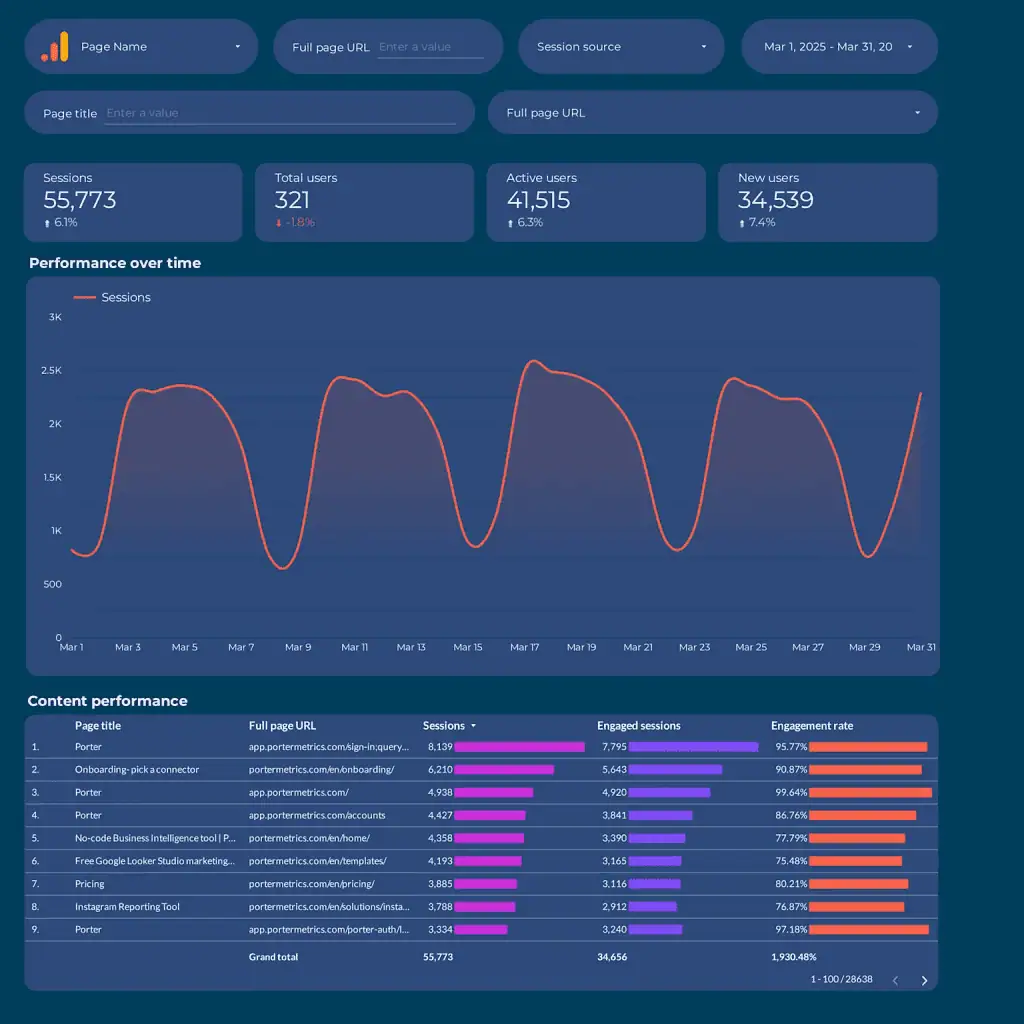
Algorithm-proof SEO becomes achievable through AI systems that continuously monitor changes in ranking factors and automatically adjust optimisation strategies. These systems analyse correlation patterns between optimisation adjustments and ranking changes to identify effective tactics before they become widely adopted.
The adaptation process involves real-time performance monitoring and predictive modelling to anticipate how algorithm updates may affect specific websites. This enables proactive optimisation adjustments that maintain or improve rankings during major search engine updates.
A digital dashboard displaying website content performance metrics, including sessions over time and detailed engagement rates for individual pages, Portermetrics
One-Click WordPress Optimisation: Reality or Marketing Hype?
Proper one-click WordPress optimisation has evolved from marketing hyperbole to practical reality through advanced AI WordPress SEO implementations. However, effectiveness depends heavily on appropriate initial configuration and ongoing AI training using website-specific performance data.
Legitimate one-click solutions combine multiple optimisation processes into a single automated workflow. These include content analysis, keyword optimisation, meta tag generation, internal link suggestions, and schema markup implementation, all executed simultaneously through unified AI systems.
The key to successful one-click optimisation lies in AI systems that learn from website-specific performance data over time. Generic optimisation approaches rarely produce optimal results, but AI systems that adapt to individual website characteristics and audience behaviours can deliver significant ranking improvements through automated processes.
Users should approach one-click solutions with realistic expectations, recognising that while these tools can automate many SEO tasks, strategic content planning and ongoing performance monitoring remain essential for long-term success.
Measuring AI WordPress SEO Success
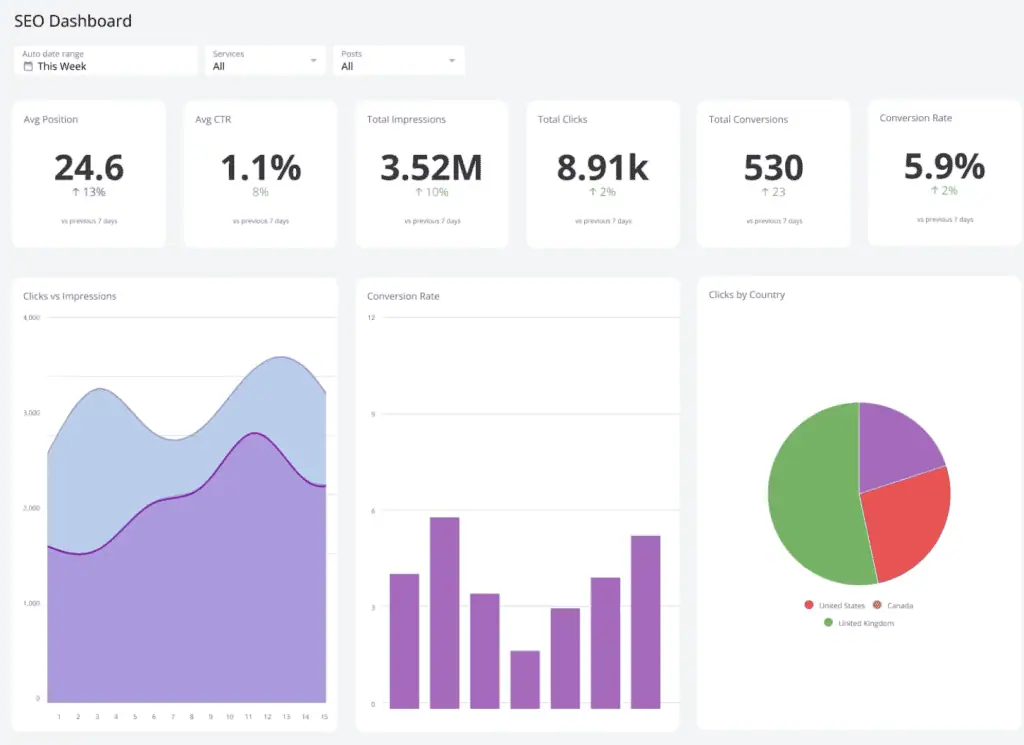
Performance Metrics and Analytics
Predictive SEO analytics enable more sophisticated performance measurement by forecasting future traffic and ranking potential based on current optimisation efforts. These metrics help website owners understand which AI-driven optimisations produce the most significant long-term benefits.
Key performance indicators for AI WordPress SEO include automated task completion rates, time savings compared to manual optimisation, ranking improvements for target keywords, and overall organic traffic growth. These metrics demonstrate the practical value of AI automation beyond theoretical benefits.
Advanced analytics platforms can track correlation between specific AI optimisations and ranking changes, providing insights into which automated processes deliver the most valuable results for individual websites and industries.
An example of an SEO dashboard displaying key performance indicators and analytics for website traffic and conversions, Klipfolio
ROI Assessment for AI SEO Tools
Calculating return on investment for AI WordPress SEO tools requires considering both direct cost savings from automation and indirect benefits from improved rankings and traffic. Most businesses find that AI SEO plugins pay for themselves within 2-3 months through reduced manual optimisation time alone.
The calculation should include time savings for content creators, improved content quality scores, faster implementation of optimisation, and enhanced ranking performance. These factors typically result in annual ROI exceeding 300% for actively maintained WordPress websites.
Long-term ROI often increases as AI systems learn from website-specific data, becoming more effective at identifying optimisation opportunities and automatically implementing successful strategies.
Future of AI WordPress SEO Technology
AI WordPress SEO is evolving faster than ever, driven by advances in natural language processing, predictive analytics, and real-time optimisation. The latest AI-powered WordPress SEO tools adapt instantly to algorithm changes, keeping your site ahead without constant manual updates.
The integration of AI WordPress SEO with voice search optimisation, featured snippet targeting, and AI-generated content creation is expanding possibilities for site owners. With AI-powered WordPress SEO, professional-level optimisation is now accessible to anyone, making high-impact results achievable on any budget.
As algorithm-update-proof strategies become a priority, AI WordPress SEO is leading the way in predicting and adjusting to search engine shifts before rankings are affected. This means greater stability, lower volatility, and greater confidence in long-term performance for sites that use WordPress AI SEO effectively.
The shift from manual SEO work to fully automated AI WordPress SEO is transforming how websites grow. By letting AI WordPress SEO handle complex technical processes, you can focus on creating strategic content and scaling your business. Early adopters of AI WordPress SEO are already seeing higher rankings, increased organic traffic, and a sustainable competitive edge that others will struggle to match.
Sources
- AIOSEO. “The 9 Best AI SEO Tools for WordPress in 2025.” https://aioseo.com/best-ai-seo-tools-for-wordpress/
- WPBeginner. “How to Use AI for SEO in WordPress (12 Tools).” https://www.wpbeginner.com/showcase/how-to-use-ai-for-seo-in-wordpress/
- Human Made. “Enhancing SEO with AI in WordPress.” https://humanmade.com/ai/enhancing-seo-with-ai-in-wordpress/
- WPForms. “7+ Best AI SEO Tools for WordPress [Automate Optimisation].” https://wpforms.com/best-ai-seo-tools-for-wordpress/
- Elegant Themes. “How to Use AI to Improve WordPress SEO.” https://www.elegantthemes.com/blog/wordpress/how-to-use-ai-to-improve-wordpress-seo
- SEOpital. “AI SEO for WordPress: Top 6 Tools for Enhanced Rankings.” https://www.seopital.co/blog/ai-seo-for-wordpress
- ClickRank. “Top 5 SEO Automation Tools in 2025.” https://www.clickrank.ai/seo-automation-tools-for-agencies/
- BEOmniscient. “Harnessing Predictive Analytics in SEO: Taking Out The Guesswork.” https://beomniscient.com/blog/predictive-analytics-seo/
- LinkDaddy. “Predictive SEO And Data Analytics: Anticipating Trends For Competitive Edge.” https://linkdaddy.com/blog/predictive-seo-and-data-analytics/
Q&A
Q: What is AI WordPress SEO, and why does it matter in 2025?
A: Automated SEO for WordPress using ML and NLP to optimise metadata, links, schema, and content at scale for higher rankings and lower effort.
Q: Which AI SEO plugins for WordPress lead in automation features?
A: Capston.ai, AIOSEO, and Rank Math provide AI titles, internal linking, schema generation, content scoring, and predictive analytics.
Q: Does one-click WordPress optimisation actually work for SEO?
A: Yes, when configured correctly, unified AI workflows analyse content, generate tags, suggest links, apply schema, and learn from site data.
Q: How to measure the ROI of AI WordPress SEO tools?
A: Track time saved, automated task completion, keyword ranking lifts, CTR improvements from AI metadata, and organic traffic growth.