Summary
Shopify SEO strategies in 2025 center on content depth, technical SEO foundations, and structured internal linking to drive sustainable organic traffic, higher keyword rankings, and conversion growth. Stores win with topical authority via content hubs, optimized product and collection pages with schema markup, fast site speed, mobile responsiveness, and rich on-page elements like titles, descriptions, and FAQs. Advanced tactics such as AI-assisted content optimization, user-generated content, and continuous measurement frameworks compound results, as shown by case outcomes like 215% organic growth and doubled conversion rates.
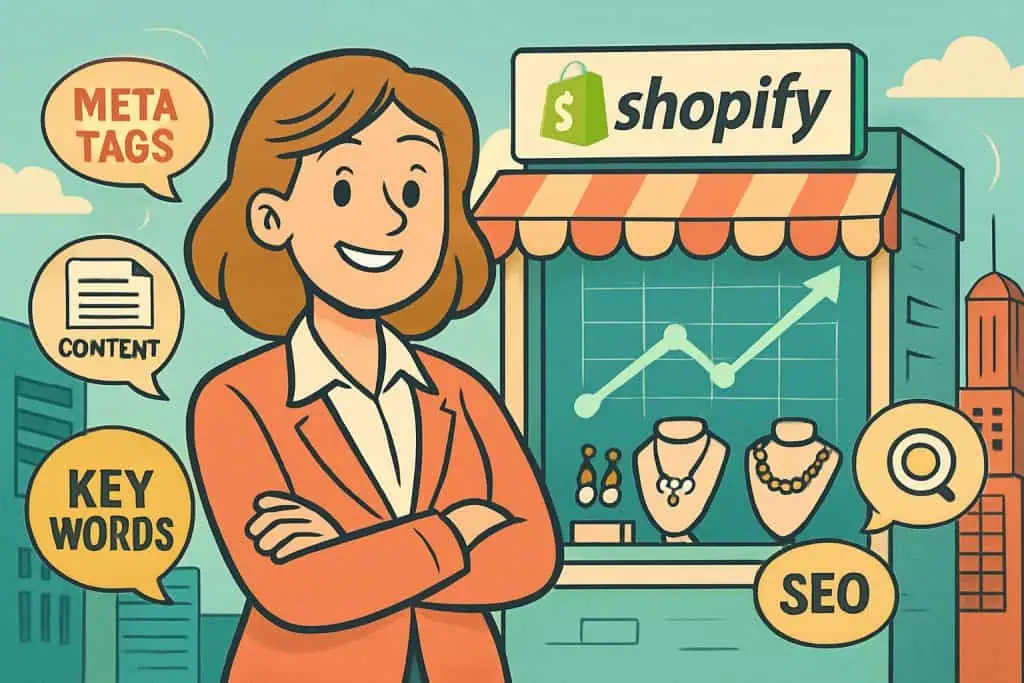
Meet Sarah, a passionate entrepreneur who launched her handcrafted jewellery store on Shopify last year. Despite exceptional products, an investment in professional photography, and a premium theme, her traffic barely reached 50 visitors per day.
Everything changed once she embraced content-focused Shopify SEO strategies. Within three months, organic traffic grew by 215%, and her conversion rate doubled. Her story shows how robust and consistent optimisation can be for any Shopify store aiming for long-term success.
Why Shopify SEO Matters in 2025
The e-commerce world is saturated with stores competing for attention. Simply launching a visually polished site no longer guarantees visibility. Implementing targeted Shopify SEO strategies is now the backbone of sustainable growth. They help drive organic traffic, strengthen brand trust, and create pathways that lead shoppers directly to purchase.
According to recent studies, Shopify stores that apply structured SEO strategies see an average 35% lift in traffic and a nearly 15-position rise in keyword rankings. These numbers prove that consistent optimisation is not optional.
Key Challenges with Shopify SEO
Shopify’s framework, while robust for sellers, poses some obstacles:
- URL structures that don’t always support best practices.
- Duplicate content risks from collections and tags.
- Themes that restrict more profound technical SEO changes.
- Competition from established global retailers.
Effective Shopify SEO strategies are built to solve these exact hurdles. With a structured site architecture, unique content, and clean internal linking, even small stores can compete with larger brands.
Content: The Core of Shopify SEO Strategies
High-quality content remains the strongest lever in any Shopify SEO plan. Blog articles, detailed product descriptions, and category-level content work together to establish authority and attract organic traffic.
Blog Articles
Blogging allows a store to target informational keywords while linking naturally to product pages. Long-form content (1,500+ words) tends to earn better rankings and backlinks. Regular publishing is what keeps Shopify SEO strategies sustainable.
Product and Collection Pages
Detailed product descriptions do more than describe features. They answer customer questions and reduce bounce rates. Optimised headings, image alt text, and structured data are standard components of effective Shopify SEO.
Guides and Tutorials
How-to guides for a product niche drive top-of-funnel traffic. Tutorials build credibility while offering natural opportunities to integrate product links. Many successful stores treat these as central pieces in their Shopify SEO strategies because they attract repeat traffic over time.
Technical Elements Supporting SEO
Content drives visibility, but technical foundations support it. Speed, mobile responsiveness, and structured internal links are essential. Without addressing these, even the best-written blog posts may fail. Leading Shopify SEO strategies always balance both creative and technical elements.
The Future of Shopify SEO Strategies
Search engines continue to refine how they rank content. In 2025, intent-driven Search means quality matters more than keyword stuffing. Voice Search, AI-enhanced indexing, and rich snippets all make content structure more critical. Shopify SEO strategies must now consider schema markup, conversational queries, and user experience signals.
Sarah’s journey reflects a truth every Shopify entrepreneur can relate to. Effective Shopify SEO strategies are not quick hacks but structured, ongoing systems. From blog articles and optimised collections to technical refinements, each part contributes to long-term growth.
Product Page Optimisation: Where SEO Meets Conversion
Your product pages are where visitors make purchase decisions, making them critical to SEO and conversion optimisation. Effective product page content should:
- Include primary and secondary keywords naturally in product titles and descriptions
- Feature comprehensive, benefit-focused product descriptions
- Incorporate schema markup to enhance visibility in Search results
- Use high-quality, optimised images with descriptive alt text
Research shows that detailed product descriptions that address common questions and objections can increase conversion rates by up to 78%.
Creating Topical Authority
Content hubs-collections of interlinked content centred around a specific topic- have proven particularly effective for Shopify SEO in 2025. By developing comprehensive resource centres focused on issues related to your products, you can:
- Establish topical authority in your niche
- Create a robust internal linking structure
- Target a wide range of keywords at different stages of the buyer journey
- Provide valuable information that builds customer trust
For example, a skincare brand might create a content hub on “natural skincare ingredients” that features blog posts, videos, and infographics, linking to relevant products.
Technical SEO Foundations for Shopify Success
While content remains essential, strong Shopify SEO strategies require a technical base that supports indexing, speed, and user experience. Without this foundation, even the best writing will struggle to achieve rankings.
Site Structure Optimisation for Enhanced Crawlability
A clear, logical hierarchy makes it easier for Search engines to interpret your store. Effective Shopify SEO strategies often begin by simplifying navigation so that key pages are no more than three clicks from the homepage.
Practical steps include:
- Organising products into logical categories and subcategories.
- Designing an internal linking framework that highlights priority pages.
- Adding breadcrumb navigation to clarify page relationships.
Research confirms that streamlined structures improve crawlability and user experience, both of which are vital components of advanced Shopify SEO strategies.
Speed Optimisation: A Critical Ranking Factor
Fast-loading websites reduce bounce rates and improve conversion. Performance is now baked into successful Shopify SEO strategies, as Search engines weigh site speed heavily.
Optimisations include:
- Using compressed images tailored for the web.
- Reducing reliance on apps that inject unnecessary code.
- Selecting lightweight, speed-focused themes.
- Leveraging Shopify’s built-in CDN and browser caching.
Data shows that a one-second increase in load time can reduce conversions by 7%. This single fact underscores why speed should be central to all Shopify SEO strategies.
Content Marketing Strategies to Boost Shopify Visibility
Content givesSearchh engines signals to rank your store. The most effective Shopify SEO strategies use structured keyword research and diversified formats to reach customers at every stage of the buying journey.
Keyword-Driven Content Planning
Every strong SEO plan starts with keyword research. The best Shopify SEO strategies look at:
- High-volume core terms in your market.
- Long-tail keywords that reflect purchase intent.
- Questions customers type when searching for solutions.
- Seasonal and trending topics tied to products.
A content calendar built around this data ensures that each article, guide, or page directly supports growth.
Diversifying Content Formats for Maximum Impact
Relying on text alone limits results. Advanced Shopify SEO strategies expand into multiple formats:
- Video content increases time on site and supports product demonstrations.
- Infographics attract backlinks due to shareability.
- Interactive tools like quizzes improve engagement.
- User-generated content adds freshness and trust.
Research from 2025 shows that multi-format approaches drive 25% higher engagement, proving diversification is no longer optional in effective Shopify SEO strategies.
On-Page SEO Best Practices for Shopify in 2025
On-page work remains a cornerstone. Even with content and speed addressed, Shopify SEO strategies fall short without precise optimisation of titles, descriptions, and structured data.
Meta Title and Description Optimisation
Titles and descriptions influence both rankings and click-throughs. Within comprehensive Shopify SEO strategies, best practices include:
- Placing primary keywords early in titles.
- Keeping titles under 60 characters.
- Writing descriptions that use secondary keywords and persuasive phrasing.
Studies show optimised descriptions can boost click-throughs by up to 25%, regardless of position. This alone justifies their role in modern Shopify SEO strategies.
Schema Markup Implementation
Schema gives Search engines context. Incorporating it into Shopify SEO strategies can deliver rich snippets that improve visibility and clicks. Key implementations include:
- Product schema for price, ratings, and stock.
- Organisation schema for brand information.
- Breadcrumb schema for structure clarity.
- FAQ schema to answer common customer queries.
Shops that use schema markup consistently see a 30% higher click-through rate, making it a mandatory element of advanced Shopify SEO strategies.
Advanced Content Strategies for Shopify SEO in 2025
As SEO continues to evolve, several advanced content strategies have emerged as particularly effective for Shopify stores in 2025.
AI-Enhanced Content Creation and Optimisation
While human creativity remains essential, AI tools are increasingly valuable for content optimisation:
- AI content analysis can identify topical gaps and optimisation opportunities
- Natural language processing tools help ensure content comprehensiveness
- AI-powered testing can optimise headlines and CTAs for maximum engagement
- Automated content audits can identify underperforming pages for improvement
Recent research shows that Shopify stores that leverage AI for content optimisation see an average 35% improvement in organic rankings for targeted keywords.
User-Generated Content Integration
User-generated content has become increasingly crucial for Shopify SEO, providing fresh, authentic content that both users and Search engines value:
- Customer reviews create unique content that targets natural language queries
- User photos and videos add visual diversity and authenticity
- Q&A sections address common questions and target long-tail keywords
- Community discussions create engagement signals that can positively impact rankings
Stores that effectively leverage UGC see 20% higher conversion rates than those without robust user-generated content.
How Content Optimisation Directly Impacts Conversion Rates
Beyond driving traffic, strategic content optimisation is crucial in converting visitors into customers.
Creating Content for Different Stages of the Buyer Journey
Effective Shopify content strategies address all stages of the buyer journey:
- Awareness stage: Educational blog posts, how-to guides, and informational videos
- Consideration stage: Product comparisons, buying guides, and case studies
- Decision stage: Detailed product descriptions, customer testimonials, and FAQs
Research indicates that stores that provide content across multiple journey stages see a 25% increase in conversion rates compared to those that focus solely on product-level content.
Leveraging Scarcity and Social Proof in Content
Strategic incorporation of scarcity and social proof elements within your content can significantly boost conversions:
- Highlight limited availability or time-sensitive offers
- Showcase real-time purchase notifications
- Feature customer testimonials strategically throughout the buying process
- Display trust badges and security certifications
Recent studies show that incorporating these elements can increase conversion rates by up to 15% when implemented thoughtfully.
Measuring and Optimising Your Shopify SEO Performance
Implementing a data-driven approach to measurement and optimisation is essential for long-term SEO success.
Key Metrics for Tracking Shopify SEO Success
Focus on these critical metrics to gauge the effectiveness of your SEO efforts:
- Organic traffic growth (overall and by a landing page)
- Keyword rankings for primary and secondary terms
- Conversion rates from organic traffic
- Average order value from SEO visitors
- Bounce rate and time on site from organic Search
- Pages per session for organic visitors
Regularly analysing these metrics will help you identify successful strategies and areas for improvement.
Continuous Optimisation Framework
SEO is never “done”-it requires ongoing refinement and adaptation. Implement this framework for continuous improvement:
- Conduct regular content audits to identify underperforming pages
- Update and refresh existing content to maintain relevance
- Test different content formats and approaches
- Monitor competitor strategies and adapt accordingly
- Stay current with Search engine algorithm updates
Stores that implement a continuous optimisation framework see 40% better long-term SEO performance than those that take a “set and forget” approach.
Implementing Your Shopify SEO Strategy for 2025
Effective Shopify SEO in 2025 requires a comprehensive approach that combines technical optimisation, strategic content creation, and continuous refinement.
The stores that achieve the most incredible success view SEO not as a one-time project but as an ongoing business practice integrated into their overall marketing strategy.
Implementing the strategies outlined in this guide, from content hub creation to schema markup to user-generated content integration, can significantly improve your store’s visibility, traffic, and conversions. Start by auditing your current SEO performance, identifying the highest-priority areas for improvement, and developing a structured plan to address them systematically.
Remember that SEO results typically take time to materialise, so patience and persistence are essential. However, by consistently applying these proven strategies, your Shopify store can achieve sustainable organic growth and profitability in an increasingly competitive e-commerce scene.
Sources
- https://www.portotheme.com/you-have-a-shopify-store-what-next-to-improve-its-visibility/
- https://optinmonster.com/shopify-seo-guide/
- https://wisepops.com/blog/shopify-seo
- https://instant.so/blog/shopify-conversion-rate-optimization
- https://onilagency.com/en/blogs/todo-shopify-y-ecommerce/tipos-de-contenidos-que-generan-trafico-y-ventas-para-tiendas-shopify
- https://www.optimonk.com/shopify-conversion-rate-optimization/
- https://www.shopify.com/blog/what-is-content-marketing
- https://www.shopify.com/blog/seo-checklist-online-store
- https://www.olitt.com/blog/organic-traffic-to-your-shopify-store/
- https://www.shopify.com/fr/blog/topics/content-marketing
- https://www.shopify.com/enterprise/blog/enterprise-seo
- https://www.shopify.com/fr/blog/content-marketing
- https://tiny-img.com/blog/shopify-seo-guide/
- https://www.shopify.com/retail/content-marketing-for-retailers-how-to-build-an-audience-online
- https://instant.so/blog/how-to-optimize-your-shopify-website-for-seo
- https://www.sweans.com/10-shopify-ecommerce-content-marketing-strategies/
Q&A
Q1. What are the most effective Shopify SEO strategies in 2025 for sustainable organic growth?
Publish keyword-driven content hubs, optimise product and collection pages with schema, improve site speed and mobile UX, and build clean internal linking.
Q2. How do content hubs build topical authority for a Shopify store?
They interlink comprehensive guides, blogs, and resources around a core theme to target clustered keywords and funnel authority to priority product pages.
Q3. Which on-page SEO elements matter most for Shopify product pages?
Clear titles with primary keywords, persuasive descriptions, optimised images with alt text, structured data for rich results, and FAQs to capture long-tail queries.
Q4. What technical SEO priorities boost Shopify rankings and conversions?
Reduce app bloat, compress images, use a lightweight theme and CDN, ensure mobile responsiveness, and maintain a logical site structure within three clicks from the homepage.