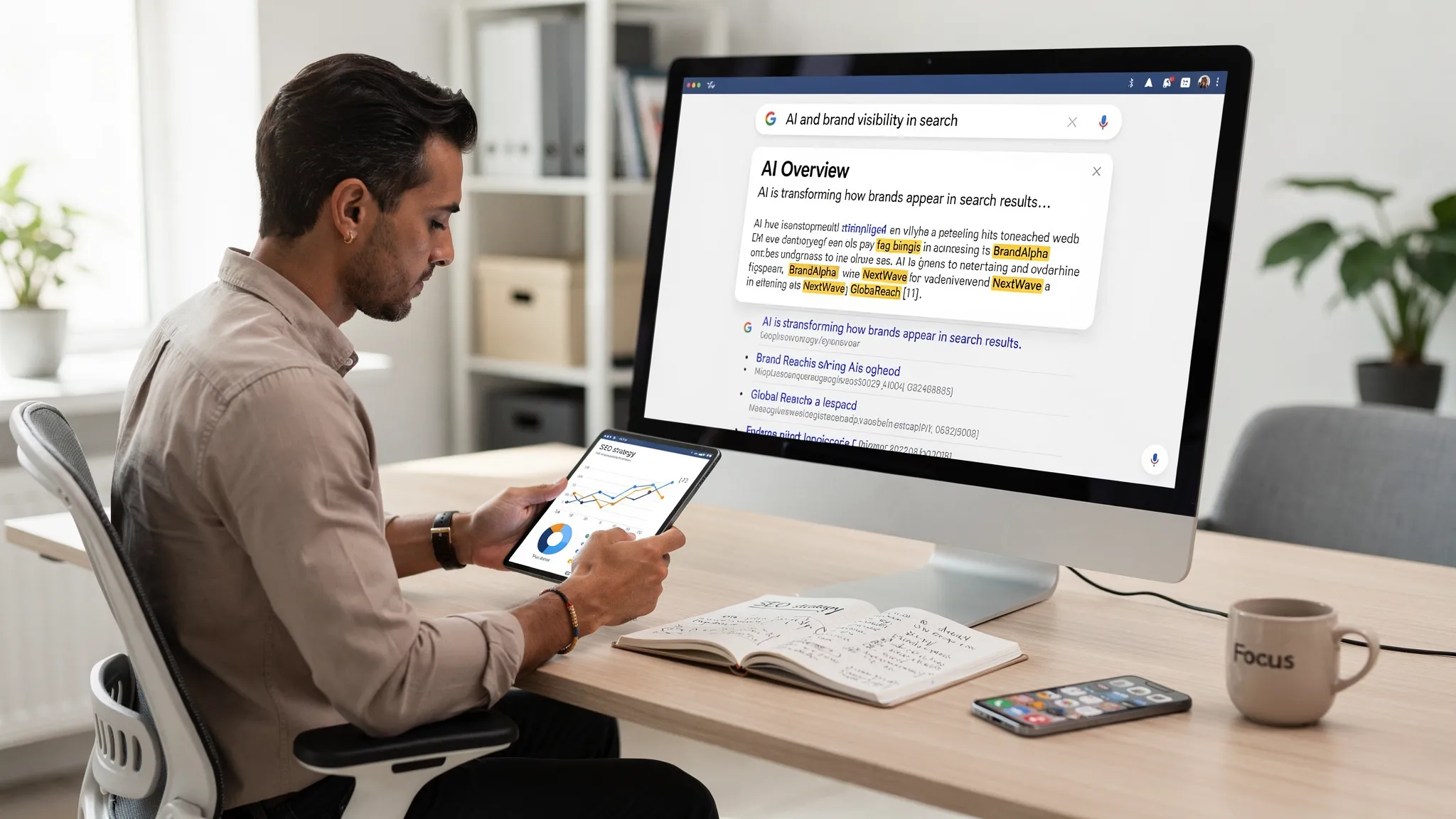
The Google AI search engine is changing brand discovery from a rankings game into an answer-selection game. In classic SEO, visibility usually meant appearing near the top of a results page. In AI-powered Google experiences, including AI Overviews and other Gemini-driven search features, visibility can mean being cited, summarized, recommended, compared, or omitted inside an AI-generated answer.
That shift matters because users do not always evaluate ten blue links anymore. They ask longer questions, compare options in natural language, and expect Google to synthesize the web into a useful response. For brands, the key question becomes: does Google’s AI layer understand, trust, and surface your business when it matters?
What “Google AI search engine” really means
Google is not replacing search with a single chatbot. Instead, it is adding generative AI features on top of its search systems. According to Google Search Central’s guidance on AI features, Google’s AI experiences use information from search results and other Google systems to generate responses, links, and supporting context.
In practical terms, Google AI search can include:
- AI-generated summaries for informational, commercial, and comparison queries
- Links to sources that support the answer
- Follow-up questions and conversational refinement
- Product, local, and business recommendations where relevant
- Contextual results shaped by intent, location, freshness, and entity understanding
For marketers, this means AI visibility is not just about whether one URL ranks. It is about whether your brand is recognized as a relevant entity across the query journey.
How brand visibility works in Google’s AI results
AI search visibility is built from multiple layers. Google still needs to crawl, index, and understand your pages, but the generative layer also needs to decide whether your brand is useful enough to include in an answer.
Think of it as a sequence of filters.
First, Google must understand what your brand is. This includes your name, category, products, services, locations, audience, and relationships to known topics. If your entity signals are inconsistent, the AI layer may not confidently connect your brand to relevant prompts.
Second, Google must find supporting content. Your pages need to be indexable, technically accessible, and written in a way that answers real user questions. Thin landing pages, vague claims, and unsupported marketing language are harder for AI systems to summarize or cite.
Third, Google must evaluate whether your content is trustworthy and useful compared with other available sources. This is where E-E-A-T signals, structured data, third-party mentions, reviews, expert content, and topical depth can influence inclusion.
Finally, Google must match your brand to the user’s intent. A brand may be visible for “best enterprise cybersecurity provider in a region” but absent from “affordable cybersecurity software for startups.” The difference is not just keyword coverage, it is positioning, proof, and answer relevance.
Traditional ranking vs AI brand visibility
Traditional SEO metrics still matter, but they no longer tell the whole story. A page can rank well and still fail to appear in an AI answer. Another brand may be mentioned in the answer even if the cited page is not the number one organic result.
| Dimension | Traditional Google SEO | Google AI search visibility |
|---|---|---|
| Main goal | Rank a page for a keyword | Be mentioned, cited, or recommended in an AI answer |
| Unit of visibility | URL position | Brand presence across prompts and answers |
| Core content format | Pages optimized around queries | Clear, answer-ready content with supporting evidence |
| Measurement | Rankings, impressions, clicks, CTR | Mentions, citations, answer share, sentiment, competitor presence |
| Optimization focus | Keywords, links, technical SEO | Entity clarity, topical authority, structured information, prompt coverage |
| Risk | Ranking drops | AI omission, incorrect summaries, competitor recommendations |
The most important difference is that AI search visibility is prompt-based. People ask questions in many ways, and the AI answer may group several intents together. A brand needs coverage across the language customers actually use, not just the keywords a team tracks in a rank tracker.
The signals that make a brand easier for Google AI to surface
Google does not publish a simple checklist that guarantees inclusion in AI answers. However, the patterns are becoming clear: AI systems prefer brands and sources that are easy to understand, verify, and summarize.
Entity clarity
Your brand should be consistently described across your website, structured data, profiles, listings, and third-party mentions. If you are a B2B SaaS platform, a local retailer, a multi-location service business, or an e-commerce brand, that identity needs to be unmistakable.
Entity clarity includes basic facts such as company name, service categories, locations, founding information when relevant, product names, executive or author profiles, and customer segments. It also includes contextual facts, such as what problems you solve and how you compare with alternatives.
Topical authority
AI answers often synthesize from sources that cover a topic deeply. A single sales page is rarely enough. Brands need clusters of useful content that explain concepts, answer objections, compare options, and provide implementation guidance.
For example, a company targeting AI visibility should not only publish a homepage claiming expertise. It should also have educational pages explaining the category, use cases, measurement methods, and common mistakes. CapstonAI’s guide on Generative Engine Optimization is an example of this broader topic-building approach.
Answer-ready structure
Generative systems work better with content that is clear, specific, and well organized. Pages that directly answer questions, use descriptive headings, include concise definitions, and provide tables or FAQs are easier to extract from.
This does not mean writing robotic content. It means removing ambiguity. If a page explains who a product is for, what it does, how it differs, and when to choose it, the AI layer has more usable material.
Evidence and trust signals
AI search systems are designed to reduce low-quality answers. Brands that support claims with data, customer proof, expert authorship, documentation, and reputable citations are easier to trust.
Trust also comes from consistency beyond your website. Reviews, directory listings, partner pages, press mentions, and local citations can all reinforce what your brand does. For location-sensitive companies, these signals are especially important. A regional provider such as MDSI, an IT and cybersecurity partner for businesses in La Réunion and Mayotte benefits when its service areas, expertise, and business category are clear across its own site and the wider web.
Technical accessibility
If Google cannot crawl or understand your content, AI visibility suffers before the answer is even generated. Search fundamentals still apply: clean internal linking, fast pages, mobile usability, canonical consistency, indexable content, and useful structured data.
Structured data is not a magic ticket into AI answers, but it helps machines interpret entities, products, organizations, FAQs, reviews, events, and local business information. Google’s own documentation on creating helpful, reliable, people-first content remains relevant because AI features still depend on quality signals from the web.
Why brands get omitted from Google AI answers
AI omission is often more dangerous than a ranking drop because it can be invisible in standard SEO dashboards. You may still see impressions and clicks in Google Search Console while losing influence inside AI-generated answers.
Common reasons brands disappear include weak entity signals, outdated content, lack of comparison pages, missing FAQs, thin category pages, duplicate descriptions, inconsistent local data, and no third-party validation.
Another frequent issue is prompt mismatch. Your SEO team may track “project management software,” while buyers ask Google questions such as “best project management tool for a 20-person agency with client approvals.” If your content does not address the use case, the AI answer may recommend competitors with more specific proof.
This is why AI visibility measurement must start with prompts, not only keywords.
How to measure brand visibility in Google AI search
A strong measurement system looks beyond rankings and asks: when buyers ask relevant questions, what does Google’s AI answer say?
Useful AI visibility metrics include:
- Answer presence: whether your brand appears in AI-generated responses for target prompts
- Citation presence: whether your website is linked as a supporting source
- Share of voice: how often your brand appears compared with competitors
- Mention quality: whether the answer describes your brand accurately and positively
- Prompt coverage: which buyer questions trigger your brand and which do not
- Competitor displacement: where competitors are recommended instead of you
- Content gap severity: which missing pages, metadata, or FAQs likely explain the omission
This is where traditional SEO reporting needs a new layer. Google Search Console can show clicks and impressions, but it does not fully explain how AI answers mention your brand across conversational prompts. Teams need AI search scans, prompt mapping, competitor tracking, and answer-level diagnostics.
How to improve visibility in Google’s AI search engine
Improving AI search visibility is not about tricking the model. It is about making your brand easier to retrieve, understand, and recommend.
Start by mapping the prompts your buyers are likely to ask. Include informational prompts, comparison prompts, local prompts, product-fit prompts, and problem-aware prompts. Then test whether your brand appears, which competitors appear, and which sources Google cites.
Next, audit the pages that should support those answers. A page may need a clearer definition, a stronger opening answer, better structured data, a comparison table, updated examples, or a FAQ section. For AI Overviews specifically, CapstonAI’s guide on how to optimize for AI Overviews covers practical formatting and content improvements.
Then reinforce your entity signals. Align your About page, product pages, schema, Google Business Profile where relevant, social profiles, review platforms, and partner mentions. Inconsistent descriptions create friction for AI systems.
Finally, track changes over time. AI answers can shift as competitors publish content, Google updates systems, or market language changes. Visibility should be monitored like rankings, pipeline, and brand sentiment.
A practical workflow for marketing teams
A simple AI visibility workflow can be built around five recurring actions.
| Step | What to do | Why it matters |
|---|---|---|
| Discover prompts | Collect real buyer questions from search, sales calls, support tickets, reviews, and competitor pages | AI visibility depends on natural-language queries, not only keywords |
| Scan answers | Test priority prompts in Google AI search experiences and other AI engines | Shows where your brand appears, is cited, or is missing |
| Diagnose gaps | Compare cited sources, answer wording, schema, freshness, and competitor content | Reveals why another brand may be selected |
| Publish fixes | Improve FAQs, metadata, product pages, comparisons, and supporting articles | Gives AI systems clearer material to retrieve and summarize |
| Monitor movement | Track mentions, share of voice, sentiment, and citations over time | Turns AI visibility into a measurable growth channel |
This workflow is especially valuable for agencies, retailers, SaaS companies, and multi-location brands because their visibility problems are rarely limited to one page. They often span hundreds of prompts, products, locations, and competitor scenarios.
Where CapstonAI fits
CapstonAI helps brands, retailers, and agencies measure, improve, and defend their AI search visibility across major AI engines. For teams trying to understand how they appear in Google AI search, the platform can support AI visibility scans, competitor and market tracking, prompt and mention mapping, share of voice analytics, automated content recommendations, AI-ready FAQ and metadata publishing, CMS integration for faster fixes, multi-location brand management, and critical alert dashboards.
The goal is not to replace SEO. It is to add the missing layer: how AI systems mention, cite, compare, and recommend your brand when buyers ask high-intent questions.
Frequently Asked Questions
Is Google AI search different from traditional Google Search? Yes. Traditional Google Search ranks pages, while Google’s AI search features can synthesize answers from multiple sources. SEO still matters, but brands also need to optimize for mentions, citations, entity understanding, and answer inclusion.
Can I guarantee that my brand appears in Google AI Overviews? No. There is no guaranteed method to force inclusion. However, you can improve your chances by publishing helpful content, strengthening entity signals, using structured data, answering specific buyer questions, and earning credible third-party validation.
Why does a competitor appear in AI answers when we rank higher organically? AI answers may choose sources based on answer relevance, clarity, trust, freshness, and how well the content matches the prompt. A competitor with more specific comparison content or clearer entity signals may be easier for the AI system to include.
What is the most important metric for AI brand visibility? There is no single metric. Start with answer presence, citation presence, share of voice, and mention quality across your most valuable prompts. Together, these show whether AI search is helping or hurting your brand discovery.
How often should brands monitor Google AI search visibility? Competitive or fast-changing categories should monitor weekly or even daily for priority prompts. Smaller brands can start with monthly scans, then increase frequency around launches, algorithm changes, seasonal campaigns, or major content updates.
Turn Google AI search visibility into a measurable channel
The Google AI search engine rewards brands that are clear, credible, specific, and easy to summarize. If your content, metadata, FAQs, and entity signals are fragmented, AI answers may overlook you even when traditional SEO looks healthy.
CapstonAI helps you find those blind spots and fix them. Run a free AI visibility audit to see how ChatGPT, Gemini, Claude, Perplexity, and Google AI search experiences mention your brand, where competitors are winning, and what to improve next.