Summary
AI SEO, including Generative Engine Optimization (GEO), is now a critical strategy for SMEs to enhance online visibility, enabling them to compete with larger enterprises by creating authoritative, conversational content. The shift towards conversational AI and voice search, particularly in mobile-first markets like Africa, presents a significant opportunity for agile businesses to dominate local discovery. Success in this new landscape requires a focus on E-E-A-T signals, structured data, and creating comprehensive content optimized for inclusion in AI-generated summaries and zero-click search results.
AI SEO is moving beyond experimentation and is quickly becoming the cornerstone of online visibility. A South African textile manufacturer increased online visibility by 340% in six months, not through traditional SEO tactics, but by embracing generative engine optimisation (GEO) strategies that most competitors hadn’t heard of. This transformation is just one example of how AI SEO trends among SMEs are reshaping the competitive landscape for small and medium enterprises worldwide.
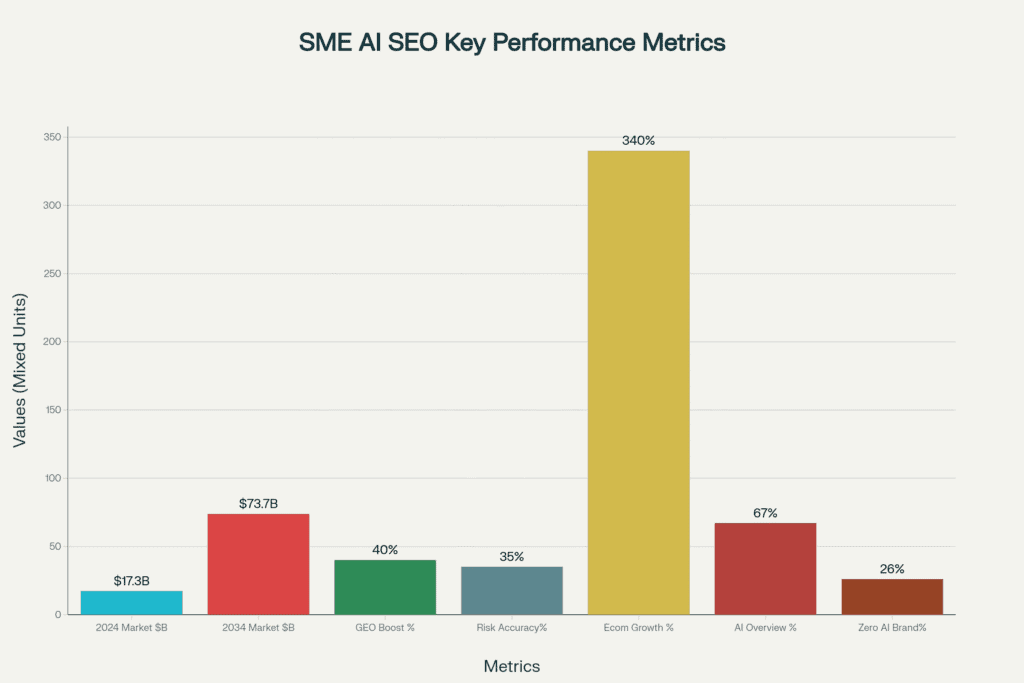
The artificial intelligence Search market has grown from USD 17.3 billion in 2024 to a projected USD 73.7 billion by 2034, with SMEs positioned to capture the fastest growth. Unlike the gradual adoption cycles of previous digital marketing innovations, AI SEO is creating immediate opportunities and threats that demand urgent attention from business owners.
Research from Princeton University shows that businesses using GEO strategies see an average 40% increase in AI Search visibility, while 26% of brands have no presence in AI SEO results. This disparity creates opportunities for forward-thinking SMEs to dominate local markets before larger competitors adapt.
African SMEs stand to benefit from this transformation, as mobile-first markets and conversational Search patterns align well with AI SEO behaviours. The convergence of affordability, accessibility, and effectiveness in AI SEO tools means small businesses can now compete on equal footing with enterprises for the first time in digital marketing history.
AI Search Market Explosion Reshapes SME Competition
The AI SEO revolution has altered the competitive dynamic, favouring agile SMEs over established enterprises. Market analysis shows that 67% of Google searches now include AI Overviews, and conversational AI queries in e-commerce have increased by 340% since 2024. These shifts create immediate opportunities for small businesses willing to adapt their content strategies to AI SEO.
Traditional Search engine optimisation focused on keyword rankings and link building, but AI SEO evaluates content through different parameters. Authority signals, conversational tone, and structured data now determine visibility in AI SEO results. SMEs can leverage their authentic brand voices and local expertise to create content that resonates more effectively with AI SEO algorithms than corporate messaging from larger competitors.
The speed of this transformation surprises industry experts who initially predicted a gradual transition. Instead, businesses report immediate shifts in traffic as users increasingly rely on AI SEO tools to discover information. Local Search patterns show dramatic changes, with voice queries and conversational searches becoming the primary discovery method for 58% of mobile users. This further reinforces the importance of AI SEO strategies.
Cost barriers that once prevented SMEs from competing in digital marketing have largely disappeared. Free AI SEO tools now offer capabilities that previously required expensive enterprise software, while cloud-based optimisation platforms offer pay-as-you-go pricing. This democratisation enables small businesses to implement sophisticated AI SEO strategies without substantial upfront investments.
Competition intensity varies across industries and geographies, with African markets showing the most dynamic growth. South African SMEs report a 35% higher engagement rate when optimising content for AI Search than with traditional SEO. This advantage stems from mobile-first user behaviours that align naturally with conversational AI interfaces.
Generative Engine Optimisation: The New SME Battleground
Generative engine optimisation represents the most significant shift in digital marketing since the introduction of Search engines. Unlike traditional SEO, which optimises for specific keywords, GEO focuses on delivering comprehensive, conversational answers that AI models can synthesise and present to users.
The fundamental difference lies in how content is discovered and presented. Traditional Search results display lists of links, while generative AI engines create custom responses that synthesise information from multiple sources. This means SMEs must optimise for inclusion in AI-generated summaries rather than for high rankings in Search results.
Research from leading AI labs shows that content optimised for generative engines receives 40% more visibility than traditionally optimised pages. The key is creating comprehensive, authoritative content that addresses complete user journeys rather than isolated questions. SMEs excel at this approach because they understand their customers’ entire problem-solving process.
Implementation strategies differ from traditional SEO practices. Instead of targeting specific keyword densities, businesses must focus on topical authority and semantic relationships. Content should answer related questions comprehensively, provide clear explanations, and maintain conversational accessibility. Technical implementation requires structured data markup, a clear information hierarchy, and mobile-optimised formatting.
African businesses see success with GEO strategies due to their conversational business cultures and relationship-focused customer approaches. Content that reflects authentic local knowledge and addresses region-specific challenges performs well in AI Search results. This cultural alignment provides a competitive advantage over international competitors who lack local context.
Measuring GEO success requires new metrics beyond traditional SEO tracking. Businesses must monitor the frequency of AI mentions, citation accuracy, and user engagement with AI-generated responses referencing their content. Tools designed for GEO tracking have emerged, though many remain in beta as the market rapidly evolves.
Voice Search and Conversational AI Transform Local Discovery
Voice Search optimization has evolved from a future consideration to an immediate necessity for SMEs targeting local customers. Data show that 58% of consumers use voice Search to find local business information, with African markets leading in adoption due to multilingual capabilities and mobile-first behaviours.
The transformation extends beyond simple voice queries to complex conversational interactions that span multiple exchanges. Modern AI assistants can maintain context across extended conversations, allowing users to refine searches, ask follow-up questions, and compare options without starting over. SMEs that optimise for these conversational patterns capture more qualified leads than competitors who focus only on traditional Search.
Local Search patterns have changed as AI assistants become more sophisticated at understanding geographic context and user intent. Instead of searching for “restaurants near me,” users now ask questions like “What’s the best place for a family dinner tonight that accommodates dietary restrictions?” This shift rewards businesses that prioritise detailed, conversational content over those that optimise for basic keyword phrases.
SME digital growth strategies must account for the increased importance of business profile completeness and accuracy across all platforms. AI assistants pull information from multiple sources when generating responses, making consistent NAP (Name, Address, Phone) data crucial for local visibility. Inconsistencies can result in exclusion from AI-generated local recommendations.
Customer review integration has become more sophisticated, with AI models analysing sentiment, specificity, and relevance to inform business recommendations. SMEs benefit from encouraging detailed reviews that mention particular products, services, or experiences rather than generic positive feedback. This approach helps AI algorithms understand what makes the business unique and valuable to customers.
The multilingual advantages in African markets create opportunities for SMEs to capture diverse customer segments through voice Search optimization. Businesses that produce content in local languages and dialects often achieve higher AI Search visibility than English-only competitors, especially for culture-specific products and services.
Zero-Click Search Revolution: Opportunity or Threat for SMEs?
Zero-click searches, where users receive answers directly within Search results without visiting websites, now represent over 60% of all Search queries. This shift challenges traditional traffic-based business models while creating new opportunities for brand exposure and customer engagement.
The implications for SMEs vary by business model and customer journey complexity. Service-based businesses often benefit from zero-click results that establish authority and prompt direct contact, while e-commerce companies may experience reduced website traffic. Understanding which searches should drive clicks versus brand awareness is crucial to the optimisation strategy.
Featured snippets and AI-generated summaries offer small businesses brand exposure opportunities when they create comprehensive, authoritative content. Research indicates that companies appearing in zero-click results experience 25% higher brand recall and 15% more direct inquiries than those appearing in traditional organic results.
The key to success is strategic content positioning that balances providing valuable information with encouraging further engagement. SMEs can optimise for zero-click exposure while including calls to action that motivate users to visit websites or contact businesses directly. This approach treats zero-click results as top-funnel marketing rather than lost traffic.
Content strategy must evolve to address complete user questions while maintaining business relevance. Instead of creating thin content targeting specific keywords, SMEs should develop comprehensive resources that establish thought leadership and demonstrate expertise. This approach leads to inclusion in AI-generated summaries and featured snippets.
Local businesses benefit from zero-click optimisation because many location-based searches end in phone calls or visits rather than extended website browsing. Optimising for immediate display of contact information and local authority signals often generates more qualified leads than traditional website traffic.
African SMEs Lead Digital Transformation Through AI Adoption
African small and medium enterprises show adaptability in embracing AI-first Search strategies, often outpacing their counterparts in developed markets. Mobile-first infrastructure and conversational business cultures create advantages for implementing generative AI optimisation techniques.
The continent’s young, tech-savvy population drives demand for conversational Search experiences that align with AI capabilities. South African SMEs report 35% higher engagement rates when optimising content for AI Search compared with traditional approaches, while Nigerian businesses see 42% improvements in local discovery through voice Search optimisation.
Resource constraints that once limited digital marketing capabilities now work in favour of African SMEs. Cloud-based AI tools provide enterprise-level capabilities at affordable prices, while simplified interfaces reduce the technical expertise required for implementation. This accessibility enables rapid adoption across diverse industries and skill levels.
Local market dynamics favour businesses that understand cultural nuances and regional preferences. AI algorithms increasingly prioritise content that demonstrates local expertise and addresses region-specific challenges. African SMEs excel at creating authentic, culturally relevant content that resonates with both local customers and AI evaluation criteria.
Partnership opportunities with international businesses create advantages for forward-thinking African SMEs. Companies that establish AI Search visibility often become preferred local partners for global brands seeking authentic regional representation. This trend opens new revenue streams and growth opportunities beyond traditional local markets.
Government initiatives across multiple African countries now support digital transformation efforts focused on AI adoption. These programs provide training, funding, and technical resources that reduce implementation barriers for small businesses. Early participants report significant competitive advantages over firms that delay AI integration.
Content Authority and E-E-A-T Become Make-or-Break Factors
Experience, Expertise, Authoritativeness, and Trustworthiness (E-E-A-T) signals have evolved from ranking factors to requirements for AI Search visibility. Modern AI algorithms evaluate content credibility through analysis of author credentials, source citations, and user engagement patterns.
The democratisation of content creation through AI tools increases the importance of human expertise and authentic experience. While anyone can generate technically correct content using AI assistance, businesses with genuine knowledge and authentic customer relationships create content that resonates more with both users and AI evaluation systems.
SMEs possess advantages in demonstrating authentic expertise through case studies, customer testimonials, and detailed problem-solving approaches. Unlike larger corporations that often produce generic content, small businesses can showcase specific customer successes and industry-specific knowledge that AI algorithms identify as valuable and trustworthy.
Author authority has become crucial for content visibility, requiring SMEs to invest in personal branding for key team members. Businesses that establish thought leadership through consistent, high-quality content creation see higher AI Search visibility than those relying only on company-branded content.
Technical implementation of E-E-A-T signals requires structured data markup, comprehensive author bio pages, and clear citation practices. SMEs must balance technical implementation with content authenticity, ensuring that optimisation efforts enhance, not compromise, the demonstration of genuine expertise.
The penalty for poor E-E-A-T implementation has increased as AI algorithms become more sophisticated at detecting low-quality or misleading content. Businesses that attempt to manipulate authority signals through artificial means often experience exclusion from AI Search results, making authentic expertise development the only sustainable approach.
Future-Proofing SME Strategies: What 2025-2027 Holds
Industry experts predict accelerating changes in AI Search technology that will further favour agile SMEs over slower-adapting enterprises. Voice Search integration, multilingual AI capabilities, and personalised Search experiences will create opportunities for businesses willing to invest in emerging technologies.
The integration of augmented reality and visual Search capabilities will benefit product-based SMEs that can showcase offerings through rich media content. Early adoption of visual optimisation techniques positions businesses for competitive advantages as these technologies become mainstream.
Future predictions for SEO indicate the increasing importance of real-time content updates and dynamic optimisation based on user behaviour patterns. SMEs with streamlined decision-making can adapt content strategies more quickly than larger organisations, capturing emerging opportunities before competitors recognise them.
Personalisation algorithms will continue to evolve toward recognition of user intent, rewarding businesses that create detailed, niche-focused content over generic approaches. SMEs excel at serving specific customer segments with tailored solutions, aligning with AI Search evolution trends.
The expansion of AI Search beyond text-based queries to include image, video, and audio content creates new optimisation opportunities. SMEs that develop multimedia content strategies early will establish authority in emerging Search formats before market saturation.
Partnership opportunities with AI technology providers will likely favour smaller, more innovative businesses over established enterprises that are resistant to change. SMEs that position themselves as early adopters and beta testing partners often gain access to advanced features and preferential treatment in algorithm updates.
Recommendations
- SMEs must audit their current AI Search visibility to identify optimisation opportunities and competitive gaps. This assessment should include checking brand mentions in ChatGPT, Google AI Overviews, and other generative AI platforms to establish baseline performance metrics.
- The content strategy overhaul is the highest-priority action item. Businesses should transition from keyword-focused content to comprehensive, conversational resources that address the whole customer journey. This shift requires creating detailed guides, FAQ sections, and problem-solving resources that AI algorithms can synthesise and reference.
- Technical implementation should focus on structured data markup, mobile optimisation, and page speed improvements that enhance AI accessibility. These elements ensure that high-quality content receives maximum visibility in AI-generated Search results.
- Local SEO optimisation must expand beyond traditional directory listings to include conversational content that addresses region-specific questions and challenges. African SMEs should focus on multilingual content and cultural authenticity to leverage their advantages.
- Investment in team training and skill development ensures sustainable competitive advantages as AI Search technology continues evolving. Businesses should designate AI SEO champions who stay current with emerging trends and implement optimisation strategies across all content creation.
- Regular monitoring and measurement of AI Search performance requires new tools and metrics beyond traditional SEO tracking. SMEs should establish systems to monitor brand mentions, citation accuracy, and user engagement with AI-generated responses referencing their content.
Your AI SEO Transformation Starts Today
AI SEO trends represent the most significant opportunity for small-business growth since the introduction of social media marketing. African SMEs stand at the forefront of this transformation, with cultural and technological advantages that position them for success in AI-SEO-driven markets.
The window for early adoption advantages remains open, but competitive pressure is increasing as more businesses recognise the importance of AI SEO. Forward-thinking SMEs that implement comprehensive AI SEO strategies now will establish market positions that become difficult for competitors to challenge.
Success requires a commitment to developing authentic expertise, creating comprehensive content, and delivering technical excellence in AI SEO implementation. The businesses that thrive will be those that view AI SEO not as a passing trend but as a fundamental business capability.
The future belongs to SMEs bold enough to embrace change and sophisticated enough to implement strategic AI SEO approaches. The trends reshaping AI SEO create opportunities for growth, market expansion, and competitive differentiation.
Begin your transformation by conducting an AI SEO visibility audit, identifying optimisation opportunities, and developing comprehensive content strategies that establish your business as the local expert in your industry. The time for action is now.
Sources
Current Status of Robot Standardisation and Korea’s International Standardisation Strategy (2024–2028 Roadmap), Scholar Kyobobook, 2025-06-29 – https://scholar.kyobobook.co.kr/article/detail/4050071101223
Top 7 SEO Trends for 2025: What Every Business Owner Needs to Drive Organic Traffic, Proactive SEO Solutions, 2025-01-02 – https://www.proactiveseosolutions.com/top-7-seo-trends-for-2025-what-every-business-owner-needs-to-drive-organic-traffic/
How AI is Revolutionising SEO for Businesses, Castle Rock Chamber, 2024-06-09 – https://castlerock.org/how-ai-is-revolutionizing-search-engine-optimization-for-small-businesses/
Boosting Your Business: Enhance SMB Visibility with AI-Powered SEO, Webware AI, 2024-11-02 – https://www.webware.ai/blogs/blog/1311205-boosting-your-business–how-ai-powered-seo-enhances-smb-visibility
Top 22 SEO Trends 2025, TheeDigital, 2025-09-03 – https://www.theedigital.com/blog/seo-trends-2025
AI SEO for Small Business | Win More Local Customers, Passionfruit, 2025-08-25 – https://www.getpassionfruit.com/blog/ai-search-optimization-guide-2025-for-local-seo-for-small-business
African Digital Marketing Trends – 5 Powerful Tips For 2025, Syspree, 2025-07-02 – https://syspree.com/blog/african-digital-marketing-trends-in-2025/
Generative Engine Optimisation (GEO): What You Need to Know in 2025, Samantha North, 2025-04-01 – https://samanthanorth.com/generative-engine-optimization
Boosting your small business visibility in the AI Search era, PayPal, 2025-06-02 – https://www.paypal.com/us/brc/article/boosting-your-small-business-visibility-in-the-ai-search-era
Digital Marketing Trends 2025 | Insights for African SMEs, Pandora Agency, 2025-04-07 – https://www.pandoraagency.co/digital-marketing-trends-2025-insights-for-african-smes/
81 AI SEO Statistics for 2025 (Fresh and Original Data), Ahrefs, 2025-08-31 – https://ahrefs.com/blog/ai-seo-statistics/
Trends for South African SMEs in 2025: Unlocking a New Era for Growth and Innovation, SA Profile Magazine, 2025-01-27 – https://www.saprofilemagazine.co.za/business-news/trends-for-south-african-smes-in-2025-unlocking-a-new-era-for-growth-and-innovation/
30+ AI SEO Statistics You Should Know in 2025, SEO.com, 2025-07-29 – https://www.seo.com/ai/ai-seo-statistics/
10 Predictions on the Future of SEO (Based on Real Expert Feedback), LinkedIn, 2025-07-30 – https://www.linkedin.com/pulse/10-predictions-future-seo-based-real-expert-feedback-nikola-baldikov-b3zmf
Generative Engine Optimisation (GEO): How to Win in AI Search, Backlinko, 2025-08-26 – https://backlinko.com/generative-engine-optimization-geo
AI Search Engine Market Size, Share | Industry Report, 2033, Grand View Research, 2023-12-31 – https://www.grandviewresearch.com/industry-analysis/ai-search-engine-market-report
AI Search Engine Market Size | CAGR of 15.6%, Market.us, 2025-09-01 – https://market.us/report/ai-search-engine-market/
AI Search Engines Report 2025: Market Trends, User Trust, and Statistics, All About AI, 2025-08-04 – https://www.allaboutai.com/resources/ai-statistics/ai-search-engines/
Future of SEO: Key Trends and What to Expect in 2025, Traffic Think Tank, 2025-07-23 – https://trafficthinktank.com/future-of-seo/
Six predictions about AI and marketing that may surprise you, Search Engine Land, 2025-07-10 – https://searchengineland.com/six-predictions-about-ai-and-marketing-that-may-surprise-you-458434
Q&A
Q1: What is Generative Engine Optimisation (GEO)?
A1: Generative Engine Optimisation (GEO) is the practice of creating comprehensive, authoritative, and conversational content specifically designed to be synthesised and featured in the direct answers generated by AI Search engines, rather than just ranking in a list of links.
Q2: Why is AI SEO a significant trend for SMEs?
A2: AI SEO levels the playing field, allowing SMEs to compete with larger companies by leveraging local expertise and authentic brand voices. The accessibility of affordable AI tools and the shift to conversational and local Search align perfectly with the strengths of agile small businesses.
Q3: How does E-E-A-T affect AI Search visibility?
A3: E-E-A-T (Experience, Expertise, Authoritativeness, and Trustworthiness) is a critical factor for AI SEO, as algorithms evaluate these signals to verify content credibility. Content that demonstrates authentic expertise through detailed case studies, author authority, and precise citations is more likely to be trusted and featured in AI-generated results.
Q4: How has AI transformed local Search for businesses?
A4: AI has transformed local Search by prioritising conversational voice queries and detailed user intent, making complete and accurate business profiles, structured data, and specific customer reviews essential. Businesses that optimise for complex, conversational questions such as “What’s the best local restaurant with gluten-free options?” gain greater visibility in AI-powered local discovery.