
Retail search is no longer limited to Google, Amazon, or your marketplace category pages. Customers now ask ChatGPT what to buy, use Gemini to compare features, rely on Perplexity for citations, and consult Claude for “best for” recommendations.
For retail brands, this creates a new visibility problem to solve: how often AI assistants mention you, how they describe you, and whether they recommend you over competitors.
That is exactly what “share of voice” becomes in AI search.
What “share of voice” means in AI assistants (and why retail teams should care)
In classic SEO, share of voice often means how much of the ranking real estate you own across a set of keywords.
In AI assistants, share of voice is closer to: how frequently your brand is included in the assistant’s answers for high-intent shopping prompts, across multiple models.
It is not just about whether you appear. It is also about:
- Recommendation presence: Are you in the shortlist?
- Position: Are you first, or buried as an afterthought?
- Framing: Are you described as “premium,” “budget,” “durable,” “fast shipping,” “good returns,” etc.?
- Evidence: Does the model cite sources that you influence (your site, retailers, reviews, press), or is it pulling from third parties that misrepresent you?
Here is a practical way to distinguish traditional and AI share of voice.
| Concept | Traditional search (SEO) | AI assistants (GEO / AI visibility) |
|---|---|---|
| Primary surface | SERPs (links) | Answers (recommendations, summaries, citations) |
| What you “win” | Rankings and clicks | Mentions, citations, recommendation slots, attributed sources |
| Common unit | Keyword ranking distribution | Prompt-level presence across models |
| Core risk | Traffic loss from rank drops | Being omitted, misrepresented, or replaced by competitors in AI answers |
If your brand is not present in AI-generated shortlists for retail queries, it can lose demand before a shopper ever reaches your site.
Why AI share of voice is a retail KPI (not just an SEO curiosity)
Retail is especially exposed to AI assistants because shopping journeys are naturally conversational:
- “Best running shoes for flat feet under $150”
- “Compare Dyson V12 vs Shark Stratos”
- “Best moisturizer for oily skin available at Target”
- “What’s a good gift for a 10-year-old who likes art?”
These are the exact prompts AI models handle well, and they often resolve the decision in the answer.
For retail and e-commerce teams, tracking AI share of voice helps you:
- Protect revenue by catching drops in AI recommendations before sales soften.
- Defend your brand narrative when models repeat outdated specs, wrong pricing assumptions, or false comparisons.
- Identify competitor breakouts early, especially DTC brands that build strong “AI-citable” authority.
- Bridge online and offline by tracking how models describe store availability, locations, and policies.
If you already track classic SEO KPIs, this is the natural next layer. CapstonAI’s perspective on modern KPI systems is covered in their broader dashboard guide, and it maps well to retail teams building a single source of truth: SEO KPI Dashboard: 18 Metrics That Drive Revenue in 2026.
The measurement model: prompts, models, markets, and entities
To make AI share of voice measurable (and repeatable), you need to treat AI assistants like a set of “answer surfaces” you monitor with consistent inputs.
Prompt universe (retail intent categories)
Start by defining a prompt set that reflects how people actually shop, not just how they search.
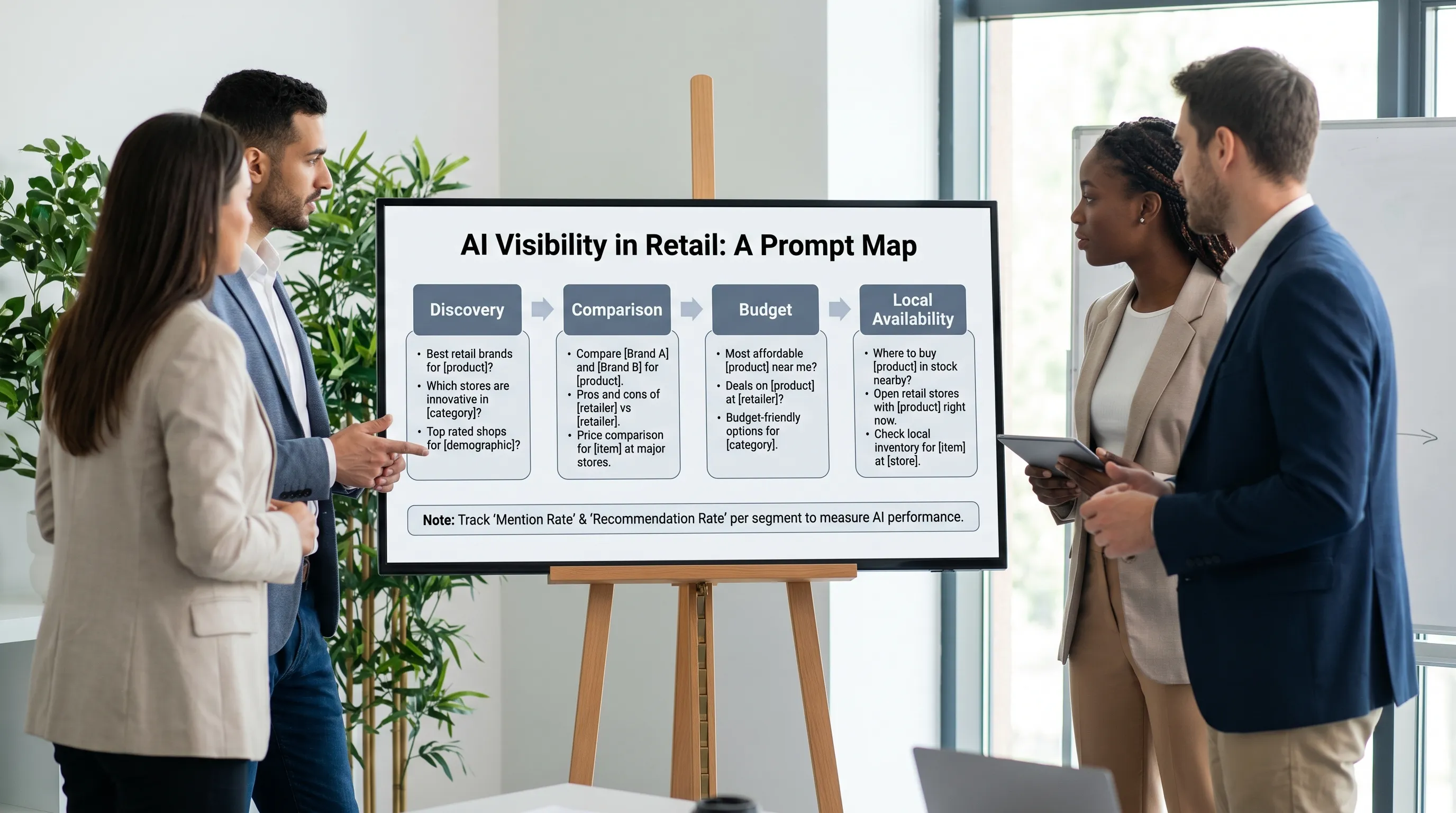
A strong retail prompt library usually spans:
| Prompt type | What it captures | Example |
|---|---|---|
| Category discovery | Early exploration and shortlist creation | “best air fryer for a small kitchen” |
| Comparison | Brand vs brand decision moments | “Allbirds vs Nike for walking” |
| Attribute-based | Feature-led intent | “nonstick pan that’s safe and durable” |
| Budget-led | Price sensitivity | “best espresso machine under $300” |
| Availability and local | Omnichannel intent | “where can I buy [brand] near me” |
| Post-purchase | Returns, warranty, support confidence | “how is [brand] warranty compared to [competitor]” |
For most retail orgs, the highest leverage prompts are comparison and attribute-based queries because they drive recommendation behavior.
Model set (the assistants you track)
You typically want coverage across the assistants shoppers actually use:
- ChatGPT
- Google Gemini
- Claude
- Perplexity
Each behaves differently (citations, browsing behavior, answer formatting, freshness), so you should expect your share of voice to vary by model.
Market and location (retail reality)
Retail visibility is often location-sensitive:
- Big-box availability differs by region.
- “Best in X country” changes brand sets.
- Store locator accuracy matters for “near me” prompts.
If you operate multiple locations, tracking AI visibility by geo is not optional. It is often where misinformation shows up first.
Entity consistency (what AI thinks you are)
AI assistants do not “rank pages” in the classic sense. They assemble answers based on entity understanding and retrievable sources.
That is why entity consistency across your ecosystem matters:
- Brand name variants
- Product naming and SKU logic
- Category associations
- Policies (shipping, returns, warranty)
- Retailer and marketplace listings
CapstonAI’s GEO primer explains the conceptual layer behind this shift, and why citations and entity signals increasingly matter: What is Generative Engine Optimization (GEO)?
How to calculate AI share of voice (a practical KPI set for retail)
You do not need dozens of metrics. You need a small, defensible set that turns AI visibility into actions.
Here is a KPI pack that works well for retail teams.
| KPI | What it answers | Simple calculation |
|---|---|---|
| AI mention rate | “Do we appear at all?” | Prompts where brand is mentioned / total prompts |
| AI share of voice | “How often are we mentioned vs competitors?” | Your mentions / total category mentions across tracked brands |
| Recommendation rate | “Are we being suggested as a choice?” | Prompts where brand is recommended / total prompts |
| Prompt coverage | “Which high-intent prompts do we miss?” | Covered prompts / total prompts in a segment |
| Citation share (when available) | “Which sources back up answers?” | Citations to your domain or controlled sources / total citations |
| Brand sentiment and framing | “How are we described?” | Categorized tone and attribute labels (tracked over time) |
Two important notes for accuracy:
- Normalize by prompt set. If you change prompts every week, your trend line becomes noise.
- Track by prompt segment. “Best moisturizer” and “best moisturizer for eczema” can produce different brand shortlists.

Tracking share of voice across AI assistants: what makes it tricky (and how to make it reliable)
AI assistants are not a stable SERP. Outputs can change due to:
- Model updates
- Retrieval differences (when browsing is enabled)
- Query phrasing changes
- Location and language context
- Safety and policy constraints
To reduce volatility and make results operational, adopt a testing discipline.
Use consistent prompt templates
Retail prompts should be templated so you can test apples to apples:
- Include the same constraints (budget, category, use-case)
- Keep the same prompt wording across weeks
- Separate “best overall” from “best budget” prompts
Capture the full answer, not just a yes/no mention
For retail, “mention” is not enough. You need to log:
- The exact phrasing around your brand
- The comparison set (who you are grouped with)
- The reason given (“durable,” “cheap,” “good for beginners”)
- Any sources or citations provided
This is where a platform approach is valuable, because manual copy-paste quickly becomes unscalable.
Track across competitors, not in isolation
Your visibility can look stable while the market shifts.
Example: you maintain a 40 percent mention rate, but two competitors surge in recommendation rate for the most valuable “best for” prompts.
Competitive and market tracking is the difference between “we show up sometimes” and “we are winning the category narrative.”
Add alerts for “critical retail moments”
In retail, some AI visibility changes are urgent:
- A model starts recommending a discontinued product.
- Your return policy is described incorrectly.
- A competitor is repeatedly recommended as “official retailer” when they are not.
A practical system includes alerting, not just reporting. CapstonAI frames this dashboard mindset well in: Which 6 GEO dashboards vs SEO reports should you use in 2025?
Retail actions that improve AI share of voice (what to fix when you find gaps)
Once you identify where you are missing, the next step is remediation. In retail, the highest impact fixes typically fall into four buckets.
1) Make product and category data easy for AI systems to interpret
AI assistants increasingly rely on structured, extractable information. For retail sites, this often means:
- Clean product titles and consistent variant naming
- Clear category definitions and buying guidance
- Structured data (where applicable)
If you sell physical products online, review your Product structured data implementation and align it with Schema.org Product fields that accurately represent your offers.
This is not “AI magic.” It is making your site machine-readable so retrieval and summarization are less error-prone.
2) Publish AI-ready FAQs that mirror how shoppers ask
Retail teams often have great content, but it is written for brand voice, not question intent.
AI assistants favor content blocks that:
- Answer a question directly in the first lines
- Use concrete constraints (size, compatibility, materials, shipping, warranty)
- Avoid vague marketing claims without specifics
If you are optimizing for Google’s generative layer specifically, the tactics overlap heavily with AI Overviews readiness. See: How to Optimize for AI Overviews: The Complete 2026 Guide
3) Strengthen “third-party proof” that models like to cite
Many retail recommendations are influenced by sources outside your site:
- Editorial lists and reviews
- Retailer PDPs (if you are a brand sold through partners)
- Community discussions and Q&A
- Knowledge bases and policy pages
If AI assistants repeatedly cite inaccurate third-party sources, you need a plan to correct the ecosystem, not just your homepage.
4) Fix multi-location signals if you have stores
For retailers with physical locations, AI assistants may answer:
- “Where can I buy this today?”
- “Is this available in [city]?”
- “What are the hours and return policy?”
This is where multi-location brand management and consistent store metadata become visibility drivers, not just “local SEO hygiene.”
A simple operating cadence for retail teams
AI share of voice works best when it becomes a recurring business review, not an ad hoc audit.
Here is a lightweight cadence that retail teams can adopt.
| Cadence | What to review | Who typically owns it |
|---|---|---|
| Weekly | Top prompt segments, sudden drops, critical misstatements | Growth marketing, SEO, e-commerce manager |
| Monthly | Competitor movement, category narrative shifts, content priorities | Marketing lead, merchandising, brand |
| Quarterly | Structural fixes (schema, CMS templates), location rollups, governance | Digital leadership, web team, agency |
If you already run an SEO dashboard, add AI visibility widgets rather than building a parallel reporting universe. CapstonAI’s broader e-commerce search framing can help connect classic SEO and AI-driven discovery: E-commerce SEO: Complete Strategy Guide for 2026
Common mistakes when tracking AI share of voice in retail
Treating “mentions” as success
A mention like “Brand X is expensive and hard to find” is not a win. Retail measurement has to capture recommendation presence and framing, not just inclusion.
Measuring without competitors
If you only track your own brand, you will miss the real story: who is gaining recommendation slots and why.
Ignoring prompt segmentation
Retail visibility is prompt-dependent. Your AI presence for “best budget” can look great while you are absent from the premium shortlist that drives margin.
Not closing the loop with fixes
Tracking is only valuable if it connects to actions:
- Metadata updates
- FAQ publishing
- Category page improvements
- Policy clarity
- Partner listing corrections
This is where platforms that combine scanning with recommendations and CMS workflows can compress time-to-fix.
Frequently Asked Questions
What is AI share of voice in retail? AI share of voice in retail measures how often AI assistants (like ChatGPT, Gemini, Claude, and Perplexity) mention or recommend your brand versus competitors for shopping-related prompts.
How is AI share of voice different from SEO share of voice? SEO share of voice is typically based on rankings and SERP presence. AI share of voice focuses on being included in generated answers, shortlists, and recommendations, often with citations and brand framing.
Which AI assistants should retailers track? Most retail teams start with ChatGPT, Gemini, Claude, and Perplexity because they cover a large share of consumer AI discovery behaviors and differ in citations, browsing, and answer styles.
What prompts should I use to measure AI visibility for e-commerce? Use prompt segments that reflect real shopping intent: category discovery, comparisons, attribute-based needs, budget constraints, availability and local queries, and post-purchase support questions.
Why do AI assistants recommend competitors instead of my brand? Common causes include weak entity consistency, unclear product data, missing AI-readable FAQs, stronger third-party coverage for competitors, or assistants pulling from sources that do not reflect your latest assortment and policies.
How often should retail teams review AI share of voice? Weekly reviews catch sudden visibility changes and misinformation. Monthly reviews are best for competitor trend analysis and content prioritization, with quarterly cycles for structural fixes.
Turn AI share of voice into a retail growth channel
If AI assistants are already shaping product discovery in your category, you need more than occasional spot checks. You need a repeatable system to scan, diagnose, fix, and defend how AI models describe and recommend your brand.
CapstonAI helps brands and agencies track AI search visibility across major AI engines, map prompts to mentions, monitor competitors, and publish AI-ready metadata and FAQs through CMS workflows.
Get started with a free AI visibility audit at CapstonAI.