Brand discovery used to be fairly linear. A buyer searched Google, scanned the first page, clicked a few results, compared options, and eventually contacted a vendor or purchased a product. In 2026, that journey is becoming less visible, more conversational, and far more dependent on how AI systems understand your brand.
AI-powered search does not simply change where people search. It changes what they expect from search. Instead of typing short keywords and sorting through links, users ask full questions, describe their context, request comparisons, and expect a usable recommendation immediately. For brands, that means visibility is no longer just about ranking for a keyword. It is about being retrieved, understood, trusted, cited, and recommended by AI engines.
Gartner predicted that traditional search engine volume would drop 25% by 2026 as users shift toward AI chatbots and virtual agents. Whether that exact number lands high or low, the direction is already clear: discovery is moving from search results pages to answer environments, shopping assistants, chat interfaces, and AI-generated summaries.
What AI-powered search means for brand discovery
AI-powered search refers to search experiences where generative AI, retrieval systems, ranking models, and conversational interfaces work together to answer questions directly. This includes AI Overviews, ChatGPT-style search experiences, Perplexity answers, Gemini, Claude-assisted research, AI shopping assistants, and vertical tools built for specific tasks.
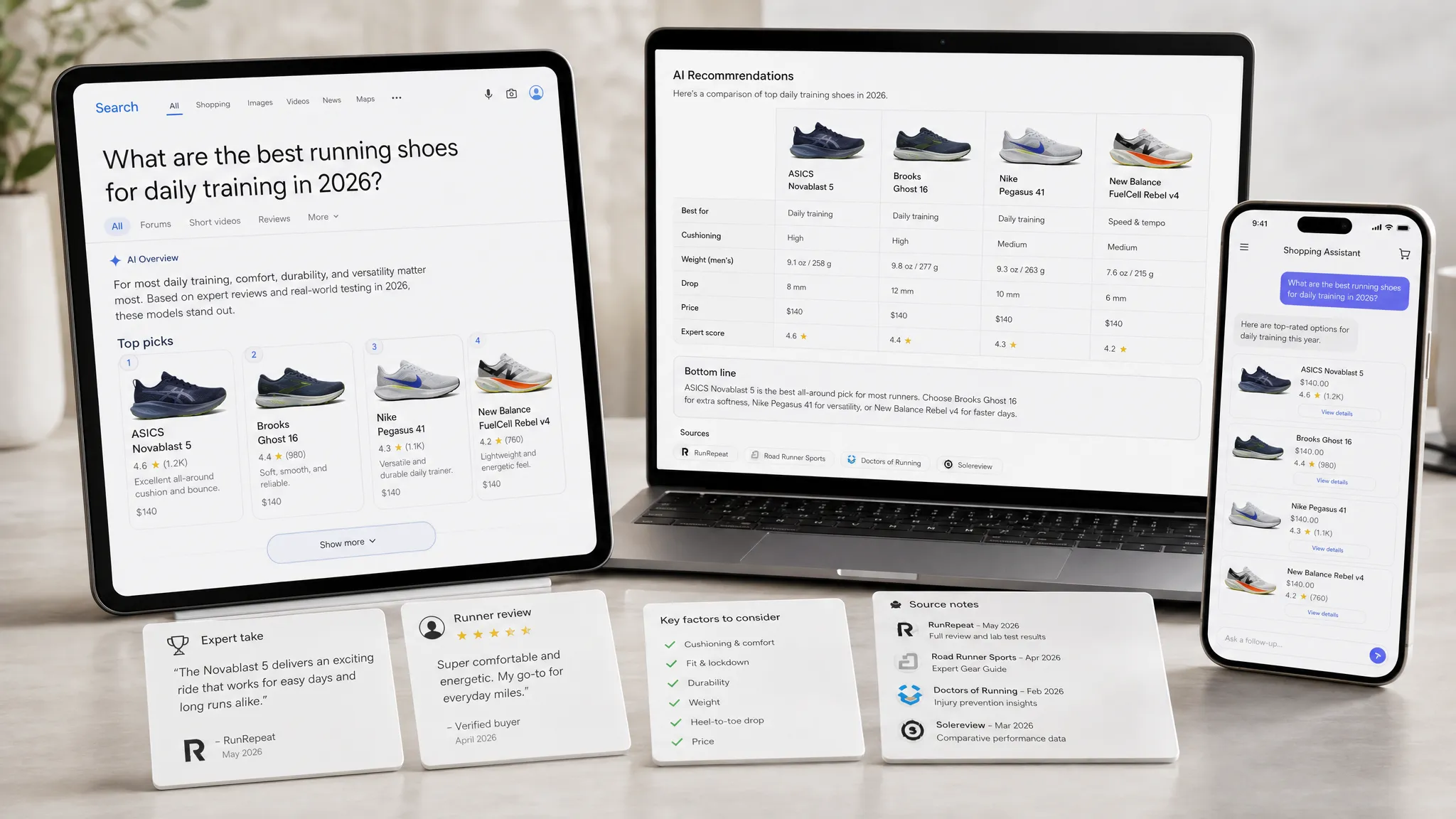
For consumers and B2B buyers, the practical change is simple: they can ask a question and get a synthesized answer instead of a page of links. For brands, the change is more profound. Your website, reviews, schema, product data, articles, third-party mentions, and public entity signals become raw material for AI-generated responses.
In traditional SEO, a brand could win discovery by ranking well and earning the click. In AI-powered search, a brand may influence the buyer before the click ever happens. The AI answer may name three vendors, summarize pros and cons, compare pricing models, mention customer fit, and cite external sources. If your brand is absent, misrepresented, or positioned poorly, the buyer may never know you were a viable option.
| Traditional search discovery | AI-powered search discovery in 2026 |
|---|---|
| Users search short keywords | Users ask contextual, conversational questions |
| Search engines rank pages | AI systems synthesize answers and shortlists |
| Visibility is measured by rankings and clicks | Visibility is measured by mentions, citations, recommendations, and accuracy |
| The website is the main conversion path | The AI answer may shape preference before the website visit |
| SEO focuses on pages and keywords | AI visibility focuses on entities, trust signals, retrievable content, and prompt coverage |
| Competitors are visible in SERPs | Competitors appear inside AI-generated comparisons |
This does not mean SEO is dead. It means SEO is becoming part of a broader visibility system. Your pages still matter, but they now need to be structured in ways that machines can confidently parse, corroborate, and reuse.
6 ways AI-powered search changes brand discovery in 2026
1. Discovery starts with a recommendation, not a result
The biggest shift is that users increasingly expect search to make sense of options for them. A buyer might ask, “What is the best inventory software for a mid-sized retail chain with multiple locations?” or “Which skincare brands are best for sensitive skin and sustainable packaging?”
In a classic search journey, the user would open several tabs and build their own shortlist. In an AI-powered search journey, the engine may generate the shortlist immediately. That makes the first recommendation moment much more important.
If an AI system includes your brand, you are part of the buyer’s consideration set. If it excludes you, you may lose the opportunity before your sales team, product page, or paid ads have any influence.
2. Buyers search by situation, not just by category
Keyword research has always tried to understand intent, but AI-powered search makes intent much more specific. Users do not need to compress their needs into a few words. They can describe constraints, preferences, urgency, budget, location, role, and desired outcome in one prompt.
That means brands need to create content that answers real-world buying situations, not just broad category terms. A generic “best CRM software” page is less useful than content that clearly explains who your product is best for, what problems it solves, what integrations matter, what limitations exist, and how it compares to alternatives.
The same pattern applies outside marketing and SaaS. Users also skip the discovery phase when a specialized AI tool completes the task directly. Someone who once searched for templates or examples may now use an AI-powered letter generator to produce a polished document in seconds, then judge the result rather than browse dozens of informational pages.
This is a warning for every brand: if AI can answer the question, compare the options, or complete the task, your discovery strategy must focus on being present in that AI-mediated moment.
3. Brand authority becomes more machine-readable
AI systems do not “trust” brands the way people do. They infer reliability from patterns in available data. Clear entity information, consistent naming, strong third-party references, expert content, structured data, reviews, and freshness all help AI systems understand whether a brand is credible and relevant.
In 2026, brand authority is no longer only a perception problem. It is also a data problem. If your company name appears inconsistently across pages, directories, product listings, social profiles, and reviews, AI systems may struggle to connect the dots. If your website hides important information behind scripts or vague marketing copy, AI may not extract the facts that make you recommendable.
Strong AI search visibility requires clarity. What do you sell? Who is it for? Where do you operate? What makes you different? What proof supports those claims? Which sources confirm them?
4. Third-party proof carries more weight
A brand’s own website is important, but AI-powered search often looks for corroboration. Reviews, analyst mentions, customer stories, marketplace listings, industry directories, expert roundups, news coverage, and community discussions can all influence how AI systems describe a brand.
This changes the role of digital PR and reputation management. Third-party mentions are not just referral traffic opportunities. They are evidence that AI systems can use to validate your category, positioning, and credibility.
For example, if your website says your platform is built for enterprise retailers, but every third-party source describes you as a small-business tool, AI answers may reflect the external consensus. If review sites consistently mention slow support, that may surface in AI-generated comparisons. If trusted publications repeatedly cite your research, that can increase your chance of appearing in answer-style results.
5. Discovery becomes fragmented across engines
In the old search model, Google dominated most visibility discussions. In 2026, brand discovery is spread across multiple AI engines and interfaces. ChatGPT, Gemini, Claude, Perplexity, Google AI Overviews, Bing Copilot, AI shopping assistants, social search, and vertical tools may all answer the same question differently.
That fragmentation creates both risk and opportunity. One AI engine may recommend your brand, while another ignores it. One may cite your latest documentation, while another relies on outdated third-party information. One may position you as a premium solution, while another compares you against entry-level tools.
Brands need to stop assuming that “we rank well on Google” means “AI understands us correctly.” Those are related signals, but they are not identical.
6. The click is no longer the only sign of discovery
AI-powered search can influence demand without sending immediate traffic. A user might see your brand in an AI-generated shortlist, ask follow-up questions, compare you with competitors, and later visit your website directly or search your brand name. In analytics, that journey may look like direct traffic or branded search, even though the initial discovery happened inside an AI answer.
This is why AI visibility metrics matter. If you only measure clicks, you will miss upstream recommendation moments. If you only measure rankings, you will miss brand mentions inside conversational answers. If you only measure conversions, you will struggle to understand which AI touchpoints shaped consideration.
How brand discovery strategy must adapt
AI-powered search rewards brands that are easy to understand, easy to verify, and easy to recommend. The goal is not to trick AI systems. The goal is to make your brand’s value, relevance, and proof clear enough that AI engines can represent you accurately.
Move from keyword coverage to prompt coverage
Traditional keyword coverage asks, “Do we have pages for our target search terms?” Prompt coverage asks, “Do we appear when buyers describe their real problems, constraints, and decision criteria?”
A strong prompt map includes category prompts, comparison prompts, alternative prompts, local prompts, product-fit prompts, pricing prompts, problem-solution prompts, and objection prompts. For example, a cybersecurity company might track prompts like “best SOC 2 compliance tools for startups,” “alternatives to manual vendor risk reviews,” and “which security automation platforms integrate with Jira?”
Prompt coverage helps marketers see where AI systems already understand the brand and where blind spots exist.
Build answer-ready content
AI systems favor content that can be extracted and summarized. Long, vague, brand-heavy pages are harder to reuse than clear sections with direct answers, definitions, comparison tables, FAQs, product details, use cases, and evidence.
Answer-ready content is not thin content. It is structured content. It gives concise answers, then supports them with detail. It uses clear headings. It explains context. It includes facts that can be verified. It avoids burying essential information in images, PDFs, or complex interactive elements.
Good answer-ready assets include:
- Use case pages that define the audience, problem, workflow, and measurable outcome
- Comparison pages that explain differences honestly and avoid unsupported claims
- FAQ sections that answer real buyer questions in plain language
- Product and service pages with clear eligibility, features, locations, integrations, and limitations
- Research, benchmarks, and original data that other sources can cite
Treat metadata and schema as AI infrastructure
Metadata used to be viewed mainly as a click-through lever. In AI-powered discovery, metadata and structured data help clarify entities, relationships, products, locations, authors, reviews, and FAQs.
Schema does not guarantee inclusion in AI answers, but it reduces ambiguity. Organization schema, Product schema, LocalBusiness schema, FAQPage schema, Article schema, Breadcrumb schema, and Review schema can all help systems interpret your pages more accurately when implemented correctly.
The same principle applies to titles, descriptions, headings, and internal links. They should reinforce what the page is about and how it connects to your broader topical authority.
Strengthen external corroboration
If AI systems compare multiple sources, your brand story should not exist only on your own site. Build a consistent external footprint across credible directories, review platforms, partner pages, customer stories, media mentions, podcasts, industry reports, and expert contributions.
This does not mean chasing low-quality backlinks. It means earning and maintaining references that accurately describe your company. For AI discovery, consistency is as important as volume. A smaller number of credible, aligned mentions can be more useful than many scattered references with conflicting descriptions.
Metrics that matter for AI-powered brand discovery
Marketers need a measurement model that reflects how AI search actually works. Rankings and organic traffic still matter, but they no longer tell the whole story.
| Metric | What it measures | Why it matters |
|---|---|---|
| Mention rate | How often your brand appears across target prompts | Shows whether you are present in AI discovery moments |
| Recommendation rate | How often AI engines actively suggest your brand | Indicates whether you are part of the shortlist, not just mentioned |
| Citation rate | How often your owned or third-party pages are cited | Reveals whether your sources support AI answers |
| AI share of voice | Your visibility compared with competitors | Helps quantify category presence across engines |
| Positioning accuracy | Whether AI describes your brand correctly | Protects against outdated or misleading answers |
| Sentiment | Whether mentions are positive, neutral, or negative | Shows how AI frames your reputation |
| Prompt coverage | Which buyer questions trigger your brand | Identifies content and authority gaps |
| Volatility | How often answers change over time | Helps teams detect risk, updates, and competitive movement |
This measurement shift is especially important for executives. AI visibility is not a vanity metric when it is tied to category demand, sales-qualified opportunities, branded search growth, and competitive displacement.
What different businesses should prioritize
AI-powered search affects every brand, but the most urgent actions depend on the business model.
| Business type | Discovery risk | 2026 priority |
|---|---|---|
| B2B SaaS | Being excluded from “best tool” and comparison prompts | Build use case, integration, pricing, alternative, and comparison content |
| E-commerce | Products not appearing in AI shopping recommendations | Improve product data, reviews, structured markup, availability, and category content |
| Multi-location brands | AI giving incomplete or wrong local information | Standardize location pages, LocalBusiness schema, hours, services, and reviews |
| Agencies | Clients asking for proof of AI search impact | Track AI visibility, competitor mentions, and prompt-level share of voice |
| Professional services | AI recommending better-known firms or directories | Publish expert content, credentials, case studies, FAQs, and third-party proof |
| Marketplaces | AI summarizing supply without citing the platform | Strengthen category pages, seller data, review signals, and crawlable inventory context |
The common thread is clarity. AI systems are more likely to recommend brands when category fit, audience fit, proof, and current information are easy to retrieve.
Common mistakes brands make in AI-powered search
Many teams are trying to adapt, but they often bring old SEO habits into a new discovery environment.
The first mistake is optimizing only for one AI engine. ChatGPT visibility matters, but it is not the entire market. Gemini, Claude, Perplexity, Google AI Overviews, and vertical AI tools may each shape different buyer segments.
The second mistake is publishing more AI-generated content without improving substance. AI-powered search does not reward volume alone. It rewards content that resolves ambiguity, answers real questions, and is supported by credible evidence.
The third mistake is ignoring incorrect answers. If AI engines describe your pricing, product fit, locations, or competitors inaccurately, that is not just a content issue. It is a brand risk. Teams should monitor hallucinated or outdated claims and fix the underlying source gaps where possible.
The fourth mistake is treating AI visibility as separate from SEO, PR, content, and product marketing. In reality, AI discovery sits at the intersection of all four. Search teams understand crawlability and structure. Content teams shape answers. PR teams build external proof. Product marketing clarifies positioning. The strongest programs connect these functions.
A practical 2026 readiness checklist
You do not need to rebuild your entire marketing strategy at once. Start with the discovery moments most likely to influence revenue.
| Priority | Action | Outcome |
|---|---|---|
| Audit | Test how major AI engines mention your brand and competitors | Establish a baseline for visibility and accuracy |
| Map prompts | Build a prompt set around buyer questions and decision stages | See where discovery actually happens |
| Fix entity clarity | Standardize brand, product, location, and category information | Reduce confusion across AI systems |
| Publish answer-ready content | Add FAQs, comparison sections, use cases, and structured explanations | Make your expertise easier to retrieve and summarize |
| Improve technical access | Check crawlability, metadata, schema, internal links, and page performance | Help AI and search systems parse your content |
| Build corroboration | Earn consistent third-party mentions, reviews, and references | Strengthen trust signals beyond your own website |
| Track over time | Monitor mentions, citations, share of voice, and sentiment | Turn AI visibility into an ongoing growth metric |
CapstonAI is built around this workflow. The platform helps brands, retailers, and agencies scan AI visibility across major AI engines, map prompts and mentions, track competitors, identify content gaps, publish AI-ready FAQs and metadata, and monitor critical changes through dashboards. For teams that already manage SEO, content, or digital reputation, AI visibility becomes the missing layer between search performance and brand recommendation.
The future of brand discovery is assisted, not passive
The most important mindset shift is this: customers are not just searching anymore. They are being assisted.
They ask AI systems to narrow options, explain tradeoffs, identify trusted brands, compare products, summarize reviews, and recommend next steps. That means your brand needs to be legible to both humans and machines. Clear positioning, structured content, trustworthy proof, and current data are no longer optional assets. They are discovery infrastructure.
AI-powered search will not eliminate websites, SEO, or brand marketing. It will make weak signals more obvious and strong signals more valuable. Brands that adapt early will not just protect traffic. They will influence the recommendation layer where more buying decisions begin.
Frequently Asked Questions
Is AI-powered search replacing traditional search? Not completely. Traditional search still matters, especially for navigation, local queries, research, and transactions. The bigger shift is that AI-generated answers are becoming an additional discovery layer that can influence buyers before they click a result.
How is AI search visibility different from SEO? SEO focuses on rankings, organic traffic, technical health, and content relevance in search engines. AI search visibility focuses on whether AI engines mention, cite, accurately describe, and recommend your brand across conversational prompts.
Can brands pay to appear in AI recommendations? Some AI search environments may include ads or sponsored placements, but organic AI recommendations are generally influenced by retrievable information, authority, relevance, and corroboration. Brands should focus on clarity, trust signals, and measurement rather than assuming paid visibility will solve the problem.
What should brands optimize first for AI-powered search? Start by auditing how AI engines currently describe your brand. Then fix high-impact gaps in entity clarity, metadata, schema, FAQ content, product or service pages, and third-party proof. Measurement should come before large-scale content production.
How often should teams track AI visibility? For competitive categories, weekly or biweekly tracking is useful because AI answers can change as sources update, competitors publish, and engines adjust retrieval systems. At minimum, brands should review AI visibility monthly and after major product, pricing, or positioning changes.
Ready to see how AI-powered search discovers, describes, and recommends your brand? Run a free AI visibility audit with CapstonAI to find blind spots, benchmark competitors, and turn AI search visibility into a measurable growth channel.