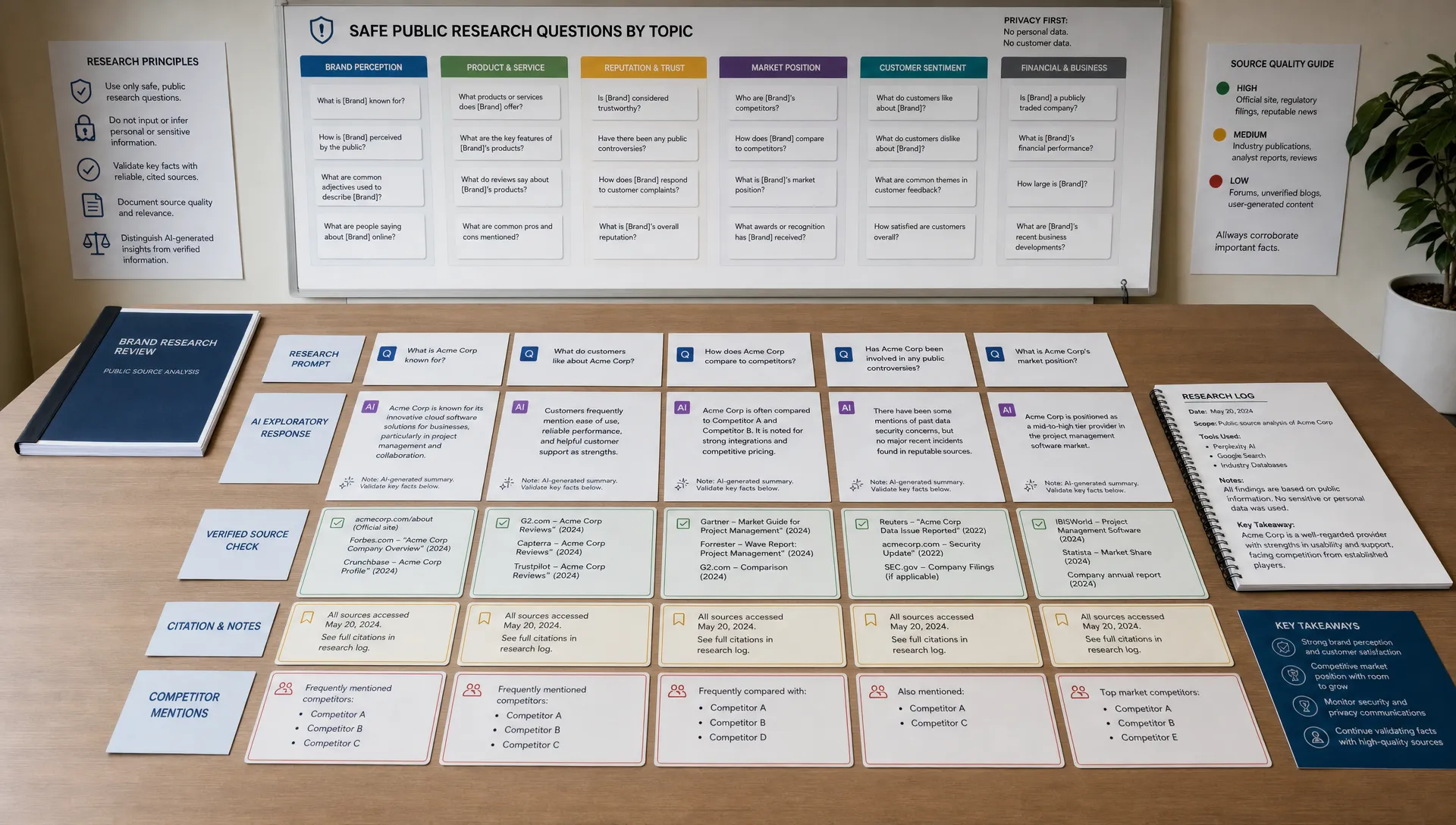
A free AI search engine can be a useful first look at how AI systems describe your brand. It can show whether ChatGPT, Gemini, Perplexity, Claude, Copilot, or Google AI Overviews recognize your company, cite your pages, recommend competitors, or miss important facts.
But it is not automatically safe, complete, or decision-ready.
For brand research, “safe” has three meanings: your inputs should not expose sensitive data, the outputs should not be treated as verified facts without checking, and the research process should not create false confidence about visibility, share of voice, or customer demand. A free tool can help you explore. It should not be the only system you use to measure, improve, or defend AI search presence.
What brand research looks like inside AI search
AI search is different from a classic search results page. Instead of giving users a ranked list of links, a generative engine often summarizes an answer, selects a few sources, and may recommend brands directly. That changes the research question from “Do we rank?” to “Are we mentioned, cited, and trusted in the answer?”
For a hotel group, that might mean asking: “What are the best boutique hotels near downtown Austin for business travelers?” For a multi-location healthcare brand, it might mean: “Which urgent care clinics near Phoenix accept walk-ins?” For an MSP, it might mean: “Who are the best IT support providers for a 100-person law firm?”
A free AI search engine can help you test these questions manually. It can reveal patterns such as:
- Whether your brand appears in category recommendations
- Which competitors are named more often
- Whether the AI cites your site, third-party directories, reviews, or editorial pages
- Whether the answer uses outdated, incomplete, or inaccurate brand information
- Which buyer questions your current content does not answer clearly
If your team is still getting oriented, this is a reasonable starting point. If you are specifically evaluating ChatGPT as a discovery channel, CapstonAI’s guide to ChatGPT as a search engine explains why brand teams now need to think beyond traditional blue-link rankings.
The short answer: safe for exploration, risky as a system of record
A free AI search engine is generally safe for brand research when you only use public, non-sensitive information and verify every important output. It becomes risky when teams paste confidential data into prompts, rely on one answer as market evidence, or make content and budget decisions without repeatable measurement.
| Brand research use case | Is a free AI search engine enough? | Main risk |
|---|---|---|
| Checking how an AI describes your public brand positioning | Yes, for a quick snapshot | The answer may be incomplete or stale |
| Testing category prompts where buyers might expect recommendations | Useful, but limited | One prompt does not represent total AI visibility |
| Comparing public competitor mentions | Useful for early research | Results vary by engine, location, and wording |
| Uploading customer lists, CRM exports, contracts, patient data, or student data | No | Sensitive data exposure and compliance risk |
| Measuring share of voice across many prompts and engines | No | Manual testing is too narrow and hard to reproduce |
| Publishing a board-level AI visibility report | No | Citations, methodology, and coverage need stronger evidence |
The safest framing is simple: use free AI search tools to discover questions worth investigating, not to close the investigation.
Privacy risk: what you type may matter more than what you ask
The most immediate safety issue is not the AI answer. It is the prompt.
Many free AI tools are consumer-facing products. Their terms, privacy controls, data retention policies, and model improvement settings can vary by provider and account type. Before using any AI tool for business research, review the provider’s current data controls and your company’s AI usage policy.
A practical rule works well: if you would not paste the information into a public support ticket or forward it outside your organization, do not paste it into a free AI prompt.
For brand teams, agencies, and MSPs, that means avoiding:
- Customer names, emails, phone numbers, addresses, or account data
- Patient, student, employee, or applicant information
- Unreleased campaigns, pricing models, acquisition plans, or internal strategy documents
- Private analytics exports, paid media reports, contracts, or vendor scorecards
- Source code, security configurations, incident reports, or access credentials
This matters especially for healthcare, education, finance-adjacent services, and multi-location businesses that may handle regulated or contractually restricted data. The NIST AI Risk Management Framework is a useful reference point because it treats AI risk as a governance issue, not just a technical issue. In brand research, governance starts with deciding what data is allowed in prompts.
You can still get useful results without exposing sensitive information. Use public URLs, anonymized examples, synthetic customer profiles, or general category questions. For example, ask “What information should a patient compare when choosing an urgent care clinic?” instead of pasting real patient inquiries.
Accuracy risk: AI answers are not the same as verified facts
A free AI search engine can sound confident even when it is wrong. It may merge facts from similar brands, cite a page that only partly supports the answer, use outdated information, or omit your brand because the model could not connect your entity to the query.
This is not just a content quality problem. It affects revenue and credibility.
If an AI assistant tells a traveler that a hotel does not offer parking when it does, that can reduce bookings. If it recommends a competing retailer because your product pages are difficult to crawl, that can shift demand. If it cites an old directory instead of your updated location page, customers may see the wrong hours, phone number, or service area.
AI search outputs should be reviewed in four layers:
- Answer accuracy: Does the answer describe your brand, locations, products, and services correctly?
- Citation accuracy: Do the cited pages actually support the claims in the answer?
- Entity clarity: Is the AI connecting your brand name to the correct company, locations, products, and categories?
- Business effect: Could the answer influence a booking, lead, store visit, demo request, or support decision?
The last layer is often missed. A minor factual error on an internal page may not matter. A wrong AI answer in a high-intent comparison prompt can matter a lot.
Sampling risk: one prompt is not AI visibility
Manual testing in a free AI search engine has a hidden weakness: it feels more representative than it is.
AI answers can change based on the engine, model version, location, freshness of retrieved pages, prompt wording, browsing availability, user context, and whether the user asks a follow-up question. A brand may appear for “best hotels for families in Charleston” and disappear for “where should I stay in Charleston with kids near restaurants?” Those are similar buyer intents, but they may produce different recommendations and citations.
That is why serious brand research needs prompt and mention mapping. You need to know which prompts surface you, which surface rivals, and which cite sources you can influence. You also need share of voice across a meaningful prompt set, not a single answer.
For a mid-market ecommerce team, that might include prompts by product category, use case, price range, shipping concern, review language, and comparison terms. For a franchise brand, it might include city, neighborhood, service line, emergency intent, insurance, availability, and “near me” variations.
A free tool can help you build the prompt list. It cannot reliably tell you your overall AI search presence without repeatable tracking.
What to verify before trusting a free AI search result
When you use a free AI search engine for brand research, document the result as if someone else will need to reproduce it later. That discipline turns casual prompting into usable evidence.
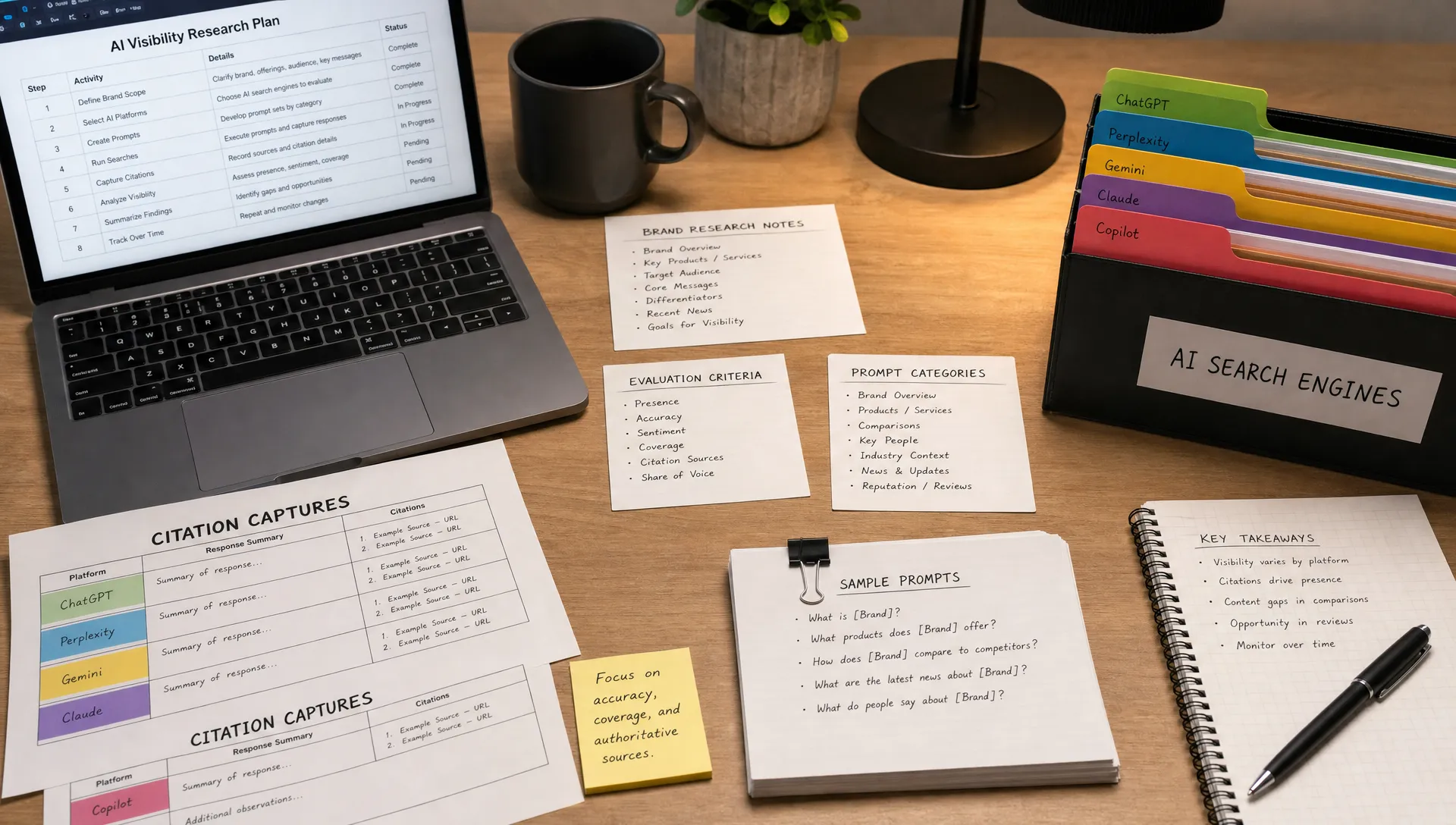
Capture the engine, date, prompt, geography, device context if relevant, answer summary, brands mentioned, citations shown, and any follow-up prompts. Screenshot important outputs, but do not stop there. Visit the cited pages and confirm what they actually say.
Then look for patterns rather than isolated surprises. One bad answer may be noise. Ten bad answers around the same service line, location, or product category usually point to a fixable visibility issue.
Common causes include weak entity signals, inconsistent business information, thin category pages, missing FAQs, blocked crawl paths, poor internal linking, slow page performance, and content that answers humans but gives machines too little structure.
This is where GEO, AEO, and technical SEO meet:
| Discipline | What it means | Business effect |
|---|---|---|
| Generative Engine Optimization (GEO) | Making your content easier for AI systems to understand, cite, and reuse in generated answers | More opportunities to be mentioned in AI recommendations |
| Answer Engine Optimization (AEO) | Structuring pages around direct questions and clear answers | Better coverage for high-intent customer questions |
| Technical SEO | Ensuring pages are crawlable, fast, internally linked, and technically clean | Search and AI systems can access the right evidence |
| Entity optimization | Making your brand, locations, products, and relationships unambiguous | Less confusion with competitors or outdated sources |
| Citation optimization | Improving the quality and consistency of pages that AI systems can cite | Stronger credibility in generated answers |
Structured data is one practical example. Schema does not force an AI engine to cite you, but it helps clarify what a page is about, such as a LocalBusiness, Product, FAQ, Organization, or Review. Google’s documentation on structured data is still a useful foundation because many AI search experiences build on web-scale crawling and structured understanding.
The same principle applies to llms.txt. It is an emerging convention some teams use to point AI systems toward preferred public resources. It should complement, not replace, sitemaps, robots.txt, schema, crawlability, and strong internal linking.
How to use a free AI search engine safely
A safe workflow is not complicated. It just needs boundaries.
Start with public prompts. Ask the kinds of questions your prospects ask before they book, buy, request a quote, or shortlist vendors. Avoid internal data. If you need examples, use synthetic customer scenarios.
Next, compare across engines. ChatGPT, Gemini, Claude, Perplexity, Copilot, and Google AI Overviews do not behave the same way. Some show citations more prominently. Some rely more heavily on live web retrieval. Some may summarize without giving you enough source transparency.
Then verify the source layer. If the AI cites a directory, marketplace, article, or review page, inspect it. If it cites your own site, check whether that page is the best possible source. Often the problem is not that the brand lacks content. The problem is that the strongest page is buried, slow, vague, missing schema, or not internally linked from relevant pages.
Finally, turn observations into fixes. For example, if AI answers consistently miss your “pet-friendly suites” offering, the fix may include updating location pages, adding a concise FAQ, strengthening internal links from destination pages, improving metadata, and making the feature visible in structured data where appropriate.
CapstonAI’s article on AI trust signals that make brands more citable goes deeper on this point: AI systems need clear, consistent evidence before they can confidently reuse your brand in an answer.
When free tools are not enough
Free AI search tools are useful for discovery. They are not enough when AI visibility becomes a business channel.
You will need stronger measurement if your team is responsible for multiple locations, multiple brands, ecommerce categories, franchise sites, or client portfolios. Manual prompting breaks down quickly when you need to track hundreds of prompts across engines and prove whether fixes improved mentions, citations, and share of voice.
This is the gap CapstonAI is built to close. CapstonAI scans across major AI search and generative engines, tracks brand mentions and citations, maps prompts that surface you or your competitors, and turns key pages into AI-ready assets through prioritized recommendations. For WordPress-first teams, CMS integration can help publish fixes such as AI-ready FAQ, schema, metadata, and llms.txt updates without turning every improvement into a long development queue.
The point is not to stop using free AI search engines. The point is to put them in the right role. Use them to explore questions, spot examples, and understand how AI answers feel to a customer. Use a dedicated AI visibility platform when you need repeatable data, competitor monitoring, alerts, scoring, and before-and-after proof.
A practical safety checklist for brand teams
Before your next AI brand research session, align on a simple operating standard:
- Use only public or anonymized inputs
- Test across more than one AI search engine
- Record prompts, dates, engines, citations, and answer summaries
- Verify every important claim against the source page
- Separate early discovery from share-of-voice reporting
- Prioritize fixes that improve crawlability, schema, internal linking, entity clarity, and page performance
- Escalate regulated or high-risk claims to legal, compliance, or subject matter experts
This keeps the work practical. It also prevents the two most common mistakes: exposing information that should stay private and treating one AI answer as if it represents the whole market.
Frequently Asked Questions
Is a free AI search engine safe for brand research? Yes, if you use public information, avoid sensitive data, and verify outputs. It is best for early exploration, not for confidential analysis or final AI visibility reporting.
Can I paste customer reviews or CRM notes into a free AI search engine? Avoid pasting raw customer data, CRM exports, patient data, student data, or private account information. Use anonymized summaries or synthetic examples instead.
Why do AI search engines give different answers for the same brand? Each engine may use different models, retrieval systems, sources, personalization signals, and freshness windows. Prompt wording and location can also change which brands and citations appear.
What should I track during AI brand research? Track the prompt, engine, date, location context, brands mentioned, citations, accuracy issues, competitor presence, and whether your own pages are cited. Over time, this becomes your AI visibility baseline.
How does CapstonAI differ from manually using free AI search tools? Free tools show individual answers. CapstonAI is designed to measure AI visibility across engines, track mentions and citations, monitor competitors, map prompts, and recommend fixes that improve how AI systems read and reuse your brand content.
Start with a free AI visibility audit
A free AI search engine is safe enough for careful exploration. It is not enough to know whether AI can consistently see, trust, and recommend your business.
If you want a clearer baseline, start with a free AI visibility audit from CapstonAI. You will see where your brand appears, where competitors are winning, and which technical, content, and structured data fixes can make your business more visible in AI search. If AI cannot see your business, CapstonAI makes it visible.