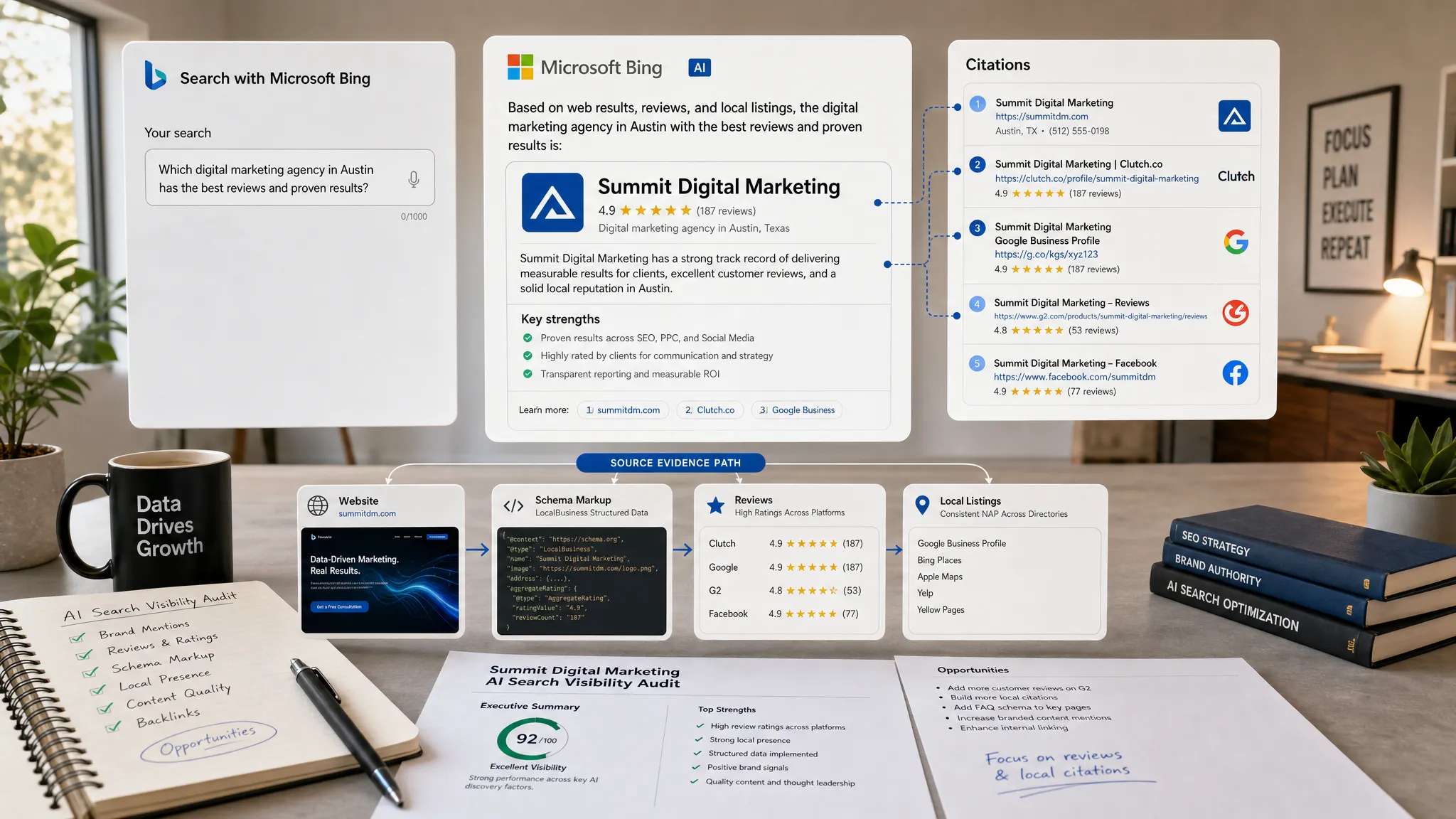
When a buyer asks Copilot for the best regional hotel group for a corporate retreat, a reliable MSP for Microsoft 365 support, or a retailer that carries a specific product, Microsoft Bing AI can shape whether your brand appears as a named option, a cited source, or not at all.
That shift matters because AI search does not simply list web pages. It interprets the prompt, retrieves supporting information, summarizes what it finds, and often cites sources. Classic SEO still matters, but it is no longer the whole visibility picture. Your pages must be crawlable, your brand must be understood as an entity, and your content must provide facts that generative engines can confidently reuse.
For marketers, the practical question is changing from whether you rank to whether AI systems can see, trust, and mention your business when prospects ask high-intent questions.
What counts as a brand mention in Microsoft Bing AI?
A brand mention is any appearance of your business inside an AI-generated answer, not just a blue-link ranking. In Bing and Copilot-style experiences, a mention can take several forms:
- A direct recommendation, such as naming your hotel group, clinic network, agency, store, or MSP as an option.
- A citation, where your page is used as a source for the answer.
- A comparison, where your brand is listed alongside competitors.
- An entity reference, where the AI describes what your business does, where it operates, or which category it belongs to.
- An omission, where competitors appear for prompts where your brand should be eligible.
The omission is often the most useful finding. It tells you where AI search understands the market but does not yet understand your brand well enough to include it.
Why Bing is a distinct AI visibility channel
Microsoft Bing AI sits inside a broader Microsoft search ecosystem that includes Bing, Copilot, Edge, Windows search experiences, and Microsoft advertising surfaces. The exact ranking and answer-generation systems are proprietary, but the observable pattern is clear: Bing’s web index, entity understanding, source quality signals, and freshness signals influence which brands can be retrieved and cited.
That makes Bing different from a traditional referral channel. A buyer may never visit a search results page. They may ask an assistant for a shortlist, compare options inside the answer, and only click one or two cited sources. If your brand is not mentioned at that point, your traffic and lead opportunity can disappear before the website visit ever happens.
This is why AI visibility now combines three disciplines:
- Technical SEO: Making sure pages can be crawled, indexed, rendered, and understood.
- AEO, or Answer Engine Optimization: Structuring content so answer systems can extract concise, accurate answers.
- GEO, or Generative Engine Optimization: Improving how generative engines describe, cite, and recommend your brand across prompts and competitors.
If you want the broader context, CapstonAI has covered how AI-powered search changes brand discovery as buyers move from keyword results to generated recommendations.
How Bing AI selects brands to mention
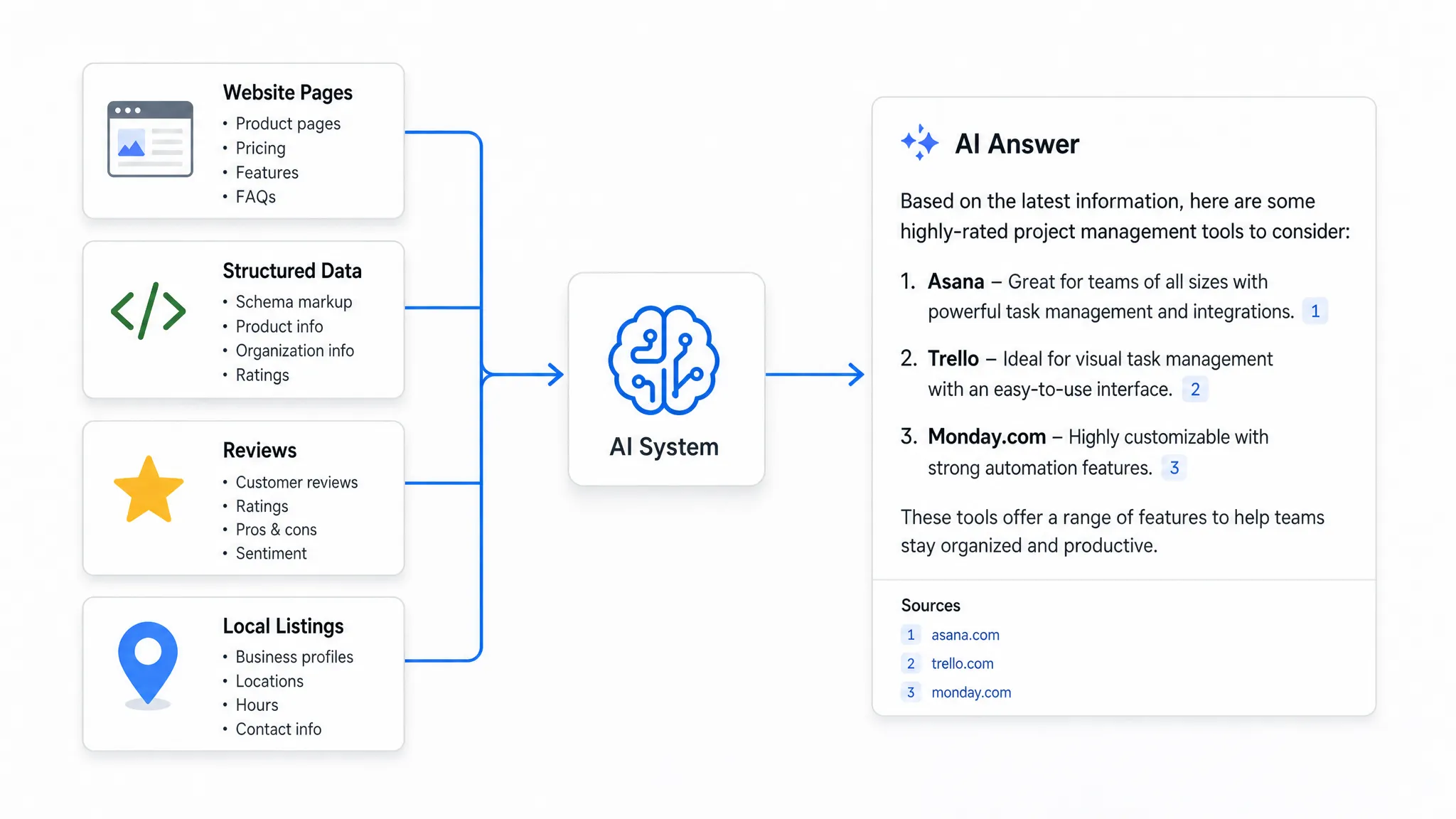
A Microsoft Bing AI answer is not a simple copy of the top organic result. It is closer to a retrieval and synthesis process. The system has to decide what the user means, which sources are relevant, which facts are reliable, and how to present the answer.
| Stage | What happens | Brand visibility effect |
|---|---|---|
| Prompt interpretation | The system identifies intent, location, category, constraints, and comparison needs. | Your brand must be clearly associated with the right services, products, locations, and use cases. |
| Web retrieval | Bing retrieves pages, entities, and supporting sources from its index. | Blocked, slow, thin, or poorly linked pages are less likely to become source material. |
| Source evaluation | The system weighs relevance, freshness, authority, consistency, and usefulness. | Brands with clear claims and corroborating references are easier to trust. |
| Answer generation | The AI summarizes selected facts and may cite source URLs. | Pages with concise answers, structured headings, and specific evidence are more reusable. |
| Context adjustment | Location, device, query history, and prompt wording can influence the final answer. | Share of voice must be tracked across prompt variations, not just one query. |
Microsoft’s own Bing Webmaster Guidelines emphasize discoverable, useful, original content and warn against tactics that obscure quality. Those fundamentals still apply, but AI answers raise the standard for clarity. A page that is technically indexable but vague may rank for a term while still failing to earn a mention in an AI answer.
The signals that shape Bing AI brand mentions
Entity clarity
AI systems need to know what your brand is before they can recommend it. Entity clarity means your business name, category, locations, offerings, ownership, and relationships are consistent across your site and the wider web.
For a hotel group, that means distinguishing the parent brand from individual properties. For a franchise healthcare group, it means making each clinic page clear while tying it back to the network. For an MSP, it means clarifying whether you provide managed IT, cybersecurity, Microsoft 365 migration, help desk support, or all of the above.
Strong entity pages usually include a clear About page, location pages, service pages, contact details, sameAs references where appropriate, and consistent naming across directories, review sites, partner pages, and social profiles.
Crawlability, indexability, and performance
If Bing cannot crawl a page, AI systems that depend on Bing’s retrieval layer are less likely to use it. Technical SEO is still the foundation: clean robots.txt rules, accurate XML sitemaps, canonical tags, accessible internal links, server-rendered critical content, and pages that return the right status codes.
Page performance also matters in a practical sense. Slow pages waste crawl resources, frustrate users who click citations, and often hide content behind heavy scripts. For multi-site brands and agencies managing WordPress fleets, performance issues can scale quickly across hundreds of pages.
Answer-ready content
Bing AI is more likely to mention brands when pages answer the exact questions buyers ask. A generic service page that says your team delivers high-quality solutions gives the model little to extract. A page that explains service areas, industries served, response times, certifications, pricing factors, implementation steps, and limitations gives it usable facts.
For example, an independent hotel chain trying to appear for corporate retreat prompts should not rely only on room descriptions. It should include meeting capacity, airport distance, group booking policies, food and beverage options, accessibility details, cancellation terms, and nearby activities.
Structured data, schema, and metadata
Structured data helps machines understand what a page represents. It does not guarantee AI mentions, but it reduces ambiguity. Relevant schema from Schema.org may include Organization, LocalBusiness, Hotel, Product, Offer, FAQPage, BreadcrumbList, Review, and AggregateRating when the markup accurately reflects visible page content.
Metadata still matters too. Titles, descriptions, headings, image alt text, Open Graph data, and clean page summaries all help reinforce the page topic. For AI search, the goal is not to stuff keywords into metadata. The goal is to align the page’s entity, intent, and evidence so a model can summarize it correctly.
Trust signals and external corroboration
Generative engines are more cautious when a claim appears only on your own site. They tend to rely on corroboration: reputable directories, industry associations, local listings, partner pages, press coverage, customer reviews, product feeds, documentation, and credible third-party mentions.
A retailer with accurate product schema and manufacturer references is easier to cite than one with thin product copy. A healthcare franchise with consistent clinic listings and clearly sourced practitioner information is easier to validate. An MSP with Microsoft partner references, case studies, and service documentation gives AI systems more reliable context.
For a deeper breakdown, see CapstonAI’s guide to AI trust signals that make brands more citable.
Freshness, llms.txt, and IndexNow
Freshness matters when answers depend on changing facts: locations, inventory, menus, rates, services, opening hours, policies, or product availability. Bing supports IndexNow, a protocol that lets sites notify participating search engines when URLs are added, updated, or removed. For large site fleets, this can help search systems discover important changes faster.
The llms.txt file is an emerging convention that gives AI systems a plain-text map of important content. It is not a universal ranking factor or a magic inclusion signal. Used well, it can help summarize key pages, documentation, policies, and conversion paths in a format that is easy for AI tools to parse.
Why rankings and AI mentions often diverge
A brand can rank well in Bing and still be underrepresented in AI answers. The reason is prompt fit. AI answers are shaped by the question, not just the keyword.
A hotel property may rank for boutique hotel in Austin, but Bing AI may cite travel guides and OTAs for a prompt asking for boutique hotels with meeting rooms near downtown Austin. If the hotel site does not provide meeting capacity, group policies, and location details in extractable language, the AI may choose sources that do.
An MSP may rank for managed IT services in its city, but Copilot may mention competitors for prompts about Microsoft 365 security assessments if their pages include clearer service definitions, Microsoft ecosystem context, FAQs, and case-specific proof.
A WooCommerce store may have strong product pages, but if product attributes, availability, shipping information, return policy, and review data are hard to parse, AI engines may prefer marketplaces or retailers with richer structured data.
This is where share of voice becomes more useful than a single ranking report. Share of voice measures how often your brand appears across a defined set of prompts compared with competitors. In AI search, that prompt set should include branded, category, comparison, local, problem-based, and buying-intent questions.
How to measure Microsoft Bing AI brand mentions
Measurement should come before content changes. Otherwise, teams often optimize pages that are already visible while missing the prompts where competitors are winning.
A practical measurement program should track Bing AI and Copilot separately from ChatGPT, Google AI Overviews, Gemini, Perplexity, Claude, and other generative engines. Each system has different retrieval behavior, citation habits, and source preferences.
| Metric | What it tells you | What to investigate when it is weak |
|---|---|---|
| Mention rate | How often your brand appears for target prompts. | Entity clarity, content gaps, missing location or service pages. |
| Citation rate | How often your URLs are used as sources. | Page structure, schema, crawlability, trust signals, source usefulness. |
| AI share of voice | Your visibility compared with competitors. | Competitor content depth, third-party corroboration, prompt coverage. |
| Accuracy | Whether the AI describes your brand correctly. | Outdated metadata, inconsistent listings, unclear page copy, stale profiles. |
| Source mix | Which domains AI systems cite for your market. | Opportunities to strengthen owned pages or earn references on trusted sources. |
| Prompt-to-page gap | Prompts that surface competitors but not your pages. | Missing answer modules, weak internal linking, thin category content. |
CapstonAI is built around this measurement-first approach. It tracks mentions, citations, prompt mappings, competitors, and AI visibility scoring so teams can see what generative engines currently understand before deciding what to fix.
A practical workflow to improve Bing AI visibility
Start by building a prompt set that reflects real buyer journeys. For a hotel group, include prompts about family stays, corporate retreats, pet-friendly rooms, accessibility, destination comparisons, and loyalty benefits. For an MSP, include prompts about cybersecurity, Microsoft 365, compliance, help desk support, and regional provider comparisons. For e-commerce, include prompts about product alternatives, use cases, shipping, compatibility, and return policies.
Next, check whether Bing can crawl and index the pages that should answer those prompts. Look for accidental noindex tags, blocked resources, redirect chains, duplicate canonicals, thin location pages, JavaScript-rendered content that is not visible in the HTML, and slow templates across your CMS.
Then strengthen entity pages and internal linking. Your homepage, About page, location pages, category pages, product pages, and service pages should reinforce one another with descriptive anchors. Internal linking helps both users and crawlers understand which pages are authoritative for each topic.
After that, add answer-ready sections. Write short, direct answers to the questions buyers ask, then support them with specifics. Good AI-ready content usually includes eligibility criteria, service areas, product attributes, booking or buying steps, limitations, proof points, and FAQs. Avoid vague claims that any competitor could make.
Publish accurate schema and metadata that match the visible page content. For WordPress and WooCommerce sites, this often means cleaning up theme-level metadata, product schema, review markup, breadcrumbs, and location information across templates instead of fixing one page at a time.
Finally, remeasure. AI visibility should be evaluated before and after changes because the business goal is not simply a cleaner page. The goal is more accurate mentions, stronger citations, better share of voice, and fewer competitor-only answers for high-intent prompts. For a broader improvement plan, use CapstonAI’s guide on how to improve AI results for your brand.
Frequently Asked Questions
Is Microsoft Bing AI the same as Copilot? Not exactly. Bing is Microsoft’s search engine, while Copilot is an AI assistant experience that can use web results and Microsoft’s AI systems. For visibility work, it is useful to track Bing AI and Copilot together, but still record where each mention appears.
Do Bing rankings guarantee brand mentions in AI answers? No. Rankings help because they make pages easier to retrieve, but AI answers also depend on prompt fit, entity clarity, source quality, structured data, freshness, and whether the page provides extractable facts.
Does schema guarantee that Bing AI will cite my page? No. Schema is a clarity signal, not a guarantee. It helps search and AI systems understand your content, especially for organizations, locations, products, offers, breadcrumbs, and FAQs, but it works best alongside strong visible content and trustworthy external references.
What is the difference between AEO and GEO? AEO focuses on making content easy for answer engines to extract and present. GEO focuses on how generative engines mention, compare, cite, and summarize your brand across many prompts and answer surfaces.
Should every site add llms.txt? It can be useful, especially for large sites, documentation-heavy businesses, agencies managing many client sites, and brands with complex service or location structures. It should support strong crawlability, schema, and content architecture, not replace them.
Start with a free AI visibility audit
If you want to know how Microsoft Bing AI currently represents your brand, start with a free AI visibility audit. CapstonAI scans your AI search presence across major generative engines, maps the prompts that mention you or your competitors, and prioritizes fixes across crawlability, metadata, schema, FAQs, llms.txt, internal linking, and page structure.
AI cannot mention what it cannot understand. CapstonAI makes your business visible, measurable, and easier for AI search to trust.