For years, search meant opening Google, scanning blue links, and choosing a source. That behavior is changing fast. Buyers now ask ChatGPT for product recommendations, vendor shortlists, local options, troubleshooting steps, and side-by-side comparisons. In those moments, ChatGPT is no longer just a chatbot. It acts like a search engine, a research assistant, and a decision filter at the same time.
For brands, this creates a new visibility challenge. You may rank well in Google and still be missing, misrepresented, or outranked by competitors inside AI-generated answers. The question is not only “Do we rank?” It is also “When customers ask ChatGPT about our category, are we mentioned, cited, trusted, and recommended?”
Is ChatGPT really a search engine?
Yes, in the way users experience it. But technically, it is different from a traditional search engine.
A classic search engine returns a ranked list of web pages. ChatGPT can interpret a question, retrieve or reference information, synthesize an answer, cite sources in some contexts, and continue the conversation through follow-up prompts. OpenAI describes ChatGPT search as a way for ChatGPT to provide timely answers with links to relevant web sources.
That distinction matters. Your brand is not competing only for a position on a results page. It is competing to be included in a generated answer, framed accurately, and selected as a relevant recommendation.
Think of ChatGPT as a hybrid discovery layer with four jobs:
- It understands user intent in natural language.
- It gathers or recalls information from accessible sources.
- It summarizes options into a direct answer.
- It helps users refine decisions through follow-up questions.
This means the old SEO playbook is necessary, but no longer sufficient.
Why ChatGPT changes brand discovery
When someone searches Google, your website title, meta description, reviews, and ranking position can influence the click. When someone asks ChatGPT, the user may never see ten options. They may see three recommendations, a summary of pros and cons, or one clear answer.
That makes AI visibility more compressed and more consequential.
A customer might ask:
- “What is the best project management tool for a remote agency?”
- “Compare Shopify SEO apps for a growing store.”
- “Which cybersecurity providers serve mid-market healthcare companies?”
- “What are the most trusted growth marketing agencies in the Netherlands?”
- “Is Brand A better than Brand B for multi-location businesses?”
Each prompt can shape perception before the customer visits your website. If ChatGPT mentions competitors and omits your brand, the consideration set narrows without you seeing a lost click in analytics. If it describes your product using outdated positioning, the buyer may disqualify you before your sales team has a chance to respond.
This is why brands need to treat ChatGPT as a search engine for the AI era, not as a side experiment.
What brands must know about how ChatGPT surfaces information
No brand can control ChatGPT outputs directly. AI engines use complex systems that vary by query, model, user context, freshness needs, and available sources. Still, the patterns that influence visibility are increasingly clear.
1. AI engines reward clear entities
ChatGPT needs to understand who you are, what you sell, who you serve, where you operate, and how you differ from alternatives. If your website, third-party profiles, review platforms, social pages, and industry mentions describe you inconsistently, AI systems may struggle to classify your brand.
A brand with clear entity signals usually has:
- A consistent company name across the web.
- Clear product and service descriptions.
- Unambiguous category language.
- Founder, leadership, or team information where relevant.
- Location, market, and audience details.
- Structured data that reinforces factual information.
This is not just branding hygiene. It helps AI systems connect your business to the right topics and questions.
2. AI answers often depend on sources beyond your website
Your own website matters, but ChatGPT may also lean on review sites, comparison pages, news articles, forums, directories, documentation, partner pages, and trusted industry content. In AI search, your “brand page” is effectively the entire web’s description of you.
That means brands need to monitor external narratives. If third-party content is outdated, thin, or biased toward competitors, AI systems may repeat those signals.
For example, a SaaS company might have excellent product pages but weak visibility on comparison sites. A retailer might have strong category pages but poor product data consistency across marketplaces. A local services brand might have good reviews on one platform but missing location details elsewhere.
3. Answer-ready content performs better than vague marketing copy
ChatGPT is designed to answer questions. If your content is written only as broad brand messaging, it may not be easy for AI systems to extract specific answers.
Strong AI-ready content includes concise explanations, comparison tables, FAQs, pricing or packaging clarity where appropriate, use cases, limitations, integration details, and audience-specific guidance.
Instead of saying “We help businesses grow with innovative solutions,” explain what you do in concrete terms. A growth team, for example, might clarify whether it offers SEO, CRO, paid acquisition, automation, LinkedIn marketing, product experimentation, or web development. Brands working with growth marketing and innovation partners should make sure campaign insights, positioning, and content experiments also feed into AI-search readiness, not only traditional traffic growth.
4. Freshness affects trust for time-sensitive prompts
ChatGPT may handle evergreen questions differently from current or fast-changing ones. For topics like software features, pricing, regulations, events, product availability, and market trends, outdated content can reduce your chance of being cited or accurately summarized.
Brands should audit whether their key pages still reflect current positioning. Old comparison pages, abandoned blog posts, outdated schema, and stale FAQs can create AI confusion.
5. Technical accessibility still matters
AI systems cannot reliably use information they cannot access or interpret. If important content is hidden behind scripts, blocked by robots rules, missing from HTML, or scattered across unstructured PDFs, visibility can suffer.
Traditional technical SEO remains foundational. Crawlability, indexability, internal linking, clean metadata, page speed, schema markup, and logical site architecture all support AI search visibility.
ChatGPT search vs Google search: the practical difference
The biggest difference is not the technology. It is the user journey.
| Factor | Google search | ChatGPT as a search engine |
|---|---|---|
| User experience | List of results, ads, snippets, maps, and SERP features | Conversational answer with possible citations and follow-up prompts |
| Brand opportunity | Win rankings and clicks | Win mentions, recommendations, citations, and accurate framing |
| Measurement | Rankings, impressions, CTR, sessions, conversions | Prompt coverage, mention rate, AI share of voice, sentiment, citation quality |
| Content need | Optimized pages for keywords and intent | Extractable answers for questions, comparisons, and decision prompts |
| Competitive risk | Competitor ranks above you | Competitor is recommended while you are omitted |
| Attribution challenge | Traffic can be tracked in analytics | Influence may happen before a visit and may not show as a click |
For marketers, this means AI search is not a replacement for SEO. It is an additional layer of discovery and decision-making.
How to optimize your brand for ChatGPT as a search engine
The goal is not to “trick” ChatGPT. The goal is to make your brand easier to understand, verify, compare, and recommend.
Build a prompt map around real buyer questions
Start by identifying the prompts your buyers are likely to ask. Do not limit this to obvious category keywords. Include problem-led, comparison, budget, location, integration, and risk-based prompts.
Useful prompt categories include:
- Category discovery, such as “best tools for…”
- Competitor comparison, such as “Brand A vs Brand B.”
- Use case prompts, such as “best option for a multi-location retailer.”
- Objection prompts, such as “is this platform worth it?”
- Local or regional prompts, such as “top agencies in Amsterdam for B2B growth.”
- Integration prompts, such as “tools that connect with Shopify or WordPress.”
Once you have a prompt map, test outputs across ChatGPT and other AI engines. Track whether your brand appears, how it is described, which sources are cited, and which competitors dominate.
Make your core pages answer-specific
Your homepage should explain your brand clearly, but AI visibility often depends on deeper pages that answer specific intent. Create or improve pages for use cases, industries, comparisons, locations, integrations, and FAQs.
For each page, answer the primary question early. Then support the answer with details, examples, proof points, and structured sections. Avoid burying the main point under long introductions.
A good AI-ready page usually has:
- A direct answer in the opening section.
- Descriptive headings that match natural questions.
- Specific product or service details.
- Evidence, examples, or customer outcomes where available.
- FAQ content that addresses objections and follow-up questions.
- Schema markup where it genuinely fits the page type.
Strengthen third-party trust signals
If ChatGPT sees your brand mentioned only on your own website, it has less external validation to work with. Build a stronger footprint across credible sources.
This may include review platforms, partner directories, case studies, podcast appearances, industry reports, local business profiles, marketplace listings, and earned media. The priority is quality and consistency, not volume for its own sake.
For B2B brands, comparison pages and analyst-style content can be especially influential. For local and multi-location brands, accurate location pages, reviews, and business profiles are critical. For e-commerce brands, product feeds, structured product data, reviews, and category clarity matter more.
Use structured data and metadata as AI context
Metadata does not guarantee AI visibility, but it helps machines understand your content. Title tags, meta descriptions, canonical tags, organization schema, product schema, local business schema, FAQ schema, and breadcrumb schema can all reduce ambiguity.
The key is alignment. Your schema should match visible page content. Your metadata should reflect what the page actually answers. Your internal links should reinforce topical relationships.
Monitor inaccurate answers and blind spots
AI engines can omit brands, cite outdated pages, summarize incorrectly, or confuse similar companies. Waiting for customers to point out these issues is risky.
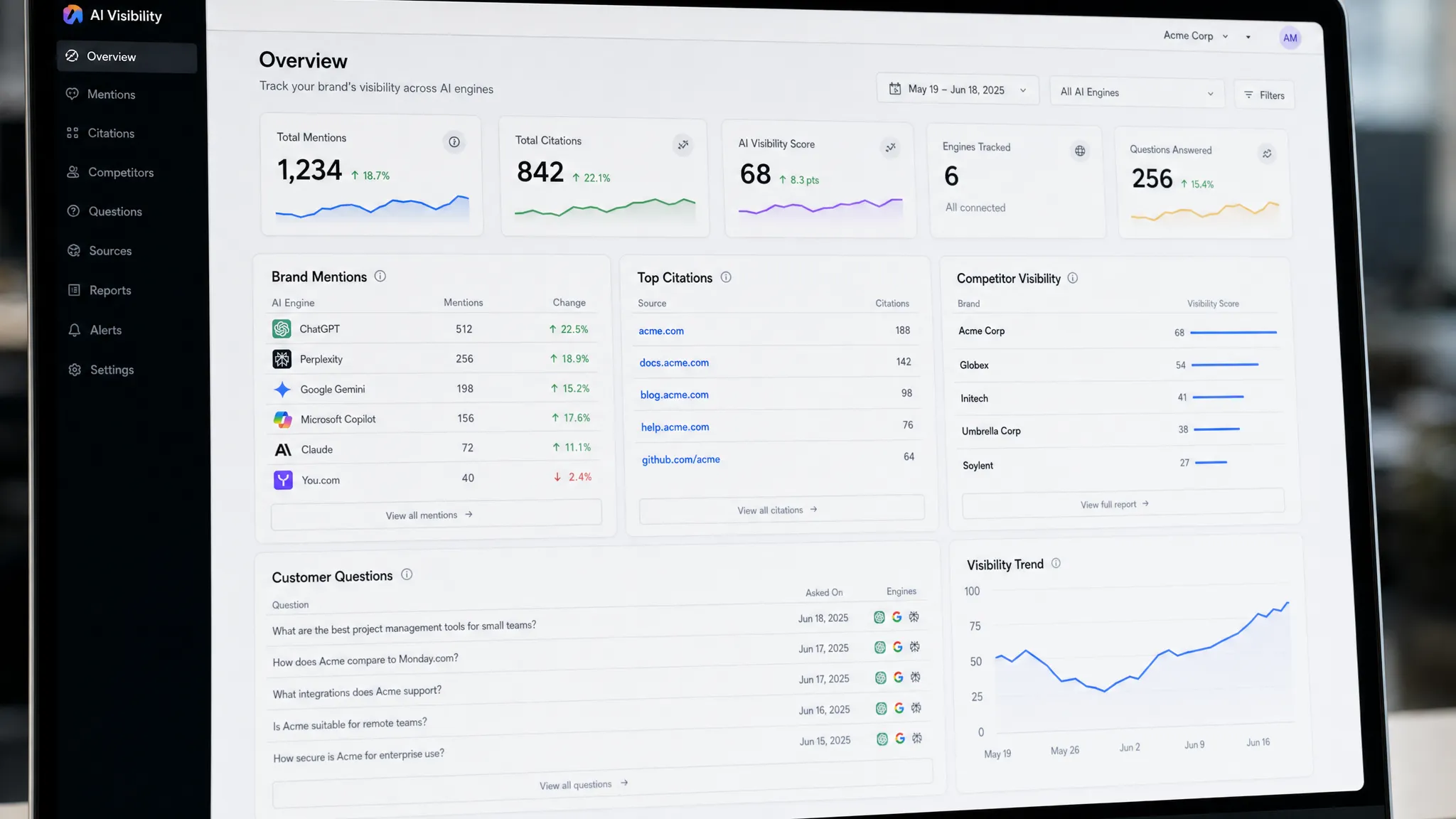
Brands should run regular AI visibility scans across key prompts. At minimum, track:
| Metric | What it tells you | Why it matters |
|---|---|---|
| Mention rate | How often your brand appears for target prompts | Shows whether you are in the AI consideration set |
| AI share of voice | Your visibility compared with competitors | Reveals category-level competitive strength |
| Citation frequency | How often sources linked to your brand are used | Shows whether AI engines can verify your claims |
| Sentiment and framing | How your brand is described | Identifies outdated, negative, or inaccurate positioning |
| Prompt coverage | Which buyer questions trigger your brand | Exposes missing use cases and content gaps |
| Source quality | Which pages influence AI answers | Helps prioritize content, PR, and technical fixes |
This is where AI search visibility becomes operational. It is not enough to test a few prompts once. Outputs change as models, indexes, competitors, and your own content change.
Common mistakes brands make with ChatGPT search
Many teams approach AI search with a traditional SEO mindset and miss the new risks. The most common mistakes are easy to understand, but costly if ignored.
Mistake 1: Treating AI visibility as a vanity metric
A mention is useful only if it appears for the right prompt, in the right context, with accurate positioning. Being named in a generic answer matters less than being recommended for a high-intent buyer question.
Mistake 2: Optimizing only for keywords
ChatGPT users do not always search in keywords. They ask full questions, explain constraints, and request recommendations. Your content strategy should reflect conversational intent, not just search volume.
Mistake 3: Ignoring competitors inside AI answers
Your competitor set in ChatGPT may differ from your Google ranking competitors. AI engines may surface brands with stronger third-party mentions, clearer comparison content, or more accessible product information.
Mistake 4: Publishing content that is too generic to cite
AI systems need extractable facts. If your content is full of vague claims, it is harder to use in a specific answer. Replace generic statements with concrete explanations, supported claims, and clear differentiators.
Mistake 5: Failing to connect AI visibility to revenue
AI search may influence buyers before they click. That makes attribution harder, but not impossible. Track branded search lift, direct traffic changes, demo quality, assisted conversions, sales-call mentions, and self-reported attribution alongside AI visibility metrics.
A 30-day action plan for brands
If you are starting from zero, do not try to optimize everything at once. Focus on the prompts and pages closest to revenue.
| Timeframe | Priority | Action |
|---|---|---|
| Week 1 | Baseline visibility | Test 25 to 50 high-intent prompts in ChatGPT and record mentions, competitors, citations, and inaccuracies |
| Week 2 | Entity clarity | Audit your homepage, about page, product pages, schema, business profiles, and third-party descriptions for consistency |
| Week 3 | Content fixes | Improve pages that answer category, comparison, use case, integration, and FAQ prompts |
| Week 4 | Monitoring workflow | Set up recurring scans, alert owners, and prioritize fixes based on business impact |
After 30 days, expand from core commercial prompts to broader educational and market prompts. This helps you build both bottom-funnel recommendation visibility and top-funnel category authority.
Where CapstonAI fits in
ChatGPT as a search engine creates a measurement problem for brands. Traditional analytics can show what happens after a user lands on your site, but they do not show whether AI engines mention you before the click.
CapstonAI helps brands, retailers, and agencies measure, improve, and defend AI search visibility across major AI engines including ChatGPT, Gemini, Claude, and Perplexity. Teams can use CapstonAI to run AI visibility scans, map prompts and mentions, track competitors, monitor share of voice, identify blind spots, and receive content recommendations.
For teams that need to act quickly, CapstonAI also supports AI-ready FAQ and metadata publishing, CMS integration for faster fixes, multi-location brand management, and critical alert dashboards. The result is a more measurable workflow for turning AI search into a growth channel instead of a black box.
Frequently Asked Questions
Can ChatGPT replace Google search for customers? For some research tasks, yes. Many users now ask ChatGPT for direct answers, recommendations, and comparisons instead of scanning traditional results. But Google, marketplaces, social platforms, and review sites still matter because they often influence the information AI engines use.
How do I know if ChatGPT recommends my brand? Test the prompts your buyers would actually ask, then track whether your brand appears, how it is described, which competitors are mentioned, and what sources are cited. For reliable monitoring, repeat this across prompt groups and AI engines over time.
Does traditional SEO still matter for ChatGPT visibility? Yes. Crawlable pages, clear metadata, structured data, authoritative content, and strong third-party signals all support AI visibility. The difference is that you must optimize for answer inclusion and recommendation quality, not only rankings and clicks.
What content works best for ChatGPT search? Clear, specific, answer-ready content performs best. Prioritize pages that explain your category, use cases, comparisons, integrations, pricing context, locations, FAQs, and proof points. Avoid vague claims that are difficult to verify or summarize.
Can I control what ChatGPT says about my brand? You cannot directly control AI-generated answers, but you can influence them by improving your owned content, strengthening credible third-party signals, fixing inconsistent information, and monitoring outputs for inaccuracies.
Turn ChatGPT visibility into a measurable growth channel
If customers are asking ChatGPT about your category, your brand is already being evaluated whether you are tracking it or not. The winners will be the brands that know where they appear, where they are missing, and what needs to be fixed.
CapstonAI helps you see how AI engines mention, cite, and recommend your business, then prioritize the updates that improve visibility. Start with a free AI visibility audit and find out how your brand shows up when buyers search with AI.