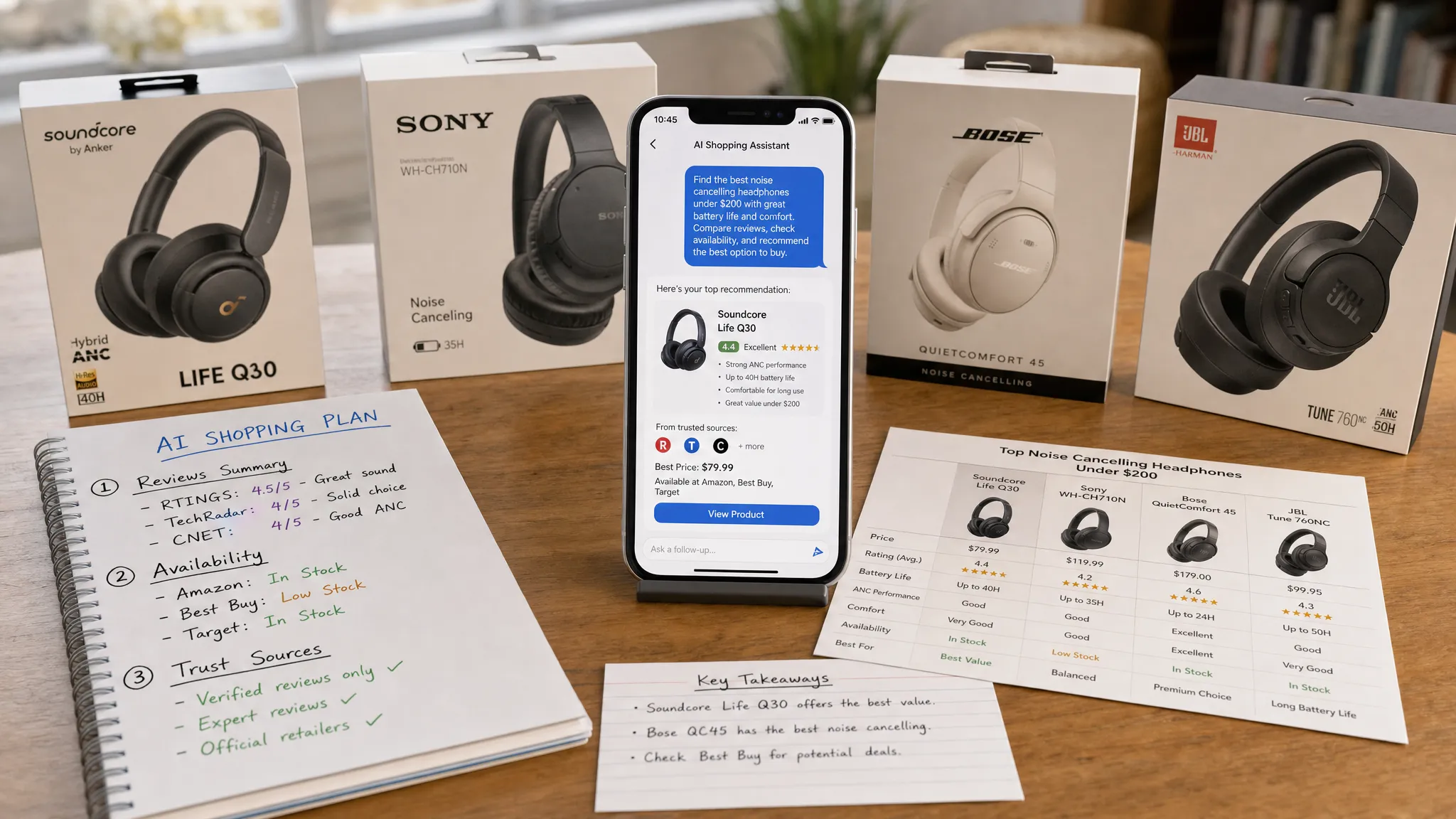
AI in shopping is changing how customers discover products. Instead of scrolling through ten blue links, marketplace filters, or category grids, shoppers can now ask an AI assistant for a shortlist: “What is the best carry-on for weekly business travel?”, “Which skincare brand is safest for sensitive skin?”, or “Where can I buy a reliable espresso machine near me?”
For brands, that shift is significant. The recommendation is no longer won only on a search results page. It is won inside an answer, a comparison, a summary, or a shopping conversation where the AI decides which products are relevant enough to mention.
The good news is that AI shopping recommendations are not magic. They are influenced by signals brands can improve: product data, structured content, reviews, third-party trust, availability, entity consistency, and ongoing visibility measurement. This is the new overlap between e-commerce SEO, Generative Engine Optimization, and brand reputation management.
What AI in shopping actually changes
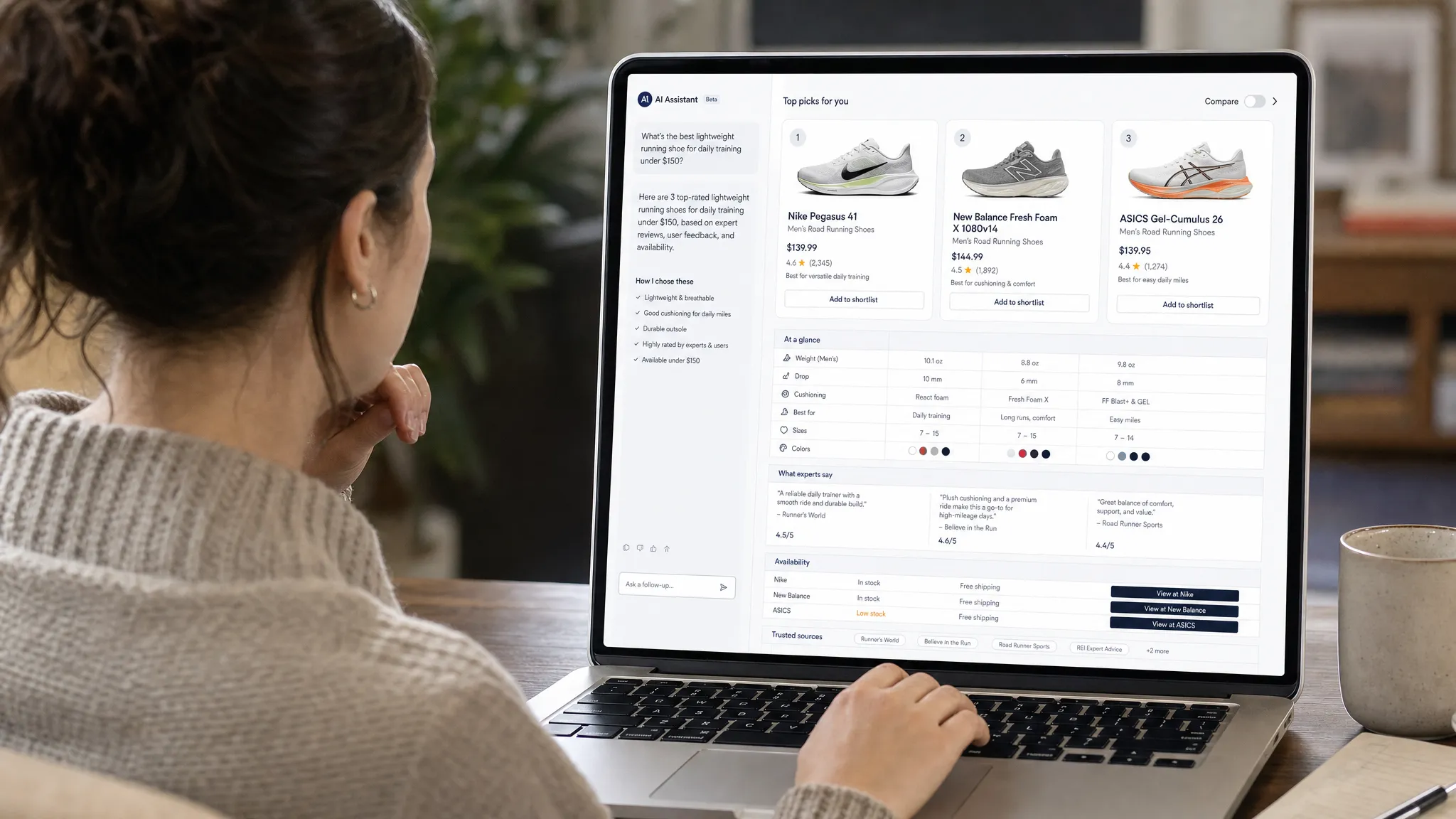
AI in shopping does not simply mean chatbots on retail websites. It includes every AI-powered experience that helps a customer evaluate, compare, and choose products. That can happen in ChatGPT, Gemini, Claude, Perplexity, Google AI features, marketplace assistants, retailer search bars, or brand-owned shopping tools.
The biggest change is how much of the customer journey happens before a click. A shopper may ask one broad question, receive a narrowed set of options, compare trade-offs, then click only when they are ready to buy. In that journey, being “findable” is not enough. Your brand has to be understandable, credible, and recommendable.
This aligns with a broader consumer expectation: people increasingly want personalized, context-aware buying help. McKinsey found that 71% of consumers expect companies to deliver personalized interactions, and 76% get frustrated when that does not happen. AI shopping raises that expectation because shoppers can now ask for recommendations based on their exact needs, constraints, and preferences.
How AI shopping recommendations are formed
No brand can know the exact ranking logic of every AI engine. Each platform uses different models, retrieval systems, partners, indexes, and personalization layers. But most AI shopping experiences rely on a familiar set of inputs.
They need to understand what your product is, who it is for, how it compares, whether it is trustworthy, and whether the shopper can buy it. If those signals are unclear, incomplete, or inconsistent, your brand becomes harder to recommend.
| Signal | What AI shopping systems need | What brands should improve |
|---|---|---|
| Product identity | Clear product names, categories, variants, identifiers, and descriptions | Align product pages, feeds, titles, schema, and marketplace listings |
| Use-case fit | Evidence that a product solves a specific problem for a specific shopper | Add buying guides, use-case sections, comparison content, and FAQs |
| Trust proof | Reviews, ratings, expert mentions, policies, and credible citations | Build authentic review programs, earn third-party coverage, and publish transparent proof |
| Availability | Current price, stock status, shipping options, and location data | Maintain accurate product feeds, store pages, and offer details |
| Entity consistency | A stable brand identity across the web | Standardize brand name, descriptions, categories, locations, and social profiles |
| Structured data | Machine-readable product and business information | Use valid Product, Offer, Organization, LocalBusiness, and FAQ markup where appropriate |
| Freshness | Up-to-date information about products, policies, and launches | Refresh pages, metadata, feeds, and FAQs on a regular cadence |
In other words, AI engines are not only looking for “keywords.” They are trying to build confidence. A brand with clean data, specific content, strong reviews, and consistent mentions gives the AI more reason to include it in a recommendation.
The five questions your brand must answer
To win more AI shopping recommendations, every important product, category, and location page should answer five practical questions.
1. What exactly do you sell?
This sounds basic, but many product pages are surprisingly vague. They use lifestyle copy, internal model names, or thin manufacturer descriptions without clearly explaining the product category, materials, specifications, compatibility, sizes, variants, and intended use.
AI systems need explicit information. If you sell a “Nova Pro,” the page should make clear whether it is a running shoe, coffee grinder, skincare serum, smart lock, or mattress. Product titles, headings, metadata, schema, and body copy should all reinforce the same identity.
2. Who is it best for?
AI shopping prompts are often use-case driven. Shoppers do not always ask for a brand. They ask for “best laptop for architecture students,” “non-irritating cleanser for dry skin,” or “budget stroller for city apartments.”
Brands win recommendations when their content connects products to real customer scenarios. That means adding sections such as “best for,” “not ideal for,” “compatible with,” “designed for,” and “common use cases.” These details help AI engines match your product to the shopper’s context.
3. Why should the shopper trust it?
AI recommendations depend heavily on confidence. Trust signals can include verified customer reviews, expert endorsements, warranties, return policies, safety certifications, media mentions, awards, independent testing, and transparent company information.
The key is authenticity. Regulators are paying attention to fake reviews and misleading endorsements. The U.S. Federal Trade Commission announced a final rule banning fake reviews and testimonials, making review integrity both a legal and visibility issue.
4. How does it compare to alternatives?
AI assistants are built for comparison. If your site avoids comparison language, the AI will gather that context elsewhere, often from competitors, marketplaces, affiliates, or review sites.
Helpful comparison content does not need to attack competitors. It should explain differences in price range, features, materials, target customer, warranty, performance, or suitability. A useful comparison page helps both humans and AI understand when your product is the right choice.
5. Can the customer buy it now?
Recommendations lose value when the AI cannot verify availability. Product feeds, stock status, shipping regions, store locations, and pricing should be accurate. If you sell through retailers, keep third-party listings consistent with your own site.
This matters especially for local and multi-location brands. A prompt like “best place to buy running shoes near me” requires location, inventory, hours, reviews, and category relevance. If that information is fragmented, another brand may be recommended instead.
Build product pages that AI can understand
AI-ready product pages are not just longer product pages. They are clearer, more structured, and easier to extract.
Start with the fundamentals. Use descriptive product titles, unique copy, visible specifications, strong internal links, and crawlable HTML. Avoid hiding key information entirely inside images, scripts, or tabs that are difficult for crawlers to parse. Make sure canonical tags, indexation rules, and redirects do not block important products or categories.
Structured data is also essential. Schema.org Product markup can help define product attributes, offers, ratings, and related information. Google’s product structured data documentation explains how price, availability, reviews, shipping, and return information can be marked up for search features. If you use product feeds, follow the Google Merchant Center product data specification to keep data clean and complete.
A strong AI-ready product page often includes:
- A clear product name, category, and variant structure.
- A concise summary explaining who the product is best for.
- A specifications table with dimensions, materials, compatibility, ingredients, or technical details.
- Use-case sections that map the product to real customer needs.
- Authentic reviews with visible review text, not only star ratings.
- Shipping, return, warranty, and availability information.
- FAQs that answer pre-purchase objections in plain language.
If your store runs on Shopify, WordPress, or another CMS, automation can help keep metadata, schema, and FAQs consistent at scale. The goal is not to mass-generate generic copy. The goal is to make accurate product information easier for both shoppers and AI systems to understand.
For a deeper foundation, see CapstonAI’s E-commerce SEO strategy guide, which covers product pages, category architecture, structured data, and AI-era discovery.
Create content for conversational shopping prompts
Traditional e-commerce SEO often begins with category keywords. AI in shopping begins with questions. Shoppers describe goals, constraints, anxieties, and comparisons in natural language.
That means your content strategy should include prompt coverage, not just keyword coverage. Map the questions that matter before, during, and after purchase. Then create pages that answer those questions with enough specificity to be useful.
| Prompt type | Example shopper question | Best content asset |
|---|---|---|
| Problem-led | “What is the best shampoo for oily roots and dry ends?” | Buying guide or use-case collection page |
| Comparison | “Brand A vs Brand B for long-distance hiking?” | Honest comparison page |
| Constraint-led | “Best noise-canceling headphones under $200?” | Curated category page with filters and rationale |
| Audience-led | “Best laptop for a freelance video editor?” | Persona-specific guide |
| Local intent | “Where can I buy a premium mattress near Austin?” | Local store page with products, reviews, and availability |
| Trust intent | “Is this supplement brand safe and reputable?” | Trust page, certifications page, expert FAQ, and review content |
| Post-purchase | “How do I clean this espresso machine?” | Support guide, care instructions, and video transcript page |
The best content does not simply repeat product claims. It helps the shopper make a decision. It explains trade-offs, gives context, defines terms, and acknowledges limitations.
For example, a skincare brand should not only publish “best moisturizer” content. It should create content around skin type, climate, ingredient sensitivity, fragrance preferences, budget range, and routine order. A home goods brand should address room size, installation, maintenance, energy use, and style compatibility.
This is where prompt and mention mapping becomes strategic. Instead of asking, “Do we rank for this keyword?”, ask, “When shoppers ask AI assistants these buying questions, are we mentioned, recommended, cited, or ignored?”
Strengthen trust signals beyond your own website
AI shopping recommendations are shaped by more than your site. Assistants often synthesize information from public web pages, reviews, marketplaces, news articles, social discussions, forums, knowledge bases, and third-party comparison content.
That means brand reputation and AI visibility are now connected. If your brand is described inconsistently across retailers, directories, review sites, and media coverage, AI systems may struggle to form a confident recommendation.
Start with the sources you can control: your website, product feeds, Google Business Profiles, retailer listings, marketplace pages, social bios, press pages, and customer support content. Make sure your brand description, product categories, addresses, policies, and claims are consistent.
Then improve the sources you influence. Encourage detailed customer reviews, respond to recurring objections, pitch credible publications, support expert testing, and build relationships with creators who disclose partnerships properly. The aim is not to manipulate AI outputs. It is to create a stronger evidence base around your brand.
CapstonAI’s guide to AI trust signals that make brands more citable explores this in more detail.
Measure AI recommendations like a growth channel
One of the biggest mistakes brands make is treating AI shopping as an unmeasurable trend. If shoppers are using AI engines to discover and compare products, you need a dashboard for that journey.
Traditional SEO tools show rankings, impressions, clicks, and CTR. Those metrics still matter, but they do not fully capture AI visibility. A brand can lose influence inside AI-generated recommendations before traffic declines show up in analytics.
AI shopping measurement should track how often your brand appears, where it appears, what attributes are mentioned, which competitors are recommended instead, and which sources the AI relies on.
| Metric | Why it matters | How to use it |
|---|---|---|
| AI mention rate | Shows whether your brand appears for relevant shopping prompts | Identify prompt groups where your brand is invisible |
| Recommendation share | Measures how often your products are included in shortlists | Compare visibility against competitors by category and use case |
| AI share of voice | Tracks brand presence across engines and markets | Prioritize categories where competitors are gaining influence |
| Citation coverage | Reveals which sources AI engines use when discussing your brand | Improve weak pages, missing schema, and third-party proof |
| Sentiment and attribute accuracy | Shows whether AI describes your products correctly | Fix outdated claims, unclear specs, or misleading summaries |
| Competitor substitution | Identifies when another brand is recommended for your ideal prompts | Build content and proof around the missing decision criteria |
| Fix velocity | Tracks how quickly visibility issues are diagnosed and corrected | Connect AI visibility work to team execution and CMS updates |
This is exactly where an AI visibility platform becomes useful. CapstonAI helps brands, retailers, and agencies scan how ChatGPT, Gemini, Claude, and Perplexity mention and recommend their business. Teams can map prompts, track competitors, analyze share of voice, receive content recommendations, publish AI-ready FAQs and metadata, and monitor critical visibility changes.
If you are building a measurement system, also read CapstonAI’s guide on how to measure AI performance across search engines.
A 90-day plan to win more AI shopping recommendations
Brands do not need to rebuild their entire digital presence at once. The fastest progress usually comes from prioritizing the product categories, prompts, and engines that matter most to revenue.
- Audit your current AI visibility: Run shopping prompts across major AI engines and document whether your brand is mentioned, recommended, cited, or absent.
- Map high-intent prompts: Group prompts by category, audience, problem, comparison, budget, local intent, and trust concern.
- Fix product data first: Clean product titles, descriptions, schema, feeds, availability, pricing, and variant information.
- Upgrade priority pages: Add use cases, comparison tables, FAQs, reviews, trust proof, and clear buying guidance to your most important product and category pages.
- Strengthen off-site trust: Improve retailer listings, review profiles, business listings, PR coverage, and expert validation.
- Track competitors weekly: Monitor which brands AI engines recommend instead of yours and why.
- Publish and iterate: Use visibility data to decide which pages, FAQs, metadata, and content updates to publish next.
The key is iteration. AI recommendations can shift as models update, sources change, competitors publish, and shoppers ask new questions. Brands that monitor and fix continuously will have an advantage over teams that only run occasional SEO audits.
Common mistakes that keep brands out of AI recommendations
Many brands already have enough raw material to perform better in AI shopping, but that information is scattered, unclear, or inaccessible.
One common mistake is relying on generic product descriptions copied from manufacturers. If ten retailers use the same copy, AI systems have little reason to treat your page as uniquely helpful. Another mistake is optimizing only for branded searches while ignoring problem-led prompts where new customers are discovering options.
Brands also underinvest in comparison content because they fear mentioning competitors. But if you do not explain where your product fits, AI engines may rely on someone else’s comparison. Similarly, brands often treat reviews as conversion assets only, when detailed reviews can also clarify use cases, objections, and real-world performance.
Finally, many teams measure only clicks. In AI shopping, a recommendation may influence demand before the click happens. If your brand disappears from AI shortlists, you may not see the full impact until competitors have already captured the consideration set.
Frequently Asked Questions
What does AI in shopping mean? AI in shopping refers to AI-powered experiences that help customers discover, compare, and choose products. This includes AI assistants, AI search engines, marketplace recommendation tools, retailer chatbots, and AI-generated buying guides.
How do brands get recommended by AI shopping assistants? Brands improve their chances by making product information clear, structured, trustworthy, and easy to verify. Strong product pages, accurate feeds, schema markup, authentic reviews, comparison content, third-party mentions, and consistent brand data all help.
Is AI shopping replacing SEO? No. AI shopping is expanding SEO. Traditional rankings and product pages still matter, but brands also need to optimize for AI-generated answers, recommendations, citations, and conversational prompts.
Do product schema and feeds matter for AI recommendations? Yes. Structured data and product feeds help machines understand product identity, price, availability, ratings, variants, and other attributes. They are not the only factor, but they reduce ambiguity and support better recommendation matching.
How often should brands monitor AI shopping visibility? High-priority brands and retailers should monitor AI visibility at least weekly, especially for competitive categories, seasonal products, launches, and multi-location availability. AI outputs can change as sources, prompts, and models evolve.
Can small brands win AI shopping recommendations? Yes. Small brands can compete when they have specific positioning, clear product data, strong niche content, authentic reviews, and credible third-party proof. AI shopping can reward relevance and specificity, not only brand size.
See how AI shopping engines see your brand
If shoppers are asking AI assistants what to buy, your brand needs to know whether it appears in the answer.
CapstonAI helps brands, retailers, and agencies measure, improve, and defend AI search visibility across major AI engines. Run AI visibility scans, map shopping prompts, track competitors, publish AI-ready metadata and FAQs, and turn AI recommendations into a measurable growth channel.
Start with a free AI visibility audit and see where your brand is being recommended, where competitors are winning, and what to fix next.