AI answering is the shift from search engines returning a list of links to AI systems returning a synthesized answer. For marketing teams, that changes the job from “rank the page” to “make the brand, page, and proof easy for answer engines to understand, trust, and cite.”
This matters because prospects are already asking ChatGPT, Google AI Overviews, Gemini, Perplexity, Claude, and Copilot questions that used to happen on search result pages. They ask which hotel is best for a family trip, which MSP supports a specific industry, which WooCommerce store has the right product, or which clinic location is closest and credible.
The business effect is simple: if AI systems cannot identify your brand, connect it to the right entities, or find reliable supporting evidence, they may answer with a competitor instead. Gartner predicted that traditional search engine volume would drop 25% by 2026 as users shift to AI chatbots and virtual agents. The exact impact will vary by category, but the direction is clear: AI answers are becoming a measurable discovery channel.
What “AI answering” means
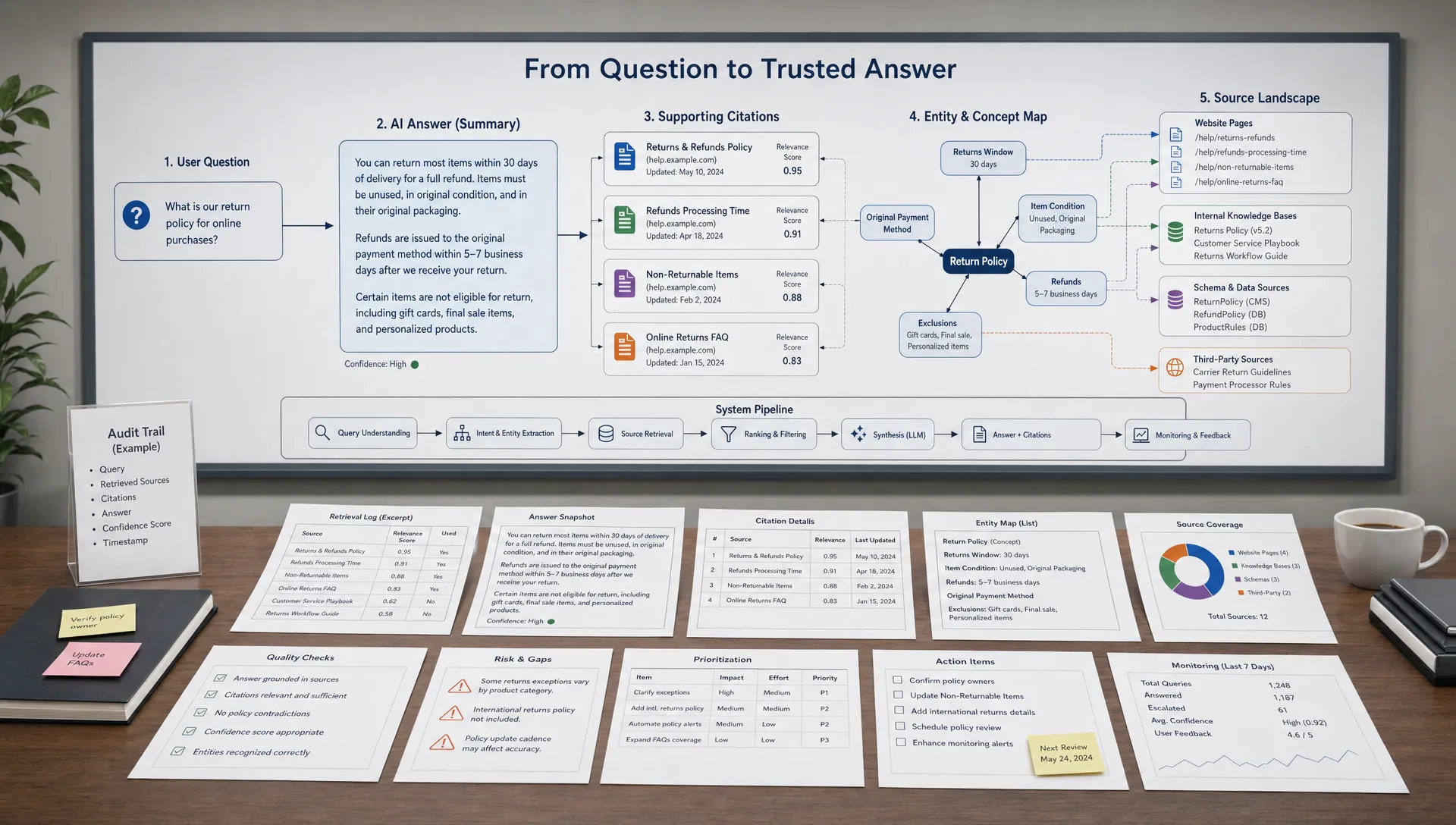
AI answering is the process where a generative system interprets a user’s question, retrieves or relies on relevant information, and produces a direct response. Some systems use live web retrieval. Some rely more heavily on trained model knowledge. Many blend both.
For marketers, the important point is not the model architecture. It is whether your brand is visible in the sources, entities, and signals the system uses to construct the answer.
A simple example:
A traveler asks, “What are the best boutique hotels near downtown Austin for a weekend with parking and breakfast?”
A traditional search engine might show ten blue links, map results, ads, review snippets, and hotel pages. An AI answer engine may summarize three options, mention why each fits, and include citations if the product supports source links. If your hotel’s parking details are buried in an image, breakfast details are inconsistent across pages, and your location page has weak schema, the AI may miss you even if your website looks good to a human.
That is the core marketing problem. AI answering rewards clarity, consistency, and machine-readable evidence.
How AI answers are different from search results
Classic SEO still matters, but it is no longer the whole system. Search rankings, crawlability, internal links, schema, and page performance remain foundational. The difference is that generative engines turn those inputs into a narrative answer.
| Area | Traditional search result | AI answering experience | Marketing implication |
|---|---|---|---|
| User output | Ranked links and snippets | Synthesized answer, often with recommendations | Your brand must be understandable without relying on a click |
| Visibility unit | URL ranking | Brand mention, citation, inclusion in answer | Track mentions and share of voice, not only rankings |
| Content need | Keyword relevance and authority | Direct answer, entity clarity, proof, and source quality | Build pages that answer specific decision questions |
| Technical dependency | Crawl, index, render, rank | Crawl, parse, retrieve, summarize, cite | Technical SEO and AI-readable metadata both matter |
| Measurement | Impressions, clicks, rank | Mentions, citations, prompt coverage, accuracy | Reporting must include AI visibility metrics |
This is where GEO and AEO fit.
Generative Engine Optimization (GEO) is the practice of improving how your brand and content appear inside generated responses. Answer Engine Optimization (AEO) focuses on making content structured enough to answer specific questions clearly. Both depend on traditional SEO foundations such as crawlability, internal linking, structured data, and fast page performance.
What answer engines look for before mentioning a brand
No outside team can know every private ranking or retrieval signal inside each AI platform. What we can observe is how brands tend to appear when their information is consistent, well structured, and supported by trustworthy sources.
Entity clarity
An entity is a distinct thing the AI can recognize: a brand, location, product, service, person, category, or organization. If your business name, address, product names, categories, and ownership details vary across your website, Google Business Profile, directories, review sites, marketplaces, and third-party articles, AI systems have more ambiguity to resolve.
For a multi-location healthcare group, “North Valley Physical Therapy,” “NVPT,” and “North Valley PT Clinic” may all refer to the same organization. Humans can infer that. AI systems may not always connect them reliably unless your pages, schema, and citations reinforce the relationship.
Citable proof
AI answers often prefer claims that can be supported. “Best customer service” is vague. “24/7 emergency support for managed IT clients, with offices in Denver and Boulder” is clearer. A product page with specifications, return policy, reviews, FAQs, and organization schema gives an answer engine more usable evidence than a thin page with promotional copy.
This is why brand mentions and citations matter. A mention is when your brand appears in the answer. A citation is when the AI system uses or links to a source that supports the answer. You want both, but citations are especially useful because they show which pages and sources the system trusts.
For a deeper look at credibility signals, CapstonAI has a useful guide to AI trust signals that make brands more citable.
Structured data and schema
Structured data helps search systems understand page content in a standardized format. Google’s own documentation explains that structured data can make a page eligible for richer search features and help systems understand the meaning of content.
For AI answering, schema is not magic, but it reduces ambiguity. Commonly useful schema types include Organization, LocalBusiness, Product, FAQPage, Review, BreadcrumbList, Article, and Service. The right schema depends on the page type.
A hotel location page, for example, should make the property name, address, amenities, phone number, check-in information, reviews, and surrounding area clear. An e-commerce product page should make price, availability, product identifiers, variants, ratings, and shipping context clear where applicable.
Crawlability and internal linking
If AI systems or search engines cannot crawl and interpret your pages, the quality of the writing will not matter. Crawlability means that important pages are accessible to bots, not blocked by robots.txt, not hidden behind broken JavaScript rendering, and not orphaned from your internal linking structure.
Internal links also explain priority and relationships. A franchise brand with 200 locations should not treat every location page as an isolated island. The site architecture should connect brand, service, category, city, and location pages in a way that helps both users and machines understand the network.
Page performance and usability
Fast, stable pages improve user experience and support search performance. Google’s Core Web Vitals focus on loading performance, interactivity, and visual stability. In an AI answering context, performance is part of the technical foundation: slow, unstable, or hard-to-render pages can make discovery and interpretation harder.
For marketing teams, the business effect is practical. A page that loads quickly, answers the question directly, and presents structured evidence has a better chance of being used, whether the visitor comes from search, an AI citation, an ad, or a referral.
The prompts marketing teams should track
AI visibility is prompt-specific. You may appear for branded prompts but disappear for category prompts. You may be mentioned in “best” comparisons but not cited in “near me” queries. A useful tracking system groups prompts by business intent, not by vanity keywords.
| Prompt category | Example prompt | What to measure |
|---|---|---|
| Branded | “Is [Brand] a good option for managed WordPress hosting?” | Accuracy, sentiment, citations, outdated claims |
| Category | “Best boutique hotels in Savannah for couples” | Brand inclusion, competitor inclusion, citation sources |
| Comparison | “[Brand] vs [Competitor] for multi-location retail SEO” | Feature accuracy, positioning, missing proof |
| Local | “Urgent care clinics near Plano that accept walk-ins” | Location coverage, NAP accuracy, local citations |
| Transactional | “Where can I buy a waterproof hiking jacket under $150?” | Product recommendation share, availability, retailer citations |
| Support | “How do I return an item from [Brand]?” | Policy accuracy, support page citation |
This is also where share of voice becomes useful. In AI search, share of voice is the percentage of relevant answer opportunities where your brand appears compared with competitors.
For example, if you track 200 category and comparison prompts and your brand appears in 34 answers, your observed AI share of voice is 17% for that prompt set. If your closest competitor appears in 71 answers, the gap is not just content volume. It may reflect stronger citations, clearer entities, better third-party mentions, or more complete answer-ready pages.
How to optimize for AI answering without abandoning SEO
The strongest approach is not “AI SEO” in isolation. It is classic technical SEO plus GEO and AEO. Marketing teams should build a repeatable workflow that starts with measurement, then fixes the pages and signals most likely to affect revenue.
Start with an AI visibility baseline
Before rewriting content, measure how answer engines currently represent your brand. Test prompts across ChatGPT, Google AI Overviews, Gemini, Perplexity, Claude, and Copilot. Capture whether the brand is mentioned, whether it is cited, which competitors appear, and whether the answer is accurate.
A baseline prevents guesswork. It also gives leadership a before-and-after view of progress.
CapstonAI’s AI Search Readiness Checklist for Brand Teams is a practical companion for this step because it connects visibility measurement with entity cleanup, technical blockers, and content structure.
Fix entity consistency first
If the AI cannot confidently understand who you are, optimization becomes inefficient. Start with the basics: organization name, locations, service areas, product categories, executive or author profiles where relevant, contact details, and social or directory profiles.
For multi-site brands, this also means aligning location pages, Google Business Profiles, local landing pages, review profiles, and third-party directories. For agencies and MSPs managing site fleets, entity consistency should become a standard QA item before content expansion.
Turn important pages into answer assets
An answer asset is a page that a human can use to make a decision and an AI system can parse for a reliable answer. It usually includes a clear topic, concise answers, supporting details, schema, internal links, and credible proof.
A hotel amenities page should not only say “thoughtful amenities.” It should list parking, breakfast, pet policy, accessibility, check-in times, meeting rooms, and nearby landmarks. A service page for an MSP should specify supported industries, response model, certifications if applicable, service regions, and common use cases.
For e-commerce teams, this matters because AI shopping journeys often compare products before users reach a retailer. CapstonAI’s article on how brands win more recommendations in AI shopping explains why product data, reviews, availability, and clear category context can influence recommendation visibility.

Add schema where it clarifies meaning
Schema should reflect what is actually on the page. Do not add FAQ schema for questions that are not visible to users. Do not mark up reviews that are not valid for the page. The goal is not to decorate the code. The goal is to make the page easier to interpret.
For many marketing teams, the highest-impact schema review starts with these page types: homepage and about page, location pages, service pages, product pages, article pages, FAQ sections, breadcrumb navigation, and review or rating content where appropriate.
Use llms.txt carefully
llms.txt is an emerging convention for helping AI systems find important site information. Think of it as a potential navigation aid for language models, not a replacement for XML sitemaps, robots.txt, schema, internal links, or strong content.
Because adoption varies, marketing teams should treat llms.txt as a supporting layer. It can point to key pages, documentation, policies, product collections, or brand facts, but it should not become the only place where that information exists.
Improve source quality beyond your website
Answer engines do not only look at your owned pages. They may reference review platforms, business listings, publisher articles, marketplace data, social profiles, partner pages, and local directories. That means off-site accuracy is part of AI answering.
For a hotel group, review sites and travel listings can reinforce amenities and location facts. For a healthcare franchise, directories and insurance-related pages can influence local confidence. For an MSP, partner listings, certifications, and case studies can strengthen credibility.
Metrics that belong in an AI visibility report
Rank tracking alone is not enough. A useful AI visibility report should show whether your brand is present, whether it is cited, and whether the answer is correct.
| Metric | What it tells you | Why it matters |
|---|---|---|
| Brand mention rate | How often your brand appears for tracked prompts | Indicates top-level AI visibility |
| Citation rate | How often your pages or trusted sources are cited | Shows which sources answer engines rely on |
| Prompt coverage | Which journey questions surface your brand | Reveals gaps by funnel stage, product, or location |
| Competitor share of voice | How often rivals appear in the same prompt set | Quantifies market visibility gaps |
| Answer accuracy | Whether facts about your brand are correct | Protects credibility and reduces misinformation |
| Source diversity | Which owned and third-party sources are used | Helps prioritize content, PR, listings, and schema fixes |
| Change over time | Before-and-after movement after updates | Connects optimization work to measurable outcomes |
A concrete report might show that your brand is strong for branded prompts, weak for comparison prompts, and absent for local service prompts in three priority cities. That is a better action plan than “write more blog posts.” It tells the team where to improve entity data, location pages, category pages, and third-party citations.
Common mistakes marketing teams make
The first mistake is treating AI answering as a copywriting project only. Better copy helps, but answer engines also need technical access, structured data, consistent entities, and credible sources.
The second mistake is optimizing only the homepage. AI systems often need specific pages: product detail pages, location pages, FAQs, comparison pages, documentation, policies, and category hubs. The homepage rarely carries enough detail to answer high-intent questions by itself.
The third mistake is measuring only branded prompts. Branded answers are important because they affect reputation, but most growth opportunities sit in non-branded prompts. A buyer asking “best IT support company for dental practices in Phoenix” may be closer to a lead than someone asking your exact brand name.
The fourth mistake is ignoring negative or incomplete answers. If an AI system gives outdated pricing, wrong locations, missing amenities, or an inaccurate service description, that is not just a visibility issue. It is a credibility issue.
A practical 30-day plan for marketing teams
In the first week, build a prompt set around your real customer journeys. Include branded, category, comparison, local, transactional, and support questions. Run the prompts across multiple generative engines and capture mentions, citations, competitors, and accuracy.
In the second week, audit the pages that should answer those prompts. Check whether they are crawlable, internally linked, fast enough, structured with proper headings, supported by schema, and clear about the entity they represent.
In the third week, update the highest-value pages. Add direct answers, improve metadata, clarify entity relationships, publish useful FAQs, strengthen internal links, and clean up inconsistent facts. For multi-location brands, prioritize the locations or categories with the largest visibility gap.
In the fourth week, re-run the prompt set and compare changes. Do not expect every engine to update at the same speed. The goal is to establish a repeatable system: measure, fix, publish, monitor, and repeat.
That loop is how marketing teams turn AI answering from an unknown risk into an operating channel.
Frequently Asked Questions
Is AI answering the same as SEO? No. AI answering builds on SEO, but the output is different. SEO often focuses on rankings and clicks, while AI answering focuses on whether your brand is mentioned, cited, and described accurately inside generated responses.
Do marketing teams still need technical SEO? Yes. Crawlability, internal linking, schema, page performance, canonicalization, and clean site architecture remain essential. If important pages are hard to access or interpret, AI visibility work becomes much less effective.
Which AI answer engines should we monitor? Most teams should start with ChatGPT, Google AI Overviews, Gemini, Perplexity, Claude, and Copilot. The right mix depends on your audience, but tracking several engines helps reveal where your brand is visible and where it is missing.
What is the difference between a brand mention and a citation? A brand mention means the AI includes your brand in the answer. A citation means the AI points to a source that supports the answer. Citations are especially useful because they show which pages and sources the system trusts.
Can schema guarantee that AI systems will cite us? No. Schema helps clarify meaning, but it does not guarantee inclusion. It works best alongside strong content, consistent entity data, crawlable pages, internal links, credible third-party references, and ongoing monitoring.
How often should we measure AI visibility? For active brands, monthly measurement is a practical starting point. Fast-moving categories, multi-location businesses, agencies, and e-commerce teams may need more frequent monitoring around launches, seasonal campaigns, and competitor changes.
Start with a free AI visibility audit
AI answering is now part of how prospects evaluate brands. The right response is not panic, and it is not guesswork. It is measurement first, then targeted fixes to the pages, metadata, schema, citations, and internal links that influence how AI systems understand your business.
CapstonAI helps brands, retailers, agencies, and multi-site teams track how ChatGPT, Gemini, Claude, Perplexity, Google AI Overviews, and Copilot mention and cite their business. It also helps diagnose blind spots, monitor competitors, prioritize content recommendations, and publish AI-ready metadata, FAQ, schema, and llms.txt improvements.
If AI cannot see your business, CapstonAI makes it visible. Start with a free AI visibility audit and find out where your brand appears, where competitors are winning, and which fixes should come first.