AI search is no longer a side experiment for curious users. Buyers now ask ChatGPT, Gemini, Claude, Perplexity, Google AI features, and other assistants to shortlist vendors, compare products, explain categories, and summarize brand reputations before they ever click through to a website.
That makes AI search readiness a brand team responsibility, not only an SEO task. Your brand must be easy for AI systems to identify, understand, trust, cite, and recommend. If the web contains inconsistent facts, thin product pages, blocked content, weak third-party proof, or unclear positioning, AI answers may skip you, misdescribe you, or recommend a competitor instead.
Use this checklist to audit your current state, prioritize the most important fixes, and turn AI visibility into a repeatable workflow.
What AI search readiness means
AI search readiness is the state of having your brand, products, locations, and expertise represented clearly across the open web in a way that AI systems can retrieve and summarize accurately.
Traditional SEO still matters. Fast pages, crawlable content, structured data, authority, and useful information are all part of the foundation. The difference is that AI search often produces a synthesized answer rather than a ranked list of links. Your goal is not only to rank, but to become the brand an AI answer can confidently mention, compare, cite, and recommend.
| Area | Traditional SEO focus | AI search readiness focus |
|---|---|---|
| Discovery | Ranking pages for queries | Being mentioned in AI-generated answers |
| Content | Keywords, intent, and clicks | Clear, extractable answers and facts |
| Authority | Backlinks and domain signals | Corroborated brand proof across sources |
| Technical setup | Crawlability and indexation | Machine-readable pages, metadata, and schema |
| Measurement | Rankings, traffic, CTR, conversions | Mention rate, citation rate, recommendation rate, share of voice, accuracy |
| Risk | Ranking drops | Wrong answers, outdated claims, competitor substitution |
The AI Search Readiness Checklist
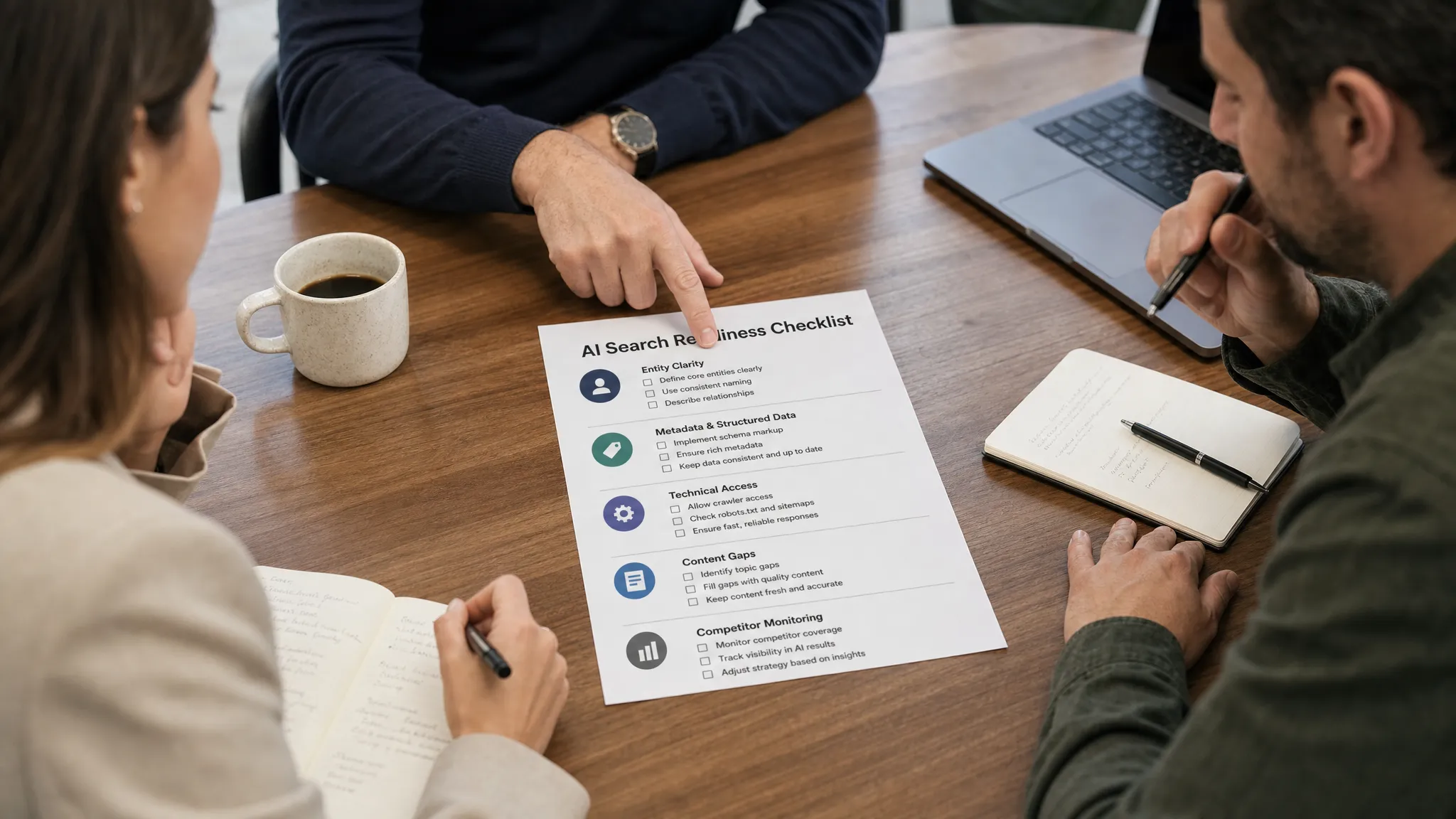
Start with the full checklist below, then work through each section in detail. For most brand teams, the fastest wins come from fixing entity clarity, answer-ready content, and metadata before moving into deeper authority and monitoring work.
| Readiness area | Primary owner | Pass condition |
|---|---|---|
| AI visibility baseline | SEO, analytics, growth | You know where your brand appears, where it is absent, and how competitors are described across major AI engines. |
| Brand entity clarity | Brand, communications | Your name, category, positioning, products, locations, and official facts are consistent across key pages and public profiles. |
| Technical accessibility | SEO, web, engineering | Important pages are crawlable, indexable, fast, internally linked, and not hidden behind scripts or blocked paths. |
| Structured data and metadata | SEO, content, web | Core pages use accurate titles, descriptions, schema, FAQs, and entity markup where relevant. |
| Answer-ready content | Content, product marketing | Key pages answer real buyer questions directly, with clear comparisons, use cases, and proof points. |
| Third-party proof | PR, partnerships, customer marketing | Reviews, listings, press, partner pages, and authoritative mentions support your claims. |
| Product and location accuracy | E-commerce, operations, local marketing | Product, service, availability, pricing, policy, and location details are current and consistent. |
| Governance and alerts | Marketing operations, analytics | Owners, review cadence, dashboards, and alert thresholds are defined. |
1. Establish your current AI visibility baseline
You cannot improve AI search visibility from anecdotes. A brand team needs a baseline that shows how AI engines currently respond to the prompts your buyers are likely to ask.
A useful baseline includes three things: the AI engines you want to monitor, the prompts that reflect real buying behavior, and the competitors or alternatives that should appear in the same answer set. Do not limit your audit to branded prompts. If you only ask AI systems about your company by name, you will miss the category searches where buyers are discovering vendors for the first time.
Include prompts such as:
- Brand prompts, such as what does your brand do or is your brand reputable.
- Category prompts, such as best platforms for your category or top brands for a use case.
- Comparison prompts, such as your brand versus a competitor.
- Problem prompts, such as how to solve a pain point your product addresses.
- Local, retail, or availability prompts, such as best store near me for a product type or where to buy a category in a specific market.
Track outcomes in plain language before you turn them into charts. Did the AI answer mention your brand? Did it cite your website or a third-party source? Did it recommend you, list you neutrally, or omit you? Did it get facts wrong? Did it mention outdated products, old locations, or competitors as better options?
For executive reporting, translate these observations into metrics such as mention rate, citation rate, recommendation rate, accuracy rate, AI share of voice, and volatility. If you need a deeper measurement framework, see CapstonAI’s guide on how to measure AI performance across search engines.
CapstonAI supports this step through AI visibility scans, prompt and mention mapping, competitor tracking, and share of voice analytics across major AI engines.
2. Clean up your brand entity before rewriting content
AI systems need to understand what your brand is. If your website says one thing, your marketplace listings say another, and third-party profiles use outdated positioning, AI answers may blend those signals into a confusing or inaccurate summary.
A brand entity audit should confirm that your official facts are consistent across your website, social profiles, knowledge panels, review platforms, partner pages, press releases, and major directories.
| Brand fact | Why it matters | Where to verify |
|---|---|---|
| Official brand name | Prevents confusion with similarly named companies | Homepage, About page, footer, profiles, listings |
| One-sentence description | Helps AI summarize what you do | Homepage hero, About page, boilerplate, profiles |
| Category and use cases | Connects your brand to buyer prompts | Product pages, category pages, case studies |
| Product or service names | Reduces outdated or incorrect recommendations | Product pages, docs, pricing pages, marketplaces |
| Locations served | Supports local and multi-location discovery | Location pages, Google Business Profiles, directories |
| Trust and compliance claims | Prevents unsupported or risky AI summaries | Legal pages, certifications, third-party validation |
This step is especially important after a rebrand, acquisition, product launch, pricing model change, or geographic expansion. AI answers can lag behind your current messaging if older sources remain stronger or more consistent than your updated content.
3. Remove technical blockers that keep AI systems from reading you
If important information is hard for search crawlers to access, it is also less likely to be available for AI retrieval and summarization. Technical SEO is not the whole AI readiness story, but it is the foundation.
Start with indexable, text-based access to your most important brand information. Your homepage, About page, product pages, location pages, FAQs, comparison pages, support content, and policy pages should be discoverable through internal links and sitemaps.
Google’s documentation on robots.txt and crawler access is a useful reference for understanding how crawl controls work. For structured data, Google’s guide to structured data markup explains how machine-readable context can help search systems understand page content.
| Technical risk | What brand teams should ask |
|---|---|
| Important pages blocked by robots.txt | Are we unintentionally blocking pages that explain products, services, locations, or support policies? |
| Content hidden behind heavy JavaScript | Can key facts be read in the rendered page and page source, or are they only visible after complex interactions? |
| Orphaned pages | Can crawlers find our best FAQs, case studies, comparison pages, and location pages through internal links? |
| Duplicate or conflicting pages | Are outdated pages competing with current positioning or product information? |
| Broken pages and redirect chains | Are AI systems and search crawlers hitting dead ends before reaching authoritative content? |
Brand teams do not need to debug every server log themselves, but they should know which pages are considered source-of-truth pages and make sure SEO and web teams protect their accessibility.
4. Convert key pages into answer-ready assets
Many brand pages are persuasive for humans but vague for AI systems. They use broad claims, design-heavy sections, and abstract taglines without enough direct answers. AI search favors content that can be extracted into a useful response.
Answer-ready content does not mean robotic content. It means every important page should clearly state who the page is for, what problem it solves, what makes the offer different, what evidence supports the claim, and what the reader should do next.
| Page type | Buyer question it should answer | Readiness upgrade |
|---|---|---|
| Homepage | What does this brand do and who is it for? | Add a clear category statement, primary use cases, and proof points. |
| Product or service page | Is this the right solution for my need? | Include use cases, features, limitations, integrations, and outcomes. |
| Comparison page | How does this brand compare with alternatives? | Present factual differences, best-fit scenarios, and transparent criteria. |
| FAQ or support page | Can I trust the brand to answer practical questions? | Answer real customer questions in concise, specific language. |
| Case study | Has this worked for someone like me? | Include customer context, challenge, solution, and measurable results when available. |
| Location page | Does this brand serve my area? | Include local details, services, hours, contact information, and nearby relevance. |
Do not create thin pages just to target AI prompts. The strongest AI-ready content is genuinely useful to buyers, easy for humans to skim, and structured enough for machines to parse.
5. Publish AI-ready metadata, schema, and FAQs
Metadata and structured data are not magic switches, and they do not guarantee that ChatGPT, Gemini, Claude, Perplexity, or Google AI features will mention your brand. They do, however, reduce ambiguity and help search systems understand your pages.
At minimum, core pages should have unique title tags and meta descriptions that accurately describe the page. Avoid generic metadata like Home, Solutions, or Product. Use language that matches how buyers describe the category, but keep it natural and specific.
Schema should reflect what is actually on the page. Depending on your business, relevant types may include Organization, Product, LocalBusiness, FAQPage, Article, Review, BreadcrumbList, or SoftwareApplication. For FAQ markup, refer to the FAQPage schema definition and use it only when the questions and answers are visible to users on the page.
A practical metadata workflow for brand teams should include content review, SEO review, legal or compliance review when needed, CMS publishing, and post-publish validation. CapstonAI can help teams move faster here with automated content recommendations, CMS integration for instant fixes, and AI-ready FAQ and metadata publishing.
6. Strengthen third-party proof and citation paths
AI systems are more likely to trust claims that are supported beyond your own website. A brand that describes itself clearly on its website and is also corroborated by reputable external sources has a stronger chance of being cited accurately.
Third-party proof can include customer reviews, industry directories, partner pages, marketplace profiles, reputable media mentions, independent comparisons, analyst coverage, association memberships, podcast interviews, and public case studies. The goal is not to manufacture mentions. The goal is to make legitimate proof easier to find and easier to connect back to your brand entity.
Quality matters more than volume. A handful of accurate, authoritative, current mentions can be more useful than dozens of thin directory listings with inconsistent descriptions. Review your most visible external profiles quarterly and correct outdated descriptions, old logos, retired products, broken links, and inaccurate categories.
For a deeper look at authority and credibility signals, read CapstonAI’s guide to AI trust signals that make brands more citable.
7. Make product, pricing, and location information impossible to misread
AI answers often go wrong when operational information is fragmented. This is common for retailers, multi-location businesses, marketplaces, franchises, healthcare groups, hospitality brands, and B2B companies with multiple product lines.
Your goal is to make important facts current, consistent, and easy to verify. If you do not publish pricing, say how buyers can get a quote. If availability changes often, make inventory or service-area information as clear as your systems allow. If policies vary by location, avoid using one generic policy page that leaves local questions unanswered.
| Business type | Information to keep especially current |
|---|---|
| Retail and e-commerce | Product names, descriptions, categories, availability, shipping, returns, reviews, and marketplace data. |
| Multi-location brands | Addresses, hours, service areas, phone numbers, appointment links, local services, and location-specific FAQs. |
| B2B SaaS or platforms | Product positioning, integrations, security information, pricing model, implementation details, and comparison content. |
| Service businesses | Service areas, qualifications, guarantees, booking process, response times, and customer proof. |
CapstonAI’s multi-location brand management, competitor and market tracking, and critical alert dashboards are designed for teams that need to manage AI visibility across many markets, locations, or product categories.
8. Define ownership, workflow, and alerts
AI search readiness fails when everyone agrees it matters but no one owns it. Brand teams should define a simple operating model that connects brand, SEO, content, PR, web, legal, customer support, and analytics.
| Owner | Responsibility |
|---|---|
| Brand and communications | Maintain positioning, approved descriptions, messaging pillars, and tone. |
| SEO and growth | Manage prompt sets, technical audits, structured data, and content optimization. |
| Product marketing | Keep product facts, comparison narratives, use cases, and launch updates current. |
| Web or CMS team | Publish metadata, schema, FAQs, redirects, and page updates efficiently. |
| PR and partnerships | Build external proof through credible mentions, partnerships, and customer stories. |
| Legal, compliance, and support | Review sensitive claims, regulated content, policy changes, and recurring customer questions. |
| Analytics and marketing operations | Maintain dashboards, alert thresholds, reporting cadence, and executive summaries. |
For most teams, a monthly AI visibility review is enough to start. Fast-moving categories, seasonal retailers, multi-location brands, and companies in regulated markets may need weekly monitoring or real-time alerts for inaccurate or negative AI mentions.
9. Score your readiness and prioritize fixes
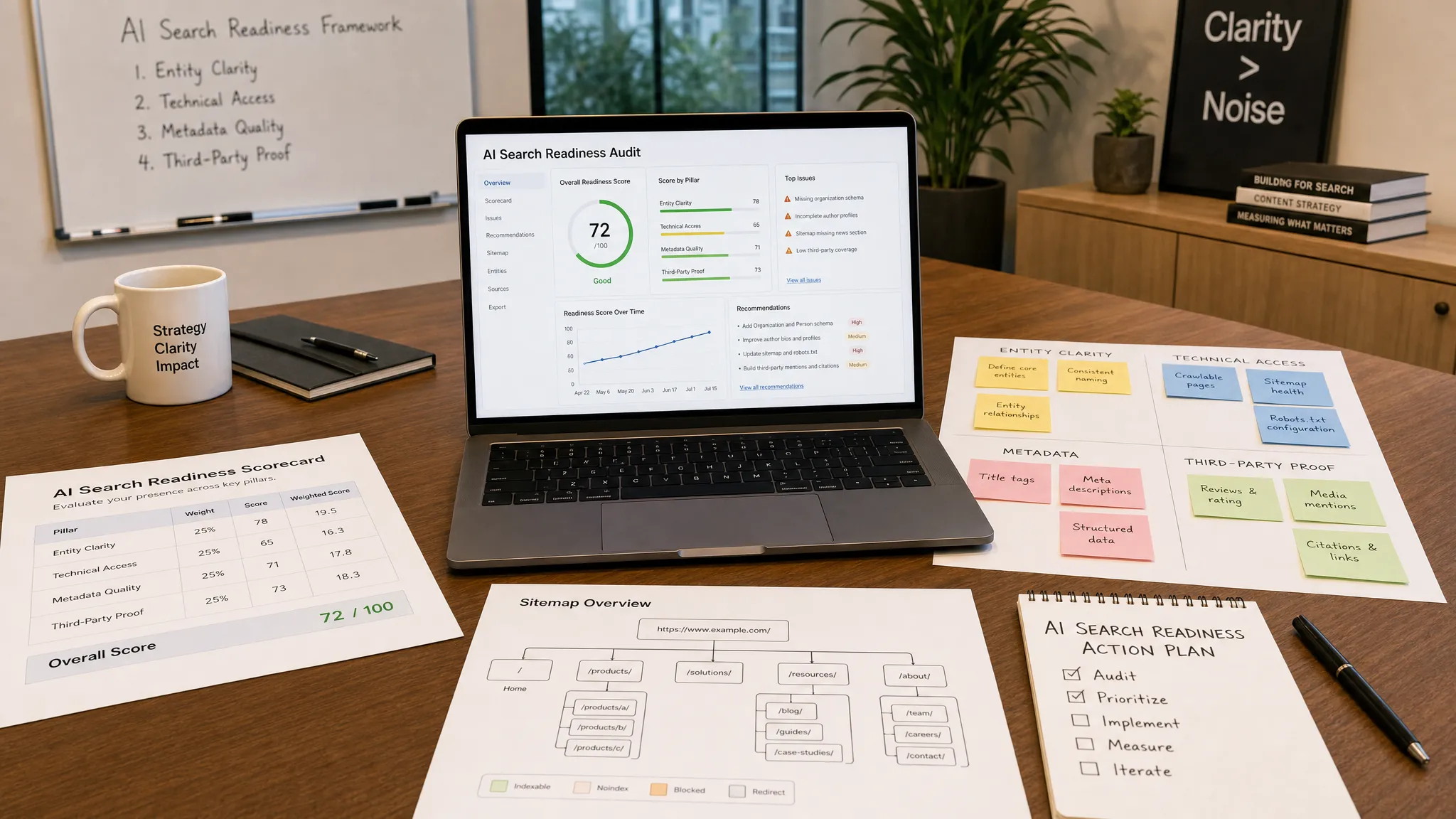
Use a simple 0 to 2 score for each readiness area. Score 0 if the area is missing or unknown, 1 if it exists but is inconsistent, and 2 if it is documented, current, and actively monitored. This is not an official AI engine standard. It is a practical internal prioritization tool.
| Total score | Readiness level | Next priority |
|---|---|---|
| 0 to 5 | High risk | Build a baseline, fix entity confusion, and unblock core pages first. |
| 6 to 10 | Developing | Improve metadata, structured data, FAQs, and high-intent content. |
| 11 to 14 | Competitive | Strengthen third-party proof, comparison content, and market tracking. |
| 15 to 16 | Advanced | Add alerts, expand prompt coverage, and connect AI visibility to revenue metrics. |
The biggest mistake is trying to fix everything at once. Prioritize the areas that directly affect how AI systems describe your brand in high-intent prompts. If buyers are asking for recommendations, comparisons, locations, or proof, start there.
A 30-day rollout plan for brand teams
- Days 1 to 3: Build the baseline. Select AI engines, define 25 to 50 priority prompts, choose competitors, and record current mentions, citations, recommendations, and inaccuracies.
- Days 4 to 7: Clean up entity facts. Align your official brand description, product names, category labels, locations, boilerplate, and public profile descriptions.
- Days 8 to 14: Fix technical and metadata gaps. Review indexability, internal links, title tags, meta descriptions, schema, sitemap coverage, and pages blocked by crawl rules.
- Days 15 to 23: Upgrade answer-ready content. Improve the homepage, top product pages, comparison pages, FAQs, location pages, and proof assets that match high-intent prompts.
- Days 24 to 30: Add monitoring and governance. Assign owners, set a review cadence, define alert triggers, and create a report that shows AI visibility trends alongside SEO and revenue metrics.
This first month should give your team a usable system, not a one-time audit deck. AI answers change, competitors publish new proof, products evolve, and search engines adjust how they retrieve and summarize information. Readiness is an ongoing operating habit.
Frequently Asked Questions
What is AI search readiness? AI search readiness is the process of making your brand easy for AI search engines and assistants to identify, understand, trust, cite, and recommend. It includes entity clarity, technical accessibility, structured data, answer-ready content, third-party proof, and ongoing measurement.
Is AI search readiness the same as SEO? No. SEO is a foundation, but AI search readiness also focuses on AI-generated mentions, recommendations, citations, answer accuracy, and share of voice across tools like ChatGPT, Gemini, Claude, Perplexity, and Google AI features.
How often should brand teams run an AI visibility audit? Most brand teams should run a full audit monthly and monitor priority prompts more frequently during product launches, PR campaigns, market expansions, seasonal peaks, or reputation-sensitive events.
Does structured data guarantee AI search visibility? No. Structured data helps clarify page meaning, but it does not guarantee inclusion in AI answers. It works best when paired with useful content, crawlable pages, consistent brand facts, and credible third-party proof.
Which AI search metrics should executives see? Executive reporting should focus on mention rate, recommendation rate, citation rate, accuracy, AI share of voice, competitor visibility, and the business outcomes connected to those signals, such as qualified visits, leads, store actions, or revenue.
Can CapstonAI help with this checklist? Yes. CapstonAI helps brands, retailers, and agencies scan AI visibility, map prompts and mentions, track competitors, generate content recommendations, publish AI-ready metadata and FAQs, manage multi-location visibility, and monitor critical alerts.
Turn the checklist into a live AI visibility system
A spreadsheet can help you start, but AI search readiness becomes more valuable when it is measured continuously. Brand teams need to know when AI engines mention them, when competitors gain share of voice, when facts are wrong, and which content fixes are most likely to improve visibility.
CapstonAI helps teams track, fix, and defend AI search presence across major AI engines. Run a free AI visibility audit to see how your brand appears today, where competitors are winning, and which fixes should come first.