Traditional SEO tracking answers a useful question: where do we rank, and what traffic follows? AI search adds a second question: when a prospect asks an assistant for a recommendation, comparison, or shortlist, does your brand appear, and is the answer accurate enough to move them forward?
That is the new weekly discipline. SEO tracking for AI search should still include rankings, crawl status, CTR, and conversions. But it also needs to measure brand mentions, citations, prompt coverage, share of voice, structured data quality, entity consistency, and whether your most important pages are readable by generative engines such as ChatGPT, Google AI Overviews, Gemini, Perplexity, Claude, and Copilot.
The goal is not to chase every AI answer. It is to build a repeatable weekly view of what AI systems can see, what they trust, and where competitors are being surfaced instead of you.
What changes when SEO tracking includes AI search
Classic SEO tracking is page-centric. You monitor URLs, keyword positions, impressions, clicks, Core Web Vitals, indexing, and conversions. Those metrics still matter because generative engines often depend on crawlable, well-structured, authoritative web content.
AI search tracking is answer-centric. It asks whether your brand, products, locations, services, and proof points are included in generated answers. A page can rank well and still be absent from an AI-generated shortlist. That is why website rank alone misses part of the AI visibility problem.
Two disciplines now sit beside technical SEO:
- Generative Engine Optimization, or GEO: making your content easy for AI systems to retrieve, interpret, cite, and reuse in generated answers.
- Answer Engine Optimization, or AEO: structuring content so it directly answers high-intent questions with clear entities, evidence, and next steps.
For a hotel group, that might mean AI can connect each property to amenities, neighborhoods, event spaces, parking, pet policies, and nearby demand drivers. For a healthcare franchise, it means AI can correctly map services, locations, practitioners, insurance information, and appointment intent. For an e-commerce brand, it means AI can understand products, comparisons, availability signals, reviews, and use cases.
The weekly AI search SEO tracking scorecard
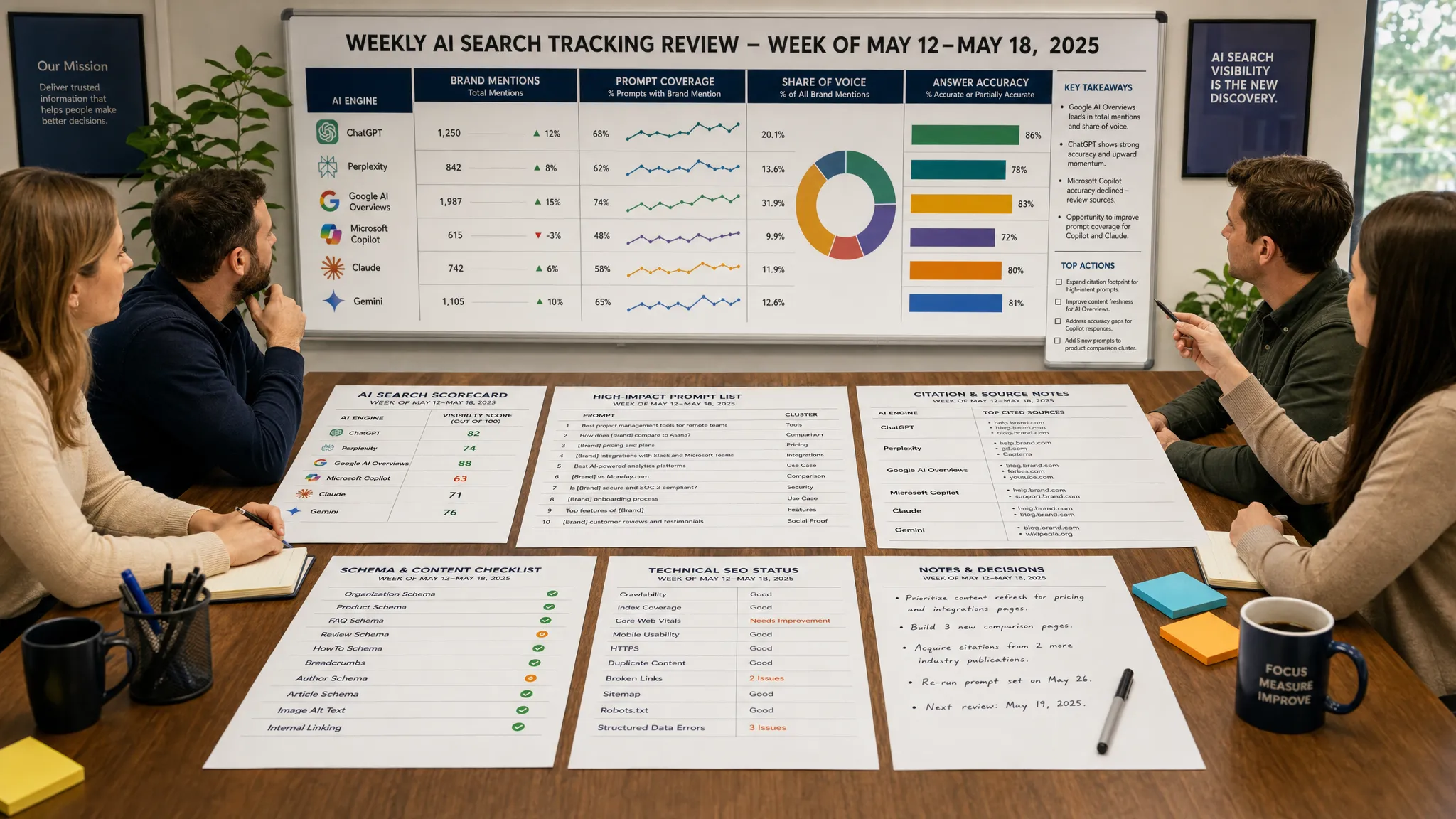
A practical weekly scorecard should be short enough to review, but complete enough to explain movement. The table below gives teams a measurement baseline that connects AI visibility to business outcomes.
| Weekly metric | What to measure | Why it matters | Typical weekly action |
|---|---|---|---|
| Prompt coverage | Which priority prompts surface your brand, pages, or competitors | Shows whether AI engines connect you to real buyer questions | Add missing answers, proof points, or internal links to priority pages |
| Brand mention rate | Percentage of tracked prompts where your brand appears | Measures baseline visibility across AI answers | Investigate prompts where competitors appear and you do not |
| Citation rate | How often AI answers cite or reference your pages | Indicates whether your site is being used as supporting evidence | Improve page structure, schema, freshness, and source clarity |
| AI share of voice | Your presence compared with named competitors | Reveals category-level visibility, not just isolated rankings | Prioritize pages and topics where rivals dominate |
| Answer accuracy | Whether AI describes your offer, locations, prices, policies, or differentiators correctly | Incorrect answers can cost bookings, leads, and trust | Update source pages, business profiles, schema, and FAQs |
| Sentiment and positioning | How the answer frames your brand relative to alternatives | A neutral mention is different from a recommendation | Strengthen proof, reviews, case evidence, and positioning language |
| Page-to-prompt mapping | Which URLs are cited or inferred for each query pattern | Shows which assets AI engines trust for each journey stage | Consolidate weak pages or build stronger hub-and-spoke paths |
| Entity consistency | Whether names, locations, services, products, and organization details match across sources | AI systems rely on consistent entities to reduce ambiguity | Fix inconsistent NAP data, service names, product labels, and brand descriptions |
| Schema and metadata health | Presence and validity of structured data, titles, descriptions, FAQs, and breadcrumbs | Helps machines understand page purpose and relationships | Add or repair relevant schema and AI-ready metadata |
| Crawlability and indexability | Robots rules, sitemaps, canonical tags, broken links, blocked assets, and crawl errors | AI visibility depends on accessible source material | Resolve critical crawl blockers and indexation problems |
| llms.txt readiness | Whether key pages are summarized and discoverable for AI crawlers where appropriate | Provides an emerging map of important AI-readable resources | Keep it aligned with current priority pages and avoid treating it as a substitute for SEO |
| Page performance | Core Web Vitals, mobile usability, server response, and page stability | Slow or unstable pages reduce user experience and can affect search performance | Fix high-impact templates before isolated pages |
| Classic SEO pulse | Rankings, impressions, CTR, organic sessions, assisted conversions, and revenue | Connects AI visibility work to existing SEO performance | Compare AI movement with organic search and conversion trends |
You do not need every metric in a weekly executive report. But your working team should track enough to answer three questions: where are we visible, where are competitors being recommended, and what should we fix next?
Build a stable prompt set before measuring anything
AI search tracking starts with prompts, not keywords. A keyword is often a compressed search phrase. A prompt is closer to the real question a buyer asks when they want help choosing, comparing, validating, or acting.
A good weekly prompt set should include four types of questions:
- Discovery prompts: broad category searches such as best boutique hotels in a city, best urgent care near a neighborhood, or best WooCommerce hosting provider.
- Comparison prompts: brand-versus-brand, product-versus-product, or agency-versus-agency questions.
- Use-case prompts: queries tied to a need, such as pet-friendly hotel near a convention center, HIPAA-compliant MSP for clinics, or durable luggage for frequent business travel.
- Action prompts: booking, appointment, quote, demo, store visit, or purchase intent questions.
Keep the core set stable week over week. If the prompts change constantly, you cannot tell whether visibility improved or the test changed. Add new prompts as a separate group, then promote them into the core set once they prove commercially important.
| Business type | Weekly prompts worth tracking |
|---|---|
| Independent hotel chain | best hotel near [landmark] for families, pet-friendly hotel in [city] with parking, where to stay near [conference venue] |
| Multi-location healthcare brand | urgent care open late in [city], best physical therapy clinic near [neighborhood], pediatric clinic that accepts [insurance] |
| Mid-market e-commerce store | best [product category] for [use case], compare [brand] vs [competitor], where to buy [product] online |
| MSP or IT service provider | managed IT provider for law firms in [city], best cybersecurity company for small business, Microsoft 365 support for healthcare offices |
| SEO or WordPress agency | WooCommerce SEO agency for mid-market stores, WordPress performance agency for multi-site brands, technical SEO audit for franchise websites |
Measure across engines, not just one assistant
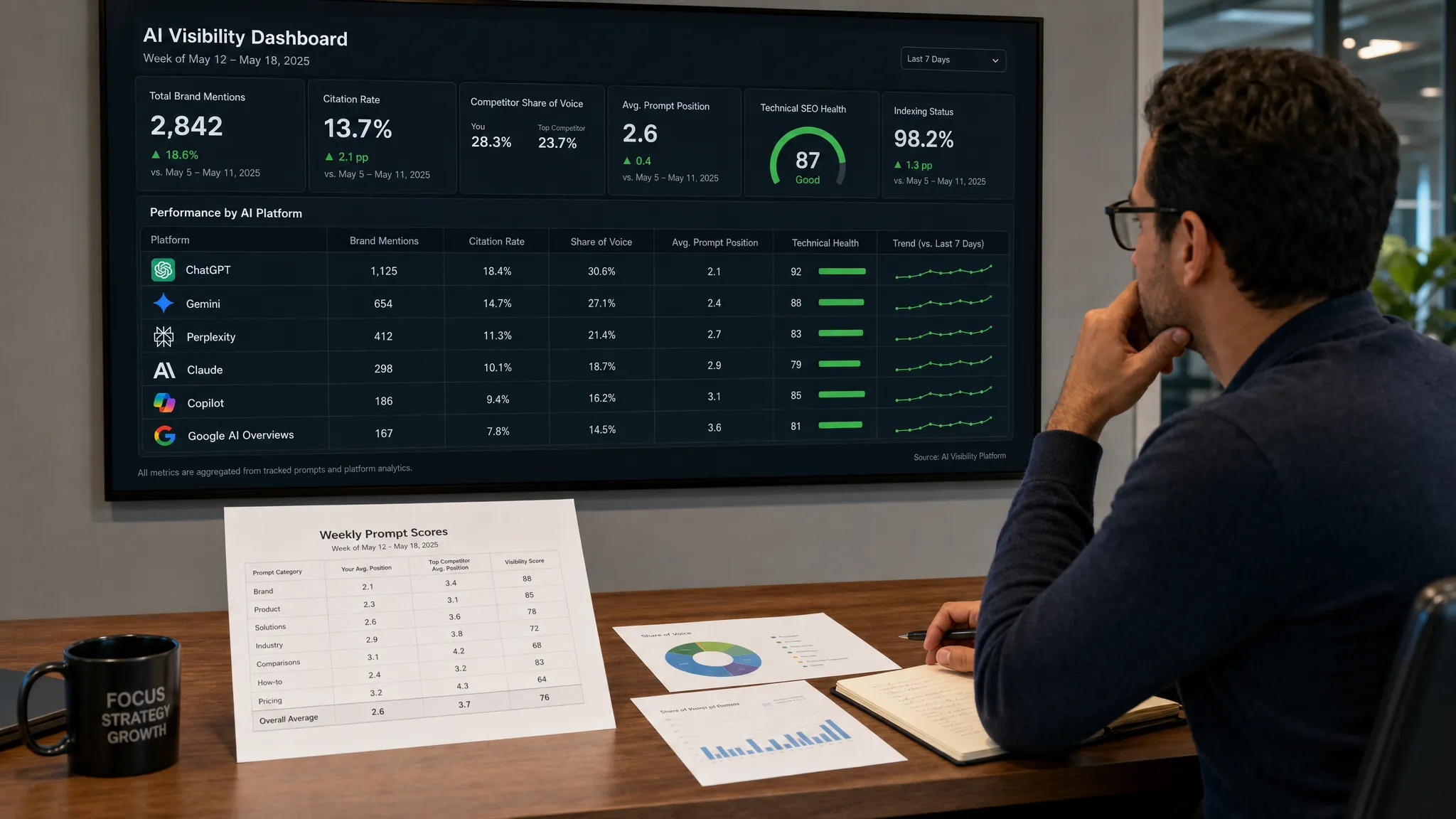
ChatGPT, Gemini, Perplexity, Claude, Copilot, and Google AI Overviews do not behave the same way. Some answers cite sources more visibly. Some synthesize from broader knowledge. Some lean more heavily on live web retrieval depending on the query, user context, and product settings.
That means weekly SEO tracking should record engine-level differences. If Perplexity cites your buying guide but Gemini omits your brand, that is not a contradiction. It is a diagnostic clue. It may point to source selection, entity recognition, content structure, or authority signals.
For a deeper measurement framework, CapstonAI has a separate guide on how to measure AI performance across search engines. For the weekly operating rhythm, the key is consistency: same prompts, same locations where relevant, same competitor set, same scoring rules.
A simple scoring model is often enough to start:
| Score | AI answer behavior | Business interpretation |
|---|---|---|
| 0 | Brand absent | No measurable AI visibility for that prompt |
| 1 | Brand mentioned without detail | Low visibility, weak commercial value |
| 2 | Brand mentioned with accurate context | Useful awareness, but not necessarily persuasive |
| 3 | Brand recommended or included in a shortlist | Stronger influence on consideration |
| 4 | Brand recommended and cited with a relevant page | High-value visibility with supporting evidence |
| 5 | Brand recommended, cited, and accurately positioned against alternatives | Best observed outcome for that prompt |
Use this score to track trend direction, not as a false precision metric. AI answers vary. The value comes from repeated observation and clear diagnosis.
Separate mentions, citations, and conversions
A brand mention is not the same as a citation. A citation is not the same as a visit. A visit is not the same as a booking, lead, or sale.
Weekly reporting should keep those layers separate:
- Mention: the AI answer names your brand, property, product, location, or service.
- Citation: the AI answer links to or references your content as a source.
- Referral or assisted visit: the user reaches your site from an AI interface, browser, or follow-up search.
- Conversion: the user books, calls, submits a form, buys, or starts a sales conversation.
This distinction matters because AI search often influences decisions before a click happens. A traveler may ask ChatGPT for hotel options, then search your brand name later. A buyer may compare MSPs in Perplexity, then visit your pricing or contact page directly. If you only measure last-click organic sessions, you may miss the earlier AI influence.
Watch branded search demand, direct traffic, assisted conversions, and changes in lead quality alongside AI visibility. The connection will not always be perfectly attributable, but patterns become clearer when tracked weekly and reviewed monthly.
Check whether your pages are machine-readable and trustworthy
If AI systems cannot parse your pages, they are less likely to reuse them accurately. Weekly SEO tracking should include a small technical and content-readiness check, especially for the pages tied to high-value prompts.
Start with structured data. Google Search Central explains that structured data helps search engines understand page content. For AI search, schema is not a guarantee of visibility, but it can clarify entities, relationships, offers, reviews, locations, breadcrumbs, articles, products, events, and FAQs.
Common schema types to review include Organization, LocalBusiness, Hotel, Product, FAQPage, Article, BreadcrumbList, Service, Review, and Event. Use only schema that accurately reflects the visible page content. Invalid or exaggerated markup creates trust problems rather than fixing them.
Metadata also matters. Titles, meta descriptions, headings, image alt text, canonical tags, and internal links help machines understand what each page is for. AI-ready content is not just longer content. It is content with clear answers, named entities, current facts, sourceable claims, and logical relationships between pages.
llms.txt is worth monitoring as an emerging convention for pointing AI systems toward important content. Treat it as a helpful map, not a ranking factor and not a replacement for XML sitemaps, robots.txt, schema, or crawlable HTML.
Keep classic technical SEO in the same weekly view
AI search does not remove technical SEO. It raises the cost of ignoring it.
If a page is slow, blocked, poorly linked, duplicated, thin, or unclear, it has less chance of performing well in traditional search and less chance of being trusted as a source by generative engines. Weekly checks should focus on the templates and journeys that matter most: location pages, product pages, service pages, category pages, comparison pages, booking pages, and lead forms.
Include these checks in the same weekly workflow:
- Crawl errors and indexation changes for priority pages.
- Canonical conflicts, redirects, broken internal links, and orphan pages.
- Sitemap freshness and robots.txt changes.
- Structured data validation errors.
- Core Web Vitals and mobile experience issues.
- Changes in rankings, impressions, CTR, and organic conversions.
Google defines Core Web Vitals as metrics that evaluate loading performance, interactivity, and visual stability, with details available in its web performance guidance. For business teams, the practical effect is simple: faster, more stable pages reduce friction and protect conversion opportunities.
A practical weekly workflow
The weekly process should be predictable. You are not trying to solve every SEO and AI visibility issue each Friday. You are trying to identify the highest-impact fixes before small visibility gaps become persistent blind spots.
| Day | Focus | Output |
|---|---|---|
| Monday | Capture AI answers and classic SEO data | Updated prompt scores, citations, rankings, traffic, and technical alerts |
| Tuesday | Diagnose gaps | List of prompts where competitors appear, your brand is absent, or answers are inaccurate |
| Wednesday | Prioritize fixes | Ranked actions for schema, content, metadata, internal links, crawlability, or page performance |
| Thursday | Publish and validate | Updated pages, validated structured data, corrected internal links, refreshed llms.txt if needed |
| Friday | Report and learn | Short summary of movement, open risks, and next week’s priority prompts |
For agencies and in-house teams, the most useful weekly report is not a 40-page export. It is a clear decision document: what changed, why it matters, what was fixed, and what impact should be checked next.
What not to overreact to every week
AI outputs can vary by wording, session context, location, personalization, freshness, and engine behavior. A single bad answer should trigger investigation, not panic.
Do not rewrite a whole site because one prompt produced a weak answer. Do not assume a new mention means your category strategy is working. Do not treat citations as the only useful outcome, because some assistants influence users without sending a measurable click. And do not rely on llms.txt or schema alone while leaving thin content, weak internal linking, and slow templates untouched.
A better rule is to look for repeated patterns. If five related prompts omit your brand across three engines, that is a priority. If competitors are cited for a topic where you have no authoritative page, that is a content gap. If AI answers describe an outdated service, that is an entity and source consistency problem.
Frequently Asked Questions
Is SEO tracking for AI search different from rank tracking? Yes. Rank tracking measures where pages appear in search results. AI search tracking measures whether generative engines mention, cite, recommend, and accurately describe your brand in answers. The two should be reviewed together.
How often should teams measure AI visibility? Weekly is a practical cadence for operational decisions. It is frequent enough to catch changes in mentions, citations, technical issues, and competitor movement, while still allowing time to publish fixes and observe trends.
Which AI engines should be tracked? Start with the engines your buyers are most likely to use: ChatGPT, Google AI Overviews, Gemini, Perplexity, Claude, and Copilot. Track them separately because each engine may surface different brands and sources.
Does schema guarantee that AI search will cite my website? No. Structured data helps clarify content and entities, but it does not guarantee citations or recommendations. It works best alongside strong content, crawlability, internal linking, authority signals, and accurate business information.
What is the best first metric for AI search SEO tracking? Start with mention rate and citation rate across a stable set of high-intent prompts. Then add share of voice, answer accuracy, entity consistency, and technical readiness to explain why visibility is improving or declining.
Start with a free AI visibility audit
Before building more content, measure what AI systems can already see. CapstonAI helps brands, retailers, agencies, and multi-location teams track mentions, citations, prompt gaps, competitors, structured data, crawlability, internal linking, page performance, and AI-ready metadata across major generative engines.
If AI cannot see your business clearly, CapstonAI makes it visible. Start with a free AI visibility audit to see where your brand appears today, where competitors are being surfaced instead, and which fixes should come first.