When a prospect asks ChatGPT, Gemini, Perplexity, Claude, Copilot, or Google AI Overviews for a recommendation, the answer often includes a small set of cited sources. For a hotel group, franchise network, MSP, or e-commerce brand, that citation can influence the next click, call, booking, or quote request.
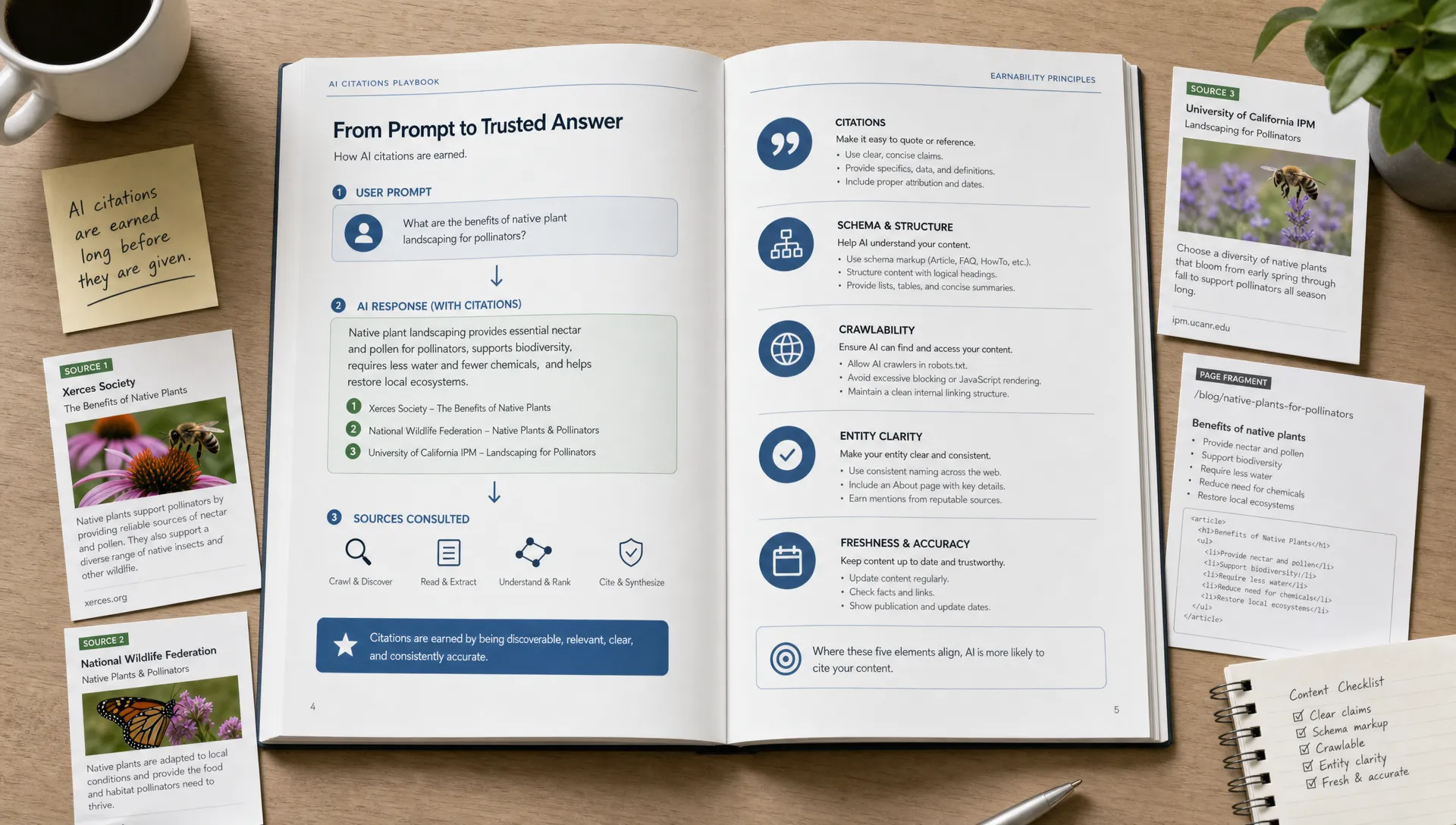
AI-driven search engines do not choose those sources randomly. They combine retrieval, ranking, synthesis, and trust checks. The exact systems are proprietary, and they differ by engine, but the observable pattern is consistent: sources that are clear, crawlable, current, entity-rich, and easy to quote are more likely to appear in AI answers.
This is where GEO, Generative Engine Optimization, and AEO, Answer Engine Optimization, meet classic technical SEO. GEO helps your brand become visible in generated answers. AEO shapes pages so they answer real questions directly. Technical SEO ensures engines can crawl, render, understand, and reuse the content.
What an AI citation really means
In traditional search, the prize was often a blue link ranking. In AI search, the prize is different. You want your brand to be mentioned, cited, and represented accurately inside the answer itself.
A citation usually means the engine has used a page as supporting evidence for a generated claim. It may cite your homepage, a product page, a local landing page, a knowledge-base article, a comparison guide, a review source, or a third-party directory.
That distinction matters. A brand can rank well in Google and still be absent from ChatGPT Search or Perplexity. A franchise can have strong local pages and still lose citations to aggregators if its location data is inconsistent. A WooCommerce store can have excellent products and still miss citations if its product pages lack structured data, reviews, clear specifications, or crawlable copy.
For a wider view of citation behavior across models, CapstonAI’s 2026 LLM citation benchmark analyzed 24,800 responses across ChatGPT, Perplexity, Gemini, and Claude. The useful takeaway for operators is not that one universal ranking factor exists. It is that AI citation patterns can be measured, compared, and improved.
The short version: AI search chooses citations in five steps
Most AI-driven search engines follow some version of this workflow, even if the details differ.
- The engine interprets the prompt: It identifies intent, entities, location, constraints, and context. A query such as best pet-friendly hotel near Austin airport with shuttle has location, amenity, service, and comparison intent.
- It retrieves candidate sources: The system looks at its index, live web search results, knowledge graph data, trusted databases, and sometimes partner sources. Google AI Overviews leans on Google’s search systems, while Perplexity is visibly citation-centric and web retrieval-heavy.
- It scores evidence at the passage level: The engine looks for passages that answer the question directly, not just pages that are broadly relevant. A concise FAQ section can outperform a vague 2,000-word page if the answer is easier to extract.
- It synthesizes the answer: The model combines multiple sources, resolves conflicts, and decides which claims are safe enough to include. Corroboration matters because engines tend to avoid relying on a single weak or ambiguous source.
- It attaches citations: The final citations are often selected because they support the generated claims, are accessible, and appear useful for verification. A source can influence the answer without being cited, but the visible citation is what users and brands can measure.
The business effect is direct. If the engine cites a competitor, marketplace, OTA, directory, or review site instead of your own page, that third party becomes the trusted path to the customer.
The main signals that influence AI citations
No public source can truthfully list every citation factor used by ChatGPT, Google AI Overviews, Gemini, Perplexity, Claude, or Copilot. What brands can act on is the overlap between classic search quality signals and AI answer needs.
| Signal | What AI-driven search engines can infer | Business effect | Practical fix |
|---|---|---|---|
| Topical fit | The page answers the exact prompt or subtopic | Higher chance of appearing for commercial and informational questions | Create pages that map to real customer questions, not only broad keywords |
| Entity clarity | The brand, locations, products, people, and services are easy to identify | Fewer mistaken mentions and stronger eligibility for brand-specific answers | Use consistent names, addresses, categories, author data, and organization details |
| Authority and trust | Claims are backed by evidence, credentials, reviews, policies, and external references | Better credibility in comparison and recommendation prompts | Add proof points, source citations, expert review, testimonials, and transparent business information |
| Freshness | The content reflects current offers, hours, pricing context, inventory, or policies | Better fit for time-sensitive answers such as travel, healthcare, retail, and software | Update critical pages, show visible dates when helpful, and remove stale claims |
| Structured data | The page exposes machine-readable facts through schema | Easier extraction of products, locations, FAQs, reviews, events, and organization data | Add relevant schema such as Organization, LocalBusiness, Product, FAQPage, Article, and BreadcrumbList |
| Crawlability | Bots can access, render, and index important content | AI systems have fewer blind spots | Fix robots.txt issues, canonical conflicts, broken links, blocked scripts, and noindex mistakes |
| Internal linking | The site shows how pages relate to each other | Stronger topic clusters and clearer journey paths | Link between service pages, local pages, guides, product categories, and supporting FAQs |
| Page performance | Users and crawlers can load and interact with pages efficiently | Better user engagement and fewer crawl or rendering failures | Improve Core Web Vitals, image weight, JavaScript dependency, and server response times |
Google’s own guidance for AI features emphasizes the same foundation: content must be accessible to Google Search, and existing controls such as robots.txt and snippet settings still matter. See Google’s guidance for AI features for the baseline.
Structured data is not a magic citation switch, but it reduces ambiguity. Google’s structured data documentation explains how markup helps search systems understand page content. In AI search, that understanding can support better extraction, cleaner citations, and fewer entity errors.
How major AI-driven search engines differ
The same page may be cited by Perplexity and ignored by Google AI Overviews. That does not always mean one engine is right and the other is wrong. It usually means their retrieval systems, freshness thresholds, source preferences, and answer formats differ.
| Engine or experience | Common citation behavior to plan for | What to optimize first |
|---|---|---|
| Google AI Overviews and Gemini | Strong connection to Google’s index, entity understanding, Search quality systems, and web results | Technical SEO, structured data, helpful content, entity clarity, and page-level relevance |
| ChatGPT Search | Uses web retrieval when browsing is active and often blends source-backed answers with model reasoning | Clear passages, credible references, crawlable pages, and brand facts that are consistent across the web |
| Perplexity | Often surfaces multiple cited web sources and favors pages that directly support concise answers | Answer-ready pages, current data, comparison content, FAQs, and strong citations to primary evidence |
| Claude with web access | Tends to be cautious with claims and relies on accessible supporting sources when citations are shown | Trust signals, source transparency, clear explanations, and low ambiguity |
| Microsoft Copilot | Connected to Bing-style web retrieval and Microsoft experiences | Bing crawlability, IndexNow where relevant, schema, entity consistency, and business profile accuracy |
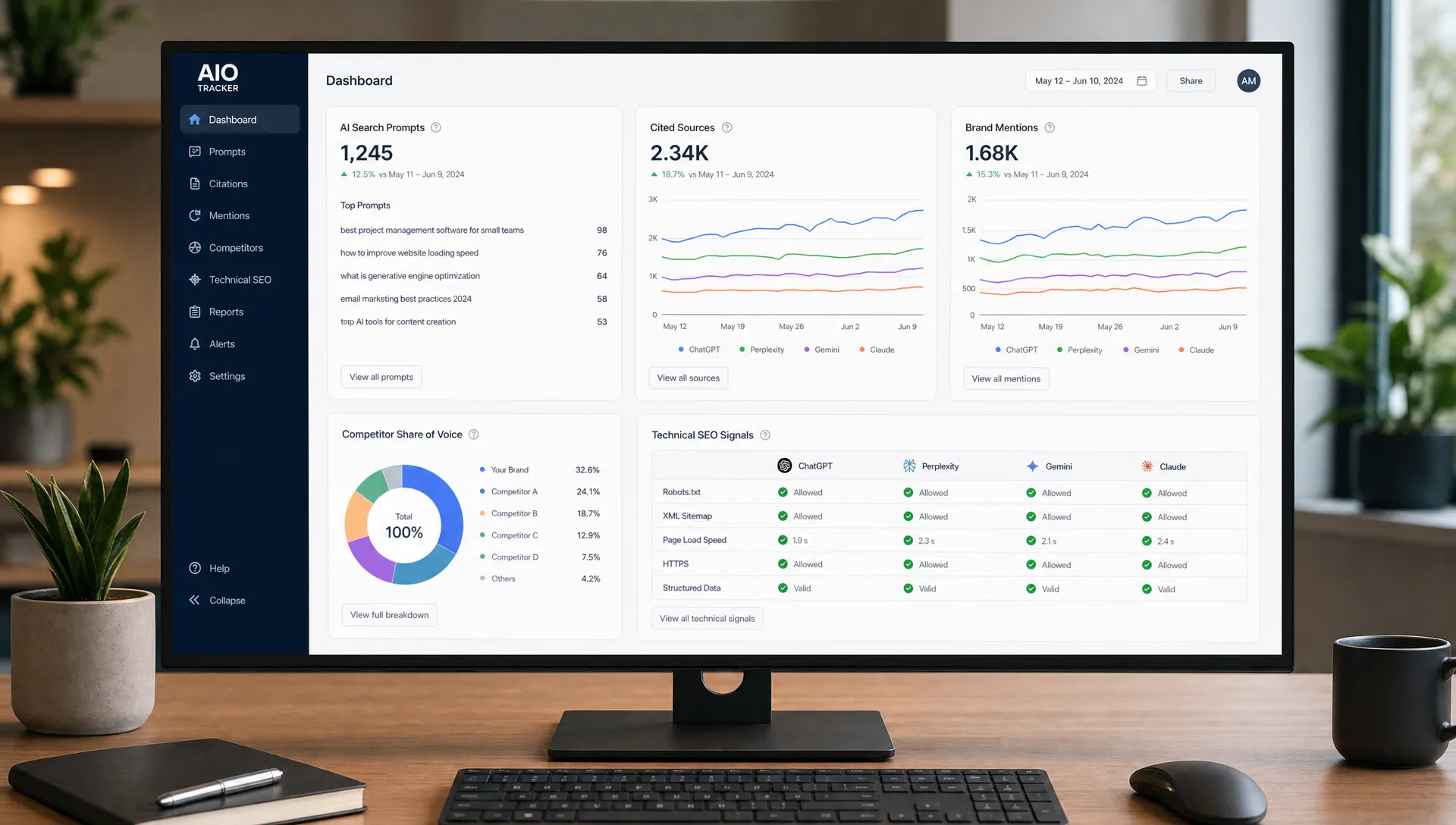
For brands, the operational point is simple: you cannot manage AI visibility by checking one engine once. You need to track prompts, citations, mentions, and competitors across the surfaces your buyers actually use.
Why strong brands still get skipped
Here is what we often observe when a known brand fails to earn citations.
The first issue is answer mismatch. The page is relevant, but it does not answer the exact question. A hotel page may mention airport access, parking, and pet policies in separate sections, but the prompt asks for pet-friendly airport hotels with shuttle service. If no single passage connects those attributes, an AI engine may cite an OTA or travel guide that does.
The second issue is entity confusion. Multi-location brands are especially vulnerable. If the same clinic appears with slightly different names, categories, addresses, hours, or service lines across its website and third-party profiles, the model has to reconcile conflicting facts. When confidence drops, citations often shift toward aggregators.
The third issue is thin technical access. Important content hidden behind scripts, tabs, personalization, or blocked resources can be difficult to extract. Traditional crawlers have improved, but server-rendered, well-structured, internally linked content still gives AI systems fewer reasons to guess.
The fourth issue is weak trust context. AI engines are more likely to cite sources that make claims verifiable. For healthcare, education, finance, hospitality safety policies, and B2B technology, that means credentials, policies, dates, service scope, customer proof, and clear ownership matter. CapstonAI covers this in more depth in its guide to AI trust signals that make brands more citable.
The fifth issue is freshness. Search engines have long cared about recency for topics where facts change. AI search amplifies that problem because stale details can produce wrong answers. If a restaurant, clinic, store, or hotel page has old hours, expired offers, outdated amenities, or unavailable inventory, an engine may prefer a fresher third-party source.
How to make your pages easier to cite
The best approach is not to chase every model update. Build pages that are useful to humans and unambiguous to machines.
Start with prompt mapping
Prompt mapping is the AEO layer. Instead of only asking which keywords rank, ask which questions buyers pose to AI assistants.
For an independent hotel chain, prompts might include family-friendly hotels near a convention center, hotels with EV charging and late checkout, or best hotel for a weekend trip to a specific neighborhood.
For an MSP, prompts might include managed IT provider for dental clinics in Dallas, Microsoft 365 migration support for a 100-person company, or SOC 2-ready IT helpdesk provider.
For a WooCommerce brand, prompts might include best non-toxic nursery furniture, compare refillable skincare brands, or where to buy replacement parts for a specific product.
Each prompt should map to a page, section, FAQ, or content asset that answers it directly.
Build answer-ready sections
AI engines often work at the passage level. That means the page should include short, complete answers that can stand on their own.
A strong answer-ready section usually includes:
- A direct answer in the first 1 to 2 sentences
- Specific details such as location, audience, compatibility, amenities, or service scope
- Supporting evidence such as policies, reviews, certifications, data, or examples
- A clear next step such as booking, requesting a quote, checking availability, or contacting a location
This is not about writing for robots. It is about removing friction. If a human has to scan five sections to understand whether your clinic offers pediatric urgent care on weekends, an AI system may struggle too.
Strengthen entity signals
Entities are the named things search systems understand: your brand, locations, services, products, people, certifications, categories, and relationships. Clean entity data helps AI-driven search engines connect your business to the right prompts.
For multi-site brands, this means every location page should have consistent NAP data, hours, service categories, appointment options, and links to the relevant parent brand. For e-commerce, product pages should clarify variants, specifications, availability context, return policies, and related categories. For agencies and MSPs, service pages should identify industries served, platforms supported, certifications, and geography.
Fix the technical foundation
Technical SEO still matters because AI systems need retrievable, readable source material. GEO does not replace crawlability, metadata, canonical logic, internal links, or performance. It depends on them.
Prioritize these fixes first:
- Make critical pages indexable and avoid accidental noindex, canonical, and robots.txt conflicts
- Use descriptive title tags and meta descriptions that match page intent
- Add relevant schema and validate it before publishing
- Make important copy available in HTML, not only inside images or client-side scripts
- Improve Core Web Vitals, especially Largest Contentful Paint under 2.5 seconds, Interaction to Next Paint under 200 milliseconds, and Cumulative Layout Shift under 0.1, based on Google’s Core Web Vitals thresholds
- Use internal links to connect hubs, service pages, local pages, products, FAQs, and comparison content
For Bing-connected surfaces such as Copilot, faster discovery can also matter. IndexNow, documented at IndexNow.org, allows participating search engines to be notified when URLs are created, updated, or deleted.
Add AI-readable support files where they fit
The emerging llms.txt convention gives publishers a way to point AI systems toward preferred, high-value content. It is not a substitute for crawlable pages or schema, and not every engine treats it the same way. Still, for brands with large content libraries, documentation, locations, or product catalogs, it can help clarify which URLs deserve attention.
Used well, llms.txt complements structured data, sitemaps, clean internal linking, and content governance. Used poorly, it becomes another stale file. Treat it as part of your publishing workflow, not a one-time technical task.
What to measure after optimization
AI visibility should be measured like a search channel, not treated as a mystery. The goal is to know when you are mentioned, when you are cited, when competitors appear instead, and which pages influence the answer.
Track these metrics by engine, prompt group, location, and business line:
- Brand mention rate: how often your brand appears in relevant answers
- Citation rate: how often your owned pages are cited
- Share of voice: your presence compared with competitors and aggregators
- Prompt coverage: which buyer questions surface you, and which do not
- Source mix: owned site, review platforms, marketplaces, news, directories, and competitors
- Accuracy: whether AI answers describe your services, locations, pricing context, policies, or products correctly
- Page contribution: which URLs earn citations and which important pages are invisible
If you need a measurement framework, CapstonAI’s guide on how to measure AI performance across search engines breaks this down across engines and prompt sets.
Frequently Asked Questions
Do AI-driven search engines simply cite top-ranking Google results? Not always. Traditional rankings can influence candidate retrieval, especially in Google-connected experiences, but AI citations are often selected at the passage and claim-support level. A lower-ranking page that answers the prompt clearly may be more useful than a broad page that ranks well.
Is schema enough to get cited by AI engines? No. Schema helps machines understand facts, but citations also depend on relevance, trust, freshness, crawlability, corroboration, and answer quality. Treat schema as a clarity layer, not a shortcut.
How often should pages be refreshed for AI search? Refresh pages whenever facts change, especially hours, inventory, prices, amenities, policies, service areas, staff, and compliance claims. For competitive guides and comparison pages, review them on a scheduled basis so AI systems do not prefer fresher third-party sources.
Why does an AI engine cite a directory instead of my brand website? Directories often have structured, comparative, and location-rich content. If your owned pages are thin, inconsistent, slow, or hard to crawl, the directory may look like the safer evidence source. The fix is to make your own pages more complete, structured, and verifiable.
Can paid ads make AI engines cite my site? Paid search and AI citations are generally separate systems. Advertising can increase visibility in sponsored surfaces, but it should not be treated as a reliable way to earn organic AI citations. Owned content quality and technical accessibility still matter.
Start by finding what AI can and cannot see
Before rewriting pages or adding schema at scale, establish a baseline. Which prompts mention your brand? Which cite competitors? Which engines see your locations, products, and services accurately? Which pages are technically readable but never reused?
CapstonAI helps brands, retailers, agencies, MSPs, and multi-location teams measure and improve AI visibility across ChatGPT, Google AI Overviews, Gemini, Perplexity, Claude, and Copilot. It tracks mentions, citations, share of voice, prompt coverage, technical readiness, and AI-ready metadata opportunities.
Start with a free AI visibility audit. AI can’t cite what it can’t confidently understand. CapstonAI helps make your business visible, measurable, and easier for generative engines to trust.