
Free SEO AI can turn a crawl export into a useful internal linking backlog, but only if you give it evidence and a clear definition of priority. Asking a chatbot to “improve my internal links” usually produces plausible suggestions, not a defensible implementation plan.
A better workflow combines your actual URLs, existing links, search performance and business priorities. AI helps organize that evidence and propose relevant connections. Your team verifies the recommendations before publishing. The result should be a short queue of specific fixes, each with a source page, destination, reason and measurable outcome.
Decide what an internal linking fix should accomplish
Internal links help visitors and crawlers discover pages, understand relationships and reach useful next steps. For a hotel group, that might mean connecting a destination guide to the relevant property. For an MSP, it might mean connecting a troubleshooting article to the service that addresses the problem.
Classic technical SEO establishes whether those links and pages are accessible. Answer Engine Optimization (AEO) makes answers easier to understand, while Generative Engine Optimization (GEO) focuses on visibility in generated responses.
These disciplines overlap, but adding internal links does not guarantee an AI citation. ChatGPT, Google AI Overviews, Gemini, Perplexity, Claude and Copilot use different retrieval systems and sources. Clear site relationships can support discoverability without controlling what an engine ultimately includes.
Prioritize links that repair a documented access problem or help a reader complete a relevant journey. More links are not automatically better.
Build a free SEO AI workflow from real crawl data
Start with a spreadsheet, a crawler’s free tier and a free AI assistant. Google Search Console supplies search performance and indexing evidence. Your CMS and XML sitemap help establish which URLs should exist.
| Input | Accessible source | What it helps establish |
|---|---|---|
| Expected page inventory | CMS export and XML sitemap | Which published pages should be checked |
| Crawl and link exports | SEO crawler’s free tier | Status codes, discovered URLs and internal link connections |
| Search performance | Google Search Console | Pages receiving impressions and clicks |
| Business importance | Analytics and owner input | Which pages support bookings, purchases or qualified leads |
| Page text | Rendered pages or CMS content | Whether a proposed link fits the surrounding content |
Free crawlers and AI accounts have limits. If you cannot crawl the whole site, audit a defined section and label the findings as partial. Do not describe a page as sitewide-orphaned based on a small sample.
Export a link-edge file, not just a URL list. Each row should identify the source URL, destination URL, anchor text and link location, such as navigation or main content.
Validate the inventory before analyzing opportunities
Your free SEO AI workflow needs consistent URL handling. Reconcile redirects, canonical URLs and tracking parameters so one page does not appear as several unrelated destinations. Preserve meaningful differences, including location pages and language versions.
An orphan page has no discoverable crawlable internal links pointing to it within the audited scope. A page with a navigation link but no contextual links is not an orphan. It has a different, usually less urgent, problem.
Compare the expected inventory against the crawl, then investigate missing URLs. A crawler cannot discover a genuinely isolated page by following links alone.
Also separate access problems from linking opportunities. An important page that is unintentionally blocked, marked noindex or canonicalized elsewhere needs that issue resolved first. Adding more links will not fix the underlying instruction.
Ask AI for evidence-backed link candidates
Give the assistant a manageable batch of page records and existing link relationships. Include content excerpts, not just titles. Similar titles can conceal different audiences, locations or service boundaries.
Free SEO AI works best here as a constrained analyst: identify possible connections, explain the user benefit and flag missing evidence. Do not ask it to invent a complete site architecture from a homepage URL.
Use a prompt like this:
Analyze only the supplied page inventory, content excerpts and link-edge data.

Find internal linking fixes involving:
- Broken internal destinations
- Important pages without discovered inbound links
- Relevant source pages missing a useful contextual link
- Ambiguous anchors that obscure the destination

Return these columns:
source_url, destination_url, issue_type, proposed_anchor,
suggested_placement, supporting_evidence, verification_needed.

Use only URLs present in the inventory. Never invent a URL,
service, location, eligibility rule or page claim.

Do not recommend a link already present in the supplied edges.
If content or crawl evidence is insufficient, mark the candidate
as needing review rather than treating it as a confirmed fix.
Keep private analytics, customer information and unpublished commercial data out of public AI tools unless your organization has approved that use. Aggregated page-level figures are often sufficient.
Reject recommendations that only sound relevant
Review each candidate against the live source and destination. The surrounding paragraph should create a genuine reason to follow the link.
A free SEO AI suggestion fails review if it connects different service areas, duplicates an existing link without adding value or promises something the destination does not explain. Reject recommendations based only on shared vocabulary.
For example, “managed security” and “security camera installation” might share a keyword while serving entirely different buyers. Likewise, two hotel properties in different cities should not be connected as though either one satisfies a location-specific booking request.
Check suggested anchors for accuracy. “Check insurance eligibility” should lead to verified eligibility information, not a general health article. Specific wording helps readers anticipate the next page and reduces misleading journeys.
Score fixes by business value, access severity and effort
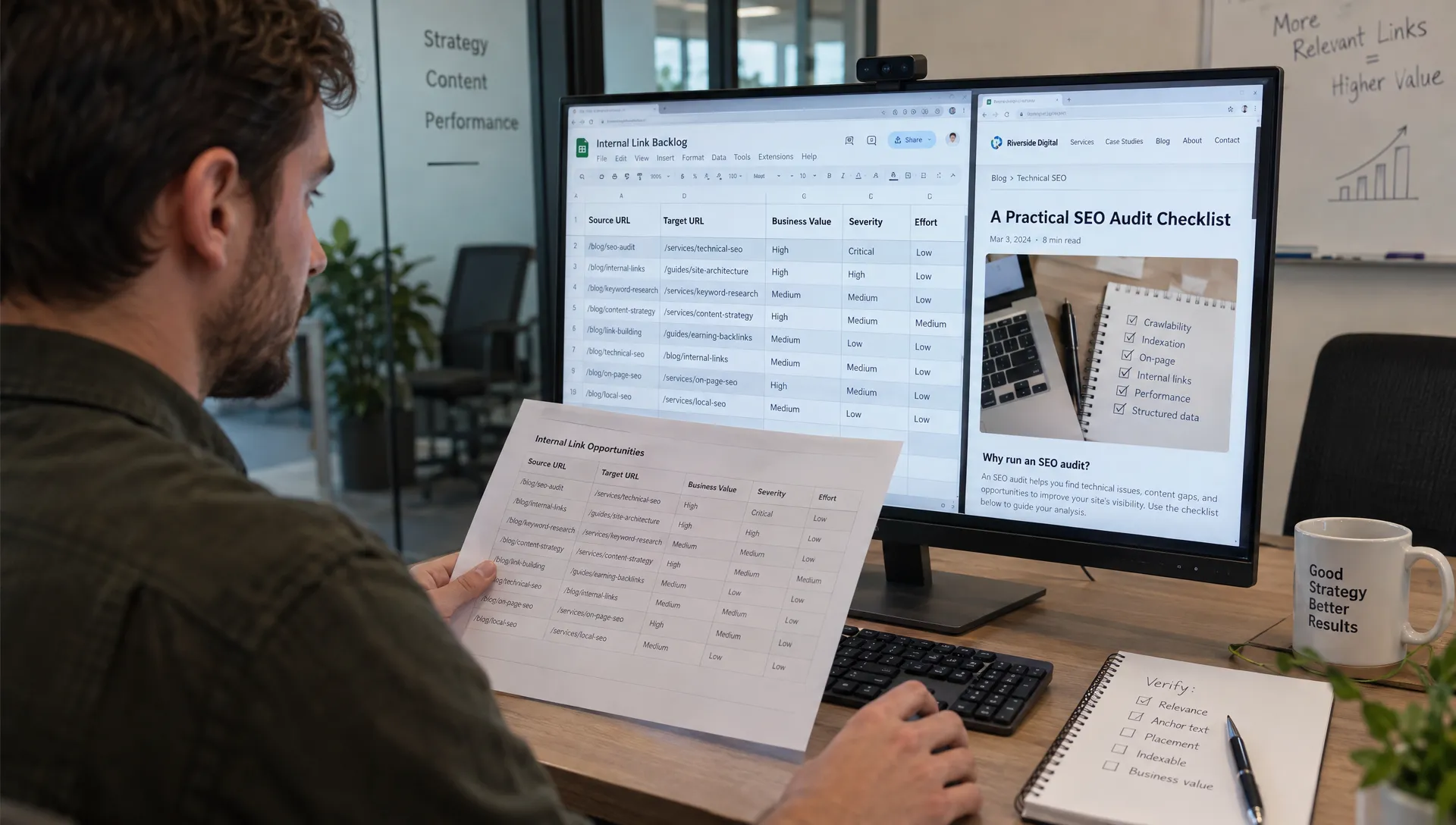
Use a simple scoring model after verification:
Priority score = business value × access severity ÷ implementation effort.
Rate each factor from 1 to 3. Business value reflects the destination’s role in revenue or qualified demand. Access severity reflects the documented problem. Effort includes editing, approvals, development and testing, not just the time needed to insert a link.
| Verified candidate | Business value | Access severity | Effort | Score |
|---|---|---|---|---|
| Broken contextual link to a priority booking page | 3 | 3 | 1 | 9 |
| Confirmed orphaned service page requiring several source edits | 3 | 3 | 2 | 4.5 |
| Missing contextual route to a relevant product category | 3 | 2 | 2 | 3 |
| Vague anchor on a low-priority article | 1 | 1 | 1 | 1 |
These are illustrative scores, not measured results or ranking predictions. Adjust them to your business, but use consistent definitions across the backlog.
A free SEO AI assistant can calculate and sort the scores. The business owner should confirm value, while an SEO or technical reviewer confirms severity. Treat widespread broken navigation or an active conversion-path failure as an operational incident rather than waiting for routine scoring.
Use customer intent to break ties
When two fixes have similar scores, favor the one that removes friction from a meaningful next step.
For a hotel, a family-travel guide might lead naturally to a property page that verifies family room options. A broad link to every hotel in the group would be less helpful. For an online store, a compatibility guide may deserve a direct route to the matching category rather than a generic shop page.
A service such as insurance-covered personal training and nutrition coaching illustrates another intent distinction: someone researching coverage needs eligibility information, not simply another fitness article. In an audit of this type of business, recommend that connection only when the relevant pages exist and their wording supports it.
These examples describe linking decisions, not findings about any provider’s current website. The principle is consistent: the destination must answer the next question created by the source.
Publish a small, verified batch first
Choose a manageable initial batch, such as five to ten verified fixes. That is a workflow choice, not a threshold required by search engines. Small batches make implementation errors easier to identify and reverse.
For each change, record the source, destination, previous anchor, new anchor, placement and publication date. This creates an audit trail for agencies and teams managing multiple sites.
Implement links as crawlable HTML anchors with real href destinations. Google’s guidance on crawlable links explains the supported format. A button that only triggers a script is not an equivalent replacement for a normal navigational link.
Use the verified canonical destination where appropriate. Repair an outdated link to its relevant replacement, but do not send unrelated broken URLs to the homepage merely to eliminate an error report.
Your free SEO AI backlog should remain a proposal queue until these checks pass. The distinction between drafting and approval is also central to where SEO automation helps and human review matters.
Protect templates, accessibility and page performance
A template edit can affect hundreds of pages. Test its scope before deployment, especially across franchises, local service areas and multilingual sites. Location-specific content should not accidentally inherit links to a different branch.
Use descriptive anchors that make sense in context. Avoid forcing an exact-match keyword into every link or adding several near-identical anchors to the same paragraph.
Internal links also do not require a heavyweight recommendation widget. If implementation introduces extra scripts, check page performance and the booking or checkout experience. A linking improvement that slows a critical journey can create a separate business problem.
After publishing, inspect the rendered page and run another crawl. Confirm that the link exists, resolves correctly and points where the reader expects.
Measure the repair before claiming a visibility gain
Separate direct implementation evidence from downstream performance. The first is observable immediately after deployment; the second needs comparable reporting periods and careful interpretation.
Your free SEO AI workflow should maintain three measurement layers:
- Technical completion: Confirm that broken destinations are corrected, intended links are present and verified orphan counts decline within the audited scope.
- Journey performance: Track link clicks and subsequent bookings, purchases or lead submissions where measurement is configured.
- Search performance: Review impressions, organic clicks and relevant landing-page outcomes in Google Search Console and analytics.
For example, “12 confirmed orphan pages reduced to three” is a valid technical result if both crawls use the same inventory and scope. It is not evidence that organic revenue increased.
Measure crawl depth from link paths, not URL folder structure. A short URL can still be difficult to reach. There is no universal click-depth target that suits every site, so focus on whether important pages have sensible routes from relevant entry points.
Track AI visibility as a separate outcome
Maintain a stable set of buyer questions across the generative engines relevant to your market. Record brand mentions, citations and which exact pages receive citations. Define share of voice consistently, for example, the proportion of monitored answers that mention your brand.
Keep prompt wording and collection conditions comparable, while recognizing that AI answers vary. A citation appearing after an internal linking change does not establish that the change caused it.
Structured data and schema can clarify entities, such as a hotel, service or product, when they match visible content. They do not replace crawlable relationships. Likewise, llms.txt is not a substitute for internal linking or an eligibility requirement for Google AI features. Google’s AI features documentation states that no special AI markup is required.
A useful free SEO AI report keeps technical repairs, customer behavior and AI visibility in separate columns. That makes progress visible without implying more certainty than the evidence supports.
Frequently asked questions
What is the best free AI for internal linking? Start with the free assistant your team can use safely and consistently. ChatGPT, Claude or Gemini can help classify supplied content and draft recommendations. The more important requirement is reliable crawl data and a process for checking every proposed URL and connection.
Can ChatGPT find orphan pages by itself? Not reliably without an expected URL inventory and sufficient internal link data. A page absent from a crawl may be orphaned, blocked, excluded by crawl settings or outside the audit scope. The cause needs verification.
Can I prioritize internal linking fixes without paid software? Yes, for a defined scope. Combine CMS and sitemap exports, Google Search Console, a free crawler tier and a spreadsheet. Larger sites may exceed free crawling or processing limits, so document coverage rather than implying the audit is complete.
Should I automatically publish AI-generated internal links? Not before validation. AI can invent destinations, miss existing links or connect pages with conflicting intent. Require review of URLs, page claims, anchor text and placement, especially for healthcare, insurance and location-specific services.
Start with a free AI visibility audit
Start with a free AI visibility audit from CapstonAI, then use the findings to select one important site section for this workflow. CapstonAI tracks brand mentions, citations and share of voice across AI engines, helping establish a baseline beyond traditional rankings.
Pair that baseline with your link inventory. Verify the highest-value access problems, publish a small batch of fixes and measure what changed before expanding the rollout.