AI SEO keywords are useful starting points, not evidence that buyers want what you plan to publish. A model can produce convincing phrases, cluster them neatly and assign plausible intent labels without knowing whether those searches lead to bookings, qualified leads or sales.
The practical task is to validate each idea against buyer language, current search results and your ability to deliver what the query promises. This workflow turns an AI-generated list into a defensible content plan, with clear reasons to publish, investigate or reject each cluster.
Separate AI suggestions from measured evidence
A generated keyword is a hypothesis. Search volume, keyword difficulty and conversion potential require separate evidence.
In a keyword platform, the language model may generate variations or summarize intent while a conventional database supplies volume and difficulty estimates. Those are different functions. Ask where each metric comes from, which market it represents and when it was updated.
A general-purpose chatbot's unsupported statement that a phrase receives 2,000 monthly searches should not enter your forecast. Even database-backed estimates describe a market, not your likely revenue.
Use three evidence layers: what buyers actually say, what search platforms currently show and what your business can credibly offer. Agreement across those layers supports a content decision. A polished AI explanation does not substitute for any of them.
Validate AI SEO keywords in a buyer-evidence ledger
Create one shared worksheet before generating more ideas. Give each candidate a traceable source and a clear status.
| Field | What to record | Why it matters |
|---|---|---|
| Candidate and cluster | Phrase, variants and underlying buyer task | Prevents duplicate pages |
| Buyer evidence | Anonymized inquiry, sales note or search term | Connects language to a real need |
| Market and date | Location, language and collection date | Keeps comparisons relevant |
| Search-result evidence | Dominant page types and recurring requirements | Tests intent and format |
| Commercial fit | Relevant offer, customer type and next action | Connects visibility to revenue |
| Proof available | Verified specifications, policies or service details | Prevents unsupported promises |
| Decision | Publish, improve, investigate or reject | Makes the research actionable |
Keep the original wording alongside your normalized cluster. “Can we check in after midnight?” and “hotel late check-in” may belong together, but the first phrase reveals an operational concern that a broad keyword can hide.
Count independent sources rather than repeated records. One customer asking the same question in five messages is one buyer signal, not five separate buyers.
Collect buyer language without exposing private data
Start with sources close to purchase: booking inquiries, sales-call notes, customer-service tickets, internal site searches and paid-search term reports. Use organic query data to understand discovery, then connect it to downstream behavior where your analytics allow.
Google Search Console's performance report supplies query, impression and click data for your property. It is not a complete record of every search: privacy filtering and reporting limitations mean some queries are unavailable.
For B2B teams, the same service may attract questions from technical evaluators, procurement staff and budget owners. A structured approach to mapping procurement questions helps keep those needs distinct.
When validating AI SEO keywords, remove names, email addresses, booking references and confidential contract details before sending records to an AI tool. Healthcare and education teams should be especially careful with sensitive information.
Check the tool's retention, training and access settings before uploading data. Prefer approved systems and minimized extracts; preserve source references in your controlled worksheet rather than exposing complete customer records.
Check current results, not the model's memory
Search each shortlisted cluster in the relevant country and language. For location-dependent services, inspect the intended service area rather than relying on results from your office.
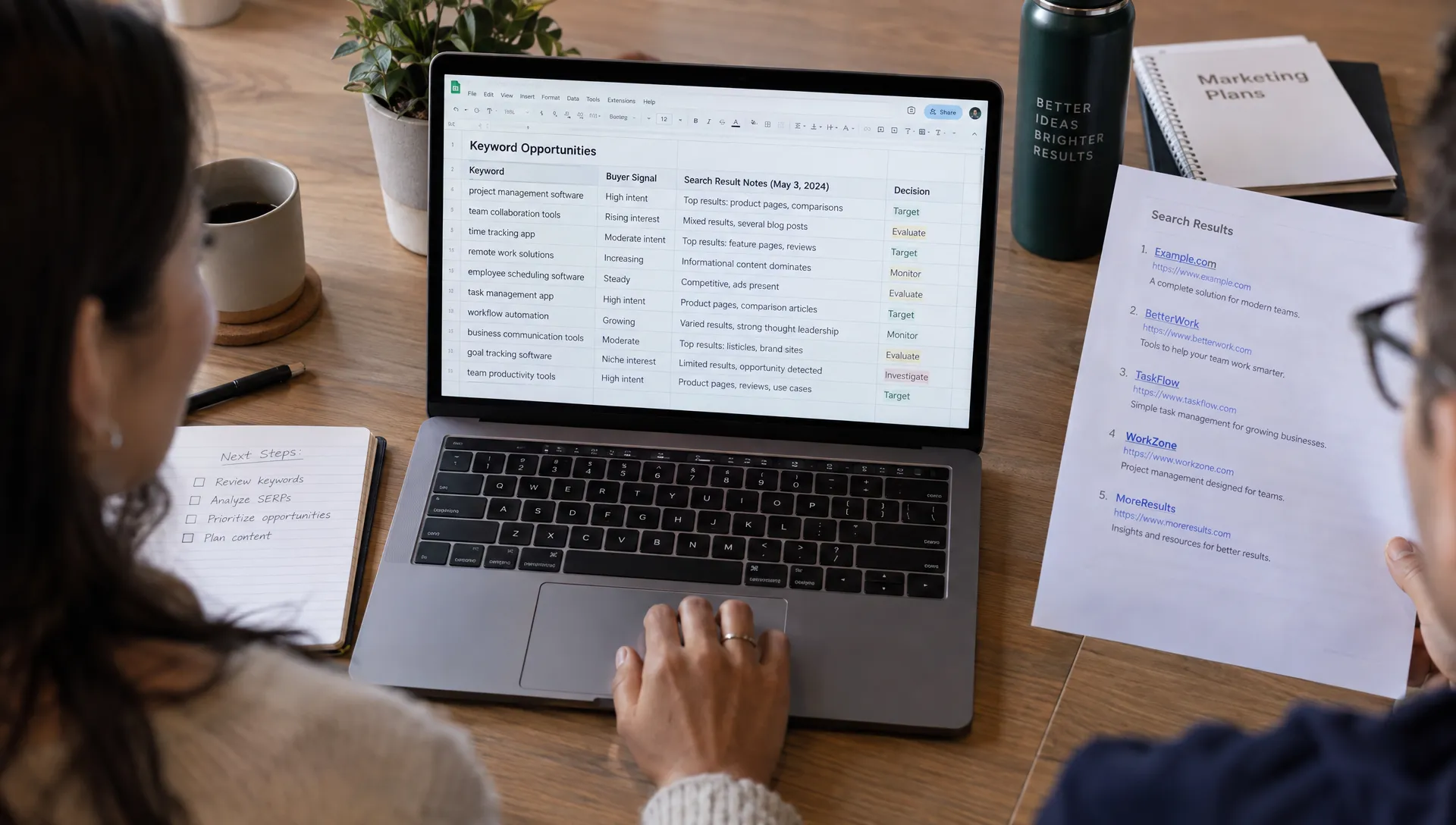
Record the date, device context and prominent result types. Note whether the page favors product listings, local businesses, comparison guides, service pages or informational answers. These observations help determine whether your proposed page matches the task.
For example, a hotel group might distinguish “extended stay hotel near hospital” from “what to pack for a hospital stay.” Both mention the same setting, but only one clearly expresses an accommodation need. The second could support awareness content without deserving the same acquisition priority.
Review competitors for recurring buyer requirements, not phrases to copy. Cancellation terms, parking restrictions, compatibility details and service availability can explain why certain pages satisfy the query.
The goal is not to declare AI SEO keywords valid because a competitor uses them. It is to establish that the query represents a recognizable task and identify what evidence a useful answer requires.
Turn broad phrases into testable buyer tasks
A broad phrase such as “managed IT services” leaves the buyer, location and purchasing constraint unclear. Translate it into a specific task, such as finding an MSP that supports multiple retail locations and documents its response commitments.
Keep two linked research assets: a conventional search cluster and several natural-language prompts. A search might be “multi-site retail MSP,” while an assistant prompt could ask, “Which IT providers support a 20-store retailer, and what should we verify before signing?” Neither proves that exact wording is common.
A real page such as garage door repair in Topsfield can establish service-and-location vocabulary for a local research project. It cannot establish monthly demand or justify applying the same service promises to another business. Verify each client's coverage and capabilities before expanding location clusters.
Treat AI SEO keywords as labels for buyer tasks, not phrases that every heading must repeat. This keeps local, product and B2B research grounded in an actual purchase decision rather than increasingly elaborate variations.
Prioritize with a transparent score, not invented volume
Use a simple rubric to expose your reasoning. The following is a proposed internal method, not an industry benchmark or a prediction of rankings.
| Criterion | 0 points | 1 point | 2 points |
|---|---|---|---|
| Commercial relevance | Outside your offer | Adjacent need | Direct fit with a target offer |
| Buyer evidence | AI suggestion only | One independent source | Repeated independent signals |
| Intent and format fit | Proposed page conflicts with results | Mixed or uncertain fit | Clear task and suitable format |
| Proof readiness | Required claims unsupported | Evidence needs work | Relevant facts verified |
As a starting rule, investigate candidates scoring 4 or 5 and consider those scoring 6 to 8 for production. Reject or park lower-scoring ideas unless there is a documented strategic reason to test them.
Apply hard gates before the total: do not publish an unavailable service, unsupported medical claim or incompatible product recommendation just because other scores are high.
For AI SEO keywords, this score describes decision confidence, not expected traffic. Add estimated demand, production cost and margin as separate fields when reliable data exists. A low-volume compatibility query may still deserve priority if it serves a valuable purchase and reduces costly returns.
Map each validated cluster to one useful page
Choose an existing destination before commissioning a new URL. Several variations can share a page when they represent the same task, offer and audience. Separate them when buyers need materially different evidence or actions.
For a hotel group, late arrival information may belong on a property's booking or FAQ page. For a WooCommerce store, product compatibility usually belongs on the relevant product page, supported by a guide when buyers need additional explanation. An MSP's procurement requirements may need a service page plus a detailed supporting resource.
Your brief should specify the buyer question, verified answer, supporting evidence, destination URL and conversion action. Include uncertainties that the writer must resolve rather than inviting the model to fill gaps.
Do not create separate pages simply because AI SEO keywords differ by one adjective. That can split useful evidence across thin URLs and make the right page harder to identify.
Build internal linking around the buyer's next step. A comparison guide should lead naturally to the relevant product or service, while a property guide should connect to the correct booking destination. The business benefit is a shorter route from research to action, not merely more links.
Make the evidence crawlable and reusable
Classic technical SEO helps eligible pages become accessible to search systems. Check crawlability, indexability, canonical URLs and whether essential facts appear in accessible page content. Fixing these issues reduces the chance that validated demand points toward a page systems cannot retrieve or understand.
Keep entities consistent: the same business, property or product should have coherent names, locations and identifiers across relevant pages. Use structured data and schema that match visible, verified information. Markup can clarify facts; it does not prove them or guarantee inclusion.
Page performance also matters commercially. Buyers who reach a slow booking flow or unstable product page may leave before converting, regardless of how well the keyword was researched.
Validating AI SEO keywords does not create a separate technical rulebook. GEO, or Generative Engine Optimization, focuses on visibility in generated answers. AEO, or Answer Engine Optimization, focuses on answering questions clearly enough for answer-oriented experiences.
Google's guidance on AI features and websites explains that established SEO practices remain relevant and that special AI markup is not required for its AI search features. Treat llms.txt as an emerging publishing convention, not a replacement for crawlability or proof that an assistant will cite you.
Test visibility and business outcomes separately
Once a page is published or improved, record a baseline and a review schedule. A team might review technical implementation immediately, search performance after several weeks and commercial outcomes over a longer period appropriate to its sales cycle. These are planning choices, not guaranteed response times.
Maintain a fixed set of buyer prompts across relevant experiences, including ChatGPT, Google AI Overviews, Gemini, Perplexity, Claude and Copilot. Record the engine, date, prompt and available location or account context. Distinguish answers using web retrieval from answers that do not expose current sources.
A single response is not a stable ranking. Repeat observations and preserve the answers so changes can be reviewed.
Measure AI SEO keywords through three separate lenses:
- Search exposure: Relevant impressions, clicks and landing-page performance for the cluster.
- AI inclusion: Brand mentions, cited URLs, factual accuracy and competitor presence across the tracked prompt set.
- Business outcomes: Qualified inquiries, bookings, assisted purchases or other verified conversion events.
Define share of voice before reporting it. For example, “answers mentioning our brand divided by all tested answers” differs from a citation-based measure. Neither is market-wide coverage unless the sample supports that claim.
CapstonAI's guide to measuring visibility beyond rankings explains how to keep exposure, inclusion and outcomes distinct. A citation is useful evidence of visibility, but it is not automatically a lead or sale.
Use findings to revise the decision
If impressions increase but qualified inquiries do not, inspect intent, offer fit and the conversion path before producing more content. If assistants mention the brand but repeat incorrect facts, prioritize correcting the source information and checking relevant third-party references.
If neither search nor AI visibility changes, confirm that the page is accessible and that the tested queries still match its purpose. Then revisit the evidence ledger. A weak hypothesis should be revised, not protected because the team already published it.
Keep a change log covering content edits, technical fixes and campaign activity. Without that context, a before-and-after comparison can wrongly attribute seasonality or paid promotion to keyword work.
Frequently asked questions
Can AI SEO keywords prove buyer demand? No. They identify possibilities. Validate them with independent buyer signals, current search results and commercial fit. Search estimates can support the decision, but they do not prove that your business will win traffic or conversions.
Should we reject keywords with no reported volume? Not automatically. Niche procurement, compatibility and location-specific questions can be valuable despite limited reporting. Require stronger buyer evidence and use a bounded test instead of assuming demand.
Which AI tool is best for this workflow? Choose tools by the evidence they expose: metric sources, market settings, source links, exportable records and privacy controls. Fluent suggestions are less useful than traceable data and decisions your team can review.
Do we need a new page for every assistant prompt? No. Group prompts by the underlying buyer task. Create another page only when the audience, offer or required evidence differs enough to justify it.
Start with a free AI visibility audit
Before expanding your keyword list, establish what search assistants currently see. Start with a free AI visibility audit from CapstonAI, then connect the findings to your buyer-evidence ledger.
CapstonAI tracks brand mentions, citations and competitive visibility across multiple engines and provides prioritized content recommendations. Use that baseline to select a small, defensible set of AI SEO keywords, improve the pages they map to and measure visibility separately from bookings, leads and sales.