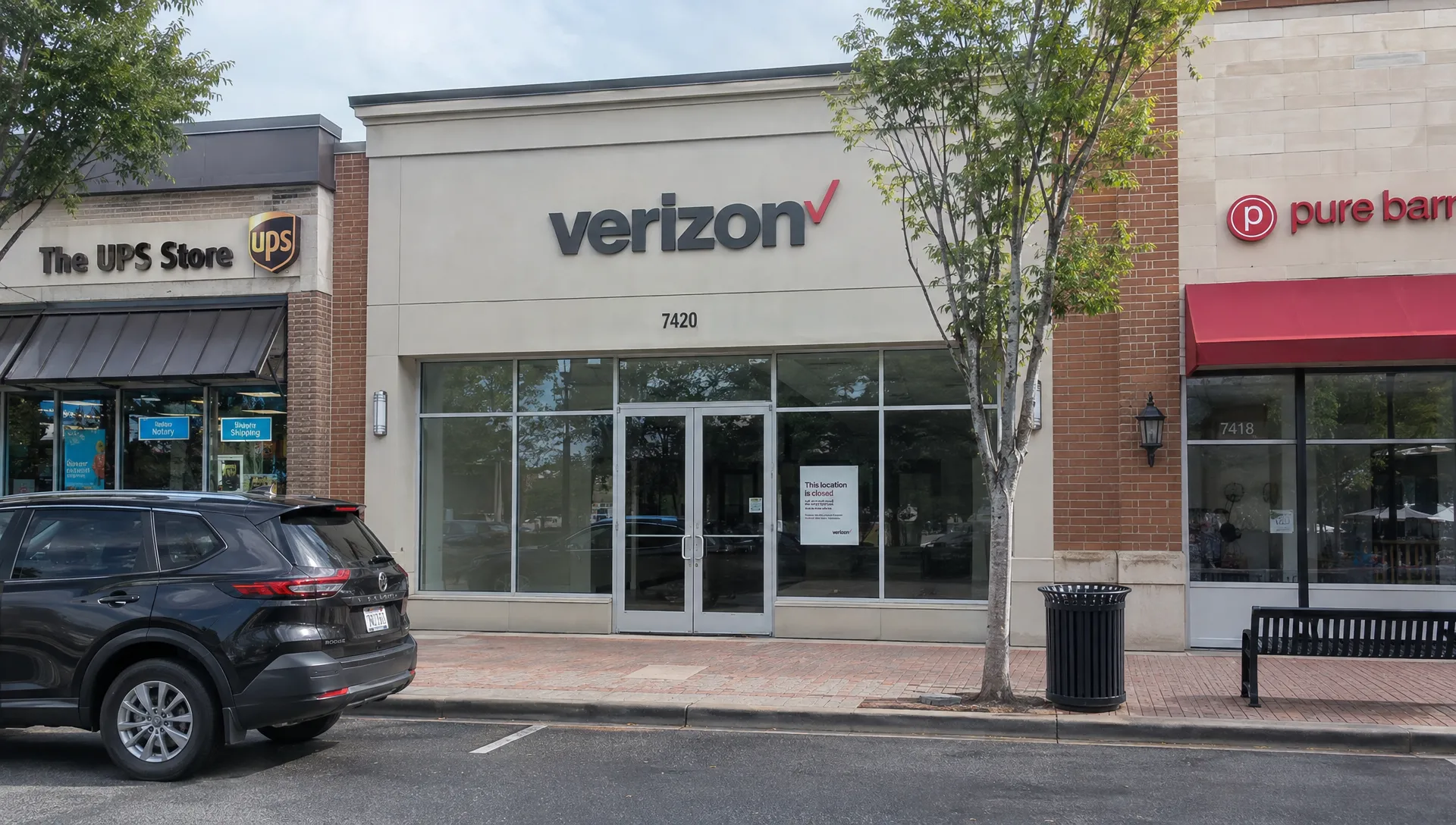
For a franchise network, tracking brand mentions after a location closes is an accuracy task, not just a reputation task. An old directory listing can send customers to a locked door. An AI-generated recommendation can repeat outdated opening hours. Meanwhile, deleting every reference to the former branch can erase useful closure information and disrupt journeys to nearby locations.
The objective is to stop closed locations from appearing as available options while preserving accurate history and visibility for the operating network. That requires location-level monitoring, clear ownership of corrections and repeatable checks across search, maps, review sites and AI answers.
Start by separating three things: the physical location, the franchise operator and the parent brand. They may have different names, identifiers and closure dates. A branch can close while its operator remains active, or leave the franchise while the premises continue trading. Those distinctions determine what you should correct.
A workflow for tracking brand mentions after a closure
A brand mention is a reference to your business, whether or not it includes a link. After a closure, its accuracy depends on the location, date and claim being made.
A historical newspaper article about a branch opening is not necessarily wrong. A current recommendation to book an appointment there is. Likewise, an AI citation shows which page an answer references, but does not prove that the answer accurately represents that page.
| Reference type | Example | Appropriate action |
|---|---|---|
| Accurate historical mention | “The Riverside branch opened in 2018” | Usually preserve it |
| Outdated operational claim | “Riverside is open until 8 p.m.” | Request a correction |
| Incorrect recommendation | “Book your next appointment at Riverside” | Correct the underlying sources and retest |
| Common-name match | An unrelated business named Riverside | Exclude from reporting |
| Indirect location reference | An old phone number without the brand name | Check against location records |
Sentiment alone cannot make these distinctions. A positive recommendation for a permanently closed clinic can cause more immediate harm than a critical but accurate historical review.
Track mentions, citations and recommendations separately. Then label whether each reference is current, historical, ambiguous or incorrect. This prevents a reporting mistake: treating every lost mention as a visibility problem, even when removing an obsolete recommendation was the desired outcome.
Create a location-level closure record
Effective tracking brand mentions starts with a reliable record of what actually changed. Without it, agencies, franchisees and corporate teams can submit conflicting edits.
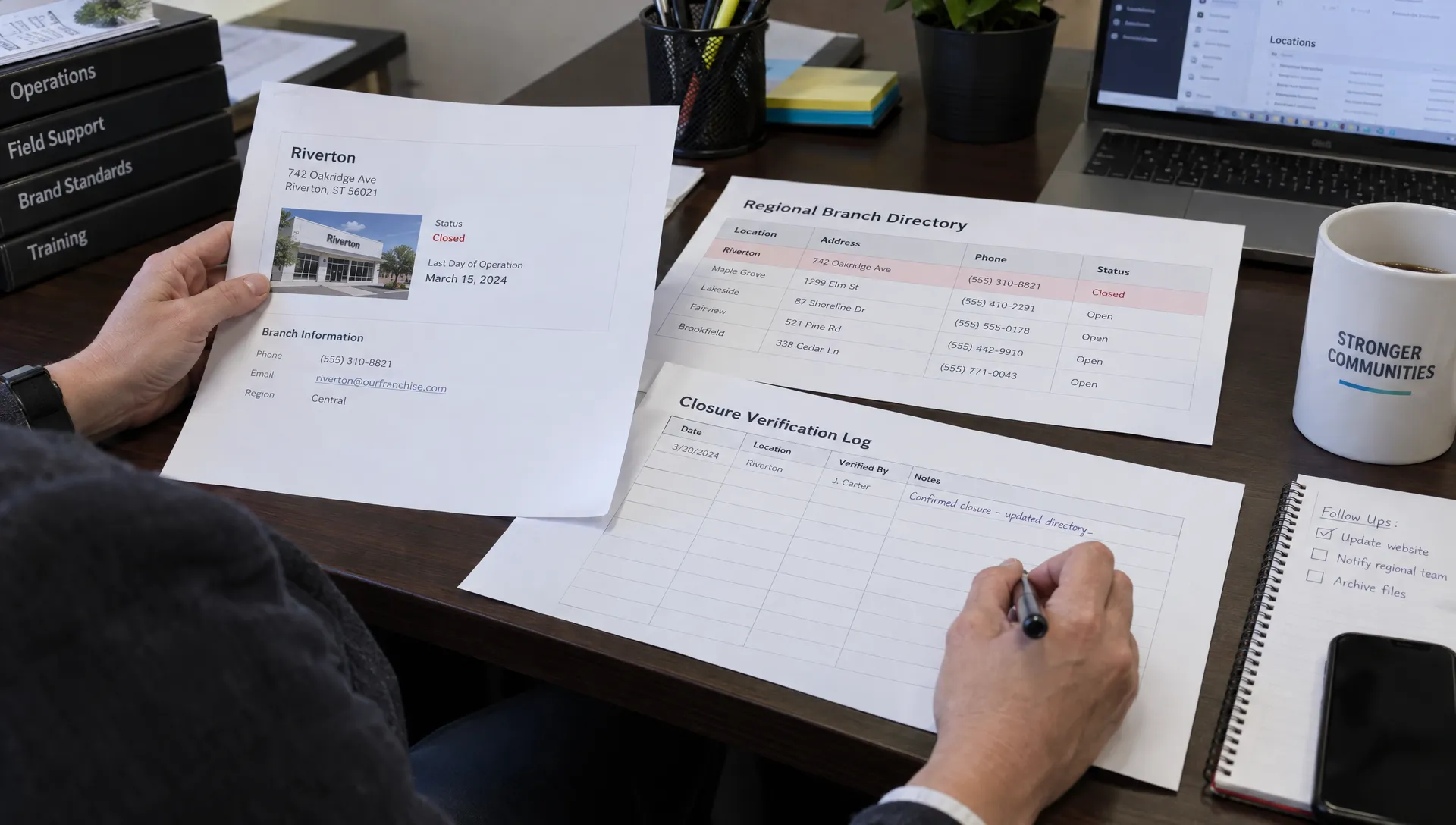
Create one closure record for each affected location, using a stable internal location ID rather than its trading name alone. Include:
- Official name, former names, address, phone number and location URL.
- Confirmed closure date and whether the change is permanent, temporary, a relocation or a franchise exit.
- Business profile identifiers, directory URLs and known booking or appointment links.
- Approved customer wording and any verified alternative location.
- Named owners for website changes, listings, customer support and external corrections.
Attach evidence such as an approved operations notice. Keep a change log showing who verified the status and when. If the closure date is uncertain, resolve that uncertainty before publishing definitive language.
For example, suppose a hypothetical retail network closes its Riverside branch on October 31. Its location record should distinguish that branch from a similarly named outlet across town. It should also state whether another branch accepts returns from Riverside customers, rather than assuming network-wide policies are identical.
This record becomes the reference for every correction. It also prevents former franchisee details from being accidentally merged into an active branch’s identity, which can misdirect calls, appointments and customer complaints.
Monitor the sources customers and AI actually encounter
For tracking brand mentions, begin with sources that can still generate a visit, call or transaction. These usually deserve attention before low-traffic historical coverage.
Check your location finder, individual branch pages, booking systems, Google Business Profile, Bing Places, major review platforms and relevant industry directories. Hospitality groups should include travel listings; healthcare franchises should check appointment directories and provider profiles.
Then search for combinations of the branch name, address, phone number and former operator. Queries such as "brand name" "street name" and "old phone number" can expose references that a brand-only alert misses. Free search alerts can supplement this work, but they are not a complete inventory.
Media monitoring and social listening add another layer. Look for local news, public community discussions, tagged posts and customer questions about the closure. Respond where clarification helps, rather than asking publishers to remove accurate history.
Record coverage gaps explicitly. Private groups, restricted platforms, unindexed pages and unsupported languages will not be fully visible to every monitoring tool. “No mentions found” means none were found within the monitored sources, not that none exist.
For multi-country networks, test local spellings and languages. Address formats and transliterations can reveal branch references that an English-language brand query would miss.
Test AI answers with repeatable local prompts
A useful approach to tracking brand mentions in AI separates brand recall from location accuracy. Asking whether an assistant knows your brand is not enough to discover whether it recommends a closed branch.
Build a fixed prompt set covering different customer intentions:
| Intent | Example prompt |
|---|---|
| Status verification | “Is Brand’s Riverside location still open?” |
| Local discovery | “Where can I get an eye exam near Riverside?” |
| Transaction | “Where can I book a room with Brand near the airport?” |
| Post-closure support | “Where can I return something bought at Brand Riverside?” |
Monitor ChatGPT, Google AI Overviews, Gemini, Perplexity, Claude and Copilot where relevant to your audience. Treat each surface separately because answer availability, retrieval behavior and citations differ.
For each test, save the prompt, timestamp, language, geographic settings where available, answer text, links and screenshot. Record whether web search was enabled. Use fresh conversations and repeat tests, since one response is not representative of every customer experience.
A manageable pilot could use 12 prompts across four surfaces, repeated three times: 144 scheduled test cases. For Google AI Overviews, record when no overview appears instead of treating it as an accurate answer.
Keep a stable core prompt set for comparisons, then add new discovery prompts separately. Our guide to monitoring ChatGPT mentions and competitor share explains the broader measurement approach. For closures, the additional requirement is verifying the specific branch behind each mention.
Prioritize errors by customer harm, not sentiment
When tracking brand mentions, urgency should reflect what a customer might do next. An incorrect booking link deserves faster action than a dated article that clearly describes the past.
Use a shared queue with an evidence link, location ID, severity, correction owner and next review date. Separate the person who can request a correction from the platform that controls publication.
| Priority | Finding | Primary owner | First action |
|---|---|---|---|
| Critical | Payment or appointment flow accepts transactions for the closed branch | Operations and web team | Disable the unavailable transaction path |
| High | Maps or AI recommends visiting the closed branch | Listings or SEO team | Correct authoritative sources and submit edits |
| Medium | Directory displays old hours without a transaction path | Local marketing team | Request an update and record the submission |
| Low | Accurate historical coverage mentions the former branch | Communications team | Usually retain and monitor |
Validate ambiguous matches before escalating them. A matching brand name alone is weak evidence; a matching address or branch phone number is stronger. Keep uncertain references in a review queue rather than inflating the error count.
For public replies, state the closure date and a verified next step. Do not disclose franchise disputes or promise refunds, service transfers or appointment availability without operational approval. Accurate, restrained replies protect credibility better than generic reassurance.
Correct owned pages before requesting outside edits
The fastest gains from tracking brand mentions often come from fixing sources you control. Start with the pages and transaction paths that still imply the branch is operating.
A useful closure page states the location name, full address, permanent closure date and approved support route. Where appropriate, it can offer a nearby operating branch, but only after confirming service availability and any restrictions.
Do not automatically redirect every closed branch URL to the homepage or nearest location. Customers may need to confirm the closure, retrieve contact information or understand an existing booking. If there is a genuine replacement page, a permanent redirect can make sense; Google’s redirect guidance explains how these signals work.
Keep a useful closure notice accessible while it serves a customer need. If a page has no continuing value and no suitable replacement, returning a proper 404 or 410 can be appropriate. Do not return a successful status code with an empty page and expect a clear outcome.
Update internal linking at the same time. Remove closed branches from “open locations” lists, promotional cards, navigation and booking selectors. Retain contextual links to closure information where customers still need it.
Correct business profiles to the appropriate status through their management workflows. Do not treat profile deletion as a substitute for communicating closure, and do not attempt to remove legitimate reviews simply because the location stopped trading.
Align schema, crawlability and page performance
Technical cleanup makes tracking brand mentions actionable: it reduces contradictions between what customers read and what machines can retrieve.
Structured data, including schema markup, describes entities such as organizations, locations and services. Review the closed page for obsolete opening hours, booking actions, offers and branch details. Do not invent a universal “permanently closed” schema property or assume markup alone will override conflicting listings. Follow Google’s LocalBusiness structured data documentation for supported usage.
An entity is the specific business or location a system is trying to identify. Keep branch identities distinct from the parent organization and any replacement operator. Our explanation of how search engines understand franchise locations covers those identity relationships in more detail.
Check that useful closure notices are crawlable, return the intended HTTP status and display essential information without requiring an interactive location search. Remove retired URLs from XML sitemaps when they are no longer intended for indexing.
Page performance matters because a slow or broken closure notice can prevent customers from reaching the alternative branch or support channel. Test mobile loading and the actual call, booking and directions journeys.
These improvements support technical SEO, Generative Engine Optimization (GEO) and Answer Engine Optimization (AEO): making reliable information discoverable and usable in search and generated answers. An optional llms.txt file is not a guaranteed ingestion mechanism or a replacement for accessible pages.
Separate storefront status from corporate status
Another benefit of tracking brand mentions at location level is avoiding false statements about the wider business. “This branch is permanently closed” does not mean “the company has ceased trading.”
A franchise closure may involve a lease ending, an operator change, a relocation or termination of a franchise agreement. Each requires different public language. If a former franchisee continues independently, describe the end of the brand affiliation accurately instead of automatically labeling the premises closed.
Keep corporate changes in a separate, coordinated workstream. For UAE portfolios, providers such as Alldren, which offers company compliance and governance services, address corporate administration rather than the search-listing correction itself. The relevant legal and finance teams should confirm any required company-level updates.
This distinction matters for monitoring rules. A media report about the former operator may be accurate without describing the parent brand. Conversely, an old directory may retain the franchise name after the operator has changed.
Before requesting edits, establish which entity the reference concerns and which statement is wrong. That reduces unnecessary disputes with publishers and avoids spreading an inaccurate claim about insolvency, ownership or continued trading. Give customer support the same approved wording so phone responses do not contradict the website.
Prove recovery without mistaking silence for success
Reporting for tracking brand mentions should show whether misinformation is declining while accurate visibility for active branches is preserved. Raw mention volume cannot establish that.
Measure location-specific error rates alongside commercial signals. Useful measures include the proportion of returned answers that incorrectly describe the closed branch as open, the proportion of eligible local recommendations that suggest visiting it and the number of unresolved incorrect source pages.
Keep denominators visible. In a hypothetical test, eight incorrect recommendations among 40 returned recommendation answers is 20%. Three among 42 is about 7.1%. That is an improvement within the tested sample, not proof of the same change across all users.
Track share of voice for operating branches separately from obsolete branch mentions. Removing a closed location from recommendations can reduce total mentions while improving customer outcomes. Competitor comparisons should use the same prompts, surfaces and testing conditions.
Connect corrections to wrong-location calls, failed bookings, refund requests or completed journeys to alternative branches where those signals are available. Annotate changes rather than attributing every movement to one edit.
Retest frequently during the initial cleanup, then adjust the cadence to the rate of new errors. Reopen issues when misinformation returns. Close a correction ticket only after checking the live source, not merely receiving confirmation that an edit request was submitted.
Frequently asked questions
How long should we keep monitoring a closed franchise location? Continue while outdated references create a meaningful customer risk. Maintain a lighter recurring check afterward, especially if the old address, phone number or location page still attracts attention. There is no universal point when all third-party references disappear.
Can tracking brand mentions confirm that ChatGPT has forgotten a closed location? No. It can show how ChatGPT responds to a defined set of prompts under recorded conditions. Repeated tests improve confidence in that sample, but cannot establish what every user will see or whether underlying model knowledge has changed.
Should every mention of the closed branch be removed? No. Preserve accurate historical references. Prioritize misleading operational claims, unavailable transaction paths and recommendations that could send someone to the closed location.
Will correcting our website immediately fix AI answers? Not necessarily. An answer may draw on third-party pages, previously retrieved material or other information. Correct owned sources, request external updates and repeat the same tests. A citation is useful evidence, but it does not expose every influence on an answer.
Start with a free AI visibility audit
Start with a free AI visibility audit from CapstonAI to establish how your brand appears across AI search. Then add your closure register and location-specific tests to the correction workflow.
CapstonAI supports multi-location monitoring, brand mention and citation tracking, competitor visibility analysis and prioritized content recommendations. Use that measurement foundation to distinguish accurate visibility for operating branches from outdated references that need correction.