
Strong rankings tell you where a page appears. They do not tell you whether your seo visibility extends to an AI-generated recommendation, whether that recommendation is accurate or whether it helps someone book, buy or request a quote.
Consider a hypothetical hotel group that ranks well for destination searches but is missing from answers about family-friendly stays. Another brand might appear frequently, yet be described with outdated amenities. Those are different problems, and neither is explained by average ranking position.
The useful measurement unit is no longer just a keyword and a URL. It is a buyer question, an answer, a named business and the evidence supporting that answer.
For hotels, franchise networks, MSPs and e-commerce teams, the reporting goal is straightforward: identify where discovery breaks down, distinguish missing visibility from incorrect information and connect improvements to commercial outcomes. Start by separating those questions rather than compressing everything into one score.
Define seo visibility across three measurement layers
Traditional search visibility usually estimates exposure from rankings, search volume and sometimes assumed click-through rates. AI search adds another layer: whether an engine includes your business in a generated answer and what it says about you.
Keep three measurement layers separate:
- Search exposure: Impressions, ranking distribution, clicks and organic landing-page performance.
- Answer inclusion: Brand mentions, recommendations, citations and factual accuracy across defined buyer questions.
- Business outcomes: Qualified visits, bookings, purchases, leads and assisted conversions.
A gain in answer inclusion does not automatically create more website traffic. Someone may use the answer without clicking, search for your brand later or contact a location directly. Conversely, a rise in clicks can come from unrelated search demand.
Preserving these layers prevents a common reporting mistake: treating an AI mention as revenue, or treating flat organic traffic as proof that AI discovery has not changed.
Build an answer-level scorecard
A defensible seo visibility scorecard gives every metric a clear numerator, denominator and interpretation. The following definitions are a practical starting point, not universal industry standards.
| Metric | Working definition | Business question it answers |
|---|---|---|
| Brand mention rate | Valid prompt runs naming your brand ÷ all valid prompt runs | Are buyers encountering the business? |
| Owned-site citation rate | Valid runs linking to your domain ÷ all valid prompt runs | Is your website being used as supporting evidence? |
| Recommendation rate | Valid runs explicitly recommending your brand ÷ all valid prompt runs | Are you included as a relevant option? |
| Competitive share of voice | Your brand-answer appearances ÷ appearances for all brands in a defined comparison set | How much of the measured competitive conversation belongs to you? |
| Critical-fact accuracy | Correct checked facts ÷ all checked facts | Can buyers rely on the description? |
| AI referral conversion rate | Conversions from identifiable AI referrals ÷ sessions from those referrals | Does measurable referred traffic produce outcomes? |
A valid run is a completed observation under your documented test conditions. Exclude technical failures, but record them separately. If Google does not display an AI Overview for a tested query, record that absence rather than silently removing the query.
Separate mentions, citations and recommendations
A mention is not necessarily an endorsement. An answer can name a hotel while explaining that it lacks a requested facility. A citation can link to a comparison article without recommending every business discussed there.
For useful seo visibility reporting, label these outcomes separately. At minimum, distinguish a neutral mention, a positive recommendation, an explicit exclusion and an incorrect description.
Also distinguish an owned-site citation from a third-party citation supporting a statement about your brand. The first indicates direct use of your content. The second may reveal that directories, reviews or editorial coverage are supplying information about the business.
For example, in an illustrative set of 40 valid runs, a brand might receive 24 mentions, 10 owned-site citations and 14 recommendations. Those correspond to 60%, 25% and 35%, respectively. They are overlapping categories, not percentages to add together.
Store the exact answer and cited URLs. A summary score without the underlying evidence makes it difficult to diagnose an error or verify a reported improvement.
Make share of voice and accuracy auditable
Share of voice requires an explicit counting rule. Count each brand once per answer, even if it appears several times. Define the competitor set before testing and state whether results are calculated separately by engine or combined.
Suppose your brand appears in 24 answers, competitor A in 36 and competitor B in 20. Within that three-brand set, your share of voice is 24 ÷ 80, or 30%. Your mention rate can still be 60% if the test included 40 runs. The metrics answer different questions.
Accuracy is equally important to seo visibility, particularly for multi-location businesses. An incorrect address, service area, accessibility claim or product availability statement can undermine an otherwise positive recommendation.
Check facts against an approved source of truth, such as current location pages or product records. Report missing facts separately from incorrect ones, and flag commercially important errors rather than hiding them inside an average. A wrong booking policy deserves attention even when nine other facts are correct.
Make comparisons reproducible
Build prompts around actual buying decisions
A test set should represent the questions your customers ask, not just variations of your brand name. Branded prompts are useful for accuracy checks, but they cannot establish whether an unfamiliar buyer would discover you.
Use customer interviews, sales conversations, support logs and search-query data to identify relevant questions. Examples include “hotels near the convention center with accessible rooms,” “managed IT support for a multi-site dental group” and “WooCommerce inventory tools for multiple warehouses.”
Group prompts by intent, geography, service line and buying stage. This makes seo visibility actionable: a weakness in high-intent local recommendations deserves a different response from a gap in broad educational answers.
Keep a fixed benchmark set for comparisons and a separate exploratory set for new questions. If you replace the benchmark whenever results look weak, changes in the score may reflect easier questions rather than better performance.
Do not present equal-weight prompt results as market-wide exposure. Your selected questions are a sample, and their commercial importance will differ.
Record the conditions behind every answer
ChatGPT, Google AI Overviews, Gemini, Perplexity, Claude and Copilot do not provide interchangeable observations. Their retrieval behavior, available sources and interfaces differ. Answers can also vary between repeated runs.
Record the engine, displayed model where available, date, locale, account state, prompt wording and whether web retrieval was enabled. Start new conversations for benchmark tests so earlier messages do not influence the result. Capture the visible answer and links, not an assumed account of the model's reasoning.
For an illustrative pilot, 12 prompts repeated three times across six surfaces produce 216 planned observations. Record how many actually returned an AI answer, how many were valid and how many failed technically.
Interpret changes in seo visibility against that sample size. Moving from two mentions to three in five runs is a weak basis for a strategic conclusion. A repeated improvement across several relevant prompt groups is stronger evidence.
Keep API results separate from consumer-interface results unless you have established comparability. Matching the model name does not prove that retrieval settings or answer behavior match.
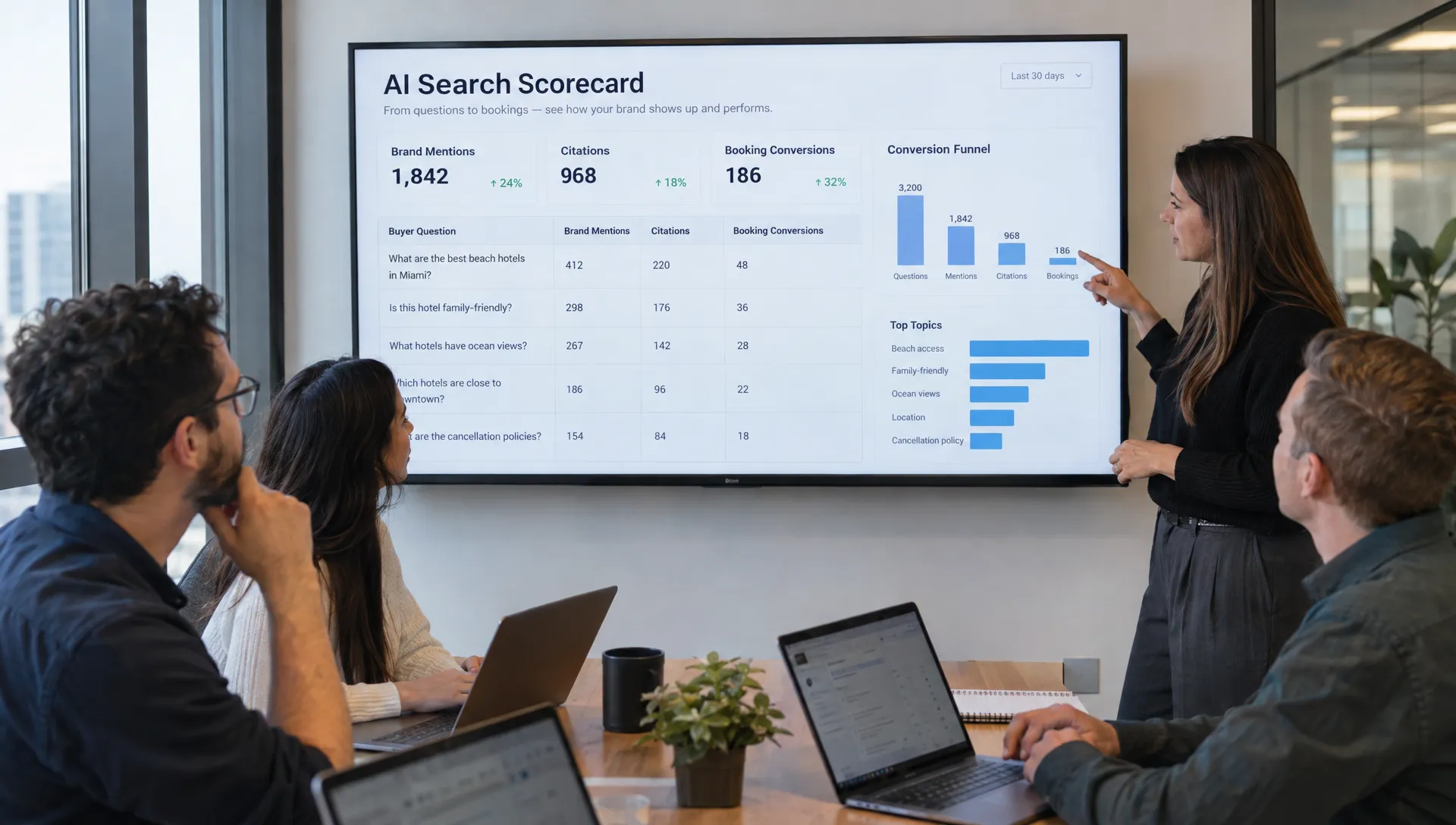
Connect answer inclusion to bookings, leads and sales
Measure identifiable AI referral sessions in analytics, then examine landing pages, engagement and completed conversions. Confirm that referral rules and conversion events work before interpreting trends.
Google's guidance on AI features and website reporting explains how traffic from its AI search features is included in Search Console reporting. Do not treat an aggregate Web search total as a clean measurement of AI-only traffic.
Some journeys will remain unattributed. Buyers can read an answer, return directly or complete a purchase on another device. Branded search trends and self-reported discovery questions can provide supporting evidence, but they do not establish causation by themselves. Our guide to AI's impact on traffic, leads and reporting explores this reporting distinction in more detail.
Keep discovery and conversion diagnostics separate. For example, an event organizer using TixFlow's event ticketing platform could measure whether AI answers recommend its events, then separately measure whether referred visitors complete the ticket checkout. More recommendations with unchanged sales could indicate an audience mismatch or a checkout problem rather than an inclusion problem.
The same distinction applies to hotel bookings, franchise inquiries and e-commerce orders.
Diagnose the gap before choosing a fix
Generative Engine Optimization (GEO) aims to make content easier for generative engines to retrieve, interpret and use. Answer Engine Optimization (AEO) focuses on making answers clear and directly usable. Both depend on technical SEO foundations, but neither guarantees inclusion.
Map the observed failure to a specific intervention. Missing mentions, missing citations and inaccurate descriptions should not automatically trigger the same content rewrite.
If the business is missing, inspect access and identity
First check whether important pages are crawlable and indexable where appropriate. Review robots directives, canonical tags, status codes, rendering and internal links. Distinguish search-retrieval crawlers from training crawlers when evaluating access policies, since their purposes can differ.
A location page buried behind filters or accessible only through an on-site search can be difficult to discover. Linking it from a relevant regional hub gives users and crawlers a clearer route to booking information.
For multi-site brands, seo visibility also depends on consistent entity information. An entity is the identifiable business, location, person or product an engine is describing. Conflicting names, addresses and service claims make that identity harder to resolve.
Use suitable structured data, such as Organization, LocalBusiness, Product or Hotel schema, to express facts already visible on the page. Schema can clarify relationships; it does not force an engine to recommend a business.
Google's AI search guidance does not prescribe special AI-only schema. Validate the markup you use and prioritize accurate page content over adding unsupported properties.
If the answer is wrong or unsupported, improve the evidence
Publish important facts in accessible page content, not only inside images, downloadable brochures or interactive components. Explain who a service is for, where it is available and what limitations apply. Connect supporting policies and relevant detail pages through contextual internal linking.
An MSP page saying “complete IT solutions” gives little evidence for a specific recommendation. A page describing supported environments, service coverage and escalation arrangements helps a prospective buyer evaluate fit and gives an engine more precise material to use.
Treat llms.txt as a supplementary publishing experiment. It is a proposed convention for directing language-model tools to useful content, not a guaranteed inclusion mechanism or a replacement for crawlability.
Page performance supports the business side of seo visibility. Slow booking forms, unstable layouts and unresponsive filters can waste traffic that discovery improvements generate. Use Core Web Vitals alongside real funnel data to identify experience problems. Better performance is not proof that an AI engine will cite a page more often.
Use paired tests, not before-and-after storytelling
Record a baseline before changing content or technical settings. Save the tested URLs, prompts, answers and measurement conditions. Document what changed and when it became available to relevant crawlers.
Retest the same benchmark under comparable conditions, allowing for recrawling and normal answer variation. Where practical, keep a similar unchanged page or prompt group as a comparison. It will not eliminate every confounding factor, but it helps reveal broader engine changes.
Evaluate the result at the level of the intervention. If you corrected location facts, assess factual accuracy. If you improved a service page's supporting evidence, examine relevant citations and recommendations. Site-wide traffic is too broad to explain every local change.
An improvement in seo visibility is more credible when the relevant answers improve repeatedly, the underlying facts are correct and commercial indicators move in a compatible direction. Avoid claiming that a single edit caused a revenue increase without stronger evidence.
Once definitions and test conditions are stable, incorporate the measures into a weekly AI search tracking routine. Monitoring should preserve comparability, not encourage constant changes to the test set.
Frequently asked questions
Can a brand rank well but be absent from AI answers? Yes. Ranking measures placement in search results, while answer inclusion depends on the question, available sources and engine behavior. Check both rather than assuming one predicts the other.
What is a good AI share-of-voice percentage? There is no universal benchmark. The result depends on your prompt sample, competitors, engines and counting rules. Establish a relevant baseline and compare like-for-like results, especially for commercially important questions.
Should every AI answer cite our website? No. Engines may use third-party sources or provide answers without visible citations. Track owned-site citations separately from mentions and recommendations, then investigate missing evidence where it affects buyer confidence.
Does llms.txt improve AI inclusion? Do not assume it does. Test it as a supplementary measure while maintaining accessible content, accurate facts and sound technical SEO. Publication alone is not evidence that an engine has used the file.
Can one score summarize seo visibility? A composite score can help prioritize attention if its components and weights are transparent. Keep the underlying mention, citation, accuracy and conversion measures visible so a headline score does not conceal a critical problem.
Start with a free AI visibility audit
Begin with CapstonAI's free AI visibility audit. Use the findings to establish a baseline for relevant buyer questions, brand mentions and citations, then prioritize the gaps that affect discovery or credibility.
The next step is not to chase every possible AI mention. It is to choose one meaningful gap, fix the supporting page or business information and measure whether the relevant answers improve.