A search for “seo chatgpt” can lead an MSP toward tactics for getting mentioned in AI answers. For services with long sales cycles, mentions are only the beginning. A prospect may discover your firm while researching ransomware recovery, return months later to compare managed service providers and involve finance before requesting a proposal. Your content needs to support that entire decision, not just win an initial recommendation.
The practical goal is to make your services discoverable, your claims verifiable and your buying process easier to evaluate. Measure progress through qualified visibility and sales conversations, then connect those signals to pipeline without pretending every AI mention caused a deal.
Optimize for evaluation, not just discovery
Consider a hypothetical manufacturer evaluating an MSP for 12 locations. Its IT director wants coverage details, its security lead needs evidence of operational controls and its CFO wants to understand transition costs. A generic “best managed IT provider” page cannot answer all three.
ChatGPT SEO should help each stakeholder resolve a specific uncertainty. Being recommended without accurate information about service scope can create unqualified inquiries. Being cited for a useful migration checklist may help a buyer evaluate you even when no immediate inquiry follows.
Three disciplines work together here. Technical SEO makes pages accessible and understandable. Answer Engine Optimization (AEO) makes specific answers easy to find. Generative Engine Optimization (GEO) addresses how a business is represented in generated responses. None replaces the need for credible service delivery evidence.
Turn “seo chatgpt” research into a buying-committee content plan
Start with questions from discovery calls, security questionnaires, stalled proposals and lost-deal reviews. Remove confidential customer details before using that material in public content or external AI tools.
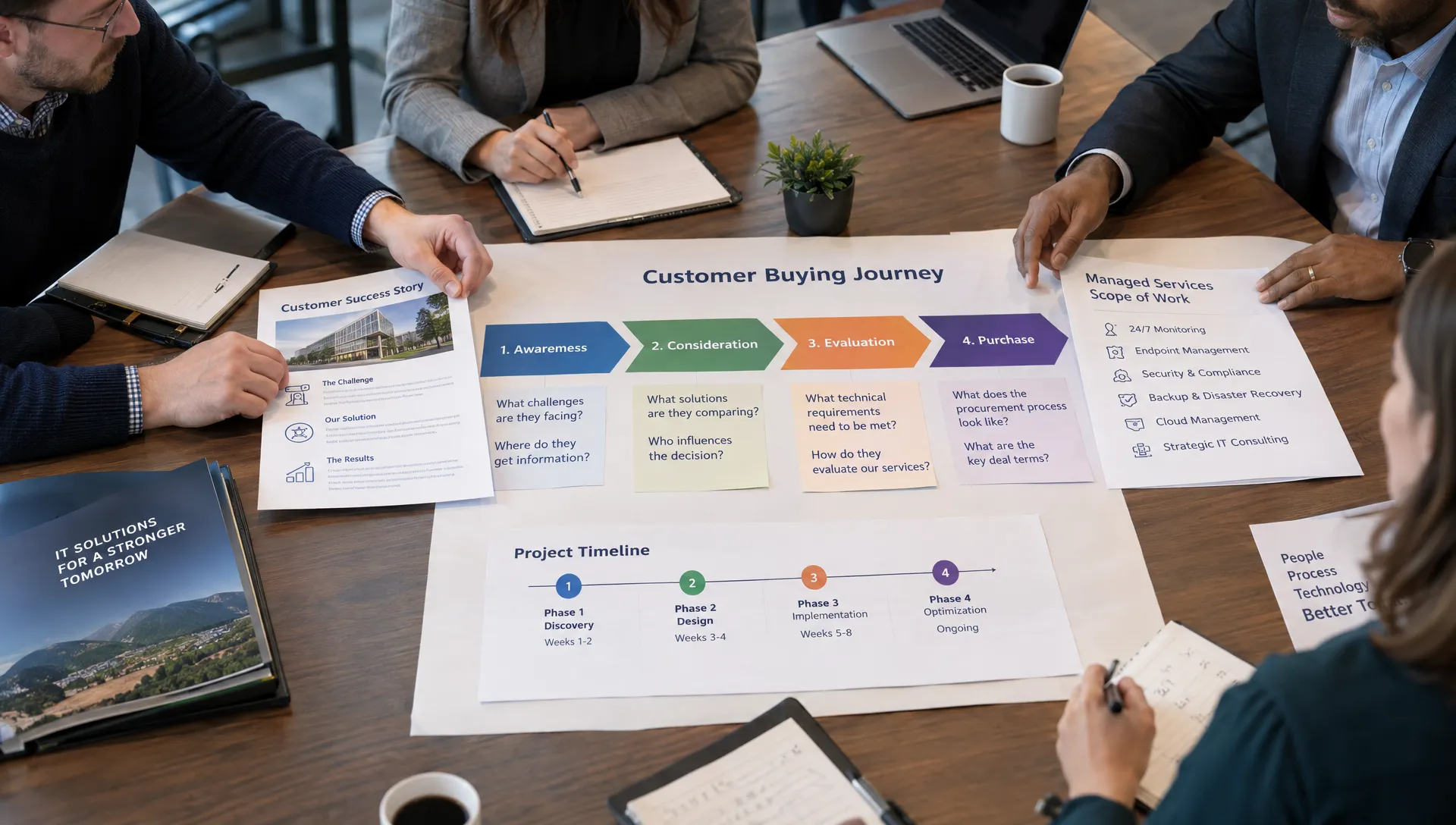
Map each question to a stakeholder, an evidence page and an appropriate next action:
| Buying situation | Representative question | Useful public content | Appropriate next step |
|---|---|---|---|
| Problem recognition | Should we outsource IT or expand our internal team? | A decision guide explaining operating trade-offs | Download a requirements worksheet |
| Technical evaluation | Can this provider support multiple sites and our existing stack? | Service scope, coverage details and documented integration boundaries | Request a technical fit discussion |
| Security review | What evidence supports the provider’s security claims? | Verified credentials and a clear description of the review process | Request controlled access to due-diligence materials |
| Financial approval | What changes the monthly cost and onboarding effort? | Pricing drivers, assumptions and an illustrative cost model | Request a scoped estimate |
| Procurement | How will transition, escalation and exit work? | Onboarding stages, governance responsibilities and contract FAQs | Schedule a transition planning call |
This makes ChatGPT SEO useful beyond acquisition. Sales teams can reuse the same pages when an opportunity pauses at a particular approval stage.
Avoid generating dozens of near-identical industry or city pages. Create separate pages when the service, evidence or buyer requirements genuinely differ, not simply because a keyword changes.
Publish answers that reduce commercial uncertainty
Explain scope, costs and exclusions
A useful service page says what is included, what depends on the contract and what requires separate work. “Comprehensive IT support” leaves too much unresolved for either a buyer or an assistant summarizing your offer.
For example, distinguish help-desk availability from guaranteed response times. Explain whether a response target varies by severity and whether on-site coverage has geographic limits. Only publish commitments your contracts and operations support.
If you do not publish prices, explain the variables: user count, locations, supported systems, coverage hours and transition complexity. A clearly labeled hypothetical scenario can show how those variables interact without presenting an invented quote.
Place the direct answer near the relevant heading, then provide conditions and supporting detail. This helps readers assess fit quickly and gives retrieval systems a coherent passage to work with. It does not guarantee that an engine will select or cite it.
Make evidence specific and safe to share
For long-cycle services, ChatGPT SEO needs evidence pages as well as service descriptions. Useful material includes approved case studies, named delivery responsibilities, verified partner credentials and an explanation of how service reviews work.
A case study should separate the starting situation, work performed and measured outcome. If a customer reported a result, identify it as customer-reported. If an outcome lacks a reliable baseline, describe the change without inventing a percentage improvement.
Keep security-sensitive details behind an appropriate review process. Public content can explain how a prospect requests an assurance package without exposing network diagrams, credentials or customer-specific runbooks.
Third-party references can corroborate your identity and capabilities. Maintain accurate vendor directories and relevant business listings, but do not treat directory volume as evidence of quality. CapstonAI’s guide to earning credible ChatGPT citations explains the broader foundations; for MSPs, the priority is evidence a buying committee can actually verify.
Remove technical obstacles to accurate retrieval
Check crawlability before rewriting content
A strong answer is of little use if the relevant crawler cannot access it. Check that priority public pages return successful responses, use appropriate canonical URLs and are not accidentally excluded by robots rules, authentication or indexing directives.
Inspect firewall and bot-management rules too. A page that works in your browser may still present a challenge to automated visitors. Put essential service information in accessible page text rather than relying entirely on interactions or downloadable PDFs.
OpenAI distinguishes its search crawler, OAI-SearchBot, from its training crawler, GPTBot, in its crawler documentation. Review access decisions against that documentation instead of treating every AI-related user agent identically. Allowing a crawler does not guarantee inclusion.
This is where ChatGPT SEO overlaps with classic technical SEO: access problems can prevent accurate evaluation before content quality even becomes relevant.
Connect your business identity, schema and internal links
An entity is the identifiable business, service or location described across your pages and external references. Use consistent company names, service descriptions and location details so those references do not contradict one another.
Structured data can make that identity more explicit. Use appropriate schema types, such as Organization, Service and BreadcrumbList, where they accurately describe visible content. Validate the markup and avoid inserting unsupported certifications, ratings or coverage claims.
Internal linking should connect a service page to its supporting evidence, relevant industry guidance and next step. Descriptive links help people and crawlers understand those relationships. Do not leave your strongest case study isolated in an archive.
An llms.txt file can provide an additional curated guide to public material, but adoption and use vary. It is not a substitute for crawlability, a sitemap or clear site architecture, and it is not a ranking requirement.
Treat performance as a buyer-experience issue
Fast, stable pages make service evaluation easier on mobile and constrained connections. Compress oversized assets, reduce unnecessary scripts and keep forms usable without heavy widgets.
Do not claim that a particular performance score earns AI citations. The immediate business effect is simpler: a prospect who follows a source link should be able to read the evidence and contact you without friction.
Google’s guidance on AI features and websites reinforces the role of established search fundamentals. Special AI markup is not a replacement for accessible, useful pages.
Measure visibility across the actual buying journey
Build a repeatable prompt panel
A practical ChatGPT SEO baseline starts with a fixed set of buyer questions, not one favorable screenshot.
For an illustrative panel, combine four buying situations with three service lines and two customer segments. That produces 24 prompts, a manageable starting sample rather than a universal requirement. Include both unbranded questions and branded evaluation questions, and report them separately so brand-led prompts do not inflate apparent discovery.
Test relevant surfaces independently: ChatGPT, Google AI Overviews, Gemini, Perplexity, Claude and Copilot. Search-enabled modes, available sources and response formats differ, so record the engine, mode, date, geography and exact prompt. Where an interface produces no AI answer, record that rather than silently dropping the result.
Save responses and citations. Repeat observations where practical to expose variability, but avoid describing repeated answers from the same prompt as independent buyers. Compare like-for-like samples over time.
Separate presence, citations and share of voice
A brand mention is not necessarily an endorsement, and a source citation is not necessarily a brand recommendation. Review the context, not just the presence of your name.
| Measure | Definition for your reporting | What it helps diagnose |
|---|---|---|
| Relevant brand presence | Share of sampled answers that include your firm as a relevant option | Whether buyers encounter you in the tested situations |
| First-party citation rate | Share of sampled answers linking to your website | Whether your pages are used as sources |
| Peer-set share of voice | Your qualifying mentions divided by qualifying mentions of all defined peers | Relative visibility within the monitored comparison set |
| Representation accuracy | Whether statements about scope, geography and credentials match verified facts | Risks from misleading or outdated descriptions |
| Journey coverage | Buying situations where useful visibility is present or missing | Which evidence pages need attention next |
For example, six first-party citations in 24 saved answers represent a 25% citation rate for that sample, not a market-wide visibility estimate. If you use share of voice, define the peer set and count each brand at most once per answer.
These distinctions keep ChatGPT SEO reporting commercially useful. A rise in mentions alongside inaccurate service claims is a correction task, not an uncomplicated success. A documented AI citation tracking process also makes before-and-after comparisons easier to interpret.
Connect visibility to pipeline without overstating attribution
Use three reporting layers: AI visibility, identifiable website engagement and qualified pipeline. Each answers a different question.
Capture referral information when available, but expect gaps. A buyer may read an AI answer, search your brand later and arrive without an identifiable AI referral. Add a neutral discovery question to forms or sales conversations, such as “Where did you first hear about us?” Keep self-reported discovery separate from analytics attribution.
In your CRM, record the original inquiry date, service interest, qualification outcome and opportunity stage. Compare cohorts over a period that reflects your actual sales cycle. A 90-day initiative may reveal better discovery and more relevant conversations before it produces closed revenue.
An on-site assistant can help visitors navigate approved material after arrival. For example, PageTend’s managed website AI chatbot describes answering from verified business information and capturing inquiries it cannot answer. That is a conversion-support role, not a mechanism for making ChatGPT recommend your MSP. Keep sensitive assessment details in an appropriately secured process.
A 90-day execution plan for an MSP team
Days 1–30: Establish the baseline and fix access problems
Start with a free AI visibility audit, then select the service line and customer segment that matter most commercially. Build the prompt panel, capture current answers and inspect the pages those answers cite.
Assign owners to incorrect claims and technical blockers. Prioritize errors that could misqualify a lead, such as an unsupported location, outdated service description or inaccurate credential. Preserve the baseline before publishing changes.
Days 31–60: Publish missing buying evidence
Choose a small set of high-value pages based on recurring sales objections. A workable pilot might include a service scope page, a transition guide, a cost-driver explanation and an approved case study.
Have delivery, security and commercial owners review the claims. Add relevant internal links and accurate structured data, then check that the published pages remain accessible. The point of ChatGPT SEO here is to make a real evaluation easier, not to create content volume.
Days 61–90: Recheck visibility and assess inquiry quality
Rerun the same prompt panel under documented conditions. Review changes in citations, relevant mentions and accuracy, then compare those findings with the questions new prospects ask.
Report what changed, what did not and what remains uncertain. If visibility improves but inquiries remain poorly matched, revisit targeting and service boundaries. If qualified opportunities emerge, track their progression rather than declaring revenue impact before contracts close.
Frequently asked questions
Is traditional SEO still worth doing for an MSP? Yes. Crawlability, internal linking, useful service pages and credible evidence support conventional search and AI-assisted discovery. AI visibility adds another measurement layer rather than making those foundations obsolete.
How quickly should we expect results from ChatGPT SEO? There is no reliable universal timeline. Access fixes and content changes may affect retrieval before they affect qualified inquiries, while revenue evaluation must account for your actual sales cycle. Track leading indicators and pipeline separately.
Should we publish pricing to get recommended? Not necessarily. Publish enough information to explain fit and cost drivers. If pricing depends on an assessment, describe the required inputs and distinguish examples from binding quotes.
Can schema or llms.txt guarantee a citation? No. Accurate structured data can clarify page meaning, while llms.txt may offer an additional navigation aid. Neither guarantees retrieval, a citation or a recommendation.
Start with a free AI visibility audit
Use CapstonAI’s free AI visibility audit to establish where your MSP appears and where important gaps need investigation. CapstonAI combines brand mention and citation tracking, competitor monitoring and prioritized content recommendations.
Then focus on one service line, one buyer segment and the evidence missing from that decision. For a long sales cycle, useful visibility means helping the right buyer reach the next informed step.