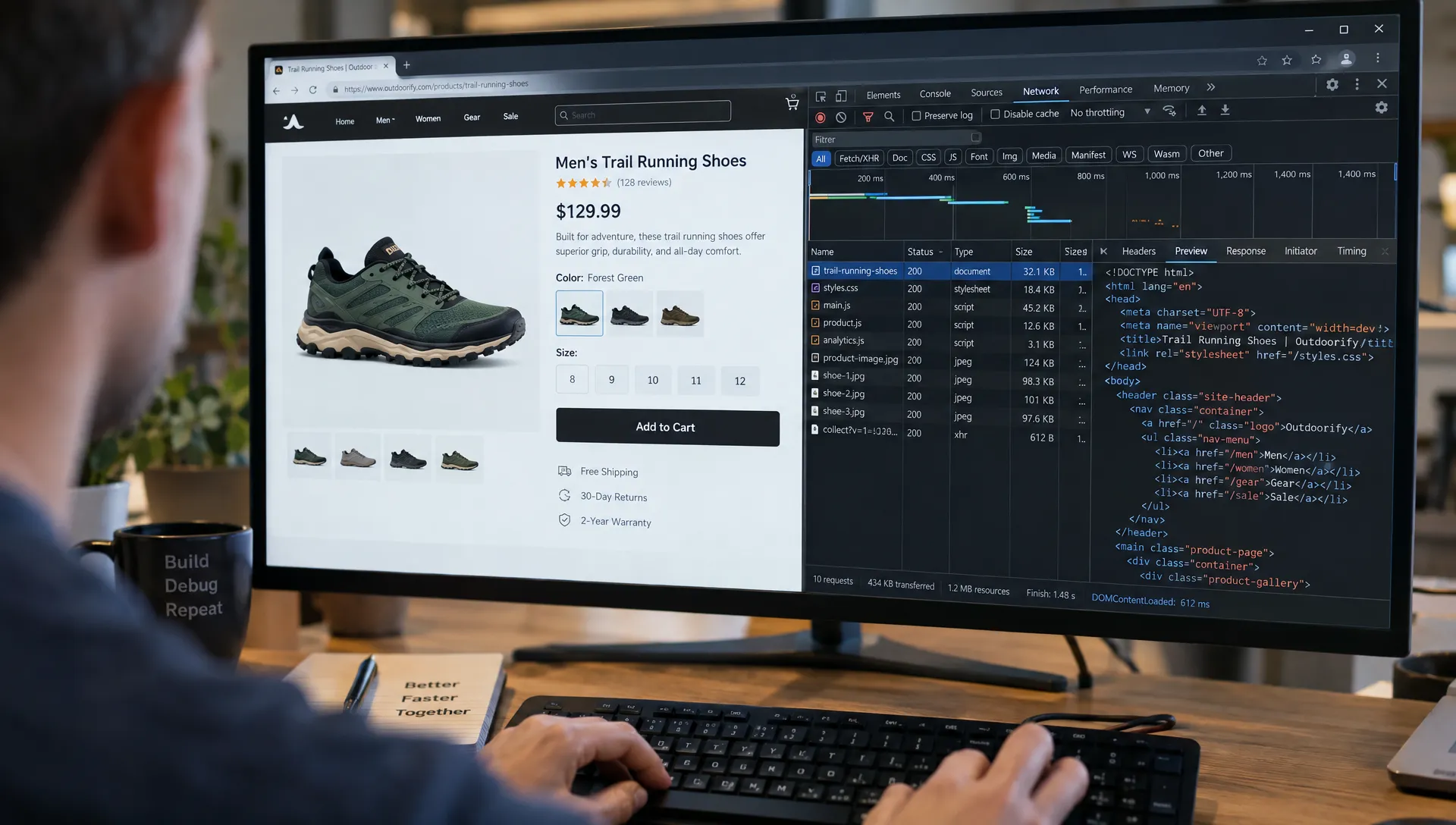
Yes, AI search can read some JavaScript product pages, but a working storefront does not prove that an assistant can retrieve its product information. An AI search website audit should establish whether product facts are available in the initial HTML, discoverable through links and accessible to the systems retrieving them.
A shopper might see price, availability and specifications after the browser runs several scripts. A crawler might receive only a page title, navigation and an empty product container. That gap can leave an assistant without the evidence it needs to describe or recommend your product accurately.
The practical goal is not to remove JavaScript. It is to make essential product information available without requiring a successful shopping session, then measure whether that information reaches AI answers.
What AI search actually retrieves from your website
A JavaScript website can expose several different versions of the same page:
| Layer | What it contains | What to verify |
|---|---|---|
| Initial HTML | The server response before browser scripts execute | Whether essential product facts are present |
| Rendered page | Content after JavaScript runs | Whether rendering adds or changes important facts |
| Product API | Data used by storefront components | Whether HTML depends entirely on a separate request |
| Search index | A search provider's processed representation | Whether the indexed content is current and complete |
External assistants do not all follow the same retrieval path. ChatGPT, Gemini, Perplexity, Claude and Copilot may use different combinations of search providers, direct fetching and other retrieval tools. A result from one engine does not establish access for another.
Google documents a JavaScript rendering process in its JavaScript SEO guidance. That capability should not be treated as proof that every assistant fetch executes your scripts.
For an AI search website assessment, distinguish discoverable, retrievable and cited. A product URL can pass the first two stages without becoming a source in an answer.
Also separate external discovery from the search box inside your store. CapstonAI's explanation of AI site search versus AI search visibility covers why improving one does not automatically improve the other.
Where JavaScript product information disappears
The most common failure is a complete-looking page whose useful content arrives only after an API request. If that request fails, requires a session or depends on an interaction, the retrieved document may contain little product evidence.
Variant selectors create another gap. A shopper chooses a 500 ml bottle, but the initial response describes the default 250 ml option. If the price and availability change only in the browser, a retriever can receive the wrong combination of facts.
Ajax filters present a related discovery problem. A layout such as Kimistry Hair Salon's Ajax-filter shop page illustrates why a shop interface and an individual product document need separate checks. Category links and filter controls do not, by themselves, establish what information exists at each product URL. The interface alone is not evidence of a crawling defect.
An AI search website review should therefore test more than the homepage or a populated browser screenshot. Include direct product URLs, configurable products and important category routes. These are the pages that must supply evidence when a buyer asks about compatibility, size, availability or price.
Run an AI search website audit in five checks
Start with a manageable sample. For example, select 12 representative URLs: four best sellers, four configurable products and four category or filtered landing pages. This is a diagnostic sample, not a statistical guarantee.
Record the expected product name, selected variant, price, currency, availability and canonical URL before testing. That gives developers and content teams a shared definition of a correct response.
1. Compare initial HTML with the rendered page
Use the browser's page source or a basic HTTP request to inspect what the server actually returns. Browser developer tools show the live document after scripts have modified it, so they are not interchangeable with page source.
A simple request provides a starting point:
curl -L -D headers.txt "https://your-store.example/products/example-product" -o product.html
Search the saved response for the expected product name, a distinctive specification, the price and any Product structured data. Then compare those findings with the fully rendered browser page.
If the browser displays detailed specifications but the response contains only a loading container, you have found a rendering dependency. You have not yet proved that every AI system fails to retrieve it.
Document the difference explicitly: “The initial HTML omits capacity and stock status; both appear after the product API responds.” That is more actionable than “AI cannot read the site.”
This part of an AI search website audit identifies the missing evidence, the affected templates and the likely implementation owner.
2. Check whether product URLs are discoverable
A product can return excellent HTML and still be difficult to find if every route to it requires typing into a search field or clicking a JavaScript-only control.
Inspect links from category pages, related products and navigation. Important product destinations should generally have ordinary anchor links with usable href values. An XML sitemap supports discovery but does not replace a coherent internal linking structure.
For filtered collections, decide which combinations deserve persistent, indexable landing pages. A useful “fragrance-free shampoo” collection may warrant a stable URL and explanatory copy. Every possible combination of sorting, size and price filters probably does not.
Check canonicals at the same time. Do not canonicalize distinct, valuable product pages to a generic category merely to reduce URL counts.
The discovery stage of an AI search website review should answer a business question: can a retrieval system reach the products that match your customers' actual buying criteria?
3. Test bot access separately from rendering
A server-rendered page still fails if the request receives a challenge, access-denied response or login screen.
Inspect robots.txt, HTTP status codes, redirect chains, robots directives and content delivery network rules. Review server logs for the relevant crawlers, including requests blocked by your firewall. A 200 response is not sufficient if the body contains a bot challenge rather than product content.
OpenAI's crawler documentation distinguishes search-related crawling, user-triggered visits and training-related crawling. Policies for one purpose should not automatically be applied to another. Allowing training crawlers is not a prerequisite you should assume for search visibility.
A user-agent test can reveal different server behavior, but changing that header does not prove a request came from a legitimate crawler. Validate bot identity using the provider's documented methods where available.
In an AI search website access review, record what actually happened: requested URL, timestamp, response status and returned content. This makes security exceptions narrower and easier to verify.
4. Reconcile visible facts, variants and schema
Structured data is machine-readable information about a page. Schema.org's Product and Offer vocabulary can describe a product, its identifiers and its commercial offer.
Use it to reinforce facts that users can access, not to publish a separate version of the product. Compare the product name, SKU, brand, price, currency and availability across the initial HTML, rendered page and structured data.
For example, a configurable chair might default to black upholstery while its structured data describes the blue variant. Even if both are real products, the page now gives conflicting evidence about the offer being cited.
Keep entity identifiers consistent. A stable product ID, accurate brand name and applicable GTIN or manufacturer part number help distinguish similar products. Do not invent identifiers to fill schema fields.
An AI search website audit should flag mismatches before adding more markup. More structured data does not repair contradictory source facts, and valid schema does not guarantee a citation or a rich result.
5. Verify answers and citations, not just mentions
Once access and content checks pass, test a fixed set of buying questions. Use prompts tied to facts you can verify, such as “Which of these bottles fits a standard bicycle cage?” rather than only “What is the best bottle?”
For each answer, record the engine, date, prompt, product mentioned and cited URL. Follow the citation and check whether the source actually supports the statement. A citation to a category page may not substantiate a claim about a specific variant.
Repeat tests under consistent conditions and document differences in region, account state and available search features. Asking an assistant to summarize a supplied URL tests a different task from asking it to discover products independently.
The answer-verification stage of an AI search website audit should distinguish a missing brand mention, an unsupported claim and a stale fact. Those require different fixes: stronger discovery, clearer evidence or fresher source data.
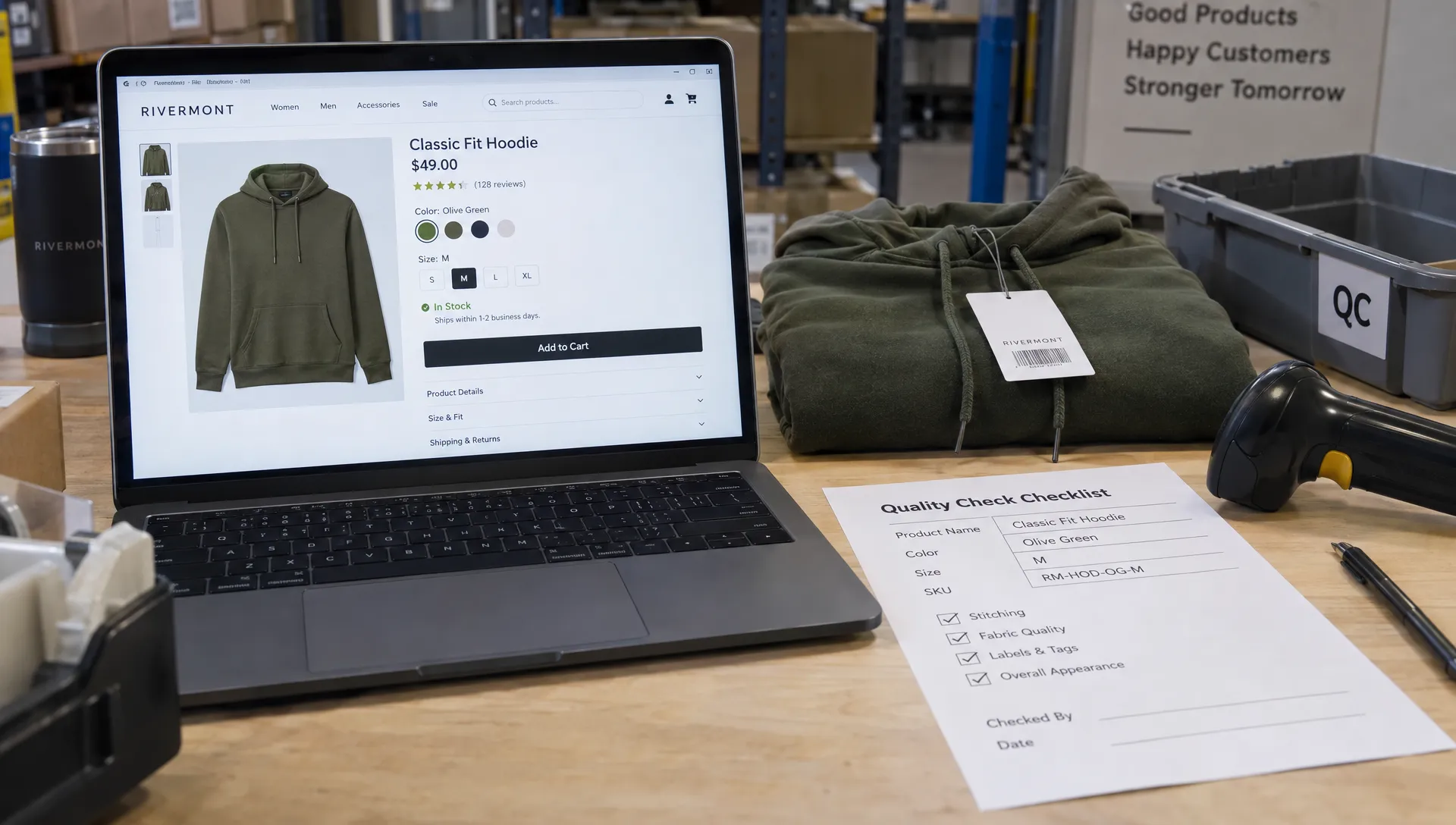
Fix the rendering dependency without rebuilding everything
Prioritize the information needed to identify, evaluate and purchase the product. Product name, core specifications, selected offer and availability deserve more dependable delivery than animations or recommendation widgets.
| Approach | Suitable use | Main caution |
|---|---|---|
| Server-side rendering | Product details assembled when requested | Slow upstream services can delay the response |
| Static generation with refreshes | Product content that changes less frequently | Price and stock need an appropriate freshness strategy |
| Hybrid rendering | Stable product descriptions plus frequently updated offers | Initial and updated content must remain consistent |
| Client-only rendering | Secondary interactive features | Essential facts depend on successful script execution |
For WooCommerce, inspect the actual response rather than assuming a theme or plugin behaves in a particular way. A conventional product template may expose useful HTML while a custom block or headless storefront changes that behavior.
For headless implementations, move essential product fields into the server response and keep interactive enhancements in the browser. Test cached responses as well as uncached ones, especially when prices vary by market.
The best fix from an AI search website audit is often a template change that improves an entire product family. Validate representative URLs before extending it across the catalog.
Keep performance and freshness in the same acceptance test
Server rendering is not automatically fast. A page that waits on several slow services before returning HTML creates another retrieval risk and a poor shopping experience.
Reduce unnecessary API dependencies, cache appropriate content and monitor response times. Measure the shopper experience with Core Web Vitals, but do not treat a passing score as proof of AI accessibility. Rendering completeness and page performance are separate checks.
Freshness matters equally. If a product sells out, determine how that change reaches the HTML, structured data, caches and any product feeds you maintain. A fast response containing yesterday's offer is still inaccurate.
Treat llms.txt as an optional supplementary file, not a replacement for accessible product pages, robots controls or sitemaps. Do not assume an engine reads it or treats it as an instruction to recommend your products.
Measure technical fixes separately from AI visibility
Technical SEO makes pages discoverable and accessible. Answer Engine Optimization (AEO) makes information easier to extract into direct answers. Generative Engine Optimization (GEO) addresses how your business is represented and supported in generated responses. Their work overlaps, but their measurements differ.
Google's guidance for AI search features says supporting links in AI Overviews and AI Mode rely on established Search eligibility requirements, not special AI-specific markup. Eligibility still does not guarantee selection.
Use two reporting layers for an AI search website improvement project:
- Technical acceptance: Product facts appear in the response, links resolve, relevant crawlers receive usable content and schema agrees with the offer.
- Visibility outcomes: Brand mention rate, citation rate, answer accuracy and competitive share of voice change across a defined prompt set.
Define every metric. If your brand appears in five of 20 sampled answers, its mention rate in that sample is 25%. That is not automatically its market-wide share of voice. For competitive reporting, specify which brands and appearances enter the calculation.
Track referred sessions and purchases separately. More citations do not necessarily mean more traffic, and more traffic does not establish more revenue.
Once retrieval works, strengthen the substance using CapstonAI's guide to how AI web search engines evaluate product evidence. Accessible content still needs to support the buyer's question.
Frequently asked questions
Can AI search read a React, Next.js or Vue product page? Potentially. The framework name does not establish accessibility. What matters is the response content, rendering dependencies, discoverable URLs and access rules. Server-rendered and client-only pages built with the same framework can behave differently.
Does an AI search website test need JavaScript disabled? Disabling JavaScript is a useful diagnostic, not a complete simulation of every crawler. Pair it with initial-response inspection, rendered-page comparison and provider-specific access checks.
Will Product schema make assistants recommend my products? No. Accurate schema can clarify product facts, but it cannot guarantee retrieval, citations or recommendations. It should agree with the visible offer and use genuine identifiers.
Should every filter or variant have an indexable URL? No. Create stable destinations where they serve a distinct buying need, then manage duplicates deliberately. Avoid exposing unlimited low-value filter combinations. Where a variant has its own URL, ensure its content and canonical strategy match the intended experience.
Can one successful citation prove the implementation works? It proves that one observed answer cited a source under those test conditions. It does not establish reliable coverage across your catalog, engines or buying questions.
Start with a free AI visibility audit
Start with a free AI visibility audit from CapstonAI to establish how your brand appears across AI search. CapstonAI tracks brand mentions, citations and competitive visibility, then provides prioritized content recommendations.
Pair that baseline with the product-template checks above. Your next step is a scoped implementation ticket: identify the missing facts, fix their delivery and verify the same URLs and prompts again. That connects technical work to measurable changes in product discovery.