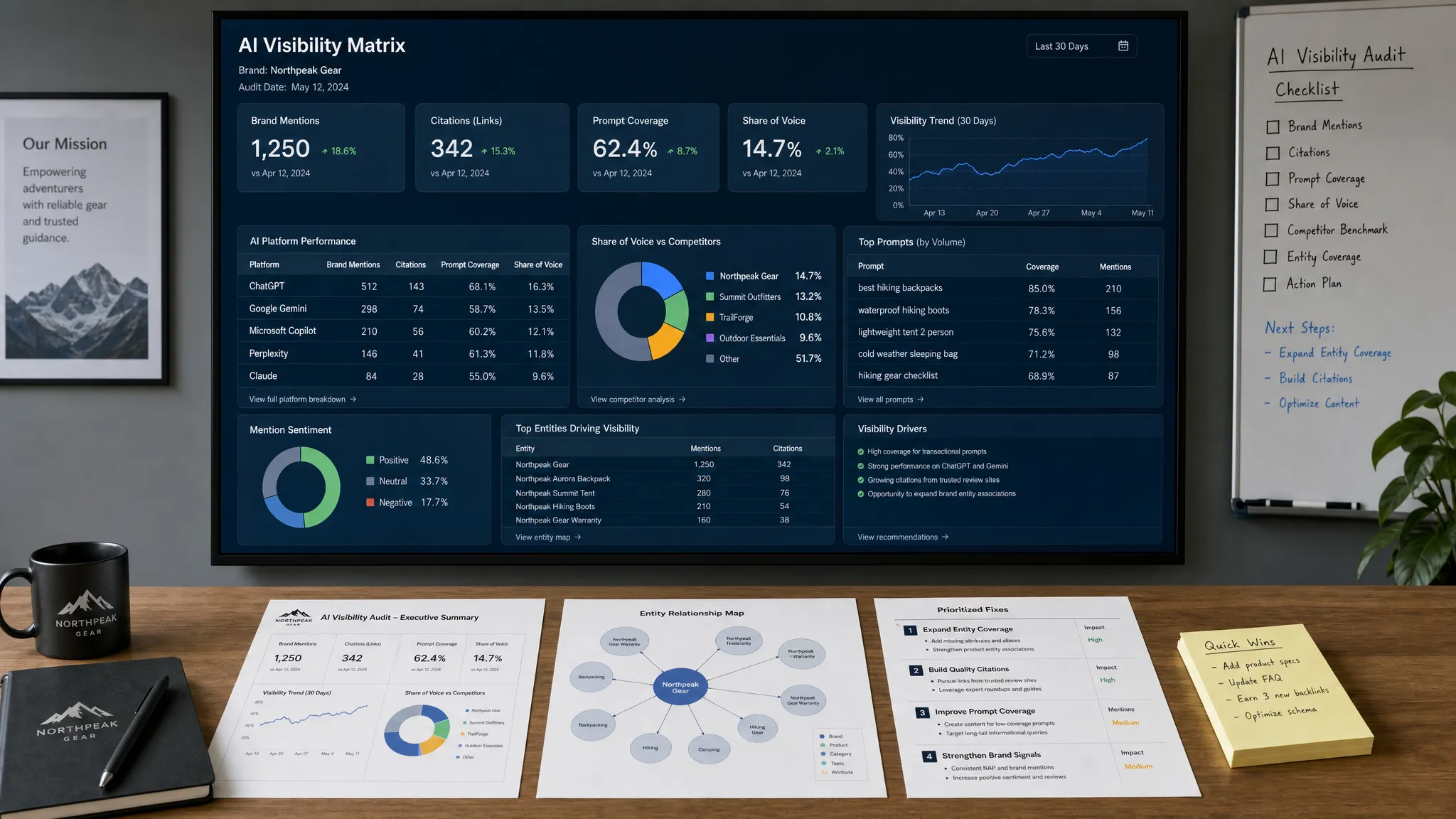
If your SEO dashboard still centers on website rank, you may be measuring only the part of search that is easiest to see.
Rank still matters. A strong organic position can drive qualified traffic, bookings, demo requests, and store visits. But AI search has changed the path between a question and a decision. Prospects now ask ChatGPT, Gemini, Claude, Perplexity, Copilot, and Google AI Overviews for recommendations, comparisons, itineraries, vendors, local options, and product shortlists.
In those answers, being visible is not the same as ranking number three for a keyword.
AI engines may mention your competitor, cite a third-party review, summarize an outdated page, or skip your brand entirely because your content is hard to parse. That is the AI visibility problem: your business can have solid traditional SEO performance and still be absent from the answers buyers actually read.
Website rank tells you position, not presence
Traditional rank tracking answers a narrow but useful question: where does a page appear in Google for a tracked query?
AI visibility asks a broader question: when a buyer asks an AI engine for help, does your brand appear, is it accurate, is it cited, and are you presented as a credible option?
Those are different measurement systems.
A web site rank report is typically based on keywords, locations, devices, and SERP positions. It assumes the user sees a list of links, compares snippets, and clicks through. AI answers compress that journey. The user may receive a synthesized answer, a short recommendation list, a cited source, or a comparison table without clicking at all.
This is not theoretical. Gartner predicted that traditional search engine volume would drop 25% by 2026 due to AI chatbots and virtual agents. Whether the exact number varies by market, the direction is clear: more discovery happens inside generated answers.
For a hotel group, the important question is no longer only "do we rank for boutique hotel in Austin?" It is also "does Perplexity recommend us when someone asks for a quiet boutique hotel near live music with parking?" For an MSP, it is not only "do we rank for managed IT services Chicago?" It is also "does Copilot surface us when a CFO asks for reliable IT support for a 75-person healthcare practice?"
Why AI engines can miss brands that rank well
Generative engines do not behave like classic ranking pages. They retrieve, interpret, summarize, and assemble answers from multiple signals. Some signals come from your website. Others come from review sites, directories, media coverage, knowledge panels, product feeds, documentation, social proof, and competitor content.
Here are the most common reasons a brand can rank well and still have weak AI visibility.
1. AI answers are prompt-based, not keyword-based
A keyword is short. A prompt is contextual.
A traditional keyword might be "family resort Florida." A real AI prompt might be "What are the best family-friendly resorts in Florida with suites, kids activities, and easy beach access for a March trip?"
That second query contains intent, constraints, seasonality, amenities, and comparison logic. If your page ranks for the short keyword but does not clearly answer the detailed prompt, an AI engine may choose another source that is easier to summarize.
This is where AEO, or Answer Engine Optimization, becomes important. AEO structures content so engines can extract direct answers, criteria, comparisons, and next steps. It does not replace SEO. It makes useful SEO content easier for answer engines to reuse.
2. AI engines need entities, not just pages
Classic SEO often treats the page as the unit of optimization. AI search also cares about entities: your brand, locations, services, products, people, categories, and relationships.
For example, a multi-location healthcare group may have dozens of clinic pages. If the site does not clearly connect each location to specialties, providers, accepted services, reviews, hours, and nearby areas, AI systems may struggle to understand which clinic is relevant to which question.
Structured data helps here. Google describes structured data as a standardized format for providing information about a page and classifying page content in its Search Central documentation. Schema alone will not guarantee inclusion in AI answers, but it reduces ambiguity. Less ambiguity usually means fewer missed mentions and fewer wrong summaries.
3. Citations may come from sources you do not control
In AI search, your own website is only one evidence source.
Perplexity may cite a review page. Google AI Overviews may summarize a forum, publisher article, or local listing. ChatGPT with web browsing may use content that describes your category better than your own product page. Claude may respond from a mix of known web content and retrieved sources, depending on the workflow.
This matters because AI visibility is partly a citation problem. If authoritative third-party pages describe your competitors more clearly than they describe you, your organic rank may not protect your share of voice.
4. Technical SEO problems become AI extraction problems
Technical SEO still matters because AI systems cannot confidently use what they cannot access, parse, or trust.
Crawlability, indexability, canonical tags, internal linking, page speed, clean HTML, metadata, and schema all affect whether engines can understand your content at scale. A slow, thin, duplicate, or JavaScript-dependent page may rank for some branded terms, but still be a poor source for generated answers.
For WordPress, WooCommerce, franchise, and multi-site environments, these issues compound quickly. One weak template can affect hundreds of pages.
5. Rank does not measure accuracy
A page can rank while AI systems still misstate the business.
Examples include outdated amenities, wrong service areas, missing product availability, old brand descriptions, incorrect location counts, or competitor comparisons that omit your strongest differentiators. AI visibility monitoring needs to capture not just whether you were mentioned, but whether the answer was correct enough to influence a buyer.
Rank tracking vs. AI visibility tracking
The simplest way to see the gap is to compare what each system measures.
| Measurement area | Traditional website rank | AI visibility |
|---|---|---|
| Core question | Where does my page rank for this keyword? | Does my brand appear in AI answers for buyer prompts? |
| Primary unit | Keyword and URL | Prompt, entity, mention, citation, and answer context |
| Output | Position, URL, SERP feature, traffic estimate | Brand mention, citation, share of voice, accuracy, competitor comparison |
| Main risk detected | Lost rankings or traffic | Being absent, misrepresented, uncited, or outranked inside generated answers |
| Best use | Monitoring Google visibility for known search demand | Monitoring how AI engines understand and recommend your brand |
| Business effect | Click potential from search results | Influence potential before the click, including zero-click decisions |
Both views are useful. The mistake is assuming the first one proves the second.
If your organization wants a broader measurement model, CapstonAI's guide to checking site visibility across Google and AI engines explains how to evaluate presence across traditional search and generative engines together.
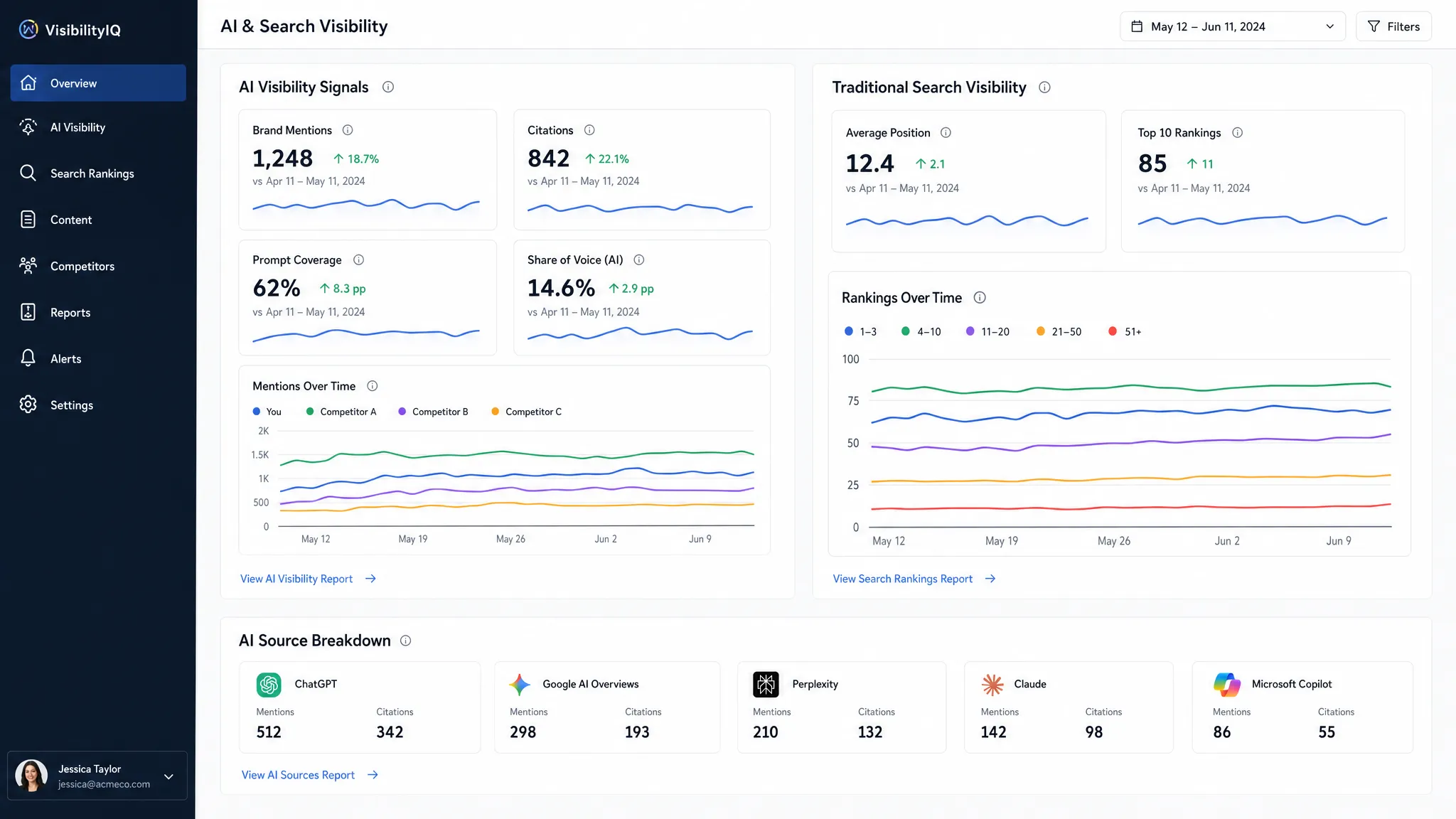
The AI visibility metrics rank reports miss
A useful AI visibility program should measure at least six signals.
- Brand mentions: How often your brand appears in answers for relevant prompts across ChatGPT, Gemini, Claude, Perplexity, Copilot, and Google AI Overviews.
- Citation frequency: Whether the engine cites your website, a third-party source, a competitor, or no source at all.
- Share of voice: How often your brand appears compared with competitors for the same prompt set.
- Prompt coverage: Which buyer questions surface you, and which questions surface rivals instead.
- Answer accuracy: Whether the engine describes your locations, services, pricing model, availability, categories, or differentiators correctly.
- Page readiness: Whether your key pages have crawlable content, strong internal links, clear metadata, structured data, and fast performance.
These metrics connect technical work to business outcomes. If a hotel is missing from "best pet-friendly hotels near downtown Denver," the issue may affect direct bookings. If a WooCommerce store is not cited for comparison prompts, it may lose product discovery before shoppers reach Google Shopping. If an MSP is absent from "best managed IT provider for law firms in Dallas," it may lose consideration before an RFP begins.
How to diagnose your AI visibility problem
You do not need to abandon rank tracking. You need to add an AI visibility layer that explains what rank cannot.
Start with buyer prompts, not only keywords
Build a prompt set around the questions your prospects actually ask when they are comparing options. Good prompt sets include category, use case, location, constraints, and decision criteria.
For example:
- "Best boutique hotels in Nashville for a weekend trip with parking"
- "Top WooCommerce agencies for site speed and conversion optimization"
- "Managed IT providers for healthcare clinics with HIPAA experience"
- "Retail franchises offering same-day pickup near me"
Run these prompts across multiple engines because results vary. ChatGPT, Gemini, Claude, Perplexity, Copilot, and Google AI Overviews use different retrieval methods, answer formats, and source preferences.
Compare mentions and citations against competitors
Do not stop at "are we mentioned?" Ask who is mentioned instead.
If competitors appear more often, inspect the sources AI engines rely on. Are they cited from stronger comparison pages? Better structured location pages? Review platforms? Industry directories? Publisher lists? Their own FAQs?
This turns AI visibility from a vague concern into a practical backlog.
Audit the pages AI should trust
For each important journey, identify the page that should answer the prompt. Then check whether that page is genuinely AI-ready.
A strong page usually has a clear entity focus, concise answers, supporting details, internal links to related pages, current facts, schema markup, readable HTML, and fast performance. For local and multi-location brands, each location page should make the business, service area, and offering unambiguous.
Internal linking matters because it helps both search engines and users understand relationships. A hotel page should connect rooms, amenities, location, offers, and FAQs. A franchise page should connect corporate brand information to local availability. An MSP site should connect service pages, industry pages, case evidence, and contact paths.
For a deeper strategic view, CapstonAI's article on how search ranking is evolving beyond blue links explains why ranking, SERP features, and AI-generated answers now need to be evaluated together.
Check structured data, metadata, and llms.txt
AI-ready metadata is not a magic switch. It is a clarity system.
Use schema to identify organizations, locations, products, services, FAQs, reviews where appropriate, breadcrumbs, and articles. Keep titles and descriptions accurate. Make sure canonical tags, robots rules, and sitemaps do not block important content.
llms.txt is an emerging convention for giving AI systems a concise map of important site content. It should not replace your sitemap, robots.txt, or technical SEO fundamentals. Used carefully, it can help point AI crawlers and retrieval systems toward the pages you most want understood.
Prioritize fixes by commercial impact
Not every missing mention deserves equal effort.
A useful prioritization model weighs prompt value, current visibility, competitor strength, conversion intent, and page readiness. A missing citation for a bottom-funnel comparison prompt is usually more urgent than a weak mention for a broad educational prompt.
This is where GEO, or Generative Engine Optimization, becomes operational. GEO is the practice of improving how generative engines understand, cite, and present your brand. The work often looks familiar: better content, stronger entities, cleaner structure, faster pages, more useful FAQs, and better evidence. The measurement is what changes.
Practical examples by business type
For an independent hotel chain, website rank may show strong performance for destination keywords. AI visibility may show that AI engines recommend OTAs, travel blogs, or competitors for amenity-rich prompts. The fix may include clearer room and amenity pages, structured lodging data, stronger local content, and FAQ sections that answer real trip-planning questions.
For a multi-site healthcare or education brand, rank may look healthy at the corporate level while AI engines fail to connect specific locations to services. The fix may include location schema, consistent NAP data, internal links between service and location pages, and content that answers eligibility, appointment, program, or coverage questions accurately.
For an MSP or IT service provider managing multiple site fleets, rank may capture only a few head terms. AI prompts often include industry, compliance, company size, location, urgency, and budget expectations. The fix may include clearer service pages, industry-specific proof, crawlable case studies, and concise comparison content.
For a WooCommerce or mid-market e-commerce brand, rankings for product categories may not translate into AI inclusion for "best," "compare," or "alternative to" prompts. The fix may include product schema, current availability signals, buying guides, clean category copy, review summaries, and internal links that help engines understand product relationships.
For agencies, this creates a new reporting opportunity. Clients still need rank tracking, but they also need visibility scans, prompt mapping, share-of-voice tracking, and prioritized AI-readiness fixes. If you are evaluating tools, the CapstonAI guide on choosing an SEO platform for AI visibility outlines capabilities to look for beyond traditional keyword tracking.
What a healthier visibility report looks like
A modern search report should combine classic SEO and AI visibility into one decision view.
It should answer:
- Which pages rank and which pages are cited?
- Which prompts mention us and which mention competitors?
- Which engines see us clearly and which miss us?
- Which answers are inaccurate or outdated?
- Which technical issues prevent AI systems from reading key pages?
- Which fixes are likely to affect revenue, bookings, leads, or credibility first?
That last point matters. AI visibility work should not become another abstract score. The goal is to improve how your business appears when prospects are actively asking for recommendations, comparisons, and next steps.
Frequently Asked Questions
Is website rank still important for SEO? Yes. Website rank still affects organic traffic and search credibility. The problem is that rank does not show whether AI engines mention, cite, or recommend your brand inside generated answers.
What is AI visibility? AI visibility measures how your brand appears across generative engines such as ChatGPT, Gemini, Claude, Perplexity, Copilot, and Google AI Overviews. It includes mentions, citations, share of voice, prompt coverage, and answer accuracy.
How is GEO different from traditional SEO? Traditional SEO improves rankings and organic discoverability in search results. GEO focuses on helping generative engines understand, trust, cite, and reuse your content in AI-generated answers. The strongest programs combine both.
Does schema guarantee that AI engines will cite my website? No. Schema improves clarity, but it does not guarantee inclusion. AI visibility also depends on content quality, crawlability, authority, citations, internal linking, page performance, and how well your pages answer real buyer prompts.
What should I check first if competitors appear in AI answers and we do not? Start by comparing the prompts, cited sources, and pages behind those answers. Then audit your equivalent pages for entity clarity, structured data, direct answers, internal links, freshness, and technical accessibility.
Start with a free AI visibility audit
If your rankings look stable but AI engines are not mentioning or citing your brand, the issue is not simply a ranking problem. It is a visibility gap.
CapstonAI helps brands, retailers, multi-location teams, MSPs, e-commerce businesses, and agencies measure how they appear across ChatGPT, Gemini, Claude, Perplexity, Copilot, and Google AI Overviews. It tracks mentions, citations, share of voice, prompt coverage, competitor presence, and AI-ready page issues so your team can prioritize the fixes that matter.
Start with a free AI visibility audit to see what AI engines currently understand about your business, what they miss, and which pages should be fixed first.