AI titles are useful when your team manages hundreds or thousands of pages. A hotel group can refresh location title tags in a day instead of a month. A WooCommerce store can give every category, subcategory and product template a clearer search promise. An agency can test metadata improvements across a site fleet without rewriting everything by hand.
The risk is that AI is good at producing plausible titles that look different to a person but read as duplicates to a crawler, a search engine or a generative engine. Duplicate metadata weakens page intent. It can make Google rewrite title links, blur entities across similar URLs and make AI systems like ChatGPT, Gemini, Perplexity, Claude and Copilot less confident about which page to cite.
The goal is not to stop using AI. The goal is to give AI enough structure so every title tag describes one page, one entity and one job.
What Duplicate Metadata Really Means
Duplicate metadata is more than two identical title tags. It includes any repeated or near-repeated metadata pattern that prevents a machine from understanding why one URL exists instead of another.
For classic SEO, the title tag is one of the strongest on-page signals for search result snippets and page relevance. For GEO (Generative Engine Optimization) and AEO (Answer Engine Optimization), the title also helps models connect your page to entities, questions, citations and answer candidates. A title is not the only signal, but it is one of the easiest signals to get wrong at scale.
| Duplicate pattern | Example | Why it creates risk | Better approach |
|---|---|---|---|
| Exact duplicate title tags | “Services | Brand” on 50 location pages | Search engines cannot easily distinguish each page’s local intent |
| Template duplicates | “Best Hotel Deals | Brand” across every hotel | Pages compete against one another for the same query |
| Near duplicates | “IT Support in Dallas” and “Dallas IT Support Services” for two overlapping pages | Similar intent may split authority and citations | Assign one page to primary service and one to a narrower subtopic |
| Metadata mismatch | Title says “Pricing” but H1 says “Plans for Agencies” | AI systems receive mixed entity and intent signals | Align title, H1, schema headline and internal links |
| Schema headline duplicates | Article schema repeats the same headline across translated or syndicated pages | AI Overviews and answer engines may cite the wrong version | Localize or canonicalize the right version |
Some repetition is normal. Brand names repeat. Product names repeat. Location names repeat within a franchise network. The problem appears when the unique part of the page is missing, buried or replaced by vague AI-generated phrasing.
Why AI Titles Create Duplicate Metadata
Most duplicate AI titles come from weak inputs, not from the model itself. If you ask an AI system to “write SEO titles for these service pages” and provide only URLs, it will infer patterns from slugs, repeat safe phrases and fill gaps with generic language.
The issue gets worse on sites with many similar pages. Independent hotel chains, healthcare franchises, education groups, MSPs and e-commerce teams often have legitimate page families that look repetitive from the outside. A model may see /locations/austin, /locations/dallas and /locations/houston and produce a neat set of titles. But it may miss the important distinctions, such as emergency care versus primary care, campus versus online program, managed security versus help desk or waterfront hotel versus airport hotel.
AI also tends to optimize for surface-level readability unless you give it business rules. That means it may generate titles that sound good but fail technical requirements:
- Too many pages start with the same generic phrase
- Important entities appear at the end, where they may be truncated in search snippets
- Similar pages receive titles with the same search intent
- Titles do not match canonical URLs or internal linking anchors
- Page titles, Open Graph titles and schema headlines drift apart
If your team already uses AI for metadata, start with a system of constraints before generating new copy. CapstonAI has a related guide on using AI to optimize meta tags that covers title and description improvement more broadly. This article focuses on the duplicate metadata problem specifically.
The Core Rule: Every AI Title Needs a Unique Page Job
A safe AI title should answer three questions in a compact way:
- What is the primary entity?
- What is the searcher trying to do?
- What makes this URL different from similar URLs?
That sounds simple, but it changes the way you prompt the model. You are not asking for “a catchy title.” You are asking for a machine-readable label for a business asset.
A reliable pattern is:
Primary entity + specific intent + differentiator or scope + brand
For example:
| Page type | Weak AI title | Stronger AI title |
|---|---|---|
| Hotel location page | “Comfortable Hotel Rooms | Brand” |
| Healthcare franchise page | “Healthcare Services in Phoenix | Brand” |
| MSP service page | “IT Support Services | Brand” |
| E-commerce category page | “Shop Running Shoes | Brand” |
| Agency service page | “SEO Services | Brand” |
The stronger titles do not just vary words. They clarify entities and intent. That makes the page easier to classify, rank, cite and reuse in AI-generated answers.
If a page’s value is tied to audience, language and location, name that value directly. For example, a homepage positioned around a VPN service for francophone TV streaming abroad should not be reduced to a generic title like “Secure VPN Service | Brand.” The title should preserve the core entity and use case because that is what makes the page distinct.
Build an AI Title Workflow That Prevents Duplicates
A good workflow catches duplicate metadata before it reaches the CMS. This matters for WordPress sites, headless builds, multi-location directories and large e-commerce catalogs where a small prompt mistake can affect thousands of URLs.
- Inventory current metadata first: Export each URL, title tag, meta description, H1, canonical URL, indexability status, template type and primary internal links. Do not generate new titles until you know which pages are live, indexed and strategically important.
- Cluster pages by intent and template: Group pages into categories such as location pages, service pages, product pages, comparison pages, guides, FAQ pages and support content. AI titles should be generated within a page family, not across the whole site in one undifferentiated batch.
- Define the unique field for each cluster: A location page may need city and neighborhood. A product category may need product type and attribute. An article may need problem and audience. A service page may need vertical, use case or deliverable.
- Create exclusion rules: Tell the model which phrases to avoid, which claims require proof and which pages should not target the same query. Exclusion rules reduce generic titles like “best,” “leading,” “trusted” or “complete solution.”
- Generate in batches with collision checks: Ask the AI to return one title per URL plus the unique entity used. Then compare every output against the rest of the batch before publishing.
- Keep human review where it changes outcomes: AI can draft, normalize and compare titles quickly. Humans should approve naming conventions, claims, legal language, local nuance and pages tied to revenue. This is the same principle behind using AI for SEO where automation helps and human review matters.
Here is a practical prompt you can adapt:
You are writing SEO title tags for a site with many similar pages.
Return one title per URL.
Use 45 to 60 characters when possible, but prioritize clarity over exact length.
Each title must include the page's unique entity or page role.
Do not create exact or near-duplicate titles.
Do not use unsupported claims such as best, number one or guaranteed.
Keep the brand name at the end unless the page is the homepage.
Return columns: URL, proposed title, unique entity used, duplicate risk notes.
The “unique entity used” column is important. It forces the model to show its reasoning in a way your team can audit.
Connect AI Titles to the Full Metadata System
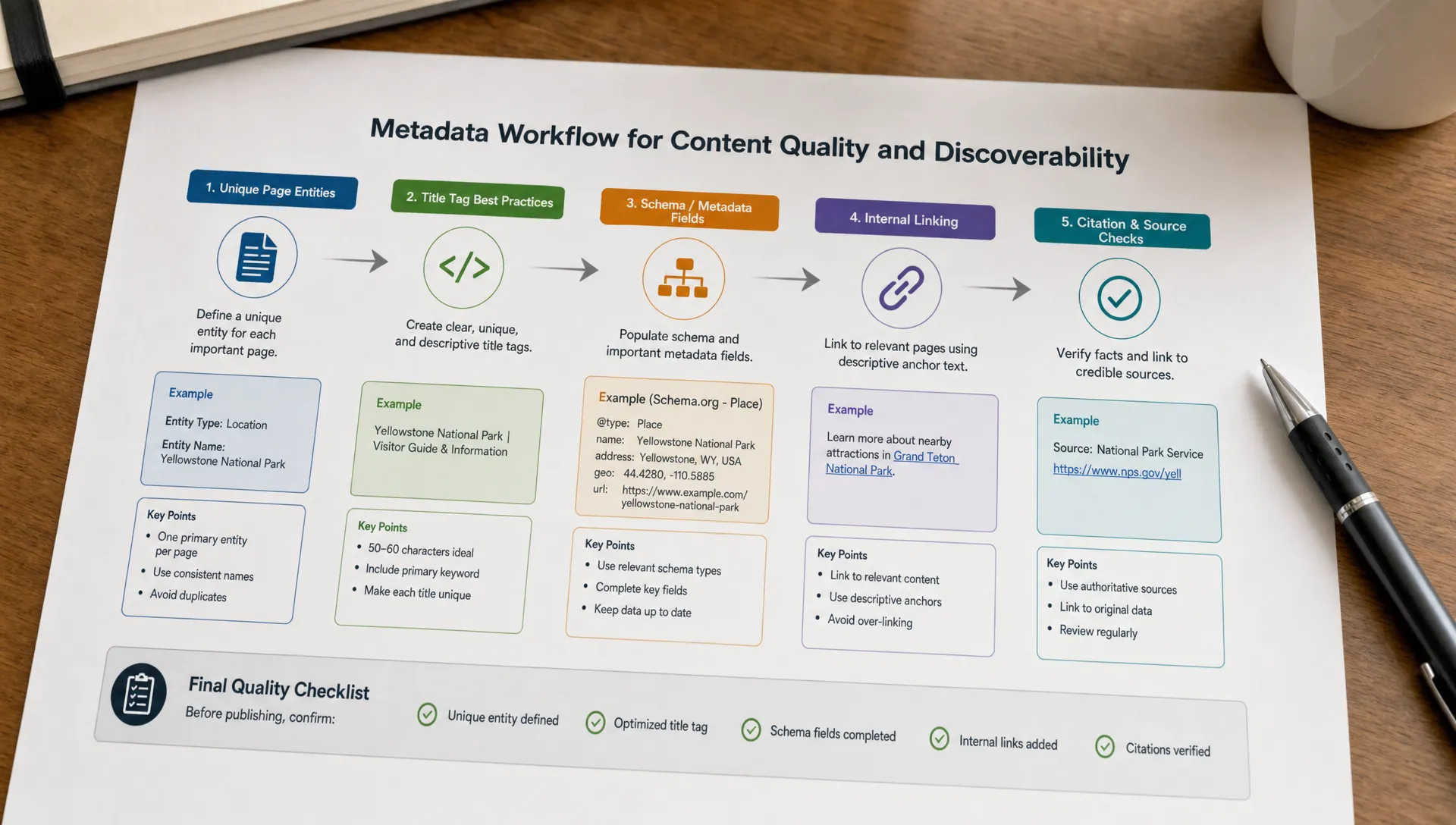
Duplicate title tags are often a symptom of a broader metadata problem. Generative engines do not read your title in isolation. They combine title tags with headings, structured data, page copy, canonical signals, internal links, citations, crawlability and performance signals.
If the title says “Managed IT Services for Dental Clinics” but the H1 says “IT Solutions for Small Business,” the page may still rank, but the entity signal is diluted. If internal links point to the page with anchors like “services” or “learn more,” the model gets less context. If schema markup uses a generic headline or missing organization details, AI Overviews and answer engines have fewer reasons to trust the page as a precise citation.
This is where GEO and AEO overlap with classic technical SEO. Clear metadata helps crawlers understand the page. Structured data helps identify the entity and page type. Internal links show how the page fits into the site. Page performance and crawlability ensure the content can actually be fetched, rendered and reused.
For AI search, title hygiene should connect with:
- Structured data and schema: Use Article, FAQPage, Product, LocalBusiness, Organization or Service schema only when the page content supports it.
- Entities: Make sure names, locations, products, services and organizations are consistent across title tags, headings, schema and body copy.
- llms.txt: Use it as a clear map for AI systems when your content strategy supports it, but do not treat it as a substitute for crawlable pages.
- Internal linking: Use descriptive anchors that reinforce the page’s real purpose.
- Page performance: Fast, accessible pages reduce friction for users and crawlers.
For pages targeting Google AI Overviews, schema is not a magic inclusion switch. It is a clarity layer. CapstonAI’s guide to schema markup that can support AI Overviews citations explains the schema types that most often matter for citation-ready content.
Quality Checks Before You Publish AI Titles
You do not need an elaborate system to catch most duplicate metadata issues. You need the right checks in the right order.
Start with exact duplicates. If two indexable URLs have the same title tag, decide whether both should exist. Sometimes the answer is not “write another title.” It is canonicalization, consolidation, noindexing a thin page or improving the content so the URL has a distinct purpose.
Then check near duplicates. A simple similarity flag can catch titles that differ only by word order, punctuation or a swapped adjective. For example, “Austin Managed IT Services | Brand” and “Managed IT Services in Austin | Brand” may be acceptable if they are the same URL, but risky if they are two separate pages.
Finally, compare metadata against the page itself. A title is only safe if the content supports it. If the title claims “24/7 support,” the page should clearly state that service availability. If the title says “for enterprise teams,” the page should not only describe small business packages.
| Check | Why it matters | Pass condition |
|---|---|---|
| Exact duplicate scan | Prevents multiple pages from sharing the same title | No two indexable URLs use the same title tag |
| Near-duplicate scan | Catches AI phrasing collisions | Similar titles are reviewed and assigned distinct intent |
| Title to H1 alignment | Reduces mixed relevance signals | The H1 reinforces the same entity and page job |
| Title to canonical check | Avoids optimizing non-canonical URLs | Only canonical, indexable pages receive strategic titles |
| Schema headline check | Keeps structured data consistent | Schema headline matches the page topic without being spammy |
| Internal anchor check | Strengthens entity context | Important links use descriptive, page-specific anchor text |
| Performance and crawlability check | Ensures metadata can be discovered and content can be rendered | Key pages are indexable, fast and not blocked by robots rules |
| AI visibility check | Measures business effect beyond rankings | Prompts, brand mentions, citations and share of voice are tracked |
That last line is where many metadata projects stop too early. A title cleanup is not finished when the CMS is updated. It is finished when you can observe whether search engines and AI systems understand the pages better.
For AI visibility, monitor prompts that match how buyers ask questions. A hotel group might track “best boutique hotels near downtown Asheville.” An MSP might track “managed IT provider for law firms in Dallas.” An e-commerce team might track “best waterproof trail running shoes for beginners.” Then compare which brands are mentioned, which URLs are cited and whether your updated pages gain or lose share of voice across ChatGPT, Gemini, Perplexity, Claude, Copilot and Google AI Overviews.
Common Mistakes When Using AI Titles
The first mistake is chasing uniqueness with empty modifiers. Adding “premium,” “expert,” “trusted” or “complete” to every title does not solve duplicate metadata. It creates a different pattern of sameness. Use attributes that exist on the page and matter to the buyer.
The second mistake is generating titles without a canonical strategy. If a category page, filtered page and tag page all target the same product intent, AI titles can make the conflict worse. Decide which page should win before optimizing all three.
The third mistake is treating title tags as the whole AI search strategy. AI engines build answers from many signals. A clear title helps, but weak content, thin FAQs, missing schema, poor internal linking and slow pages still limit visibility.
The fourth mistake is letting titles drift across systems. WordPress title tags, Open Graph titles, schema headlines, XML sitemap entries and CMS fields often live in different plugins or workflows. If one source updates and another does not, your metadata becomes inconsistent.
The fifth mistake is never measuring outcomes. Better titles should improve clarity, not just spreadsheet scores. Look at impressions, click-through rate, query mix, crawl behavior, AI citations, prompt coverage and branded versus non-branded mentions. If search and AI systems still surface competitors for prompts that match your strongest pages, the issue may be content depth, authority, schema or internal linking rather than title wording alone.
A Practical Naming System for Site Fleets
For multi-site brands and agencies, the safest approach is to create naming rules by template. This keeps AI creative inside a controlled structure.
| Template | Recommended title structure | Unique field to protect |
|---|---|---|
| Homepage | Brand + core category or market | Brand entity and primary market |
| Location page | Service or property type + city or neighborhood + brand | Location and service scope |
| Service page | Service + audience or use case + brand | Service intent and buyer segment |
| Product page | Product name + key attribute + brand | SKU, model or defining attribute |
| Category page | Category + qualifier + brand | Product type and shopper intent |
| Blog guide | How to or topic + audience outcome | Question, problem or workflow |
| FAQ page | Specific question set + brand or topic | Answer scope |
| Comparison page | Product or service comparison + decision intent | Compared entities |
This structure is not meant to make every title formulaic. It gives your AI system a boundary. Within that boundary, the model can improve wording, shorten awkward titles and suggest alternatives without collapsing many pages into the same metadata.
Frequently Asked Questions
Are AI titles bad for SEO? No. AI titles are risky only when they are generated without page context, uniqueness rules and QA. With the right workflow, AI can speed up metadata cleanup while human reviewers protect accuracy and brand judgment.
How long should an AI-generated title tag be? A common working range is 45 to 60 characters, but Google displays title links based on pixels, query context and rewriting systems. Clarity matters more than hitting an exact character count.
Should the title tag and H1 be identical? They can be identical, but they do not have to be. The safer rule is alignment. The title tag, H1, schema headline and internal anchors should reinforce the same entity and intent.
Do duplicate titles affect AI Overviews and generative engines? They can. Duplicate titles make it harder for AI systems to understand which page is the best citation for a prompt. Stronger metadata will not guarantee inclusion, but it improves clarity alongside content quality, schema, crawlability and authority.
Can llms.txt fix duplicate metadata? No. llms.txt can help describe important content paths for AI systems, but it does not replace unique titles, canonical tags, structured data, internal links or crawlable pages.
Start With a Free AI Visibility Audit
If you are using AI titles at scale, do not stop at “no duplicates found.” The business question is whether your most important pages are visible, cited and correctly represented in AI answers.
CapstonAI helps brands, retailers, agencies and site-fleet teams measure how ChatGPT, Google AI Overviews, Gemini, Perplexity, Claude and Copilot mention their business. It tracks brand mentions, citations, prompt coverage and share of voice, then surfaces prioritized fixes for AI-ready metadata, schema, crawlability and content structure.
Start with a free AI visibility audit. You will see what AI engines currently understand, what they miss and which metadata fixes can make your pages easier to read, trust and reuse.