AI for SEO works best when it removes repetitive work, exposes evidence faster, and gives humans better decisions to make. It works poorly when it is treated as a substitute for judgment, brand context, compliance review, or firsthand expertise.
That distinction matters more in 2026 because search is no longer limited to ten blue links. Prospects ask ChatGPT, Gemini, Claude, Perplexity, Copilot, and Google AI Overviews for recommendations, comparisons, summaries, and next steps. Those systems often answer before a user visits a website. If your brand, locations, products, services, and proof points are unclear to those systems, your business can be absent even when your traditional rankings look healthy.
The practical question is not whether to use AI for SEO. The better question is: which tasks should be automated, and where should human review remain non-negotiable?
What AI for SEO really includes
AI for SEO is the use of machine intelligence to improve how a brand is discovered, understood, cited, and selected across search engines and generative engines.
It now spans three connected disciplines:
| Discipline | What it optimizes | Business effect |
|---|---|---|
| Classic technical SEO | Crawlability, indexability, internal linking, metadata, structured data, page performance | Helps search engines access, understand, and rank your pages |
| AEO, or Answer Engine Optimization | Clear answers, FAQs, definitions, comparison sections, and concise summaries | Helps your content satisfy answer-style queries and featured responses |
| GEO, or Generative Engine Optimization | Entity clarity, citations, source authority, prompt coverage, and AI answer inclusion | Helps AI systems mention, cite, and reuse your brand accurately |
These are not competing approaches. GEO and AEO sit on top of classic SEO. If a page is slow, blocked from crawling, thin on entity signals, or internally orphaned, AI systems have less reliable material to work with.
Google has also been clear that automation itself is not the issue. Its guidance on AI-generated content and Search focuses on content quality, usefulness, and whether content is created primarily to manipulate rankings. In other words, AI assistance can be legitimate, but low-value automation still creates risk.
Where automation helps most
Automation is strongest when the task is repetitive, data-heavy, pattern-based, or easy to verify. In SEO and AI visibility work, that covers a large part of the workflow.
A team that manually checks 50 high-intent prompts across five engines is reviewing 250 answer surfaces before it even analyzes competitors, citations, and missing pages. Doing that once is tedious. Doing it weekly without automation is usually unrealistic.
AI visibility scans across generative engines
Traditional SEO tools show rankings, backlinks, traffic, and technical health. Those signals still matter, but they do not tell you whether ChatGPT, Gemini, Claude, Perplexity, Copilot, or Google AI Overviews mention your brand when a buyer asks a commercial question.
Automation can scan prompt sets such as:
- Best boutique hotels near a specific district
- Top managed IT providers for healthcare practices
- Best WooCommerce stores for a product category
- Urgent care locations open near a suburb
- Best franchise education programs for working adults
For each prompt, the system can capture whether your brand appears, which competitors appear, whether sources are cited, and whether the answer is accurate. That creates a measurable AI share of voice instead of a set of anecdotes.
For brands managing many locations, product categories, or service pages, this is one of the clearest places where automation pays off. A human should interpret the findings, but the collection layer should not be manual.
Brand mention, citation, and competitor monitoring
Generative engines often summarize the web by leaning on known entities, structured sources, authoritative pages, reviews, directories, and frequently cited content. Automation can track whether your brand appears as a named recommendation, a cited source, a comparison option, or not at all.
That distinction matters. A hotel may be mentioned in an AI answer but not cited. A healthcare group may be cited for one location but omitted for another. An IT service provider may appear for broad MSP prompts but disappear for vertical-specific prompts like dental office cybersecurity.
Automation helps teams spot these patterns faster:
| Signal | What automation can detect | Why a human should care |
|---|---|---|
| Brand mentions | Whether your company is named in AI answers | Indicates awareness and entity recognition |
| Citations | Whether your pages are used as sources | Indicates trust and usefulness of your content |
| Competitor inclusion | Which rivals appear for the same prompts | Shows where the market narrative may be forming without you |
| Prompt coverage | Which questions surface you or exclude you | Helps prioritize pages, FAQs, and proof points |
| Accuracy issues | Wrong amenities, locations, services, prices, or policies | Protects leads, bookings, and brand trust |
Technical SEO triage
AI is useful for identifying technical issues at scale, especially on large site fleets. It can cluster pages by recurring patterns, summarize crawl data, and prioritize fixes based on likely business impact.
For example, a franchise network with 300 local pages may not need 300 separate manual reviews to learn that 72 pages are missing LocalBusiness schema, 41 have duplicate title tags, and 18 are more than three clicks from a hub page. Automation can surface the pattern and suggest the highest-priority fixes.
The same applies to page performance. Core Web Vitals are measurable user experience signals, including loading performance, interactivity, and visual stability. Faster pages reduce friction for users and give crawlers cleaner access to content. AI can help summarize performance issues, but a developer or technical SEO still needs to validate implementation.
Structured data, schema, and AI-ready metadata
Structured data helps search engines understand page meaning. Google's structured data documentation explains how schema can make content eligible for enhanced search features when implemented correctly.
Automation can draft and validate common schema types such as Organization, LocalBusiness, Product, FAQPage, BreadcrumbList, Article, and Service. It can also identify missing fields, inconsistent names, and pages where schema does not match visible content.
For AI visibility, structured data is not a magic switch. It is a clarity layer. It helps machines connect your business name, locations, services, products, categories, and supporting evidence. That can improve consistency across classic search and AI answer systems.
Human review remains important because incorrect schema can misrepresent the business. A hotel should not mark an amenity it does not offer. A medical group should not publish unsupported service claims. An e-commerce store should not expose stale pricing or availability.
Content briefs, internal linking, and metadata improvements
AI is very effective at turning research into structured briefs. It can compare top-ranking pages, summarize user intent, identify missing questions, suggest internal links, and draft title tags or meta descriptions.
The value is speed to a better first draft, not automatic publishing. A content lead still needs to decide what the page should say, what proof belongs on it, and what the brand is qualified to claim.
If your team is building repeatable processes, the workflow examples in SEO AI workflows that save teams hours each week are a useful complement to this article.
Where human review matters most
Human review is not a ceremonial approval step. It is the control layer that protects accuracy, expertise, priorities, and reputation.
AI systems can summarize patterns, but they do not own the consequences of being wrong. Your team does.
Business strategy and prioritization
Automation can show that your brand is absent from 30 out of 50 priority prompts. It cannot decide whether the first fix should be a location page, a comparison page, a technical crawl issue, a review acquisition program, or a partner citation gap.
That decision depends on margin, seasonality, sales capacity, compliance requirements, and strategic focus. A hotel group may care more about direct bookings in two cities than general brand mentions nationwide. An MSP may prioritize healthcare and legal verticals over broad small-business IT prompts.
AI can rank opportunities. Humans should decide which opportunities are worth pursuing.
Entity accuracy and real-world facts
Entities are the named things AI systems need to understand: your brand, locations, products, services, staff, categories, awards, affiliations, and geographic coverage.
Entity errors create practical business problems. If a generative answer says a clinic offers pediatric care when it does not, that can waste calls and damage trust. If an AI answer says a hotel has airport shuttle service when it ended last year, the guest experience starts with disappointment.
Human review should verify:
- Names, addresses, phone numbers, and service areas
- Product specifications, pricing logic, and availability rules
- Amenities, policies, certifications, and credentials
- Claims about outcomes, rankings, awards, and guarantees
- Legal, medical, financial, or safety-related statements
This is especially important for multi-location brands, regulated industries, and e-commerce catalogs with frequent updates.
Original expertise and proof
AI can make generic content look polished. That is not the same as making it useful.
Human teams contribute firsthand knowledge that models cannot infer reliably: what customers ask on sales calls, which objections block conversions, how a property differs from a nearby competitor, why a SKU has a higher return rate, or which service package is most profitable.
Good AI-assisted SEO content uses automation to organize the work, then uses human expertise to add proof. That proof may include product photos, customer examples, staff expertise, original comparisons, methodology notes, location-specific details, or clear explanations of tradeoffs.
For a deeper content-focused process, see CapstonAI's guide to best practices for using AI for SEO content.
Compliance, brand voice, and risk tolerance
Automation can draft quickly, but it can also overstate. Human reviewers should watch for unsupported claims, aggressive comparisons, outdated policy language, and tone that does not fit the brand.
This matters in practical ways. A healthcare franchise needs cautious service descriptions. A travel group needs accurate cancellation and pet policies. An MSP needs to avoid promising security outcomes it cannot guarantee. A retail brand needs product descriptions that reduce returns, not just attract clicks.
Human review is where SEO becomes accountable to the business.
A practical automation and review workflow
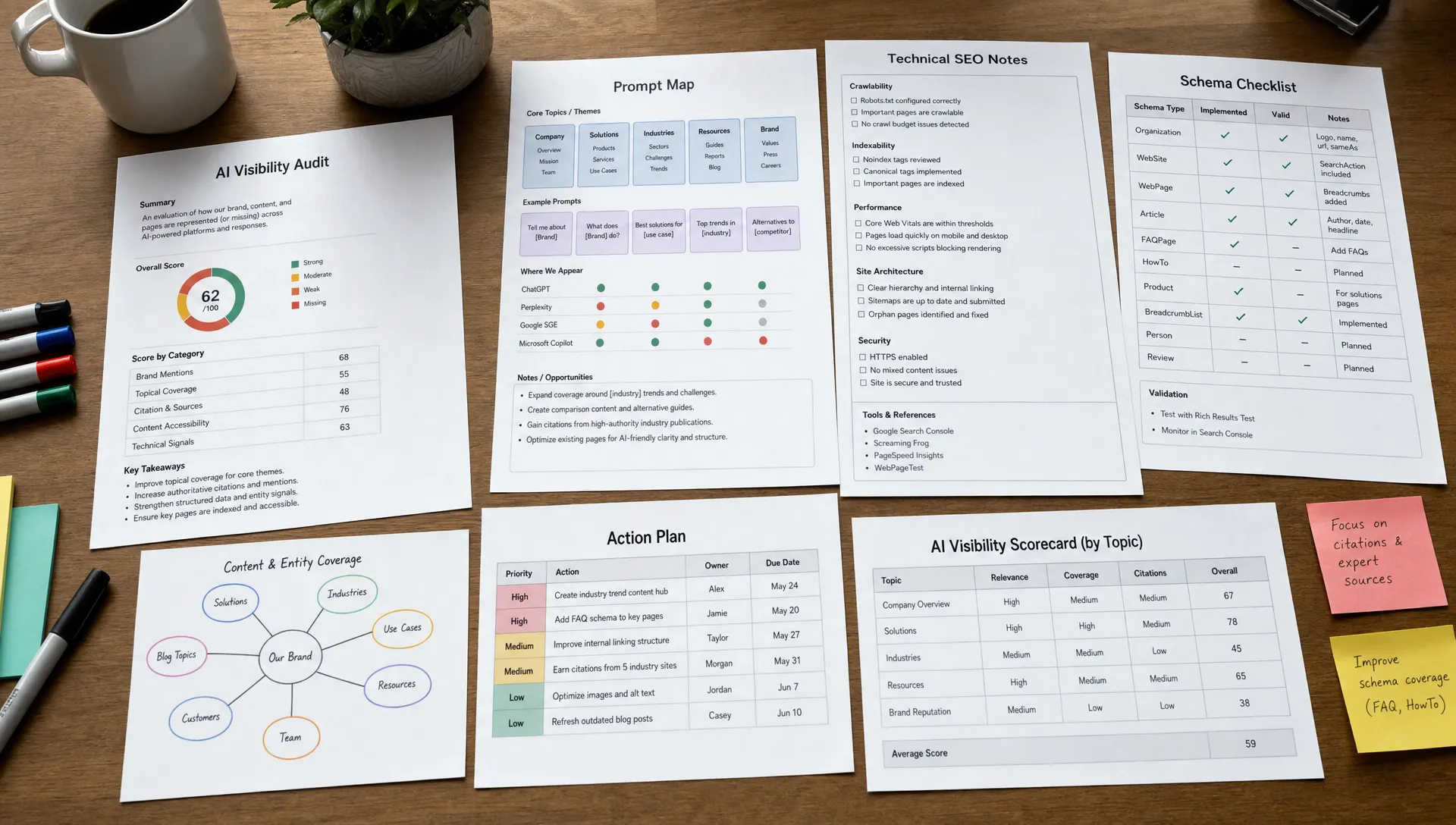
The strongest teams use AI in stages. They automate evidence collection and drafting, then add human review at defined gates.
| Workflow stage | Automation role | Human review role |
|---|---|---|
| Measure | Scan prompts, engines, rankings, citations, technical health, and page performance | Confirm which markets, journeys, and prompts matter most |
| Diagnose | Cluster issues by page type, location, category, or competitor | Separate urgent business problems from low-impact noise |
| Recommend | Draft content changes, metadata, schema, FAQs, and internal link suggestions | Approve claims, prioritize fixes, and add subject-matter expertise |
| Publish | Push approved updates through a CMS or workflow | Validate formatting, compliance, and page experience |
| Monitor | Track before-and-after visibility, mentions, citations, and technical status | Decide whether to iterate, expand, or stop |
This structure is useful because it makes accountability visible. AI handles scale. Humans handle meaning.
How this looks for different teams
The balance between automation and review changes by business model, but the principle stays the same.
Independent hotel chains and travel groups
Automation can scan prompts by destination, traveler intent, amenity, and season. For example, a hotel group might check 20 prompts across 6 priority cities and 5 AI engines, producing 600 answer checks.
Human review should verify amenities, room types, neighborhood descriptions, accessibility details, parking rules, pet policies, and direct booking advantages. The business impact is clear: fewer inaccurate expectations, stronger direct-booking paths, and better visibility for high-intent travel queries.
Multi-site and franchise brands
For healthcare, education, and retail franchises, automation can identify inconsistent NAP data, missing LocalBusiness schema, duplicate location content, thin local FAQs, weak internal linking, and uneven AI mention coverage.
Human review should confirm local services, licensing, staff credentials, operating hours, and market-specific language. The goal is not only more visibility. It is trustworthy visibility at the location level.
IT service providers and MSPs
MSPs often compete in crowded local and vertical markets. Automation can map prompts by service category, such as managed IT, cybersecurity, Microsoft 365 support, backup and disaster recovery, and industry-specific compliance support.
Human review should validate technical claims, certifications, partner status, service boundaries, and case evidence. This prevents vague AI-generated pages from sounding impressive but failing to convert knowledgeable buyers.
Mid-market e-commerce and WooCommerce stores
Automation can analyze product taxonomy, category page gaps, schema completeness, internal links, metadata, reviews, and AI answer visibility for product comparison prompts.
Human review should protect product accuracy, sizing, compatibility, shipping rules, warranty language, and return-reduction details. In e-commerce, better AI-assisted SEO should reduce uncertainty, not simply create more text.
Agencies and in-house SEO teams
Agencies and internal teams benefit from automation because it shortens reporting cycles and makes blind spots easier to explain. Instead of saying visibility has changed, teams can show which prompts, engines, competitors, pages, and citations changed.
Human review remains essential for client strategy, executive communication, QA, and prioritization. The more automated the workflow becomes, the more important governance becomes.
AI content is not the same as AI optimization
One common mistake is treating AI for SEO as a content production shortcut. Publishing more articles is not the same as becoming more visible in AI search.
AI optimization includes content, but it also includes crawlability, entity structure, schema, internal linking, page performance, citations, reviews, and source consistency. A well-written page can still be invisible if search engines cannot crawl it, if the page is buried in the site architecture, or if AI systems cannot connect it to the right entity.
That is why technical SEO still matters. Clear internal links help crawlers and users understand page relationships. Fast pages reduce friction. Structured data adds machine-readable context. Consistent entity signals across your site and the broader web reduce ambiguity.
The emerging use of llms.txt fits into this broader clarity layer. llms.txt is a proposed way to point AI systems toward important, AI-readable content on a site. It should not replace sitemaps, robots.txt, schema, or strong page architecture. Think of it as an additional signal that may help some systems understand what matters most.
For teams comparing the old and new rules, CapstonAI's breakdown of AI SEO vs traditional SEO explains how these disciplines overlap rather than replace each other.
Metrics that separate useful AI automation from noise
A good AI SEO program should create measurable visibility, not just more tasks. The metrics should connect to business outcomes such as traffic quality, bookings, leads, revenue, and credibility.
Useful metrics include:
- AI share of voice for priority prompt sets
- Brand mention rate across ChatGPT, Gemini, Claude, Perplexity, Copilot, and Google AI Overviews
- Citation rate and quality of cited pages
- Competitor inclusion by prompt category
- Prompt-to-page mapping coverage
- Crawlability, indexability, and internal link depth
- Schema validity and completeness
- Page performance and Core Web Vitals trends
- Organic traffic, assisted conversions, bookings, leads, and revenue where attribution is available
The important point is before-and-after measurement. If a team publishes FAQs, adds schema, improves internal links, and updates metadata, it should track whether those changes improve answer inclusion, citations, rankings, and user behavior over time.
No tool can promise deterministic inclusion in every AI answer. Generative engines vary by model, prompt wording, location, personalization, and time. But consistent measurement helps teams see patterns and act on evidence.
Red flags when using AI for SEO
AI becomes risky when it removes review from decisions that deserve judgment. Watch for these patterns:
- Autopublishing large volumes of content without subject-matter review
- Optimizing only for keywords while ignoring entities, citations, and user intent
- Adding schema that does not match visible page content
- Treating AI answers as static when engines change frequently
- Ignoring crawlability, internal linking, and page performance
- Reporting activity instead of visibility, citations, leads, or bookings
The fix is not to avoid AI. The fix is to design review gates. Use automation for speed, coverage, and pattern detection. Use people for strategy, factual accuracy, proof, and final accountability.
How CapstonAI fits into the workflow
CapstonAI is built around measurement first. It helps brands, retailers, agencies, and site-fleet teams track how their business appears across AI search and generative engines, including ChatGPT, Google AI Overviews, Gemini, Perplexity, Claude, and Copilot.
The platform focuses on AI visibility scans, brand mentions, citations, share of voice, prompt mapping, competitor monitoring, prioritized content recommendations, CMS-connected fixes, AI-ready FAQ and schema publishing, llms.txt support, multi-location management, and critical visibility alerts.
That matters because AI can't see your business clearly unless your pages, entities, metadata, citations, and technical foundation make it easy to understand. CapstonAI helps expose what models see, what they miss, and which fixes are most likely to improve visibility.
Frequently Asked Questions
What is AI for SEO? AI for SEO is the use of AI to measure, improve, and monitor search visibility across classic search engines and AI answer systems. It includes technical SEO, AEO, GEO, content optimization, schema, internal linking, and AI visibility tracking.
Can AI replace SEO specialists? No. AI can automate research, audits, clustering, briefs, metadata drafts, schema suggestions, and reporting. SEO specialists are still needed for strategy, business context, technical validation, factual review, prioritization, and stakeholder decisions.
Is AI-generated content bad for SEO? Not automatically. Search engines evaluate whether content is useful, accurate, original, and created for people. AI-assisted content needs human expertise, real proof, and quality control to avoid generic or inaccurate pages.
What should humans always review before publishing? Humans should review claims, compliance-sensitive language, location details, product specifications, schema accuracy, internal links, source citations, and whether the page genuinely helps the intended audience.
How do GEO and AEO differ from traditional SEO? Traditional SEO helps pages rank and be crawled. AEO helps pages answer specific questions clearly. GEO helps generative engines understand, mention, cite, and reuse your brand in AI-generated answers.
How often should AI visibility be checked? High-priority prompts and competitive markets should be monitored regularly because AI answers change. Weekly or monthly scans are common starting points, with more frequent monitoring for major launches, seasonal demand, or critical brand terms.
Start with a free AI visibility audit
The most useful next step is not to automate everything. It is to measure what AI systems currently see.
Start with a free AI visibility audit from CapstonAI. You will see where your brand appears, where competitors are being surfaced, which prompts matter, and which technical or content fixes can make your business easier for AI systems to read, trust, and reuse.