At 10 location pages, local SEO is mostly content work. At 500 location pages, it becomes an operating system.
Every store hour, booking link, service detail, phone number, schema field and local FAQ can either help search engines understand your footprint or create noise. The same is now true inside generative engines such as ChatGPT, Google AI Overviews, Gemini, Perplexity, Claude and Copilot. They do not just rank pages. They summarize entities, compare options, cite sources and answer customer questions before the click happens.
An SEO engine for 500 location pages is not a bulk page generator. It is a controlled system that turns verified location data into fast, indexable, useful pages, then measures whether search engines and AI answer engines mention, cite and trust them.
For a hotel group, that means every property page can answer practical questions about parking, pet policies, nearby landmarks and booking paths. For a healthcare franchise, it means appointment types, insurance details and hours stay accurate across every clinic page. For a retailer, it means local inventory, pickup options and category relevance do not disappear into a generic store locator.
The goal is simple: build the machine once, then use it to publish, update and improve hundreds of pages without losing quality.
Why 500 location pages break ordinary SEO processes
Most multi-location SEO problems start with a spreadsheet and a template. The spreadsheet has location names, addresses and phone numbers. The template swaps in city names. The team publishes quickly, then spends months fixing inconsistent titles, missing canonicals, broken internal links and pages that Google discovers but does not value.
At 500 pages, small errors compound. If each page has 12 core facts, you are managing at least 6,000 page-level data points before adding services, FAQs, images, reviews, schema or multilingual fields. If just 2% of those facts are wrong or stale, that is 120 incorrect signals live on your site.
AI search makes the quality gap more visible. A generative engine may answer a prospect with a competitor because your page does not clearly connect the local entity, service, category and proof. It may mention your brand but fail to cite you. It may rely on a third-party directory because your own page is slower, thinner or harder to parse.
Common failure modes include:
- Thin pages where only the city name changes
- Inconsistent NAP data across the page, schema, directory listings and Google Business Profiles
- Orphaned location pages that appear in the XML sitemap but have no meaningful internal links
- Schema markup that does not match visible page content
- No measurement of AI visibility, brand mentions, citations or local share of voice
None of these are solved by adding more copy at random. They are solved by building a repeatable SEO engine with clean inputs, useful templates, technical validation and visibility tracking.
Define the engine before writing pages
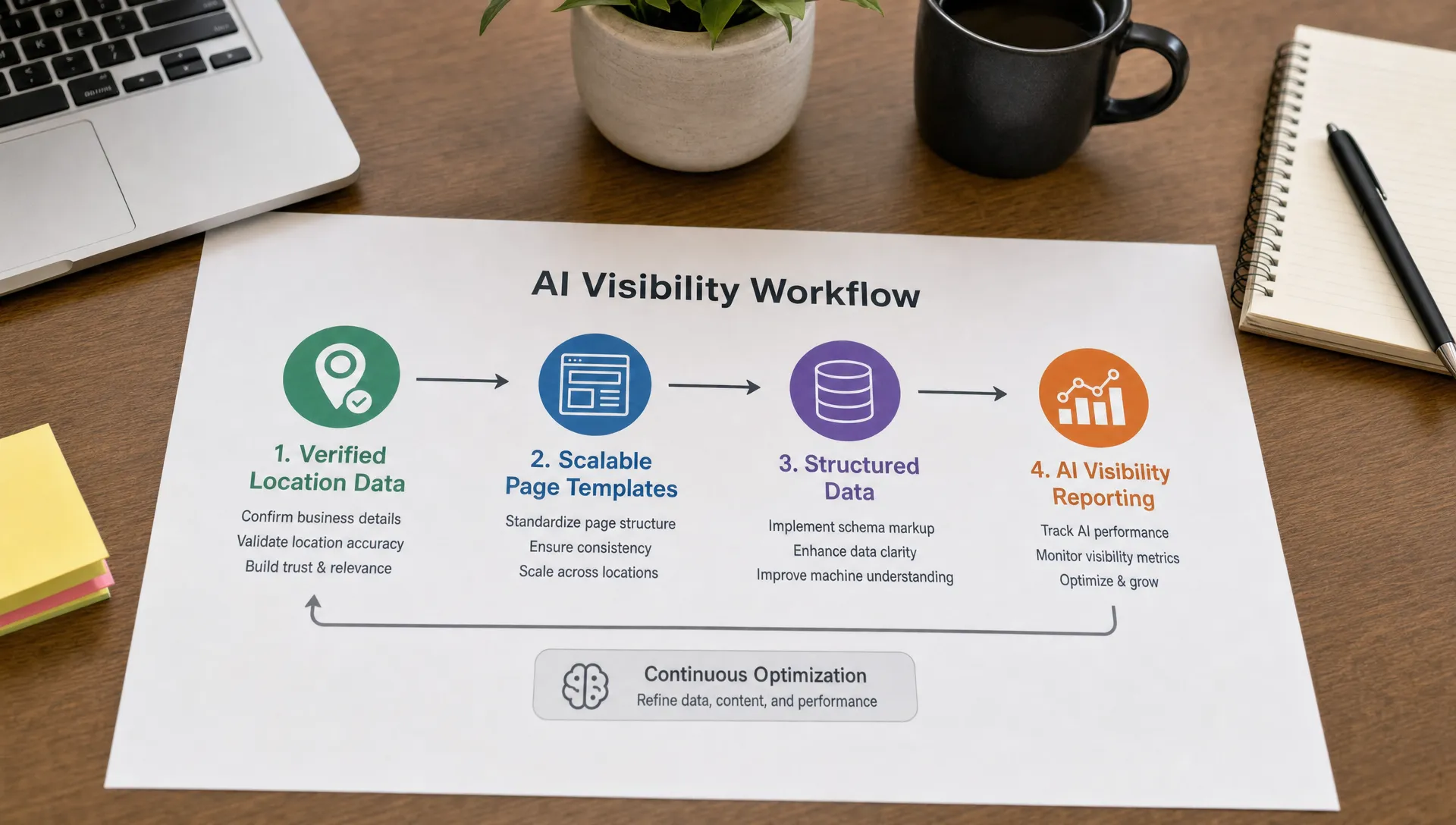
A scalable location SEO program needs four layers: data, page structure, technical foundations and measurement. Treat each layer as part of the same system. If your data is inaccurate, the best template will publish inaccurate pages. If your pages are not crawlable, the best content will not be discovered. If you only measure traffic, you will miss how AI answers are shaping demand before the visit.
| Engine layer | What it controls | Business effect |
|---|---|---|
| Location data | Name, address, phone, hours, coordinates, services, amenities, booking URLs | Reduces wrong calls, lost bookings and entity confusion |
| Page templates | Content modules, FAQs, conversion blocks, media, local proof | Creates consistent quality without writing 500 pages from scratch |
| Technical SEO | Indexability, canonicals, page performance, internal links, schema | Helps search engines crawl, understand and reuse each page |
| AI visibility | Prompt coverage, brand mentions, citations, share of voice, competitor comparisons | Shows whether ChatGPT, Gemini, Perplexity and other engines surface your brand |
The source of truth matters more than the CMS template. Before you publish or refresh 500 pages, decide where each fact lives and who owns it. Store hours may come from operations. Amenities may come from property managers. Insurance details may come from compliance. Product availability may come from inventory systems. The SEO team should not be guessing.
For example, an industrial supplier with regional dealers for sustainable cleaning and contamination-control solutions needs each dealer or market page to connect the same core entity to local support, equipment categories and regulated industry use cases. The page is not just a city placeholder. It is a local access point for a specific offer, audience and proof set.
A practical location data model should include the basics, but it should also include fields that answer buying questions. For hotels, that may be parking, shuttle service, meeting space, pet policy and nearby attractions. For clinics, it may be appointment types, accepted insurance, provider availability and accessibility. For retail, it may be categories carried, pickup windows, return options and local promotions.
Design templates that pass the usefulness test
A location page should help someone choose, contact or visit that location. If the page exists only to rank for city plus brand or service, it will struggle in both classic SEO and AI search.
A scalable template usually includes:
- A clear local entity header with location name, category, address, phone number and primary call to action
- Service or product modules that only appear when available at that location
- Local proof such as reviews, staff credentials, property details, case examples, photos or neighborhood context
- Practical visit information such as directions, parking, transit, accessibility, hours and booking links
- FAQs written from real customer questions and answered with location-specific facts
- Structured data that matches the visible page content
The variable sections are what keep 500 pages from becoming duplicates. A hotel page near an airport should not read like a resort property page. A franchise clinic with pediatric care should not look identical to a location that only handles occupational medicine. A WooCommerce store with local pickup in one region should not promise the same availability everywhere.
Do not force uniqueness through decorative prose. Local uniqueness should come from facts customers care about: services available, travel time, appointment pathways, inventory, staff expertise, nearby demand drivers and local proof.
Make crawlability and internal linking non-negotiable
An XML sitemap is a submission file, not a navigation architecture. Search engines and AI systems still need a clear crawlable path through your site.
For 500 location pages, build internal linking as a hierarchy. A national location finder should link to state or region hubs. Region hubs should link to city hubs or individual locations. Service pages should link to locations where that service is actually available. Each location page should link to related service pages, nearby locations when useful and its parent region page.
This does three things. It helps users navigate. It distributes authority across the fleet. It reinforces entity relationships, such as this brand operates this location, this location offers this service and this service is relevant in this market.
Use HTML links that are visible in the page source. Avoid hiding your entire location architecture behind JavaScript filters that search engines cannot reliably traverse. For deeper technical foundations, CapstonAI has a related guide on how to build a website with SEO that AI engines can understand, including crawlability, structured data and entity clarity.
Internal linking also supports generative engine optimization. AI systems look for consistent relationships across content. If your service page, location page, FAQ and structured data all reinforce the same relationship, your site becomes easier to interpret and cite.
Use schema, entities and llms.txt to make facts reusable
Structured data helps machines read page facts without guessing. It does not replace visible content, but it gives search engines a clearer map of the entities on the page.
For location pages, the right schema depends on the business type. A hotel group may use Hotel or LodgingBusiness. A retail chain may use Store. A clinic may use a more specific healthcare type when accurate. A service provider may use LocalBusiness or a subtype. The wrong schema can create confusion, so accuracy matters more than volume.
| Page element | Structured data to consider | Quality rule |
|---|---|---|
| Location identity | LocalBusiness subtype, name, address, telephone, geo, url | Match the visible NAP exactly |
| Navigation | BreadcrumbList | Reflect the real page hierarchy |
| Offers or services | Service, Offer or hasOfferCatalog where appropriate | Mark up only services actually available at that location |
| FAQs | FAQPage | Use only questions and answers visible on the page |
| Reviews | AggregateRating or Review when eligible | Follow platform guidelines and show supporting content visibly |
Entities are the connective tissue. A search engine should understand that the brand, location, service, staff member, product category and nearby market are related. Consistent naming, sameAs links where appropriate, accurate Google Business Profile data and clean internal links all support that relationship.
The llms.txt file is an emerging way to point AI systems toward useful, high-quality content. It is not a substitute for crawlability, schema or page quality. Use it as a guidepost for AI crawlers, not as a magic switch. For a 500-page location program, llms.txt can help highlight location hubs, policy pages, service explainers and other canonical resources that should be easier for AI systems to discover.
Add AEO and GEO, not just classic local SEO
Classic SEO helps pages rank and earn organic clicks. Answer Engine Optimization, or AEO, helps your content answer specific questions clearly enough to be selected or summarized by answer engines. Generative Engine Optimization, or GEO, focuses on how your brand is represented, mentioned and cited inside AI-generated answers.
The practical difference is measurement. A traditional local SEO report may show impressions, clicks and rankings. An AI search report should also show which prompts surface your brand, whether the answer cites your site, which competitors appear instead and how your share of voice changes over time. If your team needs a deeper primer, see CapstonAI's guide to Answer Engine Optimization for 2026.
Prompt mapping turns customer intent into a test set. For 500 location pages, prompts should cover brand, category, comparison and local need.
| Prompt type | Example intent | What the page must prove |
|---|---|---|
| Local discovery | Family hotel near a landmark with parking | Location, amenity and proximity clarity |
| Availability | Urgent care open Sunday in a suburb | Accurate hours, services and appointment path |
| Comparison | Best managed IT provider in a city for healthcare offices | Category relevance, local proof and industry fit |
| Transaction | Where to buy or pick up a product today | Inventory, store details and conversion path |
This is where 500 location pages become a data advantage. You can compare which page patterns earn mentions, citations and conversions. You can identify markets where competitors dominate AI answers. You can see whether Google AI Overviews cite your location hubs, whether Perplexity prefers third-party directories or whether ChatGPT recognizes your brand but misses key services.
Measure the engine, not only individual pages
A single location page may have low traffic and still be valuable. A 500-page fleet should be judged by patterns. Which templates are indexed fastest? Which schema errors appear most often? Which regions underperform? Which prompts mention competitors? Which pages drive calls, bookings, form fills or store visits?
Build a scorecard that combines classic SEO, technical SEO and AI visibility.
| Measurement area | Useful metrics | What it tells you |
|---|---|---|
| Discovery | Submitted pages, indexed pages, crawl frequency, orphan page count | Whether search engines can find and access the fleet |
| Organic search | Impressions, clicks, ranking by query class, non-brand visibility | Whether pages capture demand in Google search |
| Performance | Core Web Vitals, page weight, server response time, mobile usability | Whether users and crawlers can load pages efficiently |
| Conversion | Calls, bookings, forms, direction clicks, local revenue where available | Whether visibility turns into business outcomes |
| AI visibility | Brand mentions, citations, prompt coverage, AI share of voice | Whether generative engines surface and trust your brand |
Before and after measurement is essential. If you update 50 pilot pages with better templates, schema and internal links, compare them against a control group. Look for changes in indexation, impressions, conversions and AI mentions. The goal is not to claim every lift came from one fix. The goal is to identify which changes are worth rolling across all 500 pages.
Page performance becomes an operational issue at scale
Location pages often accumulate heavy maps, uncompressed images, review widgets, chat scripts and tracking tags. One slow page is a user experience issue. Five hundred slow pages become a crawl efficiency and conversion issue.
A simple example shows the scale. Reducing each page by 200 KB removes about 100 MB of unnecessary transfer across a 500-page crawl or full-fleet page view set. That does not guarantee rankings, but it does reduce waste. It also helps mobile users reach the phone number, booking form or directions link faster.
Prioritize image compression, lazy loading, caching, server-side rendering for critical content and a clean script policy. Avoid burying NAP data, hours or calls to action inside widgets that fail when scripts are blocked. AI systems and search crawlers should be able to read the core page without needing a perfect browser session.
A rollout plan for 500 pages
Do not launch everything at once unless your data, templates and QA are already mature. A staged rollout gives you proof and catches template issues before they affect the whole fleet.
| Phase | Work | Output |
|---|---|---|
| Days 1 to 30 | Audit location data, crawlability, indexation, schema, internal links and AI visibility | Baseline report, priority issue list and source-of-truth gaps |
| Days 31 to 60 | Build or update templates, CMS fields, structured data, internal linking rules and QA checks | Pilot group of 25 to 50 improved pages |
| Days 61 to 90 | Roll out by region or business unit, monitor indexation and compare pilot pages against controls | Fleet-wide publishing plan, scoring model and fix backlog |
For agencies, MSPs and in-house teams, the operational layer is where time is won or lost. Standardize field names. Create validation rules. Use AI to detect duplicate copy, missing schema fields and prompt coverage gaps, but keep humans responsible for factual accuracy and brand decisions. CapstonAI's article on SEO AI workflows that save teams hours each week covers useful patterns for keeping automation practical and reviewable.
Common mistakes to avoid
The fastest way to weaken a 500-page program is to treat scale as permission to lower standards. Search engines and AI engines both reward clarity, consistency and usefulness.
Avoid these mistakes:
- Publishing from an unverified spreadsheet without operational ownership
- Using one generic paragraph and swapping only city or neighborhood names
- Creating location pages that are only reachable through a search box or map widget
- Adding schema for services, reviews or FAQs that are not visible on the page
- Measuring only organic clicks while ignoring AI brand mentions, citations and share of voice
- Letting pages drift after launch as hours, services, staff, policies or inventory change
The fix is not more complexity. The fix is governance. Assign owners for location data, content quality, technical health and visibility measurement. Review the fleet in batches. Use alerts for critical changes such as noindex tags, broken booking links, missing schema or sudden AI visibility drops.
Frequently Asked Questions
What is an SEO engine for location pages? It is a repeatable system for turning verified location data into useful, crawlable and structured pages, then measuring performance across search engines and AI answer engines. It includes data governance, templates, internal links, schema, page performance and visibility tracking.
Do 500 location pages create duplicate content problems? They can if the pages are thin and only swap location names. They do not have to. Strong location pages use shared structure but include real local facts, available services, local proof, visit details, FAQs and conversion paths.
How much unique content does each location page need? There is no useful universal word count. A page needs enough specific information to help a customer choose or contact that location. For some businesses that may be 500 words. For hotels, clinics, education campuses or complex service providers, it may be much more.
How does AI search change multi-location SEO? AI search compresses discovery, comparison and decision-making into generated answers. That means your pages need to be easy to parse, cite and trust. Brand mentions, citations, prompt coverage and AI share of voice become part of the measurement model.
Where does llms.txt fit into a location SEO strategy? llms.txt can help point AI systems toward high-value resources, but it should support the basics, not replace them. Crawlable pages, clear internal links, accurate schema, strong content and consistent entity data still matter more.
How often should a 500-page location fleet be audited? Technical and AI visibility checks should run frequently enough to catch changes before they affect revenue. Many teams review critical issues weekly, then run deeper content and data audits monthly or quarterly depending on how often locations, services and policies change.
Start with a free AI visibility audit
If AI cannot see your business clearly, it cannot reliably recommend, mention or cite it. CapstonAI helps multi-location brands, retailers, agencies and in-house teams measure what ChatGPT, Google AI Overviews, Gemini, Perplexity, Claude and Copilot see across their location footprint.
A practical next step is to start with a free AI visibility audit. Use it to identify where your brand is missing, which competitors appear instead, which pages need AI-ready metadata, schema and FAQs, and where technical SEO issues are limiting trust.
Build the SEO engine first. Then every new location page becomes easier to publish, easier to maintain and easier for both search engines and AI engines to understand.