Building a website with SEO used to mean making pages crawlable, targeting the right keywords, and earning enough authority to rank in Google. Those fundamentals still matter. What changed is the audience reading your site.
Your pages are now interpreted by generative engines such as ChatGPT, Google AI Overviews, Gemini, Perplexity, Claude, and Copilot. These systems do not browse your site like a human prospect. They extract entities, compare claims, evaluate citations, and decide whether your brand is reliable enough to mention in an answer.
That means a modern SEO-ready website has two jobs:
- Help search engines crawl, index, and rank the right pages.
- Help AI engines understand, trust, and reuse your information in answers.
If AI cannot see your business clearly, it may recommend a competitor with better structured content, stronger citations, or more machine-readable pages. Here is how to build a website that supports classic SEO, AEO, and GEO from the start.
Start With the New SEO Stack: Technical SEO, AEO, and GEO
AI search does not replace SEO. It adds another layer of visibility.
Classic technical SEO ensures your site can be discovered, crawled, rendered, indexed, and ranked. Answer Engine Optimization (AEO) helps your pages provide concise, factual answers to specific questions. Generative Engine Optimization (GEO) improves how often generative systems mention, cite, and describe your brand across AI-generated responses.
| Layer | What it helps with | What to optimize |
|---|---|---|
| Technical SEO | Crawling, indexing, speed, rankings | Site architecture, metadata, canonicals, structured data, Core Web Vitals |
| AEO | Direct answers and featured response formats | FAQs, short definitions, comparison sections, how-to steps, schema |
| GEO | Visibility inside AI answers | Entity clarity, citations, brand mentions, topical authority, prompt coverage |
A website with SEO that AI engines can understand does not treat these as separate projects. The same page should be fast, indexable, structured, specific, and supported by credible evidence.
For example, a hotel chain’s location page should rank for local searches, answer “best family hotel near downtown Austin,” expose structured hotel and local business data, and give AI systems enough factual detail to cite it confidently.
Make Every Important Page Crawlable, Renderable, and Fast
AI visibility starts with technical access. If search crawlers struggle to reach or interpret your content, generative systems have less reliable material to work with.
Google’s own Search Central documentation on crawling and indexing emphasizes the basics: make pages discoverable, avoid blocking important resources, and help crawlers understand canonical versions. Those same principles support AI engines that depend on indexed or retrievable web content.
Focus first on the pages tied to revenue, trust, and differentiation:
- Service pages for agencies, MSPs, healthcare groups, and education brands.
- Location pages for hotel groups, clinics, stores, and franchises.
- Category and product pages for e-commerce and WooCommerce stores.
- Comparison, pricing, integration, and FAQ pages for buyers evaluating options.
- About, leadership, case study, policy, and contact pages that prove credibility.
Technical fixes should always connect to a business effect. A broken canonical tag can split authority across duplicate pages. Slow mobile pages can reduce conversions and crawl efficiency. JavaScript-rendered content that is not visible in the HTML can make key facts harder for crawlers and AI systems to extract.
A practical technical checklist includes:
- Confirm important pages return a 200 status code and are not blocked by robots.txt or noindex tags.
- Keep XML sitemaps clean, current, and focused on canonical URLs.
- Use descriptive, stable URLs that reflect the entity or intent of the page.
- Make primary content visible in the HTML, not only injected after user interaction.
- Improve page performance, especially Largest Contentful Paint, Interaction to Next Paint, and Cumulative Layout Shift.
- Fix duplicate title tags, thin pages, redirect chains, and orphan pages.
Page performance is not just a user experience metric. A faster site is easier to crawl at scale, especially for multi-location brands and large e-commerce catalogs. It also gives visitors less reason to abandon a page before converting.
Build Around Entities, Not Just Keywords
AI engines are entity-driven. An entity is a distinct thing the model can identify and relate to other things, such as a company, hotel, clinic, product, city, founder, service, certification, or software category.
Keywords still signal demand. Entities signal meaning.
For AI engines to understand your business, your site should clearly answer:
- Who are you?
- What do you sell or provide?
- Where do you operate?
- Who do you serve?
- What makes you credible?
- Which products, services, locations, and people are connected to your brand?
This matters because generative answers often synthesize information from multiple sources. If your site says one thing, your listings say another, and third-party mentions use inconsistent names, AI systems may describe your business inaccurately or ignore it.
For a franchise healthcare brand, entity clarity means every location page should use consistent naming, address formatting, service categories, clinician information, and local proof. For a WooCommerce store, product entities need complete names, model numbers, specifications, availability, reviews where applicable, and clear category relationships.
The goal is not to repeat your brand name everywhere. The goal is to remove ambiguity.
Design Pages for Questions, Comparisons, and Decisions
Many AI prompts are not simple keywords. They sound like buyer questions:
“What is the best boutique hotel in Charleston for a small corporate retreat?”
“Which managed IT provider supports Microsoft 365 and cybersecurity for dental practices?”
“What should I compare before choosing a WooCommerce SEO agency?”
A page built only around a short keyword may not satisfy these prompts. A page built around intent can.
Use a clear page structure that gives both humans and machines the answer path:
| Page element | Why it matters for AI understanding | Example |
|---|---|---|
| Descriptive H1 and intro | Defines the main topic quickly | “Managed IT Services for Multi-Location Healthcare Teams” |
| Short answer block | Helps answer engines extract concise information | “Our managed IT service supports endpoint security, Microsoft 365, backup, and help desk coverage for clinics with multiple sites.” |
| Evidence section | Gives AI systems and buyers proof points | Certifications, integrations, locations served, case studies, policies |
| Comparison section | Matches evaluation-stage prompts | “In-house IT vs. managed IT provider” |
| FAQ section | Captures natural-language questions | “Do you support HIPAA-focused IT environments?” |
| Internal links | Shows relationships between pages | Links from service pages to location, case study, and support pages |
| Schema markup | Adds machine-readable context | Organization, LocalBusiness, Product, FAQPage, Service, BreadcrumbList |
AEO is especially useful here. It turns vague content into answerable content. If a page cannot answer the obvious buyer questions in plain language, AI engines may turn to competitors, marketplaces, review sites, or directories.
For more on balancing AI assistance with editorial quality, CapstonAI’s guide to best practices for using AI for SEO content explains how to use AI for research and structure without publishing generic pages.
Use Structured Data to Confirm Meaning
Structured data is code that labels page information using a shared vocabulary. Search engines use it to understand page content, qualify pages for rich results, and disambiguate entities.
The most common vocabulary is Schema.org, which includes types such as Organization, LocalBusiness, Product, Service, Review, FAQPage, Article, BreadcrumbList, Event, and Hotel.
Structured data does not compensate for weak content. It confirms what is already visible on the page.
For AI visibility, schema can help clarify:
- Your official business name, logo, URL, and sameAs profiles.
- Locations, addresses, phone numbers, opening hours, and service areas.
- Product names, SKUs, prices, availability, and ratings when accurate.
- Article authorship, publication dates, and topical relevance.
- FAQ questions and answers that match real search and AI prompts.
- Breadcrumb relationships that show where a page sits in the site architecture.
For a hotel group, Hotel and LocalBusiness schema can reinforce location, amenities, and contact details. For a retailer, Product schema helps connect product pages to exact inventory and attributes. For an agency, Organization and Service schema can clarify market positioning.
Metadata also matters. Title tags and meta descriptions influence search presentation, but they also summarize page purpose. Clear metadata helps crawlers and users identify the page’s role. If your titles are duplicated, vague, or stuffed with keywords, you lose a simple chance to define the entity and intent of each page. CapstonAI covers this in more depth in its article on AI-assisted meta tag optimization.
Add llms.txt, but Do Not Treat It as a Shortcut
An llms.txt file is an emerging convention for giving large language models a concise map of useful content on your site. It can point AI systems toward important pages, documentation, policies, product information, and brand resources.
It is not a replacement for crawlability, sitemap hygiene, schema, or strong content. Think of it as an additional signpost.
A useful llms.txt approach should be selective. Do not list every URL. Prioritize pages that accurately describe your business, products, services, locations, policies, and expertise.
For example, a multi-brand retail group might include brand overview pages, top categories, return policies, sizing guides, and store locator pages. An MSP might include service pages, cybersecurity resources, compliance explanations, support policies, and industry pages.
The business effect is simple: you reduce the chance that AI systems infer your positioning from outdated pages, thin directory listings, or competitors’ comparisons.
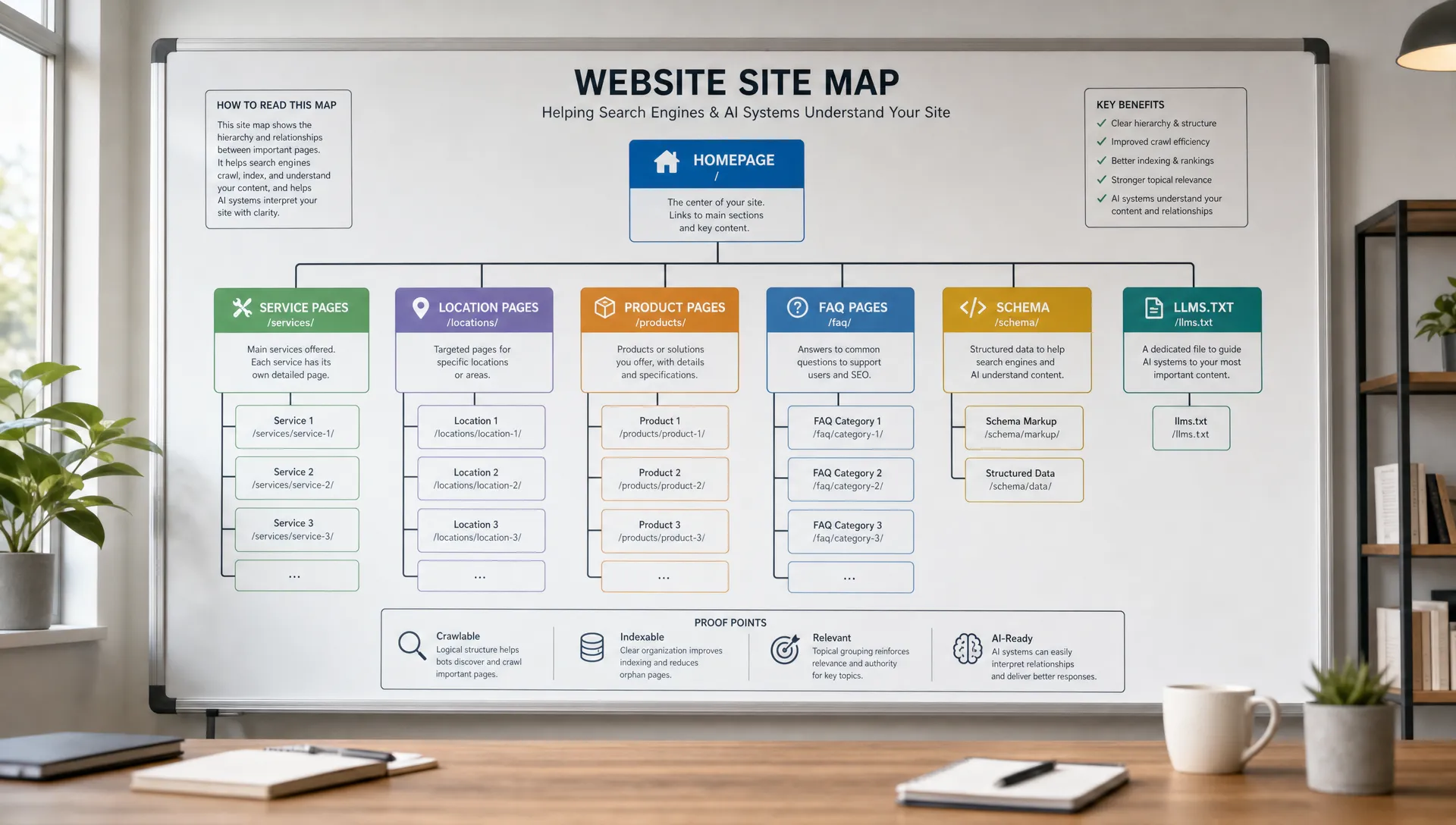
Build Internal Links That Explain Relationships
Internal linking is often treated as a ranking tactic. It is also a meaning system.
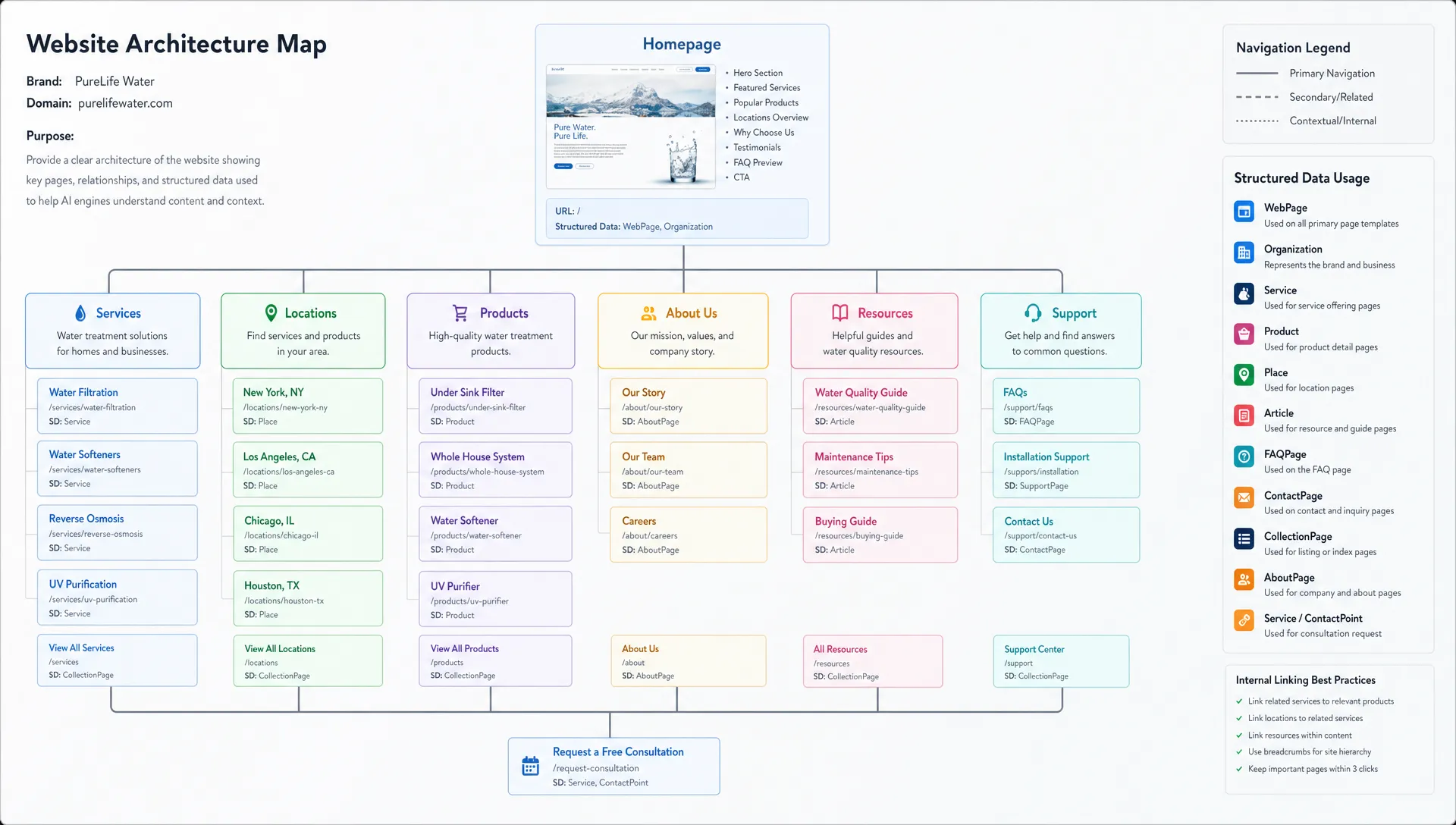
When your pages link logically, they tell crawlers and AI systems how your business is organized. A service page connected to related industries, locations, case studies, and FAQs becomes easier to interpret than an isolated page.
Good internal links use descriptive anchor text. “Cybersecurity services for healthcare clinics” is more useful than “learn more.” The anchor tells both readers and machines what relationship exists between the pages.
For multi-location and franchise sites, internal links should connect:
- Brand-level service pages to relevant local pages.
- Local pages to nearby services, booking pages, and FAQs.
- Category pages to buying guides, product pages, and comparison content.
- Blog articles to revenue pages when the intent naturally supports it.
- Case studies to the services, industries, and outcomes they prove.
This is where many websites lose AI visibility. They may have good pages, but the relationships are weak. AI engines are better at understanding a site when the site explains itself.
Earn and Track Mentions, Citations, and Share of Voice
Classic SEO often focuses on rankings and clicks. AI search adds three visibility metrics that matter just as much.
A brand mention occurs when an AI engine names your business in an answer. A citation occurs when it references or links to a source connected to your brand. Share of voice measures how often your brand appears compared with competitors across a defined set of prompts.
These metrics reveal blind spots that rank tracking alone can miss. You might rank well for “hotel in Nashville,” but not appear when someone asks Gemini or Perplexity for “best downtown Nashville hotel for a weekend trip without a car.” You might rank for your MSP brand name, but not be mentioned in ChatGPT prompts comparing providers for law firms.
That distinction is why CapstonAI’s article on why website rank alone misses your AI visibility problem is worth reading if your reporting still stops at organic position and traffic.
To measure AI visibility, build prompt sets that reflect real buyer journeys:
- Discovery prompts, such as “best hotels near…” or “top providers for…”
- Comparison prompts, such as “Brand A vs Brand B” or “alternatives to…”
- Problem prompts, such as “how to reduce downtime across retail locations.”
- Local prompts, such as “urgent care clinic near…” or “IT support in…”
- Decision prompts, such as “which provider is better for…” or “what should I look for before choosing…”
Then track which engines mention you, which cite you, which cite competitors, and which prompts return outdated or inaccurate information. This turns AI visibility from guesswork into a workflow.
Create Content That AI Can Quote Without Distorting
Generative engines prefer information that is specific, verifiable, and easy to summarize. That does not mean every page should be written in short snippets. It means important claims should be clear enough to extract.
A weak statement sounds like this: “We provide industry-leading solutions for modern teams.”
A stronger statement sounds like this: “CapstonAI tracks how ChatGPT, Gemini, Claude, Perplexity, Copilot, and Google AI Overviews mention your brand, cite your pages, and compare you with competitors.”
The second version gives AI systems entities, actions, and context. It also gives buyers a reason to keep reading.
For service and product pages, replace vague language with concrete information:
- Define the service in one or two sentences near the top of the page.
- Name the industries, locations, platforms, or use cases you support.
- Explain what is included and what is not included.
- Add evidence, such as certifications, policies, case studies, reviews, or documented processes.
- Keep claims current and avoid unsupported superlatives.
This is especially important for agencies and in-house teams using AI to scale content. AI-generated drafts often sound fluent but generic. Human editorial review should add facts, positioning, examples, and proof.
Match Content Types to Buyer Intent
A site that AI engines can understand usually has a balanced content system. It does not rely only on blog posts or only on landing pages.
| Buyer intent | Best content type | AI visibility goal |
|---|---|---|
| Learning | Guides, explainers, glossaries | Be cited as a helpful source |
| Comparing | Comparison pages, alternatives pages, buying guides | Appear in evaluation prompts |
| Local decision | Location pages, local FAQs, service area pages | Surface for geo-specific prompts |
| Product evaluation | Product pages, category pages, specification pages | Provide accurate product facts |
| Trust building | Case studies, reviews, policies, About pages | Support credibility and entity confidence |
For a travel group, this might mean pairing destination guides with property pages and local FAQs. For an education franchise, it might mean connecting program pages with campus pages, accreditation information, and parent questions. For an e-commerce site, it might mean connecting category pages with buying guides and product schema.
The principle is consistent: each page should have a job, and related pages should support one another.
A Practical 30-Day Build Plan
You do not need to rebuild an entire website at once. Start with the pages most likely to influence revenue and AI answers.
- Audit visibility across engines: Test your brand, competitors, services, products, and locations in ChatGPT, Google AI Overviews, Gemini, Perplexity, Claude, and Copilot. Record mentions, citations, and errors.
- Fix technical blockers: Review indexability, robots.txt, sitemaps, canonical tags, redirects, mobile performance, and JavaScript-rendered content.
- Clarify entities: Update organization, location, product, service, and author information. Align names, addresses, descriptions, and sameAs references.
- Strengthen priority pages: Add answer blocks, evidence sections, comparison content, FAQs, internal links, and schema to high-value pages.
- Publish AI-ready metadata: Improve titles, descriptions, structured data, breadcrumbs, and llms.txt references for important URLs.
- Track before and after: Measure whether target prompts start mentioning your brand more accurately and whether citations point to the right pages.
This is the measurement-first approach CapstonAI is built around. Before changing hundreds of pages, find what AI engines currently see, what they miss, and where competitors are being surfaced instead.
If you are evaluating platforms for this work, CapstonAI’s AI SEO tools comparison for 2026 outlines what to look for across engine coverage, measurement rigor, CMS integrations, and automation controls.
Common Mistakes That Make AI Engines Misread a Website
The most common problem is not that a business lacks expertise. It is that the website does not express that expertise in a way machines can parse.
Watch for these issues:
- Important services buried inside generic pages with no dedicated URL.
- Location pages that reuse the same copy with only the city changed.
- Product pages missing specifications, availability, or structured data.
- FAQ content that answers internal sales questions instead of buyer questions.
- Inconsistent brand names across the website, listings, directories, and social profiles.
- Thin About pages with no clear entity signals, leadership, history, or proof.
- Blog posts that attract traffic but do not link to conversion pages.
- Schema markup that contradicts visible page content.
Each issue creates friction. Search engines may still rank some pages, but AI systems may struggle to decide whether your brand is relevant, current, or trustworthy enough to include in an answer.
Frequently Asked Questions
What does it mean to build a website with SEO for AI engines? It means building pages that are technically crawlable, semantically clear, structured with schema, supported by evidence, and easy for AI engines to cite or summarize. Classic SEO gets your pages discovered. AEO and GEO help your business appear accurately in AI-generated answers.
Do AI engines use the same ranking signals as Google? Not exactly. Generative engines may draw from search indexes, direct retrieval, citations, model training data, and trusted third-party sources. That is why rankings alone do not fully explain AI visibility. You also need to track prompts, mentions, citations, and competitor share of voice.
Is schema markup required for AI visibility? Schema is not a guarantee, but it helps confirm meaning. It gives machines structured context about your organization, products, services, locations, FAQs, articles, and breadcrumbs. The best results come when schema matches strong visible content.
Should every website add llms.txt? Many brands should consider it, especially if they have important documentation, policies, services, or product pages that AI systems should understand. Treat llms.txt as a helpful guide, not a substitute for technical SEO, internal linking, schema, and quality content.
How often should we measure AI visibility? For active brands, monthly measurement is a practical baseline. Agencies, multi-location businesses, and competitive e-commerce teams may track priority prompts more often, especially after site changes, content launches, rebrands, or competitor movement.
The Concrete Next Step: Run an AI Visibility Audit
A site that ranks is valuable. A site that AI engines can understand, cite, and recommend is becoming essential to how buyers discover brands.
Start by finding out what AI engines currently see. CapstonAI scans visibility across ChatGPT, Google AI Overviews, Gemini, Perplexity, Claude, and Copilot, then helps identify missing mentions, weak citations, technical blind spots, and page-level fixes.
If you want to know whether AI can see your business clearly, start with a free AI visibility audit from CapstonAI. From there, you can prioritize the pages, metadata, schema, internal links, and content improvements most likely to increase accurate AI search presence.