If your team is searching for the phrase google seo ai because AI Overviews are citing competitors instead of your own pages, the first fix is not more content. It is better evidence. AI Overview citations tend to favor pages that are easy to crawl, clear about entities, direct in their answers and supported by consistent signals across the web. For hotels, franchises, healthcare groups, e-commerce teams and agencies, that means SEO now has two jobs: keep ranking in classic Google Search and make every important page usable as a trusted source inside generated answers.
Google SEO AI tactics start with citation diagnostics
AI Overview optimization is not the same as chasing one keyword ranking. Google can use a page in a generated answer even when that page is not the first organic result, and it can ignore a ranking page if the answer block needs a clearer, more specific source.
That changes the workflow. Before editing copy or adding schema, measure where your brand appears, where competitors appear and which prompts trigger citations. CapstonAI approaches this as a visibility problem first: scan the engines, map prompts to mentions and citations, then prioritize fixes by business impact.
Treat AI citations as a source selection problem
Classic SEO asks whether Google can find and rank a page. AI search asks whether a generative system can reuse that page to answer a specific question with confidence. The difference matters because AI Overview citations are usually tied to passages, entities and facts rather than a whole domain reputation score.
A practical Google SEO AI workflow begins by collecting prompts that resemble real customer questions. For a hotel group, that might include pet-friendly stays near a landmark, meeting space capacity or parking details. For a healthcare franchise, it might include insurance, location availability or treatment options. For an MSP, it might include Microsoft 365 migration support, response time and industry specialization.
Map prompts, mentions and citations separately
A brand mention means an AI answer names your business. A citation means the answer links to you as a source. Share of voice compares your presence against competitors across the same prompt set. These are different signals, and treating them as one metric hides useful information.
Here is a simple diagnostic model:
| Signal | What it tells you | Business effect |
|---|---|---|
| Mention | The model recognizes your brand as relevant | Awareness and category association |
| Citation | The model trusts a page enough to source it | Referral potential and credibility |
| Share of voice | Your visibility versus competitors | Market position inside AI answers |
| Prompt coverage | Which questions surface you or rivals | Content gaps and sales journey gaps |
For deeper measurement mechanics, CapstonAI has a separate guide on how to track brand mentions and citations in Google AI Search.
Build pages that answer before they persuade
Generative engines need short, extractable answers. AEO, or Answer Engine Optimization, is the practice of formatting information so an answer system can identify the question, the answer and the supporting detail quickly. GEO, or Generative Engine Optimization, is broader: it includes entities, authority signals, technical access and cross-engine visibility.
Your commercial page can still sell, but its first job is clarity. If a prospect asks whether your hotel has airport shuttle service, whether your clinic offers same-week appointments or whether your WooCommerce store ships refrigerated products, the answer should not be buried below generic brand copy.
Put the direct answer near the matching question
The strongest AI Overview candidates often use plain question-based sections followed by concise answers. A good pattern is a 40 to 60 word answer first, then supporting detail, proof and next steps. This helps Google AI Overviews and other systems isolate the passage without guessing.
For example, instead of a vague section called Our Services, a multi-location dental brand could use Do you offer emergency dental appointments in Austin? The first sentence should answer yes or no, name the location and explain how to book. The rest of the section can cover hours, insurance and what patients should expect.
For a multi-site brand, Google SEO AI work should identify high-intent questions by location, service line and customer stage. The goal is not to create hundreds of thin FAQ pages. It is to make the existing high-value pages answer-ready.
Clarify entities that AI systems need to connect
Entities are the named things a search system understands: your brand, services, locations, products, people, categories and attributes. If these are inconsistent across your website, business profiles, directories and third-party mentions, AI systems have more work to do before trusting the information.
Entity clarity is especially critical in high-trust categories. For example, a private wellness provider such as Montgó Lifestyle's personalized treatment approach gives AI systems concrete cues about location, care model, privacy and aftercare, which are the details users often ask about before contacting a sensitive service.
For your own site, check whether each key page clearly states who the page is for, what is offered, where it applies and what evidence supports the claim. This is basic writing discipline, but it has technical consequences for AI retrieval.
Use schema, metadata and llms.txt to reduce ambiguity
Structured data does not guarantee an AI Overview citation. Google has said for years that structured data helps its systems understand page content, not that it forces a specific display. Still, schema is useful because it gives machines a clean, explicit layer of meaning that supports the visible content.
The most effective Google SEO AI pages align three layers: the visible page copy, the structured data and the metadata. If the page says one thing, the title tag says another and the schema is incomplete, the model has to reconcile conflicting signals.
Match schema types to the page job
Use schema only where it describes real visible content. A location page may need LocalBusiness or a more specific subtype. A guide can use Article. A legitimate FAQ section can use FAQPage. A step-by-step instructional asset may qualify for HowTo. Product pages need product details that match what users can see on the page.
CapstonAI has a focused breakdown of schema types that support AI Overview citations if your team needs implementation examples.
| Page type | Helpful structure | Citation value |
|---|---|---|
| Location page | Name, address, service area, hours and local services | Helps AI match geography and availability |
| Service page | Service definition, eligibility, process and proof | Helps AI answer comparison and qualification prompts |
| Product page | Product attributes, availability, reviews and policies | Helps AI answer transactional questions |
| Educational guide | Clear headings, summaries, author context and dates | Helps AI cite explanatory passages |
| FAQ section | Real customer questions with concise answers | Helps AI extract direct responses |
Metadata also matters. Title tags, descriptions, canonical tags, Open Graph fields and clean headings should reinforce the same topic. An llms.txt file can help communicate key AI-readable paths and preferred resources, but it should complement crawlable site architecture rather than replace it.
Strengthen the source graph around your brand
AI systems do not evaluate your page in isolation. They compare what your site says with signals from across the web: citations, directories, reviews, business profiles, articles, partner pages and competitor content. A weak source graph makes even strong pages harder to trust.
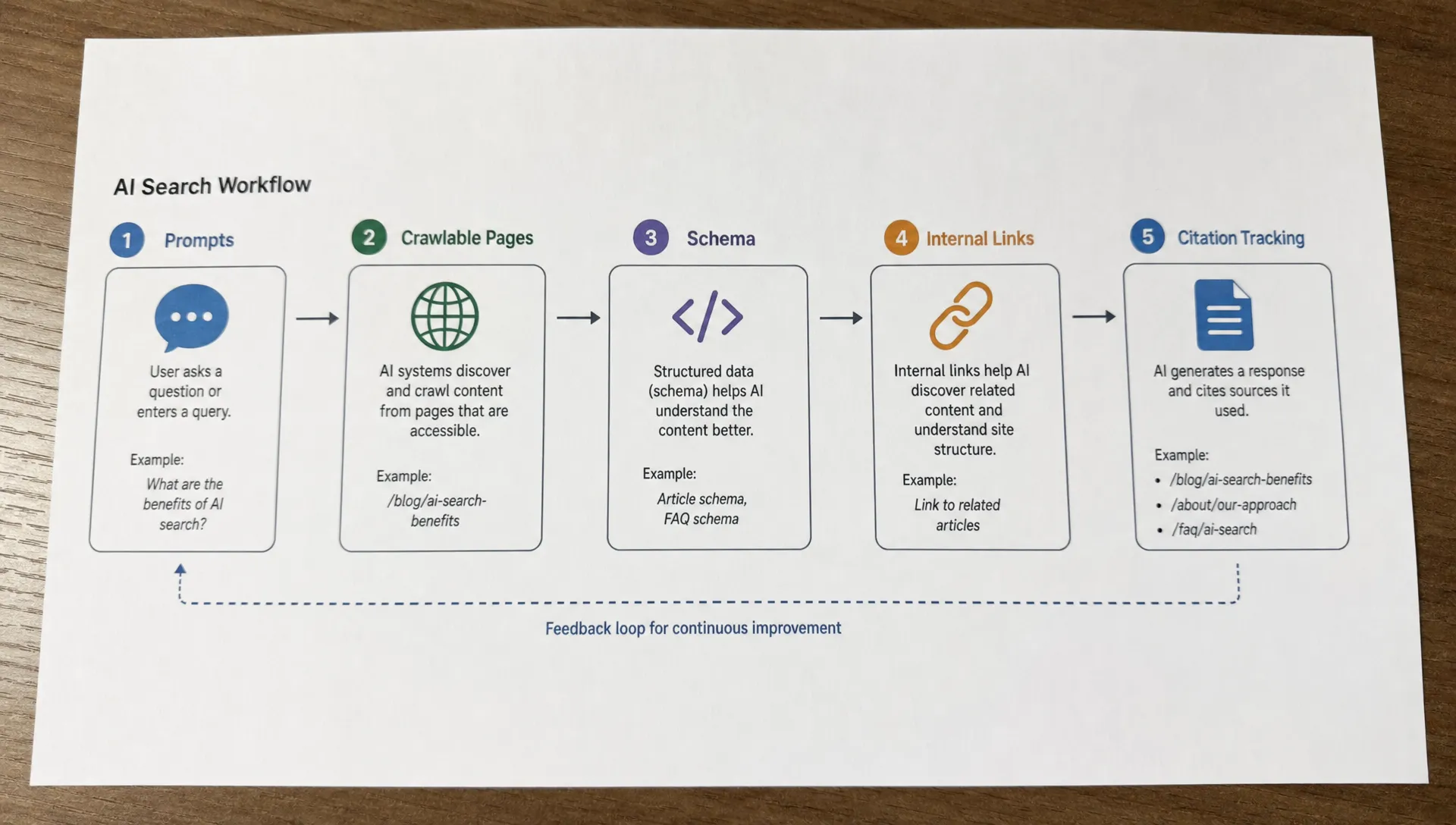
Strong Google SEO AI execution treats internal linking and external consistency as part of the same system. Your website should make the entity map obvious, and the wider web should confirm the same facts.
Use internal linking to show topical relationships
Internal links help search systems understand which pages are central, which pages support them and how topics connect. For a hotel group, a destination guide should link naturally to relevant property pages, amenities and booking paths. For an MSP, a Microsoft 365 service page should connect to migration guides, security pages, case studies and local service pages.
Good internal linking is not a footer full of exact-match anchors. It is contextual routing. The anchor should explain why the next page helps. This improves crawl discovery, distributes authority and gives AI systems a cleaner map of your expertise.
Keep facts consistent across the web
For multi-location and franchise brands, inconsistency is common. One directory lists an old phone number, another uses a different category, and a local page describes services that are no longer offered. Humans may work around these inconsistencies. AI systems may choose a competitor with cleaner signals.
Run periodic checks for name, address, phone number, hours, service names, product categories and executive or practitioner names. If your brand depends on bookings, appointments or lead forms, small inconsistencies can affect whether an AI answer feels confident enough to recommend you.
Fix crawlability and performance before rewriting everything
A page cannot become a reliable AI source if it is hard to fetch, render or interpret. Technical SEO remains the foundation of AI visibility because Google AI Overviews, Gemini, Perplexity and other systems still depend on accessible content, links and structured signals.
In practice, Google SEO AI performance improves when teams fix technical blockers before expanding content. This is especially true for WordPress site fleets, WooCommerce catalogs, franchise locators and headless builds where templates can create sitewide issues.
Remove access and rendering friction
Start with the basics: indexability, canonical tags, XML sitemaps, robots.txt, redirect chains, duplicate templates and JavaScript rendering. If important content loads only after a script runs or sits inside tabs that are not easy to parse, test whether Google can see the final rendered content.
For location and product pages, make sure the unique information is present in HTML, not only injected from a client-side app. AI-ready content should be visible, crawlable and tied to a stable URL. Thin duplicate pages with only the city name swapped rarely give AI systems enough reason to cite them.
Improve speed where it affects access and trust
Page performance is not just a user experience issue. Slow templates can reduce crawl efficiency and make users abandon pages after clicking an AI citation. Use Core Web Vitals as practical guardrails: Largest Contentful Paint at 2.5 seconds or less, Interaction to Next Paint at 200 milliseconds or less and Cumulative Layout Shift at 0.1 or less.
Those thresholds do not guarantee citations. They reduce friction. For a booking engine, appointment form or product page, reducing friction can protect the value of every visitor AI search sends back.
Publish content that generative engines can reuse
Generative engines favor source material that can be summarized without distortion. That does not mean writing bland encyclopedia copy. It means separating facts, recommendations, proof and conversion language so each part is easy to identify.
If your team already creates SEO content, Google SEO AI tactics should refine the editorial brief. Include the target entity, the user question, the answer format, supporting evidence, internal links, schema needs and the conversion path before drafting.
Use this page-level checklist before publishing:
- The primary question is answered in the first screen of the relevant section.
- The brand, location, service or product entity is named clearly.
- Claims are supported by visible details, not vague superlatives.
- The page links to the next logical resource or conversion step.
- Schema, metadata and visible copy describe the same thing.
- The page is crawlable, fast and included in your sitemap.
For broader strategic context, CapstonAI also explains how AI Overviews affect CTR and citation behavior. The practical takeaway is simple: if AI answers absorb more informational clicks, the pages that do receive citations need to be more trustworthy, more specific and closer to the buying journey.
Measure results across Google and other generative engines
Google AI Overviews are only one surface. Prospects also ask ChatGPT, Gemini, Claude, Perplexity and Copilot for vendor shortlists, travel ideas, product comparisons and local recommendations. Visibility can vary by engine because each system uses different retrieval methods, freshness signals and source preferences.
Your Google SEO AI dashboard should separate Google-specific AI Overview performance from broader generative engine visibility. A page that earns citations in Perplexity but not Google may have strong source clarity but weaker classic SEO signals. A page that ranks in Google but never appears in ChatGPT-style answers may need clearer entity coverage or more third-party corroboration.
CapstonAI is built for this measurement loop. It scans multiple engines and assistants, tracks mentions, citations and share of voice, maps prompts to the pages and competitors they surface, then turns findings into prioritized recommendations. For teams managing many brands, locations or clients, that workflow is more useful than manually checking a few prompts in a browser.
The operating cadence is straightforward: scan, diagnose, fix and verify. Repeat it after content releases, technical deployments, review campaigns, migrations and major Google updates.
A 30-day plan for better AI Overview citations
You do not need to rebuild your whole site to start. A focused 30-day sprint can reveal whether citation gains are blocked by content clarity, technical issues, source consistency or measurement gaps.
| Timeline | Action | Success signal |
|---|---|---|
| Days 1 to 5 | Run an AI visibility audit across priority prompts and competitors | Baseline mentions, citations and share of voice |
| Days 6 to 10 | Select 5 to 10 high-value pages by revenue or lead impact | Clear page list tied to business outcomes |
| Days 11 to 18 | Rewrite key sections for direct answers, entity clarity and internal links | Pages answer customer questions faster |
| Days 19 to 24 | Add or correct schema, metadata, crawlability and performance issues | Cleaner machine-readable signals |
| Days 25 to 30 | Rescan prompts, compare results and document next fixes | Before-and-after proof for the next sprint |
This plan works because it avoids random optimization. Each fix is tied to a prompt, a page and a measurable visibility outcome.
Frequently Asked Questions
Does schema guarantee Google AI Overview citations? No. Schema helps search systems understand content, but it does not force Google to cite a page. It works best when the visible page, metadata and structured data all support the same clear answer.
How is GEO different from traditional SEO? Traditional SEO focuses on crawlability, relevance, authority and rankings in search results. GEO focuses on whether generative engines can identify, trust and reuse your content inside AI-generated answers. The two overlap, but GEO adds prompt tracking, entity clarity and citation measurement.
How often should brands track AI visibility? Monthly tracking is a reasonable starting point for stable sites. Weekly tracking is better during migrations, major content releases, seasonal campaigns or active competitor movement. Agencies and multi-site teams usually need a repeatable dashboard rather than manual checks.
Can a smaller brand earn AI Overview citations? Yes, when the page answers a specific question better than broader competitors and gives Google enough supporting signals. Local specificity, clear service details, credible proof and strong internal linking can help smaller brands compete on focused prompts.
Should I optimize only for Google AI Overviews? No. Google is critical, but customers also use ChatGPT, Gemini, Claude, Perplexity and Copilot. A healthy AI visibility program tracks multiple engines because your brand may be absent in one system and visible in another.
Start with a free AI visibility audit
If AI cannot see your business, it cannot cite it. CapstonAI makes that visibility measurable by showing which prompts mention your brand, which cite competitors and which pages need technical, content or structured data fixes.
Start with a free AI visibility audit to establish your baseline across Google AI Overviews and other generative engines. From there, your team can prioritize the pages that affect bookings, leads, product revenue and brand credibility first.