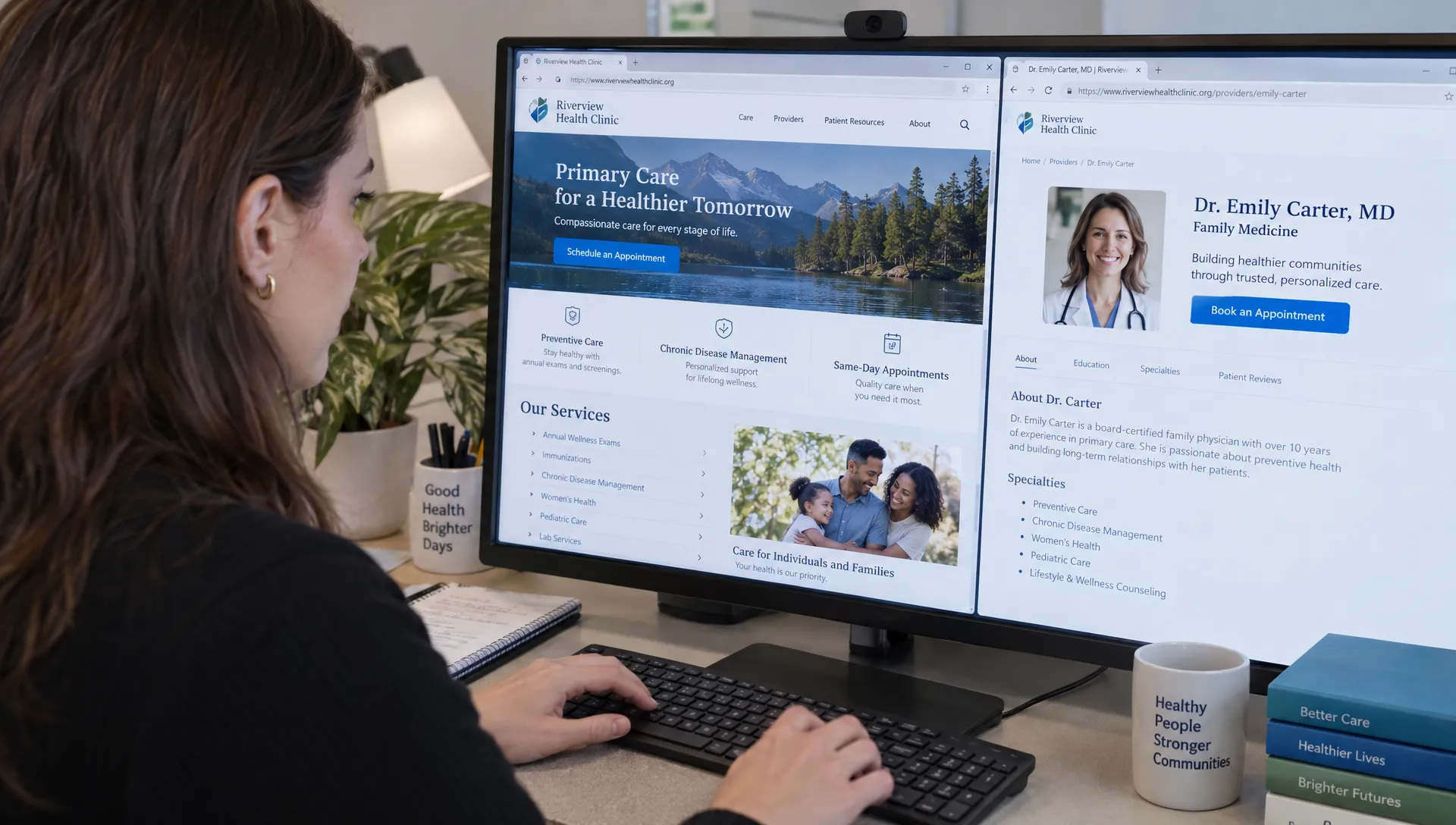
The Google changes SEO teams in healthcare should prioritize are those that affect patient access, medical credibility and appointment discovery. A ranking fluctuation matters, but so does an outdated clinic address, an inaccessible service page or an AI answer that names the wrong provider.
The practical challenge is separating these problems. A hospital network, specialty group or healthcare agency should not respond to every traffic decline by rewriting medical content. First establish whether the change affected rankings, search-result presentation, local visibility or the booking journey. Then assign the fix to the team that can resolve it.
Verify the change before changing the website
Start with the Google Search Status Dashboard to check confirmed ranking updates and search incidents. Compare those dates with your own deployment history, analytics configuration and location changes. A correlation is a starting point, not proof of causation.
For 2026 planning, avoid treating an unverified update name or an agency’s ranking chart as an official Google announcement. Document what changed on your properties: which pages lost impressions, which locations lost calls and whether appointment completions moved in the same direction.
Healthcare demand also varies by service and season. Flu-related searches and elective procedure research do not follow identical patterns. Use matched periods and service-level comparisons to separate algorithm effects from seasonality before approving a recovery project.
The first deliverable should be a short diagnosis with supporting evidence, not a sitewide content brief.
Which Google changes SEO teams should act on first
Use business risk to set the order of work. Problems that prevent patients from finding accurate care information deserve attention before speculative optimization.
| Change or symptom | What to investigate | Primary owner | Business consequence |
|---|---|---|---|
| Medical pages lose visibility | Accuracy, sourcing, authorship and intent match | Clinical editor and SEO lead | Fewer qualified service inquiries |
| Individual clinics disappear locally | Business Profile eligibility, details and duplicates | Local marketing or operations | Lost calls and directions requests |
| Impressions hold but clicks decline | AI answers, result layout and query mix | Search analyst | Reduced website visits despite visibility |
| Many locations decline together | Shared templates, indexing and deployment errors | Engineering and technical SEO | Network-wide discovery problems |
| Visits hold but bookings decline | Scheduling errors, mobile usability and tracking | Digital product and analytics | Lost appointments rather than lost rankings |
Treat these as diagnostic categories, not automatic explanations. Several can occur together. For example, a redesigned location template might introduce both indexing problems and a broken appointment button.
Medical quality: make accountability visible
When Google changes SEO quality expectations, healthcare teams need evidence of clinical accountability rather than cosmetic freshness. Updating a publication date without reviewing the medical information does not establish accuracy.
Google’s people-first content guidance gives particular attention to trust for topics that can affect health, often called Your Money or Your Life topics. Experience, expertise, authoritativeness and trustworthiness, or E-E-A-T, are a quality framework, not a public score you can increase with a plugin.
On a treatment or condition page, readers should be able to establish who wrote it, who reviewed the clinical information and which sources support consequential claims. Reviewer credentials should match the subject. A dermatologist’s review does not automatically establish expertise for a cardiology article.
Keep clinical review dates separate from ordinary website edits. Describe benefits, limitations and appropriate next steps without promising outcomes or implying that general information is a diagnosis.
For multi-location groups, shared clinical explanations can remain centralized. Local pages should contribute genuine differences such as available services, accessibility, referral requirements and clinicians. Replacing city names across hundreds of otherwise identical pages adds little patient value.
AI-assisted drafting is not automatically a policy violation. The risk is publishing inaccurate or scaled, low-value material without adequate oversight, whether a person or a model produced the first draft.
Local visibility: treat each clinic as an operational entity
The Google changes SEO teams observe nationally do not always explain an individual clinic’s local performance. Google states that local results primarily depend on relevance, distance and prominence. A content rewrite cannot move a clinic closer to the searcher.
Audit the connection between each Google Business Profile and its corresponding website page. Names, addresses, phone numbers, hours and appointment destinations should reflect the same real-world location. Check practitioner and department profiles against Google’s eligibility rules rather than creating extra listings to occupy more results.
A location page should answer practical questions: Does this site provide the requested service? Is a referral required? Is the entrance accessible? How does a patient schedule an appointment?
Structured data helps describe those relationships. Appropriate schema.org types, such as MedicalClinic or Physician, can identify a clinic, clinician and associated organization. Use stable identifiers and accurate relationships, supported by visible page content.
Schema does not establish a medical credential or guarantee a rich result. Likewise, adding more locations to markup does not make those locations eligible for Business Profiles.
For a practice acquisition or rebrand, coordinate profile updates, redirects, clinician biographies and scheduling links. Inconsistent entities can confuse patients even when the website still ranks.
AI answers: preserve SEO fundamentals and measure citations separately
As Google changes SEO through AI-generated search experiences, healthcare teams need to distinguish discovery from endorsement. An AI answer may mention a practice without linking to it, cite a page without recommending the organization or summarize a condition without naming any provider.
Generative Engine Optimization, or GEO, focuses on visibility within generated answers. Answer Engine Optimization, or AEO, focuses on making information clear and usable for direct answers. Neither replaces crawlability, accurate content or useful internal linking.
Google’s guidance for AI features and websites says there are no additional technical requirements or special schema needed for inclusion beyond established search requirements. Pages supporting AI answers must be indexed and eligible to appear with a snippet.
Make service information explicit: who provides it, where it is available, what the appointment process involves and when the page was clinically reviewed. Keep important facts in accessible page text, not only in images or an interactive booking widget.
An llms.txt file is an optional convention, not a Google ranking requirement or a guarantee of AI inclusion. It is also not an access-control mechanism.
Google AI Overviews and Gemini should be monitored alongside ChatGPT, Perplexity, Claude and Copilot. These systems use different retrieval and answer-generation processes. A Google ranking update does not directly update every assistant’s recommendations. Use AI Overview citation diagnostics to investigate Google-specific gaps rather than assuming one fix applies everywhere.
Technical changes: check shared templates before rewriting pages
When Google changes SEO visibility across an entire healthcare network, shared infrastructure deserves an early check. A mistaken noindex directive or canonical pointing every location to the parent page can undermine otherwise useful content.
Test important templates rather than inspecting only the homepage. Include a service page, clinic page, clinician profile and appointment entry point. Check rendered content, response codes, canonical tags, XML sitemaps and internal links.
Crawlability and indexing are different. Blocking a URL in robots.txt can prevent a crawler from seeing its noindex directive. Private patient information belongs behind proper authentication, not behind crawler instructions.
Page performance also affects access to care. Google’s Core Web Vitals use field thresholds of Largest Contentful Paint at 2.5 seconds or less, Interaction to Next Paint at 200 milliseconds or less and Cumulative Layout Shift at 0.1 or less, assessed at the 75th percentile. These are documented user-experience benchmarks, not promises of higher rankings.
A scheduling widget that freezes after a patient selects a location is a conversion problem even if the page passes performance tests. Test the full booking journey on mobile, including keyboard access and error handling.
Keep patient names, symptoms and appointment details out of analytics events, URLs and AI testing prompts. Review healthcare tracking implementations with privacy and compliance teams.
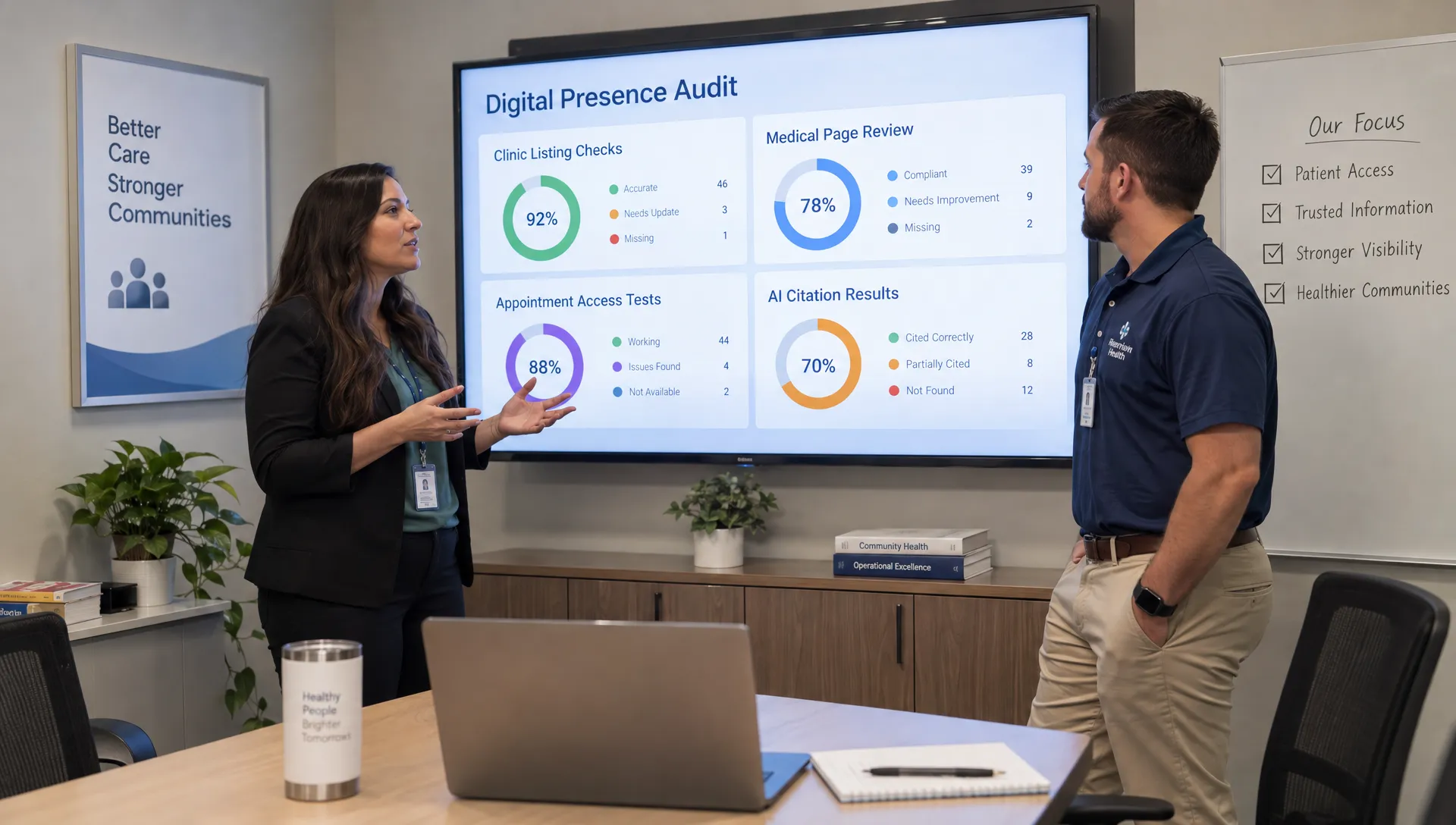
Reputation: distinguish clinical evidence from paid distribution
Not all Google changes SEO teams track require acquiring more links. For healthcare organizations, the quality and context of external references matter more than a campaign’s raw placement count.
Accurate professional profiles, relevant institutional affiliations and editorially earned coverage can help people verify who an organization is. None substitutes for substantiated medical claims or current licensing information.
Paid distribution belongs in a separate measurement category. If your organization also sells healthcare software or professional services to other providers, Naano’s B2B LinkedIn creator marketplace offers a way to run creator campaigns and attribute clicks and leads to posts. Those are B2B referral outcomes, not evidence of clinical authority or a guaranteed Google ranking benefit.
Apply the same distinction to third-party content hosted on your own website. Publishing a partner’s material is not inherently prohibited, but using a healthcare domain’s established reputation to rank unrelated, low-value commercial pages can create site reputation abuse risk. Sponsorship disclosure alone does not resolve that issue.
Measure patient acquisition and AI visibility separately
When Google changes SEO outcomes, a single organic-traffic chart cannot explain the business effect. Keep discovery, patient actions and AI representation in separate reporting layers.
| Measurement layer | Useful evidence | Interpretation limit |
|---|---|---|
| Traditional search | Search Console impressions, clicks and query groups | Average position does not describe every result layout |
| Local discovery | Available Business Profile interactions and location-page activity | Interactions are not completed appointments |
| Patient acquisition | Completed booking events and appropriately measured calls | Tracking must respect consent and privacy requirements |
| AI visibility | Brand mentions, citations and factual accuracy | Prompt tests are samples, not total market demand |
Segment reports by location, specialty and page type. A strong brand homepage can conceal declining visibility for an important specialty. Likewise, fewer informational visits may coexist with stable appointment demand.
If AI mentions increase but the answer lists a closed clinic, that is not a successful outcome. Track factual errors alongside visibility, with an owner responsible for correcting the underlying source information.
Build a small, repeatable prompt panel
Start with 12 synthetic prompts covering three service areas, two specialties and two intent types, such as provider discovery and appointment-process questions. Do not use real patient histories.
Run the panel across the six named search and assistant experiences, repeating it three times to observe variation. That creates 216 test runs. Record the date, model or experience, location context and whether an AI answer appeared. Google AI Overviews will not appear for every query, so separate feature availability from brand inclusion.
For each answer, record brand mentions, cited URLs, competitors and factual errors. Define share of voice consistently, for example as your brand’s mentions divided by all tracked brands’ mentions, counting each brand once per answer.
When Google changes SEO presentation, this panel helps distinguish lost citations from lost rankings. It still does not measure every patient’s experience: personalization, wording and product changes affect results. Compare equivalent tests over time rather than presenting a small sample as universal market share.
A practical 30-day priority plan
Use the first month to resolve confirmed problems and establish a repeatable measurement process.
- Week 1, establish the baseline: Document confirmed search changes, deployment dates, location accuracy and appointment performance. Assign one accountable owner to each verified issue.
- Week 2, fix access blockers: Resolve indexing errors, broken scheduling links, inaccurate clinic details and inaccessible critical content. Retest representative templates.
- Week 3, strengthen medical evidence: Review high-value service pages, correct unsupported claims and make authorship, clinical review and local service availability clear.
- Week 4, repeat the measurements: Recheck search performance, booking journeys and the same AI prompt panel. Record completed work separately from observed outcomes.
This sequence avoids waiting for rankings to recover before correcting operational problems. It also gives clinical, marketing and engineering teams a shared backlog without requiring every stakeholder to become an SEO specialist.
Do not label every improvement an algorithm recovery. Report what changed, when it changed and which outcomes moved. Where evidence remains inconclusive, say so.
Frequently asked questions
Is SEO still relevant for healthcare in 2026? Yes. Crawlability, indexing, relevant service pages and accurate location information still support discovery. GEO and AEO extend measurement to generated answers rather than replacing technical SEO or patient-focused content.
Which Google changes SEO priorities most for healthcare teams? Prioritize verified changes affecting medical-content visibility, local eligibility, AI answer presentation and technical access. The right response depends on the affected specialty, location and patient journey, not simply the update’s name.
Does medical reviewer markup guarantee better rankings? No. Visible, relevant clinical review helps readers evaluate accountability, but markup cannot manufacture expertise or guarantee rankings. Structured data must accurately describe the content and organization.
Can healthcare sites get FAQ rich results? Google limits FAQ rich-result availability to well-known, authoritative government and health websites. Healthcare status alone does not guarantee eligibility or display. Publish useful answers for patients first.
Should teams publish more AI-generated medical articles after a decline? Not without diagnosing the problem. Additional pages will not fix incorrect clinic information, inaccessible content or weak clinical review, and scaled low-value publishing can create further risk.
Start with a free AI visibility audit
Begin with a free AI visibility audit from CapstonAI to establish how your healthcare brand appears across AI search experiences. CapstonAI tracks brand mentions and citations, maps prompts to competitors and provides prioritized content recommendations.
Pair that visibility baseline with your location checks and appointment data. Choose the first fixes by patient impact, assign an owner and repeat the same measurements after implementation. The goal is accurate discovery that leads patients to the right care, not visibility without accountability.