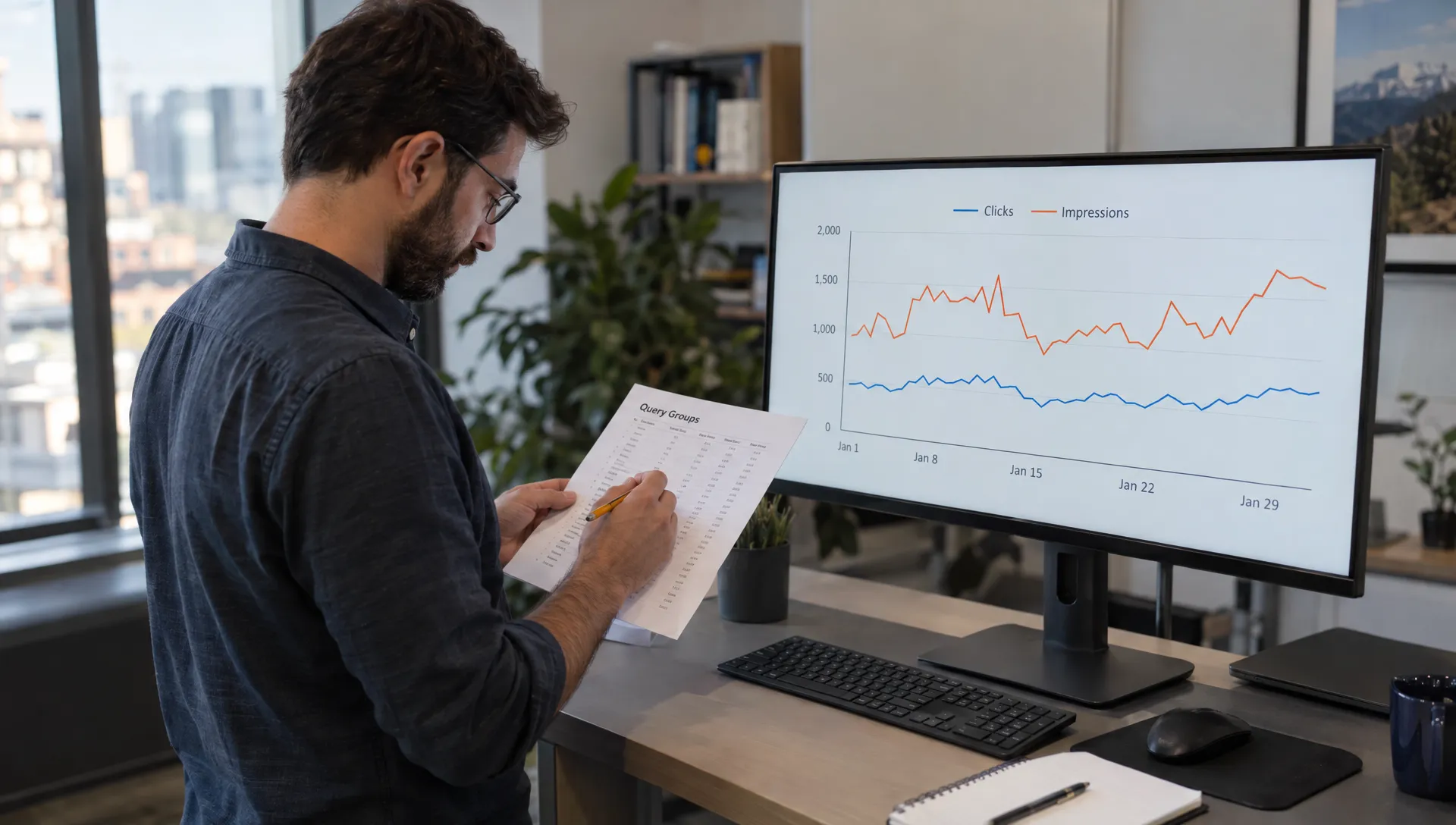
A traffic drop does not prove that an algorithm in SEO changed how Google evaluates your site. Fewer people may be searching, search results may be attracting fewer clicks or a technical release may have interrupted access. Several of these changes can happen at once.
The practical approach is to compare matched seasonal periods, separate demand from ranking performance and test affected pages against suitable comparison groups. Then check whether the remaining decline lines up with update timing, technical changes or shifts in AI answers. This gives your team a defensible diagnosis before it rewrites content, changes templates or reallocates acquisition budget.
Separate the possible causes before choosing a fix
Organic traffic combines several mechanisms. Search demand determines how many opportunities exist, rankings influence exposure and the results page influences whether people click. Your analytics setup then determines which visits you record.
Google’s guidance for diagnosing search traffic drops explicitly includes seasonality alongside technical issues and algorithmic changes. Start with competing explanations rather than assuming an update caused everything.
| Possible explanation | Evidence to examine | Business implication |
|---|---|---|
| Seasonal demand decline | Lower interest across relevant queries, with broadly stable rankings | Adjust demand forecasts before changing successful pages |
| Ranking reassessment | Position losses within consistent query and page groups | Investigate which content or page types lost competitiveness |
| Search results layout change | Lower click-through rate despite similar positions | Reassess expected traffic and visibility beyond website clicks |
| Technical or tracking problem | Indexing failures, server errors or a gap between recorded clicks and sessions | Repair access or measurement before evaluating content |
| Conversion problem | Stable traffic but fewer bookings, purchases or qualified leads | Investigate availability, forms, pricing or checkout friction |
Evidence for a changed algorithm in SEO becomes stronger when rankings deteriorate within stable query groups, not simply when total sessions fall. Even then, competitor improvements or changed intent can produce similar symptoms.
Keep revenue and lead quality beside traffic in the report. A decline in informational visits has a different business effect from losing visibility for high-intent treatment, hotel or product queries.
Build a seasonal baseline that reflects your market
Start with a recent complete period, such as four weeks, and compare it with both the preceding period and an equivalent period last year. These are investigation windows, not universal rules. Low-volume sites may need longer periods to produce a useful signal.
Match weekdays where practical. Also account for moving holidays, school calendars, major events and campaign dates. Comparing Easter week with an ordinary week can make normal demand look like a ranking problem.
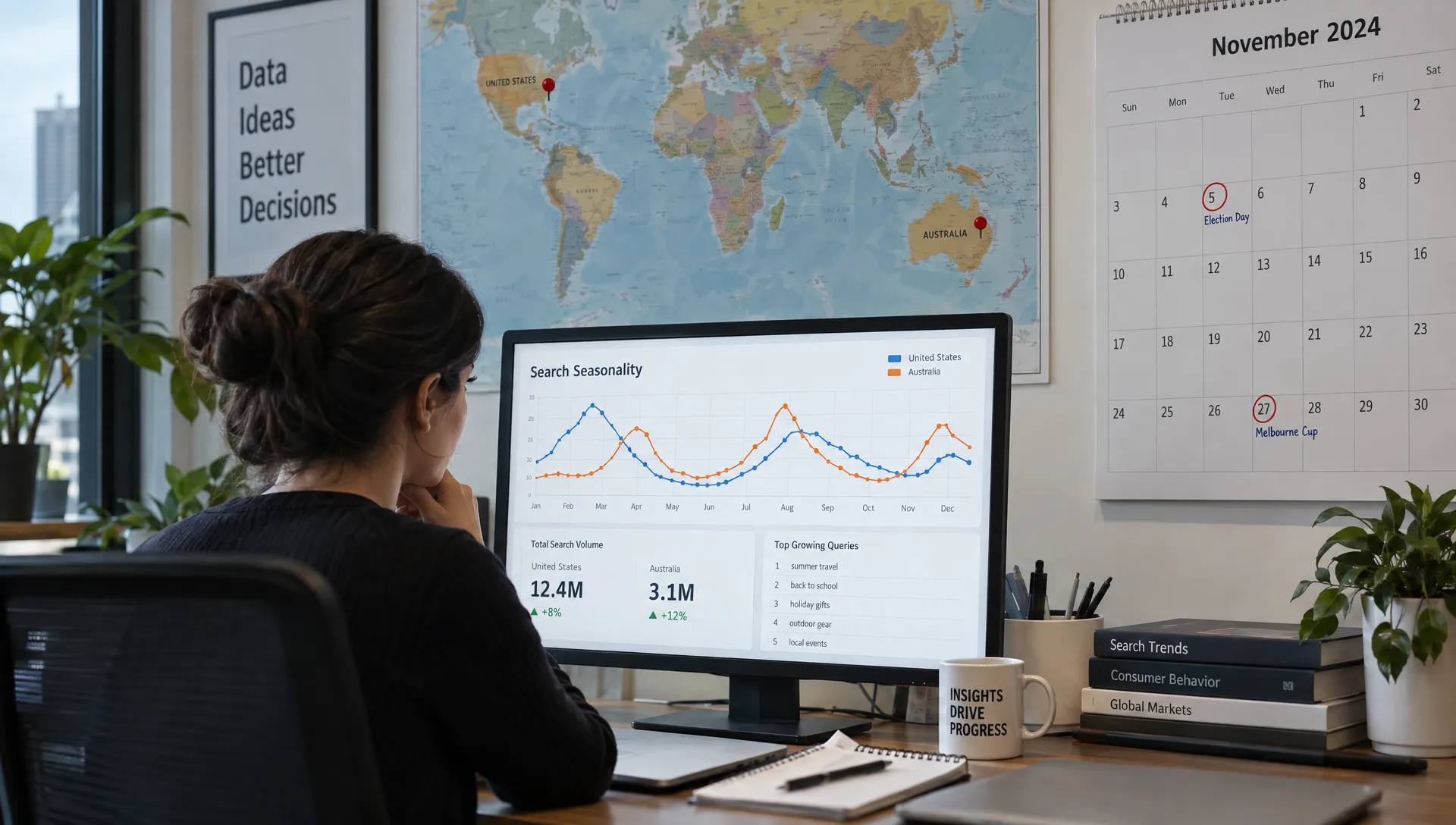
Use geography carefully. An Australian accommodation business and a US hotel group do not share the same summer calendar. A franchise network may also contain locations with different local demand patterns.
Before attributing a loss to an algorithm in SEO, check whether the comparison periods represent the same commercial circumstances. Stock availability, room inventory and service coverage can change which pages appear and which visitors convert.
Create separate reporting groups for:
- Branded and nonbranded queries, including common brand variants.
- Commercial, informational and local search intent.
- Countries, devices and individual locations.
- Page types such as hotel properties, treatment pages, product categories and articles.
Use Google Search Console for clicks, impressions, click-through rate and average position. Use analytics for sessions and business outcomes. These systems measure different events, so their totals should not be expected to match exactly.
Google Trends can help check broader demand, but its values are normalized interest scores, not absolute search volumes. Export and retain your own data regularly so you can compare more than one seasonal cycle.
Testing an algorithm in SEO with comparison groups
A seasonal baseline becomes more useful when you add a comparison group. Choose pages or queries that historically moved similarly to the affected group and have comparable geography, intent and device mix.
When investigating an algorithm in SEO, the question is whether the affected group declined more than a reasonable demand baseline would suggest. That excess decline is something to investigate, not automatic proof of an update effect.
Consider this hypothetical example. Both groups are normalized to an index of 100 before the change:
| Group | Clicks before | Clicks after | After-period index |
|---|---|---|---|
| Affected service pages | 10,000 | 7,500 | 75 |
| Comparison service pages | 8,000 | 7,200 | 90 |
The comparison group declined 10%. If the affected group had followed that pattern, it would have received approximately 9,000 clicks. Its observed 7,500 clicks leave a shortfall of 1,500 relative to that baseline.
The relative change is (75 ÷ 90) − 1 = −16.7%. That is a comparison-adjusted decline, not a measured algorithm penalty.
Before trusting it, check whether the groups followed similar patterns before the event. Also check for content releases, promotions, inventory changes and tracking differences that affected only one group.
Comparison pages can be affected by the same update, which can hide part of the impact. Treat this method as observational evidence. A second comparison group and longer pre-change history can strengthen the diagnosis without turning it into a controlled experiment.
Check update timing against rankings and release history
Consult the Google Search Status Dashboard to verify announced update dates. Record rollout start and completion separately, then evaluate a representative period rather than selecting the single worst day.
Timing supports an algorithm in SEO hypothesis only when other evidence agrees. A decline that begins during a rollout but affects only pages changed in yesterday’s deployment deserves a technical investigation first.
Compare average position within consistent query, URL, country and device combinations. A sitewide average can shift because the mix of queries changed, even when individual rankings did not.
Look at clicks and impressions together. Falling impressions with stable positions may reflect lower demand. Stable impressions with falling click-through rate may reflect different ads, answer features or snippets. Neither pattern proves a cause by itself.
Rule out access and measurement failures
Review deployment logs, redirects, canonical tags, robots directives and indexing reports. Check for accidental noindex instructions, server errors and important URLs disappearing from the index.
For WordPress and WooCommerce fleets, compare template and plugin changes across affected and unaffected sites. A shared release can create a network-wide decline that resembles an update.
If Search Console clicks remain stable while analytics sessions fall, inspect consent settings, tag execution and attribution before changing content. Protecting reliable measurement prevents expensive work on the wrong problem.
Test seasonality at the service and location level
To investigate an algorithm in SEO accurately, compare demand for the same service in the same market. Broad industry categories can conceal very different buying cycles.
For a service mix such as Creative Smiles’ cosmetic dental services in Armadale, separate Invisalign, veneers and All-on-4 queries instead of pooling them under “dentistry.” These are distinct treatments with different search journeys. This is an example of segmentation, not a claim about the practice’s traffic or performance.
For hotels, separate destination research from property-name searches and booking-focused queries. A drop in “things to do” traffic does not necessarily imply fewer room bookings.
For retailers, distinguish seasonal categories from evergreen products and record out-of-stock periods. For MSPs, separate recurring managed-service queries from interest around specific security incidents or product announcements.
The useful question is whether each group performed worse than its own demand baseline. Network-wide totals are useful for reporting, but they are usually too coarse for diagnosis.
Measure AI answer changes separately from Google rankings
A change to an algorithm in SEO can coincide with an AI visibility shift without causing it. ChatGPT, Gemini, Perplexity, Claude and Copilot do not share one retrieval or ranking system. Google AI Overviews also require separate observation from traditional result positions.
Generative Engine Optimization (GEO) focuses on making content understandable and usable in generated answers. Answer Engine Optimization (AEO) focuses on satisfying answer-oriented queries. Both rely on credible content and technical foundations, but neither can be measured through organic sessions alone.
The differences between AEO and SEO matter here: a brand can retain rankings while losing answer visibility, or gain mentions without receiving a corresponding increase in clicks.
Keep the AI measurement sample consistent
Maintain an evergreen prompt panel, then report seasonal questions separately. Hold wording, location, language and browsing mode constant where possible, recording the model or version when available.
Repeat observations because generated answers vary. For example, 12 prompts across six engines with three repetitions produce 216 responses. That is an illustrative sampling plan, not a guarantee of statistical certainty.
Track three distinct outcomes:
- Brand mentions: Whether an answer names your business and describes it accurately.
- Citations: Whether an answer links to your domain and which page it cites.
- Share of voice: Your counted mentions divided by all tracked brands’ counted mentions, using a documented counting rule.
Count each brand once per answer if you want repeated wording to have no extra weight. Track answer presence separately as the percentage of responses mentioning your brand.
When an algorithm in SEO is suspected, this parallel evidence helps distinguish a Google-specific ranking loss from a broader discoverability problem. Changes in Google visibility can affect retrieval opportunities, but they do not establish that another engine changed for the same reason.
For more detail on that distinction, see how Google algorithm changes can affect AI visibility.
Choose a response that matches the evidence
Fix confirmed failures first. An inaccessible booking page needs repair regardless of whether an update is underway. If the evidence mainly supports seasonal demand, preserve working pages and adjust forecasts, campaign timing and capacity assumptions.
If an algorithm in SEO remains the leading explanation, prioritize the page groups with sustained ranking losses and meaningful revenue exposure. Review whether their content answers current intent, provides verifiable information and offers something useful beyond competing pages.
For search and AI discoverability, connect each technical task to an observable outcome:
- Crawlability: Check search crawler and relevant AI retrieval access separately. Accessible content has an opportunity to be discovered; access does not guarantee inclusion.
- Internal linking: Connect important service, location and category pages through descriptive links so discovery does not depend on isolated URLs.
- Entities and schema: Keep business names, addresses, services and product details consistent. Structured data should describe visible content accurately, not invent credentials or offers.
- Page performance: Address loading and interaction problems that obstruct visitors, then measure bookings, leads or purchases rather than assuming a speed fix guarantees rankings.
- Metadata and llms.txt: Improve page titles and descriptions for clarity. Treat llms.txt as an optional supplement, not a replacement for crawlability or a universally adopted ranking mechanism.
Document each change and its deployment date. Avoid changing content, templates and tracking simultaneously when you need to understand which intervention helped.
Frequently asked questions
Can seasonality and an algorithm in SEO affect traffic at the same time? Yes. Lower demand can coincide with ranking losses. Matched seasonal comparisons estimate the demand component, while query-level analysis and comparison groups help investigate the remaining decline. Neither provides perfect causal attribution.
Does a decline during a Google update prove the update caused it? No. Confirmed rollout dates establish timing, not causation. Check rankings, technical releases, competitors and demand before deciding what to fix.
How much historical data is enough? One full annual cycle provides a starting point for recurring seasonality. Multiple comparable cycles are more useful when available. New sites can use broader demand indicators and comparison groups, but should report lower confidence.
Should AI mentions replace traffic reporting? No. Track mentions and citations alongside search clicks, qualified leads, bookings and revenue. AI visibility describes exposure; it does not automatically demonstrate business impact.
Start with a free AI visibility audit
Start with a free AI visibility audit from CapstonAI to establish where your brand appears, which prompts surface competitors and where mentions or citations are missing.
Pair that baseline with your seasonal demand analysis and release history. Choose one high-value page group, record the evidence and make the smallest justified intervention. Review matched periods afterward so your next decision rests on observed performance rather than the date of an update.