Support content often answers the questions that determine whether someone buys: Will this work with our systems? Can you accommodate our requirements? What happens if something goes wrong? For support teams, chatbot SEO means making those answers discoverable and useful when prospects ask AI-powered search tools for guidance.
The opportunity is not to turn every troubleshooting article into a sales pitch. It is to identify support questions that reveal buying constraints, publish trustworthy answers and offer a relevant next step. A clear compatibility page can attract a better-qualified prospect than a broad article that generates far more visits.
For hotels, franchise brands, MSPs and online stores, this connects two teams that often work separately: the people who understand customer objections and the people responsible for acquisition.
What chatbot SEO means for support content
Here, the term describes optimizing public content for discovery through AI answers, not installing a chatbot on your website. An on-site assistant can help visitors navigate, but its private conversations do not automatically become searchable content.
Generative Engine Optimization (GEO) focuses on visibility in generated answers. Answer Engine Optimization (AEO) emphasizes clear answers to specific questions. Both depend on classic technical SEO: accessible pages, useful internal links and reliable information.
The discovery surfaces include ChatGPT, Google AI Overviews, Gemini, Perplexity, Claude and Copilot. Their retrieval methods and citation behavior differ, so success in one does not establish visibility across the others.
For support-led acquisition, chatbot SEO should connect three outcomes: an accurate answer, a credible association with your business and an appropriate path toward becoming a customer. A mention without that connection may create awareness without producing a useful lead.
Choose support questions that reveal buying constraints
Start with ticket categories, pre-sales emails, site-search queries and questions raised during demonstrations. Remove personal information before using customer conversations for research or AI-assisted analysis.
Separate existing-customer troubleshooting from questions a prospect would ask before committing. “Reset my password” usually belongs in self-service support. “Can each franchise location have separate account permissions?” can help a buyer evaluate fit.
| Business | Support question with buying intent | Useful conversion path |
|---|---|---|
| Hotel group | Can you confirm accessible room features before booking? | Contact the property about specific requirements |
| MSP | Can you support our existing backup platform? | Request a compatibility assessment |
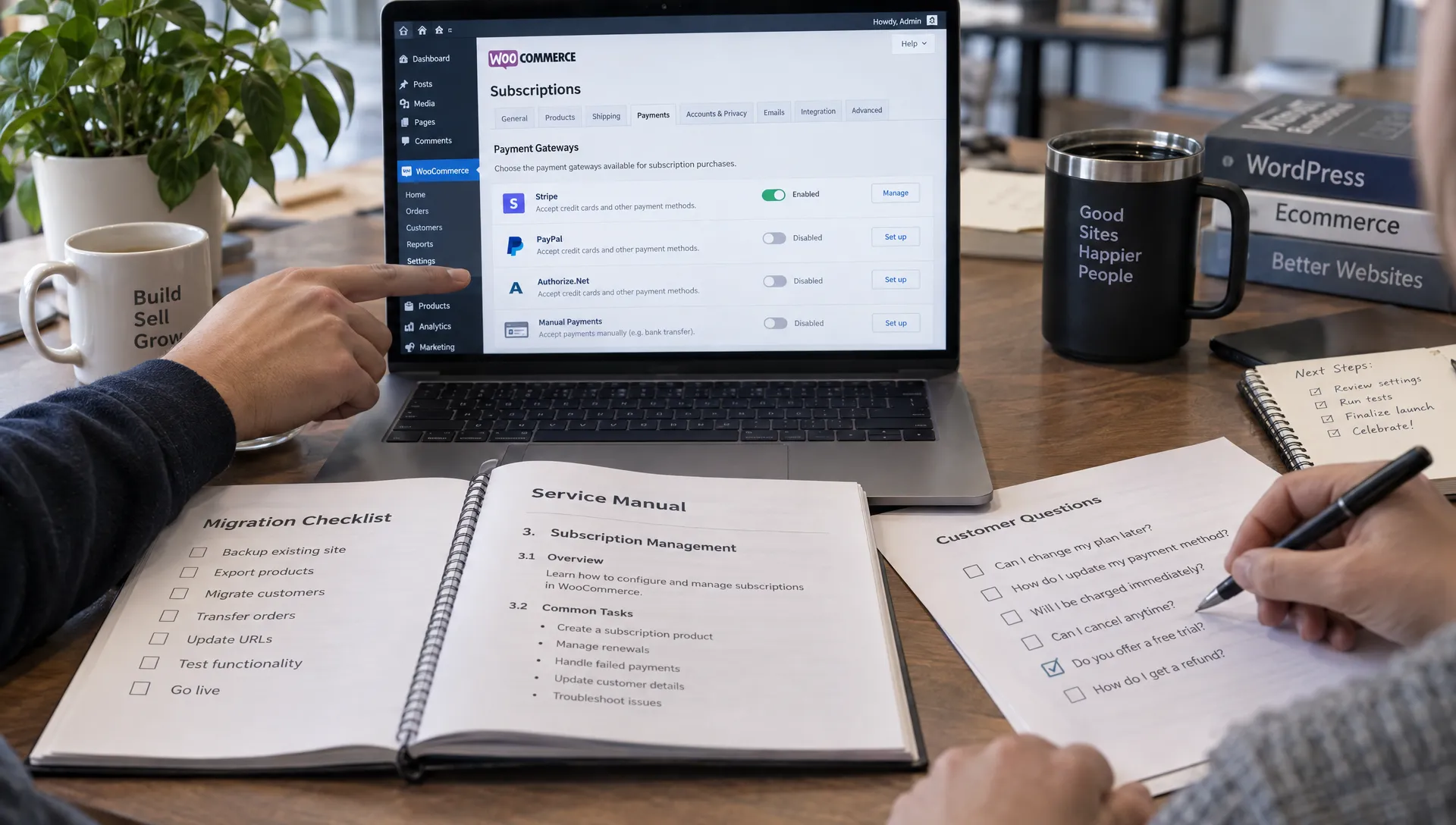
| WooCommerce agency | Can subscriptions continue through a store migration? | Request a migration review |
| Multi-location retailer | How do returns work across different locations? | View the applicable policy and eligible locations |
Prioritize questions by commercial relevance, answer quality and whether a public page should exist. A frequent question is not automatically a lead opportunity, particularly when it concerns billing disputes or account access.
Use chatbot SEO to close a documented information gap, not to generate hundreds of near-identical FAQs. CapstonAI’s guide to finding content gaps with SEO prompts can help organize those questions before drafting.
Build an answer that resolves doubt before asking for contact
A useful support page should deliver its core answer without requiring a form submission. Gating basic eligibility or compatibility information makes evaluation harder and leaves little public material for search systems to retrieve.
Open with a direct answer, then explain the conditions that change it. Include the relevant product, service, location or version so the answer makes sense outside the surrounding website.
A practical page structure is:
- Direct answer: State what is possible and what remains conditional.
- Requirements and exceptions: Explain the details that determine fit.
- Verification: Link to the relevant policy, documentation or evidence.
- Next step: Offer an action that resolves the remaining uncertainty.
For chatbot SEO, this structure serves two audiences: the buyer deciding whether to continue and the retrieval system looking for a passage that answers a specific question. Neither benefits from a long introduction that delays the answer.
Example: a migration question with commercial intent
Consider a hypothetical WooCommerce agency answering: “Can subscriptions continue when we migrate our store?”
An opening might read:
Subscription continuity depends on your subscription extension, payment gateway and migration approach. Before confirming a plan, check how recurring payment agreements and saved payment methods will be handled. Moving products and customer records alone does not establish that recurring billing will continue correctly.
The page could then explain which details the agency needs to assess compatibility, such as extension names, gateway configuration and the proposed migration scope. A service owner should validate every technical claim before publication.
The next step should match the question: “Request a subscription migration review” is more useful than an unrelated newsletter offer. Ask for the information needed to assess fit, not a complete technical inventory before the first conversation.
This approach qualifies the enquiry by clarifying the constraint rather than withholding the answer.
Make evidence part of the answer
Support content earns credibility through details readers can verify: named integrations, current policies, documented limitations and clear ownership. Show a genuine review date when information is checked, not an automatically refreshed timestamp.
For a specialty retailer such as Makai Store, which sells Campo del Cielo meteorites, questions about provenance and authenticity sit close to the purchase decision. A useful support page would explain the available documentation and connect it to the relevant products, without making claims beyond the evidence. This is a content opportunity, not a claim about the store’s search performance.
In chatbot SEO, evidence should support the exact statement a buyer needs to trust. A generic claim that a company is “reliable” does less work than a clear explanation of what its certificate, warranty or service commitment actually covers.
Make public support answers accessible and unambiguous
Content quality cannot compensate for a page that search systems cannot access. Audit the public support library separately from authenticated account tools and private ticket portals.
Check crawlability, rendering and page performance
Important answers should have stable URLs, return successful HTTP responses and appear in accessible page content. Do not make a chat interaction the only way to obtain information that belongs in public documentation.
Check robots directives, accidental noindex tags, canonical URLs and internal links. Where an answer depends on JavaScript, inspect the rendered page rather than assuming the initial HTML contains it. Keep customer records, credentials and account-specific troubleshooting private.
For chatbot SEO, distinguish search retrieval permissions from model-training permissions. Engines can use different agents and controls for these purposes; a single robots rule should not be assumed to govern every use.
Page performance matters because visitors still need to use the page after discovery. Reduce unnecessary scripts, reserve space for images and keep the answer usable on mobile. These improvements reduce friction, but a faster page does not guarantee an AI citation.
Use schema and entity details accurately
Entities are the identifiable people, organizations, products and places discussed on a page. Use consistent business names, product terminology and location details so readers and systems can distinguish one offering from another.
Structured data, also called schema markup, should match visible content. Use applicable types such as Organization, Product or BreadcrumbList where appropriate. Do not mark up claims or answers that visitors cannot see.
Google’s guidance for AI features and websites explains that established SEO practices remain relevant and no special schema is required for its AI search features. Its FAQ structured data documentation also limits FAQ rich-result availability to well-known, authoritative government and health websites.
Treat llms.txt as an optional supplementary file, not a substitute for crawlability or a guaranteed inclusion mechanism. In chatbot SEO, accurate public pages and clear relationships between them remain more actionable than an unsupported promise about a particular file format.
Connect each answer to a genuinely useful next step
The conversion action should resolve what the article cannot determine on its own. A compatibility answer may need a configuration review. A hotel accessibility answer may require confirmation of specific room features. A returns article may need only a link to the applicable policy.
Do not route every visitor to “Book a demo.” Existing customers may need support, while prospects may need a quote or an eligibility check. Make those routes distinct so sales teams do not receive avoidable support requests.
Internal linking should work in both directions. Link a support answer to the relevant service or product page, and link back from that commercial page where the question is likely to arise. This creates a clearer evaluation journey without forcing the reader through a navigation menu.
A useful chatbot SEO conversion is not simply a completed form. Define qualification with sales or operations: service fit, supported geography, relevant requirements and a realistic buying process. Ask only for information that helps determine those conditions.
For multi-location brands, route enquiries to the correct property, clinic or branch. Group-wide visibility has limited value if the resulting lead reaches a location that cannot meet the request.
Measure visibility and lead quality separately
Monitor a stable set of questions across the engines your audience uses. Include unbranded prompts, such as “Which providers support this configuration?”, alongside questions that explicitly name your business.
Record the prompt, engine, date, available location settings, brand mentions and cited URLs. Repeat observations because answers can vary. Citation tracking should identify the actual support page, not merely the presence of your domain somewhere in an answer.
For deeper work on evidence and source selection, CapstonAI’s guide to earning credible citations in ChatGPT web search explains the distinction between being mentioned and being used as a source.
Keep metric denominators visible
In chatbot SEO reporting, mention rate and share of voice answer different questions. Mention rate measures how often your brand appears across sampled answers. Share of voice compares your appearances with those of the tracked competitor set.
Consider this hypothetical reporting example, not a performance forecast:
| Metric | Example calculation | What it tells you |
|---|---|---|
| Brand mention rate | 24 of 120 sampled answers = 20% | Frequency of brand inclusion |
| Citation rate for monitored support URLs | 12 of 120 answers = 10% | Frequency of those pages being cited |
| Brand share of voice | 24 of 80 tracked-brand appearances = 30% | Presence relative to the selected competitors |
| Qualified-lead rate from identifiable AI referrals | 4 qualified leads from 80 sessions = 5% | Observed conversion quality for that traffic |
For share of voice, count each brand at most once per answer and document which competitors are included. Changing the competitor set changes the denominator, even if your own visibility stays constant.
Compare results within each engine before combining them. A blended score can hide a strong improvement in one surface and a decline in another.
Account for attribution gaps
Some AI interactions produce no website visit. Other visitors return later through a branded search or direct visit, so referral data cannot capture the full journey.
Combine identifiable referrals, landing-page events, CRM qualification and a voluntary “How did you hear about us?” field. Treat self-reported discovery as supporting evidence, not perfect attribution.
A rise in citations followed by more leads is worth investigating, but it does not prove causation. Pricing changes, seasonality and other campaigns may also affect results. Small lead counts are especially easy to overinterpret.
Run a focused 30-day support-content pilot
Begin with a small enough scope that subject-matter owners can verify every answer. Five to ten pages can be a manageable starting point, depending on review capacity and technical complexity.
- Week 1: Select questions, document baseline visibility and agree on qualified-lead criteria.
- Week 2: Rewrite answers with service owners, verify evidence and establish page ownership.
- Week 3: Fix access issues, add relevant internal links and validate applicable structured data.
- Week 4: Repeat the prompt sample, test enquiry routing and inspect early referral and lead signals.
The purpose of this chatbot SEO pilot is to validate the workflow and establish a baseline, not to promise measurable revenue within a month. Some changes may take longer to be discovered, and early fluctuations may not persist.
Keep a change log with the page URL, revision date, factual reviewer and intended business effect. That record helps distinguish an editorial improvement from a technical fix and makes later reporting more useful.
Frequently asked questions
Does installing a website chatbot improve SEO? Not by itself. A chatbot can improve navigation or service, but useful answers confined to private interactions are not equivalent to accessible public pages. Publish appropriate, verified answers separately when they serve broader search intent.
Is traditional SEO still necessary for AI search? Yes. Crawlability, internal linking, accurate content and accessible pages remain relevant. AI visibility also requires observing how individual engines mention brands and select sources, rather than relying only on conventional ranking reports.
Can ChatGPT write support articles for SEO? It can help organize questions and draft answers, but it cannot establish your current policies or integration capabilities without reliable source material. For chatbot SEO, a knowledgeable owner should verify the answer, exceptions and conversion path before publication.
Should every support article target prospective customers? No. Many articles exist primarily to help existing customers. Keep those useful without adding unnecessary sales language. Prioritize acquisition work where the question reveals a real buying constraint and a public answer can responsibly resolve it.
Start with a free AI visibility audit
Start with a free AI visibility audit from CapstonAI to establish how your brand appears across AI search before choosing what to fix.
CapstonAI combines multi-engine visibility scans, brand mention and citation tracking, prompt mapping and prioritized content recommendations. Use that baseline alongside support questions and CRM qualification data to select your first pages.
The next step is specific: choose one commercially relevant support question, verify the answer and connect it to the action a qualified prospect actually needs.