Brand discovery used to be fairly predictable: a buyer searched, scanned a results page, clicked a few links, compared options, and eventually contacted a company. That journey is being compressed by AI web search.
Now a buyer can ask ChatGPT, Gemini, Claude, Perplexity, or an AI-powered search result for a recommendation and receive a synthesized answer in seconds. That answer may include a shortlist of brands, a few cited sources, a comparison, and a suggested next step. If your brand is absent, outdated, or misrepresented, the buyer may never know to look for you.
This is not just a new SEO tactic. It is a new layer of brand discovery where visibility depends on whether AI systems can understand, trust, retrieve, and summarize your business accurately.
What AI web search changes about discovery
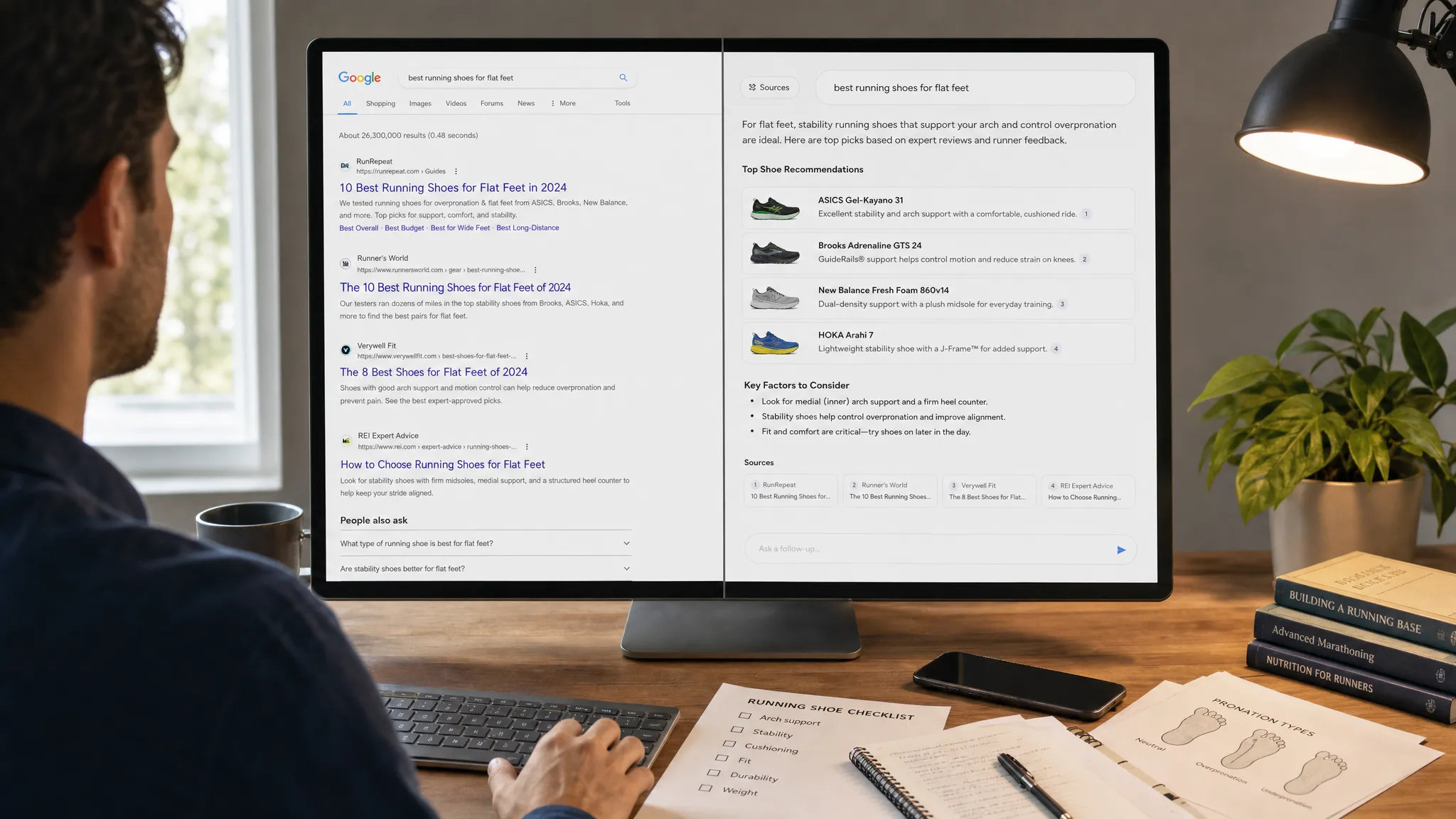
AI web search combines large language models with web retrieval, search indexes, and source citations to answer questions conversationally. Instead of returning only a ranked list of pages, these systems interpret the user’s intent, gather information, and produce an answer.
That changes the job of your website. Your content no longer has to win only a click. It also has to become clear, structured, and credible enough to be used inside an AI-generated answer.
| Traditional web search | AI web search |
|---|---|
| Users type short keywords | Users ask full, specific questions |
| Search engines rank pages | AI systems synthesize answers from sources |
| Visibility is often measured by rankings and clicks | Visibility also depends on mentions, citations, and recommendations |
| Users compare pages manually | AI may compare brands before users click |
| One keyword can represent many intents | One intent can appear as hundreds of prompt variations |
This does not mean classic SEO is dead. Crawlability, helpful content, authority, structured data, and technical quality still matter. But the outcome is broader. The goal is not only to rank. The goal is to be discoverable, citable, and accurately represented when AI systems answer buyer questions.
Why the shift is moving so fast
The speed of adoption is the biggest reason marketers cannot treat AI web search as a future problem. In 2024, Gartner predicted that traditional search engine volume would drop 25% by 2026 because of AI chatbots and virtual agents. Whether every market follows that exact curve or not, the direction is clear: more people are using AI tools as discovery assistants.
Click behavior is changing too. Pew Research Center found in 2025 that Google users were less likely to click traditional results when an AI summary appeared. For brands, that means demand may still exist, but fewer users may reach your site before forming an opinion.
The risk is not only losing traffic. The deeper risk is losing consideration. If an AI answer names three competitors and omits your company, the buyer’s shortlist forms without you.
This matters across categories. A B2B buyer might ask, “Which AI visibility platform is best for an agency managing multiple clients?” An e-commerce shopper might ask, “What is the best standing desk for a small apartment?” A local buyer might ask, “Where can I buy a 20-foot container near Raleigh with delivery and a structural guarantee?” In that last case, an AI system needs concrete details like product condition, delivery areas, pricing transparency, and guarantees, the kind of information buyers look for from providers of new and used shipping containers with transparent pricing.
The common thread is simple: AI search turns vague interest into a guided recommendation faster than a traditional results page ever did.
The new brand discovery funnel
AI web search creates a different discovery funnel. It often starts before a user knows which brands exist and before they visit a website.
| Stage | What happens | Brand implication |
|---|---|---|
| Prompt | The user asks a natural-language question | You need coverage for real buyer questions, not only keywords |
| Retrieval | The AI system pulls from web pages, citations, databases, or search results | Your content must be crawlable, specific, and easy to extract |
| Synthesis | The AI summarizes options and tradeoffs | Your positioning must be clear enough to survive compression |
| Recommendation | The answer may name brands, products, or locations | You need to be present in relevant shortlists |
| Verification | The user may click sources or search your brand directly | Your site, metadata, and reviews must confirm the AI’s answer |
| Conversion | The buyer contacts, buys, books, or shares | AI visibility must connect back to pipeline and revenue metrics |
The most important change is the synthesis stage. AI systems compress information. They may reduce dozens of pages into one paragraph. If your differentiators are buried, inconsistent, or only expressed in vague marketing language, they may not appear.
What makes a brand more visible in AI web search?
No outside marketer has a complete formula for how every AI system selects sources or mentions brands. Each engine works differently, and results can vary by prompt, location, freshness, and available sources. Still, patterns are becoming clear.
AI systems tend to perform better when a brand has clear entity information, consistent facts across the web, useful content that answers specific questions, and third-party signals that support credibility.
| Visibility signal | Why it matters | Practical improvement |
|---|---|---|
| Entity clarity | AI systems need to understand who you are, what you offer, and who you serve | Keep brand names, categories, locations, product names, and descriptions consistent across your site and profiles |
| Extractable answers | AI answers often pull concise facts, definitions, comparisons, and steps | Add direct answers, tables, FAQs, and well-labeled sections to key pages |
| Source credibility | AI systems are more likely to trust claims supported by reputable sources | Earn mentions, reviews, case studies, partner pages, and authoritative citations |
| Freshness | Outdated content can lead to outdated AI answers | Refresh product details, pricing context, service areas, and comparison pages regularly |
| Technical accessibility | If content is hard to crawl or buried in scripts, it may not be usable | Improve indexability, internal linking, schema, metadata, and page performance |
| Local and product specificity | Generic pages rarely answer high-intent prompts well | Create detailed location, category, product, and use-case pages |
| Consistency across channels | Conflicting data reduces confidence | Align your website, Google Business Profile, directories, marketplace listings, and social profiles |
The winning brands are not always the biggest. They are often the easiest for AI systems to understand and verify.
Why your old SEO dashboard is not enough
Traditional SEO dashboards still matter, but they do not show the full picture of AI discovery. Rankings and organic sessions can decline while brand demand remains strong inside AI answers. The reverse can also happen: traffic may look stable while competitors begin dominating AI recommendations for high-intent prompts.
To understand AI web search performance, teams need new visibility metrics.
| Metric | What it tells you |
|---|---|
| AI share of voice | How often your brand appears compared with competitors across target prompts |
| Prompt coverage | Which buyer questions trigger your brand, competitors, or no relevant mention |
| Citation frequency | How often AI systems cite or reference your pages as sources |
| Mention accuracy | Whether AI answers describe your products, pricing, locations, or positioning correctly |
| Competitor co-mentions | Which brands are repeatedly compared with yours |
| Source mix | Which pages, publications, directories, and profiles influence AI answers |
| Fix velocity | How quickly your team publishes and validates improvements |
This is where AI visibility tracking becomes operational. Instead of asking, “Did traffic go up?” teams also need to ask, “Are we present when AI systems recommend solutions in our category?”
For a deeper framework, CapstonAI has a guide on how to measure AI performance across search engines.
A 30-day plan to adapt your brand for AI web search
You do not need to rebuild your entire marketing strategy overnight. You do need a structured way to find blind spots, fix the highest-impact pages, and monitor how AI systems respond.
Week 1: Map the prompts that matter
Start by replacing a keyword-only mindset with prompt mapping. Keywords are still useful, but AI discovery happens through full questions and scenario-based requests.
Map prompts across the buying journey:
- Problem prompts, such as “how to improve AI search visibility for my brand”
- Comparison prompts, such as “best tools to track ChatGPT brand mentions”
- Local prompts, such as “best agency for AI SEO in Cape Town”
- Product prompts, such as “which platform tracks AI share of voice across search engines”
- Trust prompts, such as “is [brand] a reliable option for multi-location businesses”
The goal is to understand how buyers describe their situation before they know your exact solution.
Week 2: Scan AI engines, not just Google
Run the same prompt sets across major AI engines and record the answers. Look for whether your brand appears, how it is described, which competitors appear, and what sources are cited.
This step often reveals uncomfortable gaps. Your website may rank well in Google but be absent in AI answers. Your brand may be mentioned for branded prompts but missing from category prompts. Or an AI system may describe your product using outdated language from an old page or third-party listing.
CapstonAI supports this type of workflow with AI visibility scans, prompt and mention mapping, competitor tracking, and share of voice analytics across major AI engines.
Week 3: Fix answer eligibility
Once you know where your brand is missing or misrepresented, improve the pages most likely to influence AI answers. Focus on clarity, structure, and verifiable facts.
Strong AI-ready pages usually include a concise explanation of what the company does, who it serves, specific use cases, comparison-friendly details, FAQs, schema where appropriate, and metadata that reinforces the page’s purpose.
Avoid vague claims like “the leading solution for every business.” AI systems need facts they can reuse. Replace broad language with clear statements about your category, audience, integrations, locations, service model, and proof points.
CapstonAI’s automated content recommendations, CMS integration, and AI-ready FAQ and metadata publishing are designed to help teams move from diagnosis to fixes faster without turning every update into a manual project.
Week 4: Monitor, validate, and defend visibility
AI answers are not static. Competitors publish new content, models update, citations shift, and prompts evolve. A one-time audit is useful, but ongoing monitoring is what turns AI visibility into a growth channel.
Set a weekly review cadence for your most important prompts. Track changes in mentions, citations, competitor presence, and answer accuracy. Use alerts for critical changes, such as a competitor suddenly owning a high-intent prompt or an AI engine surfacing incorrect information about your brand.
For multi-location brands, this is especially important. A company may be visible in one city or region but absent in another. Location-specific monitoring helps identify where local pages, citations, reviews, or metadata need improvement.
Common mistakes brands make with AI web search
Many teams are still applying old habits to a new discovery environment. The most common mistakes are easy to understand, but expensive to ignore.
- Treating AI visibility as a content volume problem instead of a clarity and trust problem
- Tracking only branded prompts while competitors win unbranded category prompts
- Optimizing only the homepage instead of product, comparison, FAQ, and location pages
- Ignoring third-party sources that AI systems may use to validate claims
- Assuming one answer from one AI tool represents the whole market
- Waiting for traffic drops before investigating AI search presence
The brands that adapt fastest will not simply publish more. They will publish more clearly, monitor more often, and connect AI visibility to business outcomes.
AI web search does not replace SEO, it expands it
It is tempting to frame AI web search as “SEO versus AI.” That is the wrong lens. AI systems still depend heavily on web content, structured information, trusted sources, and recognizable entities. The foundations of SEO remain important.
What changes is the measurement layer. In classic SEO, a page could succeed by ranking and earning clicks. In AI web search, a page may also succeed by helping an AI system understand your brand, cite your expertise, or include you in a recommendation.
That means marketers need to optimize for both humans and machines. Humans need useful, persuasive, trustworthy content. AI systems need structured, extractable, consistent information that can be safely summarized.
The brands that win will be the ones that treat AI discovery as an ongoing visibility system, not a one-time experiment.
Frequently Asked Questions
What is AI web search? AI web search is search powered by generative AI and web retrieval. Instead of only listing links, it answers questions in natural language, often with summaries, citations, comparisons, and brand recommendations.
How is AI web search different from traditional SEO? Traditional SEO focuses heavily on rankings, clicks, and organic traffic from search results. AI web search also requires tracking whether AI systems mention, cite, compare, and accurately describe your brand inside generated answers.
Can AI web search reduce website traffic? Yes, in some cases. AI answers can satisfy part of the user’s question before a click happens. However, AI visibility can still influence brand awareness, shortlist inclusion, branded searches, and conversions.
How do I know if my brand is visible in AI answers? Test high-intent prompts across multiple AI engines, then measure mentions, citations, competitor presence, and answer accuracy. A platform like CapstonAI can automate AI visibility scans and track changes over time.
What should brands fix first for AI web search? Start with entity clarity, accurate metadata, AI-ready FAQs, structured pages for key products or services, consistent location data, and content that answers real buyer questions directly.
Turn AI web search into a measurable channel
AI web search is changing how buyers discover, compare, and trust brands. You cannot manage what you cannot see.
CapstonAI helps brands, retailers, and agencies track how ChatGPT, Gemini, Claude, Perplexity, and other AI engines mention their business. Use it to diagnose blind spots, map prompts, monitor competitors, publish AI-ready fixes, and measure share of voice over time.
Start with a free AI visibility audit and find out where your brand stands before AI answers shape your market without you.