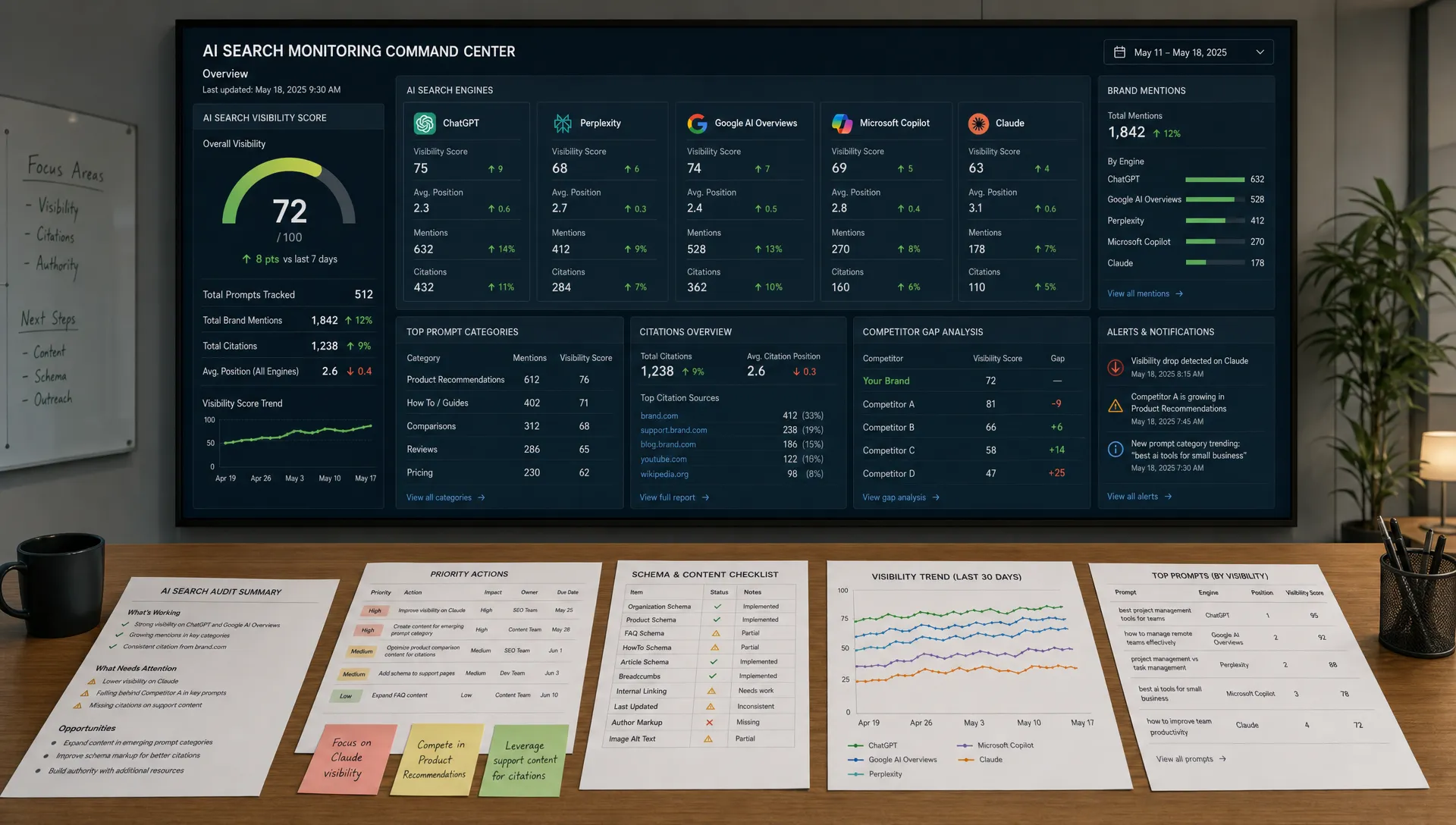
Fast AI mention tracking starts with a simple premise: search monitoring is no longer only about where your blue link ranks. It is about whether generative engines understand, trust, cite, and recommend your brand when a buyer asks a real question.
That shift matters for hotels, franchises, retailers, MSPs, agencies, and in-house teams because AI answers compress discovery. A prospect may ask ChatGPT for “best boutique hotels near a conference center,” Perplexity for “WooCommerce agencies that improve Core Web Vitals,” or Google AI Overviews for “urgent care clinics open on Sunday.” If your brand is absent, misdescribed, or uncited, the buyer may never reach your site.
The goal is not to monitor every possible prompt. The goal is to find the high-intent questions that influence revenue, track them consistently across ChatGPT, Gemini, Perplexity, Claude, Copilot, and Google AI Overviews, then fix the pages, entities, and technical signals that AI systems can reuse.
Why AI mention monitoring is different from rank tracking
Traditional SEO monitoring usually tracks a keyword, a position, a URL, and a click-through rate. AI search monitoring adds a new layer: the generated answer. You need to know whether your brand appears in that answer, how it is framed, whether it is recommended, and which source the engine cites.
An AI mention is a reference to your brand inside an answer. A citation is the source the assistant uses to support that answer. A recommendation is stronger: the assistant includes your business as a suggested option for a need, location, budget, category, or use case.
Those distinctions create different business effects. A mention can improve awareness. A citation can build credibility. A recommendation can influence bookings, leads, demos, or purchases. If you only track rankings, you miss the answer layer where more decisions now happen.
Fast tracking also requires cross-engine comparison. ChatGPT, Gemini, Claude, Perplexity, Copilot, and Google AI Overviews do not behave identically. Some rely more heavily on live web retrieval. Some summarize from indexed sources. Some cite more visibly than others. A brand can look strong in one engine and nearly invisible in another.
If you need a deeper measurement framework, CapstonAI’s guide to AI visibility metrics and KPIs explains how to evaluate mention rate, citation rate, share of voice, sentiment, and answer accuracy without reducing AI search to a single vanity score.
Start with the prompts that matter commercially
The fastest way to get useful data is to build a compact prompt set around real buyer intent. For many teams, 25 to 50 prompts is enough for an initial scan. Across six engines, that creates 150 to 300 observations, which is manageable and still broad enough to reveal blind spots.
Group prompts by journey stage rather than by keyword volume alone. A hotel group might track discovery prompts such as “best family hotels in Scottsdale,” comparison prompts such as “Hyatt vs independent boutique hotels for business travelers,” and booking-adjacent prompts such as “hotels near Phoenix Convention Center with meeting rooms.”
An MSP might monitor “best managed IT providers for healthcare clinics,” “Microsoft 365 security partner for small businesses,” and “SOC 2 IT support provider near me.” A WooCommerce agency might track “best WordPress performance agency for online stores” and “how to fix slow WooCommerce checkout.”
The prompt set should include:
- Branded prompts that test whether AI systems describe your company accurately.
- Category prompts that test whether you are surfaced when the buyer does not know you yet.
- Comparison prompts that reveal which competitors are being positioned against you.
- Location prompts for franchises, clinics, campuses, hotel groups, and retail chains.
- Problem prompts that connect your pages to a specific pain, such as slow checkout, low occupancy, appointment leakage, or poor local visibility.
This is where search monitoring becomes practical. You are not collecting AI outputs for curiosity. You are mapping the questions that can create demand, then checking whether your brand earns a place in the answer.
Track the right fields, not just the mention
A simple spreadsheet can work for a first pass, but the fields need to reflect how AI answers influence decisions. “Mentioned: yes or no” is useful, but it is not enough.
| Field to monitor | What it tells you | Business effect |
|---|---|---|
| Engine | Where the answer appeared | Shows which platforms influence discovery |
| Prompt | The buyer question tested | Connects visibility to intent |
| Mention status | Whether your brand appeared | Measures baseline awareness in AI answers |
| Citation status | Whether your site or another source was cited | Shows which sources AI trusts |
| Recommendation strength | Whether you were listed, compared, or endorsed | Indicates influence on consideration |
| Competitors mentioned | Who appears instead of you | Reveals share-of-voice gaps |
| Answer accuracy | Whether facts are correct | Protects trust and reduces sales friction |
| Source URL | Which page supports the answer | Points to content and technical fixes |
For speed, add one qualitative field: “why this likely happened.” The note can be short. Examples include “competitor has stronger location page,” “our pricing page is blocked,” “no FAQ schema,” “brand name inconsistent,” or “third-party directories dominate citations.” Those notes turn monitoring into action.
Separate brand mentions, citations, and share of voice
AI visibility has layers. A brand can be mentioned but not cited. It can be cited as a source but not recommended as a provider. It can appear once while a competitor appears in nearly every category prompt.
That is why share of voice matters. In AI search, share of voice is the proportion of relevant answers in which your brand appears compared with competitors. It is especially useful for agencies and multi-location brands because it shows whether visibility is improving across a market, not just on one query.
A franchise healthcare brand, for example, may appear in local prompts for one city but not another. That gap may point to missing location schema, weak internal linking between service and location pages, thin practitioner pages, or inconsistent entity data across the web. A travel group may find that AI engines recommend its properties for “romantic weekend hotels” but not for “business hotels with meeting space,” even though the site has the amenities. The issue may be that the relevant content is buried, slow, uncited, or not stated in a machine-readable way.
E-commerce teams should also monitor attribute-specific prompts. For example, a designer lighting retailer such as BUYnBLUE’s modern lighting and lamp collection would not only track broad category prompts like “modern pendant lights,” but also detailed prompts about customization, room fit, cable length, canopy options, shipping, and returns. Those details often decide whether an AI assistant can confidently recommend a product page or category page.
Build a fast weekly monitoring cadence
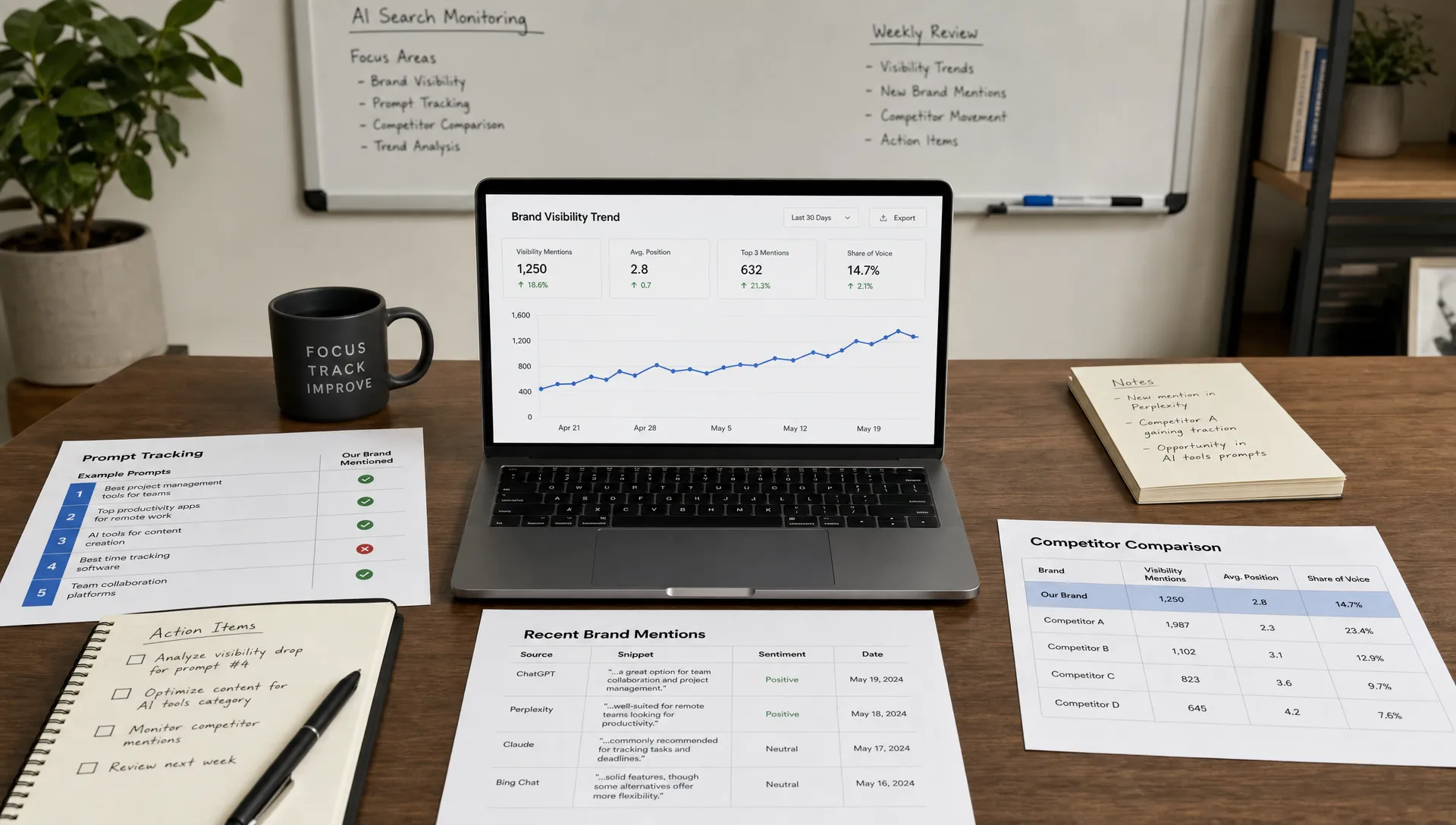
Speed does not mean checking once and moving on. AI answers change because indexes refresh, model behavior shifts, competitors publish, and prompts evolve. The practical cadence is weekly for high-value prompts and monthly for broader market scans.
A strong weekly routine is simple:
| Timeframe | Action | Output |
|---|---|---|
| Monday | Re-run priority prompts across key engines | Fresh mention and citation snapshot |
| Tuesday | Compare against last week | Gains, losses, and new competitor appearances |
| Wednesday | Diagnose the top gaps | Page, schema, entity, or crawlability issue |
| Thursday | Publish or request fixes | Updated FAQ, metadata, internal links, or content |
| Friday | Flag risks and wins | Alerts for brand, content, SEO, or client teams |
The key is to keep the prompt set stable enough to compare over time. Add new prompts when sales, support, paid search, or site search data reveals a new buyer question, but do not change the whole set every week. If the test keeps changing, you lose the ability to see whether your fixes worked.
For a more detailed cadence, use CapstonAI’s guide to weekly AI search monitoring as a companion process for recurring brand, citation, and competitive checks.
Diagnose why an AI engine did not mention you
When your brand is missing, resist the urge to rewrite everything. Start with the most likely visibility blockers.
First, check crawlability. If important pages are blocked, slow, thin, duplicated, or buried too deep in the site architecture, AI systems and traditional search engines have fewer reliable signals to work with. Page performance matters because slow pages can reduce crawl efficiency, user engagement, and conversion, especially for e-commerce and booking flows.
Second, check entity clarity. Generative engines need to understand what your business is, where it operates, who it serves, and how it differs from alternatives. Entity confusion often appears when brand names vary across pages, locations have inconsistent naming, or service pages use generic language that could apply to any competitor.
Third, check structured data. Schema helps machines interpret page purpose, business details, reviews, FAQs, products, locations, events, and services. It does not guarantee inclusion in AI answers, but it improves the clarity of the source material. For multi-location brands, LocalBusiness, Organization, FAQPage, Product, Service, and Breadcrumb schema can be especially useful when implemented accurately.
Fourth, check internal linking. AI systems and crawlers infer importance from site structure. If your “meeting rooms” content is only mentioned once in a PDF, it is less likely to support an AI answer than a crawlable page linked from hotel, location, amenity, and event pages.
Finally, check answer-ready content. AEO, or Answer Engine Optimization, means making pages easy to extract for direct questions. GEO, or Generative Engine Optimization, expands that goal by shaping content so generative engines can understand, trust, and reuse it in synthesized answers. In practice, both require concise definitions, clear comparisons, accurate facts, useful FAQs, and evidence that matches the query.
Prioritize fixes by revenue impact
Not every missing AI mention deserves the same urgency. A brand prompt with a slightly outdated description is important, but a high-intent category prompt where competitors are repeatedly recommended may be more urgent.
Use a simple prioritization model:
| Priority | Signal | Recommended action |
|---|---|---|
| Critical | Wrong brand facts in AI answers | Correct source pages, entity data, schema, and third-party profiles |
| High | Competitors recommended for your core buying prompts | Strengthen category, service, and comparison pages |
| High | Your site is not cited when your brand is mentioned | Improve source clarity, schema, internal links, and crawlability |
| Medium | You appear in one engine but not others | Compare citation sources and fill engine-specific gaps |
| Medium | Location prompts miss certain branches or properties | Audit location pages, NAP consistency, and local schema |
| Low | Low-intent prompts omit your brand | Monitor, but do not divert resources from revenue prompts |
This keeps teams aligned. Content teams know what to write. Developers know what to fix. Executives see why AI visibility work connects to pipeline, bookings, store visits, or online revenue.
Use llms.txt and AI-ready metadata carefully
The llms.txt file is an emerging convention intended to help AI systems find and understand key website resources. It is not a replacement for robots.txt, XML sitemaps, schema, or strong internal linking. Treat it as one additional clarity layer, not a magic switch.
For many brands, the more immediate gains come from cleaning up metadata, improving page titles, adding concise summaries, and publishing accurate FAQ content. AI-ready metadata should state the page’s purpose clearly. It should match the content on the page, not overpromise.
A practical page-level check is to ask: if an AI assistant could only extract five facts from this page, would it get the right ones? For a hotel, those facts might be location, amenities, room types, meeting space, and booking policies. For an MSP, they might be service area, industries served, security capabilities, certifications, and support model. For a retailer, they might be product category, material, sizing, shipping, returns, and customization.
Set alerts for the changes that matter
Fast search monitoring should include alerts, but alerts should be limited to meaningful changes. Too many notifications train teams to ignore them.
Useful alert triggers include:
- Your brand disappears from a high-intent prompt where it previously appeared.
- A competitor newly appears in multiple priority prompts.
- An AI answer states an incorrect fact about pricing, availability, service area, or policies.
- Your citation source changes from your site to a third-party directory.
- A location, product line, or service category drops out of AI answers.
For agencies, these alerts also create better client communication. Instead of saying “AI visibility changed,” you can say “Perplexity stopped citing the client’s service page for two high-intent prompts, and the likely cause is that competitor pages now answer the comparison question more directly.” That is specific, credible, and fixable.
Avoid common AI mention tracking mistakes
The most common mistake is treating one AI answer as truth. Generative engines can vary by session, wording, location, personalization, and retrieval context. Run prompts consistently, record the exact wording, and compare patterns rather than overreacting to a single response.
Another mistake is tracking only branded prompts. Branded visibility is necessary, but category and problem prompts reveal whether AI systems introduce you to new buyers. If you only ask “What is our brand?” you will not know whether the engine recommends you when the buyer asks “Who can solve this problem?”
A third mistake is separating AI search from technical SEO. AI visibility still depends on crawlable pages, structured information, strong internal links, useful content, and page performance. GEO and AEO build on SEO foundations. They do not replace them.
If your team is still establishing the foundation, CapstonAI’s AI search readiness checklist for brand teams is a useful way to audit entity consistency, technical blockers, schema coverage, and priority content gaps before scaling monitoring.
What CapstonAI adds to search monitoring
Manual testing is useful for learning the pattern. It becomes hard to maintain when you manage multiple brands, locations, clients, categories, or engines.
CapstonAI helps teams measure, improve, and defend AI visibility across ChatGPT, Google AI Overviews, Gemini, Perplexity, Claude, and Copilot. It tracks brand mentions, citations, share of voice, prompts, competitors, and market changes, then turns findings into prioritized recommendations for pages, metadata, schema, FAQ content, llms.txt, crawlability, and internal linking.
The important point is measurement first. Before you publish new content or change templates, you need to know what AI systems currently see, what they miss, and which prompts are already surfacing competitors. That baseline makes every fix easier to evaluate.
Frequently Asked Questions
What is search monitoring for AI mentions? Search monitoring for AI mentions is the process of tracking when and how your brand appears in AI-generated answers across tools like ChatGPT, Gemini, Perplexity, Claude, Copilot, and Google AI Overviews. It measures mentions, citations, recommendations, competitors, sentiment, and answer accuracy.
How fast can a team start tracking AI mentions? A team can start with a focused prompt set in a few hours if it already knows its priority services, locations, competitors, and buyer questions. The first useful baseline usually comes from testing 25 to 50 high-intent prompts across the engines that matter most to the business.
What is the difference between GEO and AEO? AEO focuses on making content easy for answer engines to extract for direct questions. GEO focuses on helping generative engines understand, cite, and reuse your content in synthesized responses. Both depend on solid technical SEO, structured data, crawlability, internal linking, and clear entity signals.
Should we monitor ChatGPT, Google AI Overviews, Gemini, Perplexity, Claude, and Copilot separately? Yes. Each engine can produce different answers and cite different sources. Monitoring them separately shows where your brand is visible, where competitors are stronger, and which technical or content fixes may improve coverage.
Which AI mentions should we fix first? Prioritize incorrect brand facts, missing mentions on high-intent category prompts, lost citations, competitor recommendations, and location gaps that affect revenue. Low-intent prompts are worth watching, but they should not outrank issues tied to bookings, leads, appointments, or sales.
Start with a free AI visibility audit
AI can only recommend what it can understand, verify, and retrieve. If AI cannot see your business clearly, CapstonAI makes it visible.
Start with a free AI visibility audit from CapstonAI to see how your brand appears across generative engines, where competitors are winning mentions, and which technical or content fixes should come first.