Every Google update is now a visibility event, not only a ranking event. When Google search algorithm changes reorder sources, refresh quality signals, or change how results are presented, the effect can reach Google AI Overviews and the broader AI search ecosystem: ChatGPT, Gemini, Perplexity, Claude, and Copilot.
That does not mean every traffic dip is an algorithm penalty. It means the response plan has to be wider than a rankings screenshot. In 2026, the practical question is: can search engines and generative engines still crawl, understand, trust, cite, and reuse your business information?
For hotels, franchise brands, e-commerce teams, MSPs, and agencies managing many sites, the answer determines more than traffic. It affects bookings, store visits, lead quality, local credibility, and whether AI assistants mention your brand when buyers ask for recommendations.
Why algorithm changes now require an AI visibility response
Google's ranking systems are still central, but the surface area has expanded. Search results pages include AI summaries, local packs, product modules, video results, forums, shopping results, and traditional organic listings. At the same time, generative engines synthesize answers from indexed pages, structured data, citations, entity references, and trusted third-party sources.
Three disciplines now overlap:
- Technical SEO makes sure your site can be crawled, indexed, rendered, and measured.
- Answer Engine Optimization (AEO) formats information so answer systems can extract a clear, useful response.
- Generative Engine Optimization (GEO) improves how AI systems mention, cite, compare, and summarize your brand across prompts.
If a core update rewards clearer experience signals or more reliable sources, a page can lose classic rankings and become less likely to be cited by AI. If a competitor improves structured product data, location pages, or review consistency, they may gain share of voice in both Google and AI answers.
Google publishes confirmed ranking update information in its Search ranking updates documentation. Use that as your first checkpoint, but do not stop there. A modern audit should compare Google visibility with brand mentions, citations, and prompt coverage across AI engines. For more context on the update types that matter most, CapstonAI has a deeper guide to Google algorithm changes that affect AI visibility.
What can change after a Google update
Algorithm changes do not affect every site in the same way. The pattern usually depends on intent, page type, content quality, technical health, and how easily machines can verify the business behind the page.
| Change area | What may shift | AI visibility risk | Business effect |
|---|---|---|---|
| Core ranking systems | Which pages are considered most helpful for a query | AI Overviews and assistants may cite different sources | Fewer visits, weaker assisted discovery, lower authority perception |
| Spam and quality systems | Low-value, duplicate, or manipulative pages may lose visibility | Thin pages may be ignored as unreliable inputs | Less organic reach and fewer qualified leads |
| Local and entity signals | Brand, location, service, and category understanding may change | AI may confuse locations, services, or brand relationships | Lost local bookings, calls, directions, or franchise leads |
| Structured data and content extraction | Product, FAQ, review, and business details may become easier or harder to parse | Generative engines may miss key facts or cite a competitor | Lower citation rate and weaker answer inclusion |
| Page performance and crawlability | Slow, blocked, or unstable templates may underperform | AI and search crawlers may not reach or reuse key content | Less indexation, slower recovery, poorer conversion rates |
The response plan below is built around one principle: measure first, then fix the pages and signals that influence both classic search and AI search.
Phase 1: Triage without making volatility worse
The first mistake after a ranking drop is editing everything at once. During a confirmed rollout, data can move for days or weeks. If you rewrite templates, change internal links, alter metadata, and publish new pages simultaneously, you lose the ability to identify what actually worked.
Start with a controlled triage window. Confirm whether there is a known Google update, then separate symptoms by page type and business impact.
Your first 48 hours should focus on evidence:
- Compare the last 7, 14, and 28 days against the same prior period in Google Search Console and analytics.
- Segment branded and non-branded queries, because brand demand can hide non-brand losses.
- Separate desktop, mobile, country, and location-level performance, especially for hotel groups and franchise networks.
- Group pages by template, such as product pages, service pages, location pages, blog posts, and category pages.
- Mark queries where Google AI Overviews appear, because ranking stability can still come with lower click-through rate.
If clicks fell while impressions stayed flat, the issue may be presentation or click compression rather than lost eligibility. CapstonAI's analysis of AI Overviews and CTR impact explains why teams should monitor both rank and search result format before drawing conclusions.
A useful rule: do not call a decline an algorithm problem until you have ruled out tracking changes, seasonality, lost paid support, site releases, crawl errors, and SERP layout changes.
Phase 2: Run an AI visibility scan, not only an SEO audit
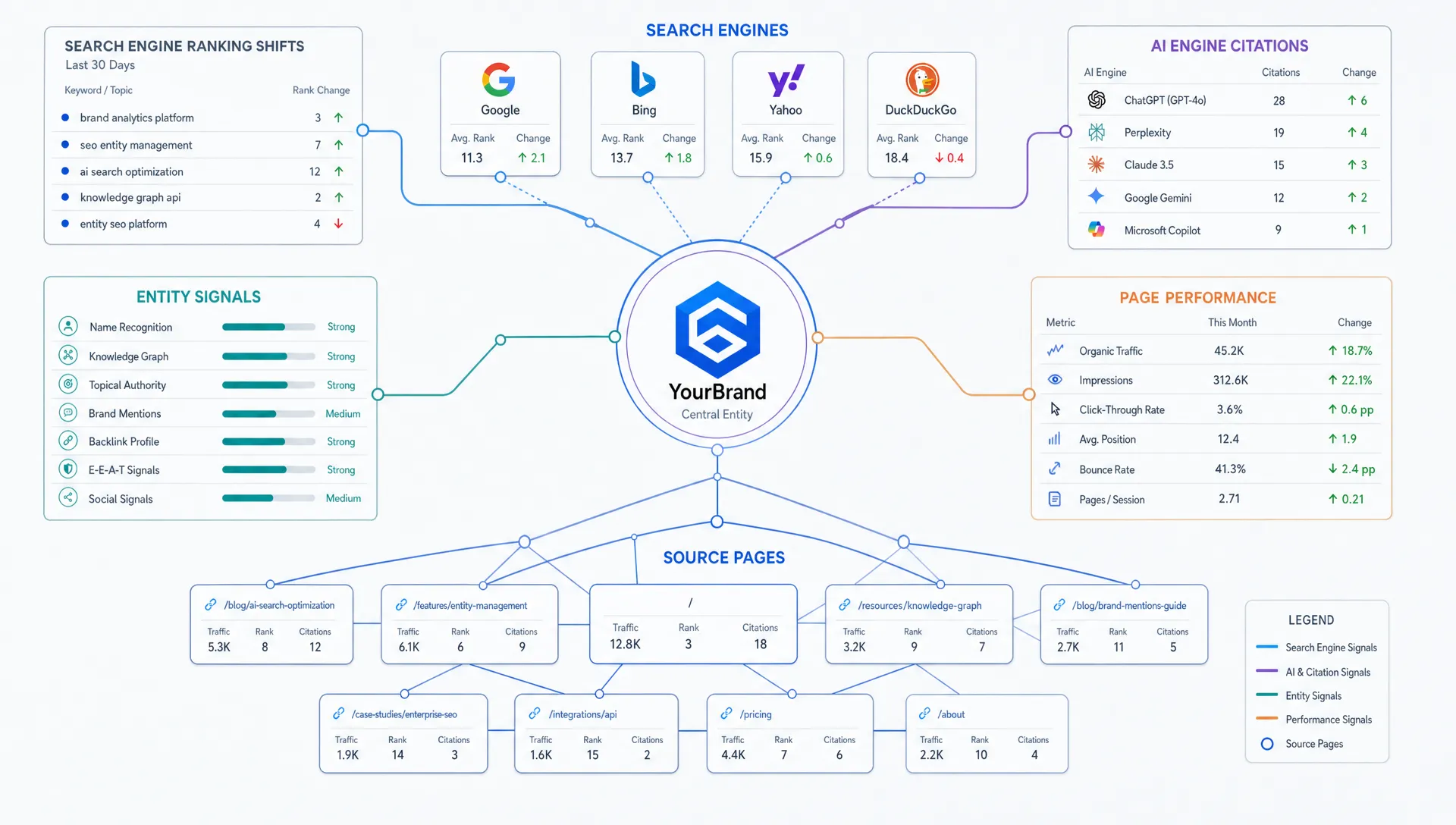
A ranking report tells you where your pages appear. An AI visibility scan tells you whether generative engines mention your brand, cite your pages, or recommend competitors when buyers ask high-intent questions.
This matters because AI search behavior is prompt-based. A buyer may not search best hotel near airport. They may ask Perplexity for a family-friendly hotel near a specific terminal with parking and late check-in. A retailer may not search running shoes size 11. They may ask ChatGPT to compare durable trail shoes for wide feet under a specific budget.
Your scan should test prompts that match real buying journeys:
- Discovery prompts, such as best providers, hotels, clinics, agencies, or products in a market.
- Comparison prompts, such as your brand versus competitors or alternatives for a use case.
- Local prompts, such as near me, in a city, near a landmark, or available in a service area.
- Problem prompts, such as how to choose, what to look for, and which option fits a scenario.
- Trust prompts, such as reviews, certifications, policies, guarantees, delivery coverage, and support.
Track four outcomes: whether the AI mentions you, whether it cites you, which page it cites, and which competitors appear instead. This turns vague AI concern into a measurable share-of-voice problem.
For teams building a baseline, this guide on how to check site visibility across Google and AI engines covers the core measurement process.
| AI visibility metric | What it answers | Why it matters |
|---|---|---|
| Brand mention rate | How often AI includes your brand in relevant answers | Measures discoverability in generative search |
| Citation rate | How often AI links to or references your pages | Shows whether your content is trusted as a source |
| Prompt coverage | Which buyer questions surface you or miss you | Reveals content and entity gaps |
| Competitor share of voice | Which rivals appear for the same prompts | Prioritizes where to defend or improve |
| Citation quality | Whether AI cites the right page for the right intent | Connects AI visibility to conversion-ready pages |
Phase 3: Fix technical access before rewriting content
Content changes are easier to see, but technical issues often control whether recovery is possible. If Googlebot struggles to crawl a template, if canonical tags point to the wrong URL, or if JavaScript hides critical content, better copy will not fix the visibility problem.
Run a technical review of affected sections, not just the homepage. For multi-site and franchise brands, compare winning and losing locations. For WooCommerce or e-commerce sites, compare product templates, category pages, filters, faceted navigation, and inventory status pages.
Prioritize these checks:
- Crawlability: Confirm robots.txt, meta robots tags, XML sitemaps, status codes, and canonical tags are not blocking important pages.
- Indexation: Compare submitted, indexed, excluded, duplicate, and crawled but not indexed URLs in Google Search Console.
- Rendering: Make sure key copy, product data, location details, pricing, and internal links are visible without relying on delayed scripts.
- Internal linking: Ensure high-value pages receive contextual links from relevant hubs, not only navigation menus.
- Page performance: Review Core Web Vitals. Google and web.dev define good thresholds as Largest Contentful Paint at 2.5 seconds or less, Interaction to Next Paint at 200 milliseconds or less, and Cumulative Layout Shift at 0.1 or less in their Core Web Vitals guidance.
Tie each fix to business impact. A slow location page is not only a technical issue. It can reduce bookings, calls, and form completions. A blocked product category is not only an indexation issue. It can remove a revenue page from both search and AI citation paths.
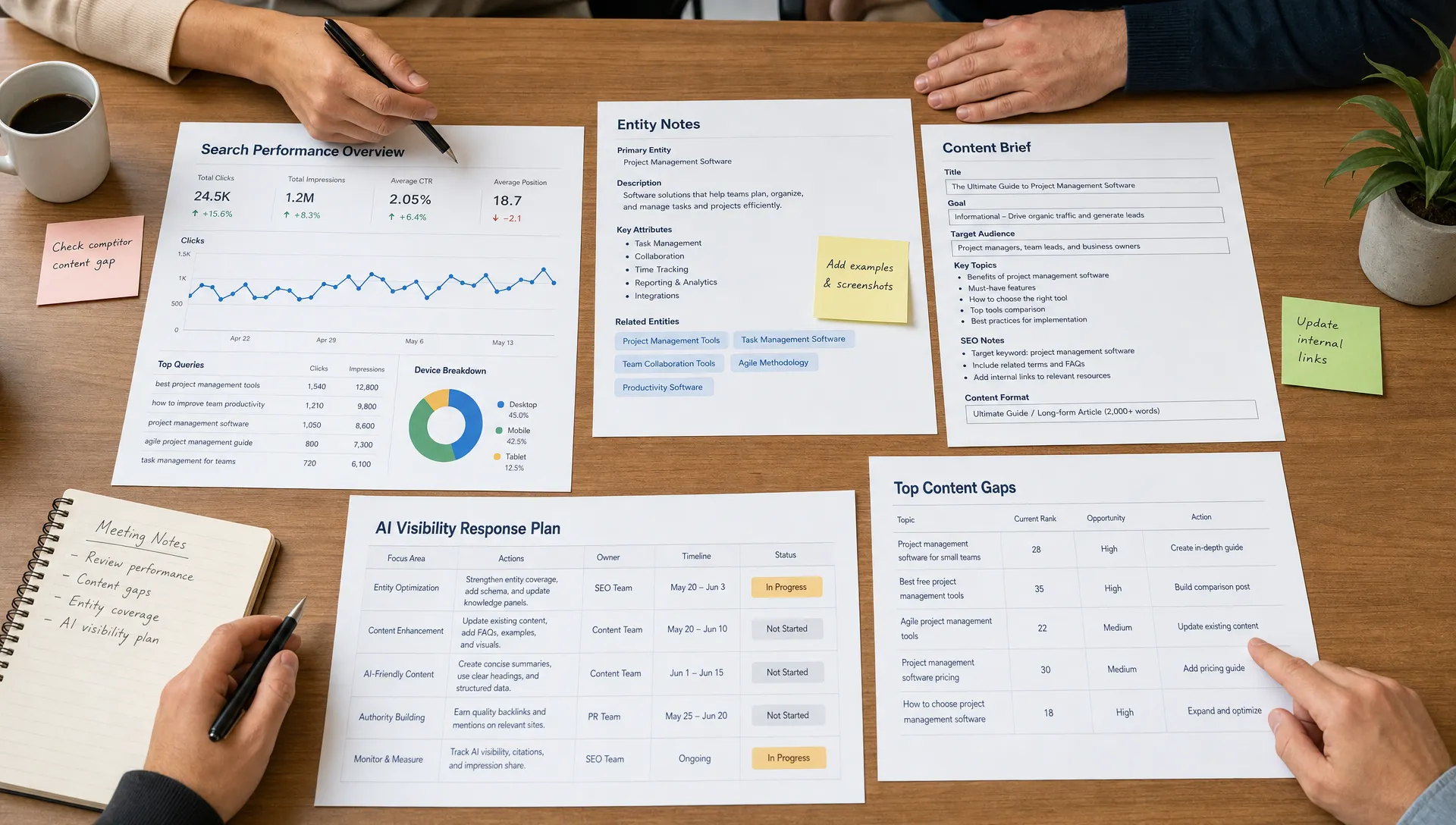
Phase 4: Make your entities unmistakable
AI systems do not only read pages. They try to understand entities: the brand, locations, products, services, people, categories, policies, and relationships behind the content. After Google search algorithm changes, pages with clearer entity signals are often easier to evaluate and reuse.
Entity clarity is especially important for businesses with many locations, service areas, or product variations. A hotel group needs consistent property names, amenities, addresses, room types, nearby landmarks, and booking policies. A healthcare franchise needs clear clinic names, services, provider credentials where applicable, insurance or payment information where published, and appointment paths. An e-commerce store needs product identifiers, category structure, specifications, availability where applicable, shipping terms, and return policy clarity.
A practical example outside hospitality: a national commerce business such as a nationwide shipping container supplier should make product types, sizes, condition terms, delivery coverage, financing availability, guarantees, and use cases easy for machines to parse. That same principle applies to any business with complex inventory or service coverage. AI cannot confidently recommend what it cannot clearly understand.
Structured data supports this work. It does not guarantee rankings or citations, but it helps search systems interpret page meaning. Use schema types that match the page, such as Organization, LocalBusiness, Product, Service, BreadcrumbList, Article, or FAQPage where appropriate. Google's structured data documentation is the safest reference for supported implementation patterns.
Do not treat schema as a patch for weak content. The visible page and the structured data should agree. If the page says one thing and the schema says another, you create trust friction for crawlers and users.
Phase 5: Rebuild key pages for answer extraction
AEO is not about writing robotic snippets. It is about helping machines and people get to a verified answer quickly.
For each high-value page, ask: what exact question should this page answer, and what evidence proves the answer? Then structure the page so the answer is visible, specific, and supported.
Strong answer-ready pages usually include:
- A concise answer near the top of the section, followed by detail for buyers who need it.
- Clear headings that match real questions and decision points.
- Specific attributes, such as locations served, room amenities, product specifications, delivery areas, service scope, pricing model where public, and policy details.
- Comparison language that explains fit, tradeoffs, and use cases without attacking competitors.
- Supporting proof, such as reviews, certifications, case studies, media mentions, documentation, or transparent policies.
- Internal links to the next logical step, such as a booking page, quote page, location page, category page, or contact path.
For a hotel chain, this may mean upgrading destination and property pages to answer parking, pet policy, airport distance, family amenities, check-in, accessibility, and nearby attraction questions. For an MSP, it may mean service pages that answer industries served, response process, security framework, tool stack where public, compliance scope, and regional support coverage. For WooCommerce teams, it may mean category pages that explain how products differ, not just grids of SKUs.
The goal is simple: make your best commercial pages the easiest trustworthy source for both Google and AI systems to quote.
Phase 6: Strengthen the citation layer beyond your website
AI visibility is not built only on your domain. Generative engines often rely on a mix of first-party pages and third-party evidence, including directories, review platforms, industry publications, marketplaces, partner pages, local listings, and reputable editorial content.
That does not mean chasing every backlink. It means making sure the facts that validate your business are consistent across the web.
Review these citation sources after a major update:
- Google Business Profiles and local listings for each location.
- Industry directories and marketplace profiles.
- Review platforms and ratings pages.
- Partner, reseller, or association pages.
- Press, awards, case studies, and customer stories.
- Social and knowledge profiles that define the brand entity.
For multi-location brands, consistency is the work. Names, addresses, phone numbers, categories, service areas, hours, URLs, and descriptions should not drift across platforms. For agencies, this is often where hidden AI visibility gains appear: a client may have strong on-site SEO but weak off-site entity confirmation.
Phase 7: Treat llms.txt as a guide, not a replacement
llms.txt is an emerging convention for giving AI systems a simple map of important content. It can point to documentation, product information, policies, support pages, and other pages that summarize what an AI assistant should understand about a site.
Use it carefully. llms.txt is not a substitute for crawlable HTML, XML sitemaps, robots.txt, schema, internal linking, or strong content. It should not contain claims that are absent from the site. It should not expose private or low-quality pages.
A sensible implementation includes:
- Links to authoritative overview pages, product or service pages, location hubs, policies, and documentation.
- Short descriptions that match visible page content.
- Regular updates when offers, locations, policies, or product lines change.
- Alignment with robots.txt, sitemaps, canonical tags, and structured data.
For CapstonAI users, this is part of a broader AI-ready metadata layer: structured data, FAQs, internal links, page summaries, and machine-readable guidance should all point in the same direction.
Phase 8: Measure recovery as visibility, not only rankings
A response plan is complete only when measurement proves what changed. Rankings matter, but they are no longer the only signal. You need a dashboard that connects crawl health, content quality, AI citations, and business outcomes.
| Layer | Leading metric | Lagging outcome |
|---|---|---|
| Technical SEO | Crawl errors, index coverage, Core Web Vitals, canonical accuracy | More stable eligibility and faster recovery |
| Content and AEO | Answer coverage, updated page sections, FAQ quality, internal link depth | Better engagement and higher conversion readiness |
| Entity and schema | Valid structured data, consistent business facts, complete product or location attributes | Stronger machine understanding and trust |
| AI visibility | Brand mentions, citations, prompt coverage, competitor share of voice | More discovery inside ChatGPT, Gemini, Perplexity, Claude, Copilot, and AI Overviews |
| Business performance | Assisted leads, bookings, quote requests, revenue by page type | Proof that visibility gains produce commercial value |
Set a before and after window. Avoid declaring success from one day's movement. For most teams, weekly measurement is enough for direction, while monthly reporting is better for decisions about content investment, technical backlog, and competitive positioning.
The best response plans also create alerts. If a competitor starts appearing in AI answers for prompts you used to own, or if a key page stops being cited, the team should know before that loss becomes a quarterly revenue problem.
A practical response checklist
Use this checklist when the next confirmed update or unexplained visibility shift hits.
- Confirm whether Google has announced or completed a ranking update.
- Separate traffic loss from click-through rate compression, tracking errors, and seasonality.
- Segment by page type, query intent, location, device, and branded versus non-branded terms.
- Scan AI engines for brand mentions, citations, prompt coverage, and competitor share of voice.
- Fix crawlability, indexation, rendering, page performance, and canonical issues before broad rewrites.
- Improve entity clarity with consistent business facts, structured data, internal linking, and trustworthy citations.
- Rewrite high-value pages for answer extraction, proof, and conversion paths.
- Validate off-site profiles and third-party sources that AI systems may use for corroboration.
- Update
llms.txtand AI-ready metadata only after the underlying content is accurate. - Measure recovery using rankings, citations, share of voice, leads, bookings, and revenue outcomes.
Frequently Asked Questions
How long should we wait before responding to a Google algorithm update? Start measuring immediately, but avoid large, unfocused changes during active volatility. Triage in the first 48 hours, diagnose by page type and intent, then prioritize fixes once you can distinguish update impact from tracking, seasonality, or technical releases.
Can AI visibility improve even if Google rankings decline? Yes, but it depends on the query and engine. A page may lose a classic organic position while still being cited by an AI answer, or the reverse may happen. That is why you need separate tracking for rankings, AI mentions, citations, and prompt coverage.
Is structured data enough to recover from algorithm changes? No. Schema helps machines interpret your content, but it cannot compensate for weak pages, inconsistent facts, poor crawlability, or thin evidence. Treat structured data as a clarity layer on top of accurate, useful, crawlable content.
What is the difference between AEO and GEO? AEO focuses on making pages easy for answer engines to extract and summarize. GEO focuses on how generative engines mention, cite, compare, and recommend your brand across prompts. Both depend on strong technical SEO and credible entity signals.
Should we block AI crawlers after a traffic drop? Not as a default response. Blocking crawlers may reduce unwanted reuse, but it can also reduce discovery and citation opportunities. Decide based on content strategy, legal guidance, and business goals, not panic after a single update.
Start with a free AI visibility audit
If Google search algorithm changes affected your traffic, rankings, or lead quality, start by measuring what AI systems can actually see. CapstonAI scans your presence across Google AI Overviews, ChatGPT, Gemini, Perplexity, Claude, and Copilot, then maps brand mentions, citations, prompt gaps, competitor share of voice, and priority fixes.
Begin with a free AI visibility audit. The goal is not to chase every update. It is to make your business visible, verifiable, and reusable wherever buyers now search.