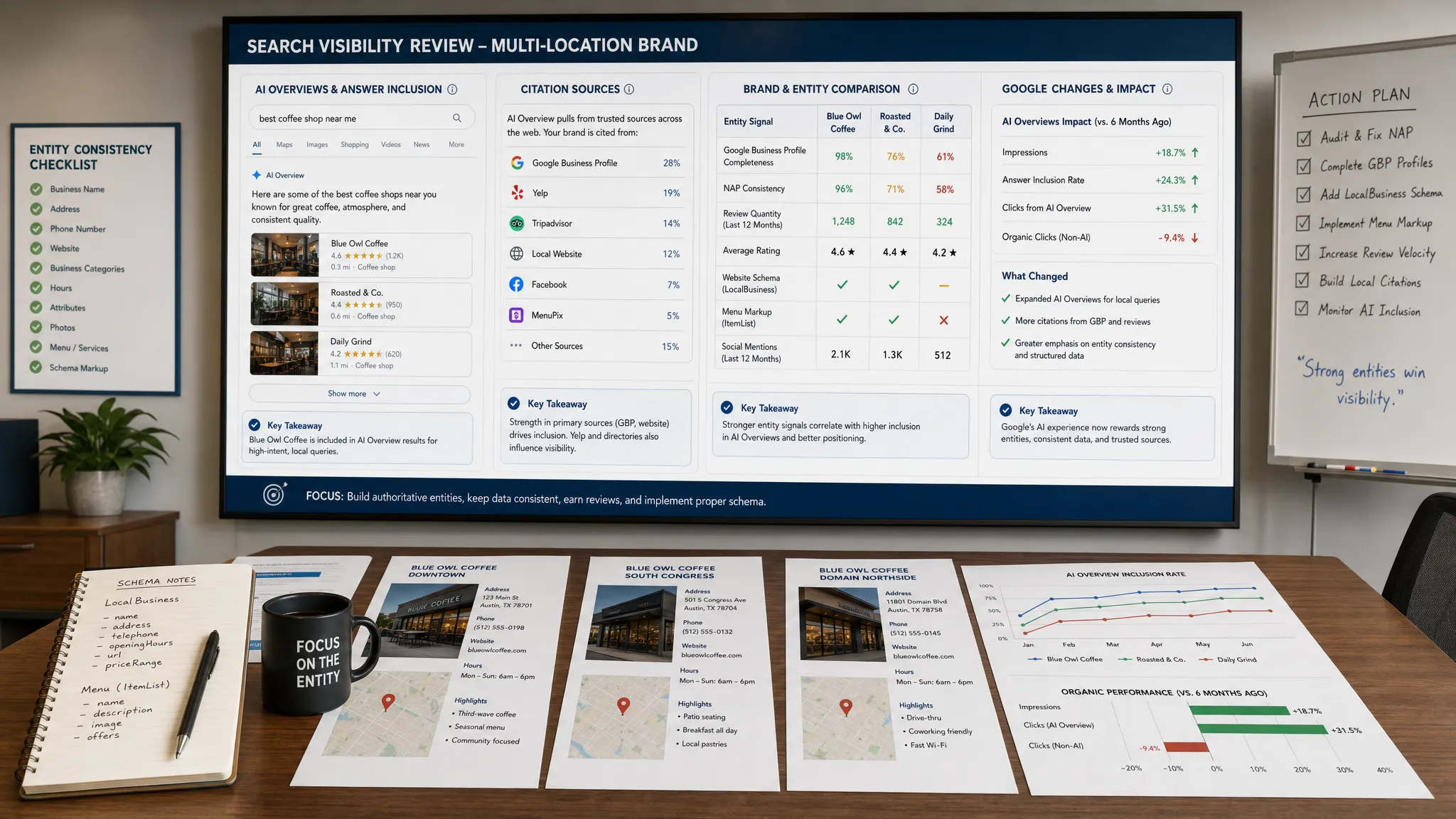
Google algorithm changes no longer affect only where your page appears in a list of blue links. They also influence whether AI systems can find your content, trust your entities, summarize your pages accurately, and cite your brand in answers.
For a hotel group, that can mean being named in an AI-generated itinerary. For a healthcare franchise, it can mean showing up when someone asks for nearby providers. For an MSP or agency, it can mean being included in a comparison answer before a buyer ever visits a traditional search result.
That is the practical meaning of AI visibility: how often and how accurately your brand appears across Google AI Overviews, Gemini, ChatGPT, Perplexity, Claude, Copilot, and other generative engines. Google updates are only one part of that system, but they are an important one because Google still shapes crawling, indexing, ranking, entity understanding, and the content that many users see first.
Why Google algorithm changes matter for AI visibility
Generative engines do not all work the same way. Some rely heavily on their own models. Some retrieve live web results. Some cite sources. Some summarize without visible citations. Google AI Overviews are part of Google Search itself, while tools like Perplexity and Copilot often combine search retrieval with model-generated answers.
Still, most AI visibility depends on a few shared inputs:
- Can the page be crawled, rendered, and understood?
- Is the brand or location a clear entity?
- Does the content answer real questions directly?
- Is the information consistent across your site and credible third-party sources?
- Are there structured signals, such as schema, that reduce ambiguity?
- Do users and other publishers reinforce the same facts?
That is where classic technical SEO, AEO (Answer Engine Optimization), and GEO (Generative Engine Optimization) overlap. Technical SEO makes the site accessible. AEO makes answers clear and extractable. GEO makes your brand, products, services, and expertise easy for generative engines to recognize, trust, and reuse.
If you want a practical baseline before making changes, CapstonAI has a detailed guide on how to check site visibility across Google and AI engines without relying on rank tracking alone.
The Google algorithm changes most likely to affect AI visibility
Google does not publish every ranking signal, and no responsible SEO team should claim to reverse-engineer the full system. What we can do is map documented Google changes to the AI visibility effects we observe most often: changes in brand mentions, citations, answer inclusion, and share of voice.
Core updates: quality, intent, and entity confidence
Core updates adjust how Google’s ranking systems assess relevance and quality across the web. Google’s own ranking systems documentation emphasizes systems designed to surface helpful, reliable information.
For AI visibility, the issue is not only whether a page ranks. It is whether the page becomes a reliable source for an answer.
A thin “services” page may still be indexed, but an AI answer is more likely to use a page that clearly states who you serve, where you operate, what you offer, how you differ, and what evidence supports the claim. This matters for multi-location brands, hotels, e-commerce stores, and MSPs where a generic page can easily be replaced by a directory, marketplace, or competitor page.
The fix is not adding more words. It is increasing specificity. A location page should include real service details, local proof, visible contact information, policies, amenities, practitioner or team details when relevant, and internal links to related pages. A product page should include structured attributes, shipping and return context, comparison information, and buyer questions.
Helpful content and people-first systems: fewer generic pages, more useful answers
Google’s helpful content work, including the March 2024 core update and spam policy changes, moved the web further away from generic pages created mainly to capture search traffic.
This directly affects AI visibility because generative engines need content they can confidently summarize. A page that repeats the same keyword variations but avoids concrete details gives AI systems little to work with. A page with clear answers, firsthand context, and concise definitions is more likely to be reused.
For example, compare these two hotel page sections:
| Weak for AI visibility | Stronger for AI visibility |
|---|---|
| “Our hotel is near top attractions and offers great amenities.” | “The hotel is a 7-minute walk from the convention center, includes valet parking, has 14 accessible rooms, and offers checkout until 12 p.m.” |
| “We provide IT support for businesses.” | “We provide Microsoft 365 migration, endpoint security, backup monitoring, and help desk support for 50 to 500 employee healthcare and legal teams.” |
| “Our clinic offers quality care.” | “This location offers pediatric urgent care, same-day appointments, flu testing, and on-site X-rays, with insurance details listed by plan.” |
Specificity helps both users and AI systems. It reduces uncertainty, improves answer extraction, and supports stronger entity associations.
Spam updates: scaled content, reputation abuse, and trust loss
Google’s spam policies have become especially important in an AI content environment. The issue is not whether AI was used to draft content. The issue is whether the final content is useful, original, accurate, and created to help users rather than manipulate rankings.
Spam-related changes can affect AI visibility in two ways. First, pages with low trust may lose organic reach, which reduces the chance of being retrieved or cited. Second, a domain with large volumes of thin or duplicated content can become less credible as a source for answer engines.
This is a real risk for site fleets. Franchise brands, multi-location providers, travel groups, and agencies managing hundreds of WordPress sites often have repeated templates with only city names swapped. That pattern creates weak local entity signals. It also gives generative engines little reason to cite the brand over a stronger directory or review platform.
A better approach is content governance. Define which pages deserve unique local detail, which can remain templated, and which should be consolidated. Use AI to accelerate drafting if needed, but require human validation, source checking, and brand-specific detail before publishing.
AI Overviews: citations become a visibility layer of their own
Google introduced AI Overviews broadly in the U.S. in 2024, positioning them as AI-generated summaries inside Search. Google’s announcement on generative AI in Search makes clear that the search results page itself is becoming more answer-led.
This changes the measurement problem. A page may rank in the top five and still receive less traffic if the AI Overview satisfies the query. Conversely, a page outside the traditional top positions may gain visibility if it is cited in the AI Overview.
For teams managing SEO performance, this means rankings and clicks are no longer enough. You need to monitor:
- Whether an AI Overview appears for important queries
- Which sources are cited
- Whether your brand is mentioned but not linked
- Whether competitors gain citation share
- Whether the answer is accurate, incomplete, or outdated
This is especially important for informational and comparison queries, where AI summaries can shift click-through behavior. CapstonAI has covered this in more depth in its analysis of AI Overviews and CTR impact.
Local algorithm changes: entity consistency across every location
Local visibility depends on more than website content. Google Business Profiles, reviews, categories, local landing pages, third-party listings, and proximity signals all contribute to how a business is understood.
For AI visibility, local consistency is critical. If your website says one address, a directory says another, and a Google Business Profile uses a different category, AI systems may hesitate or pull the wrong fact. That can lead to missing citations, incorrect hours, wrong service areas, or competitors being recommended instead.
Multi-location brands should treat every location as an entity with its own evidence set. The website, Google Business Profile, schema, directory citations, reviews, and internal links should reinforce the same facts.
Product and review-related changes: richer proof for e-commerce
E-commerce teams should pay close attention to quality signals around product pages, reviews, and comparison content. AI answers often compress buying research into a short recommendation. If your product data is incomplete, your reviews are hard to parse, or your category pages are mostly filter grids, the AI system may rely on marketplaces, affiliates, or competitors.
For WooCommerce and mid-market e-commerce stores, the priority is to make product information complete and machine-readable. Product schema, review schema where appropriate, availability, shipping information, return policy clarity, product comparisons, FAQs, and internal links between categories and guides all help.
The business effect is straightforward: if AI systems cannot confidently explain why your product fits a query, they are less likely to mention it.
Technical and page experience changes: crawlability still comes first
AI visibility can sound abstract, but it often fails for basic technical reasons. A page blocked by robots.txt, hidden behind scripts, slowed by heavy assets, duplicated by parameter URLs, or missing canonical clarity is harder for any retrieval system to use.
Google’s guidance on Core Web Vitals and page experience is not a guarantee of ranking success, but performance affects crawl efficiency, user experience, and conversion. For AI visibility, clean technical foundations also help engines extract the right content quickly.
Structured data matters here too. Google’s structured data documentation explains how schema can help search engines understand page content. Schema is not a shortcut to AI citations, but it reduces ambiguity around organizations, local businesses, products, FAQs, breadcrumbs, events, and reviews.
How to tell whether an algorithm change affected AI visibility
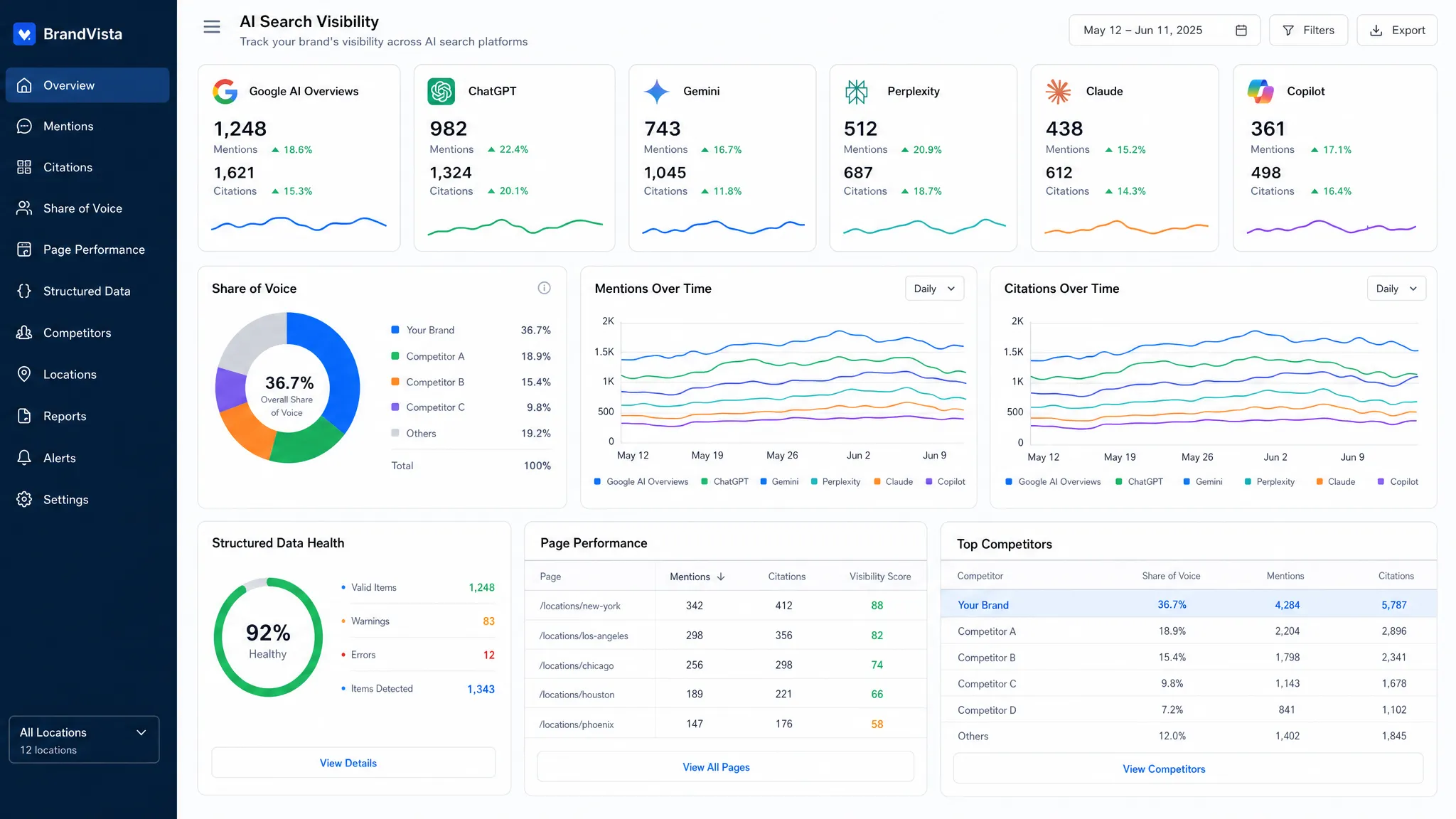
The mistake is looking only at organic sessions. Traffic can fall because rankings dropped, because AI Overviews reduced clicks, because competitors gained citations, because demand changed, or because the page still appears but no longer earns the click.
A stronger diagnosis compares Google search performance with AI answer visibility.
| Signal to compare | What it may indicate | Business effect |
|---|---|---|
| Ranking dropped and AI mentions dropped | Quality, relevance, technical, or trust issue | Fewer leads, bookings, or product sessions |
| Ranking stable but AI citations dropped | AI answer source mix changed | Competitors may shape buyer perception earlier |
| AI mentions exist but facts are wrong | Entity confusion or inconsistent data | Lost credibility and higher support friction |
| Competitor cited for your core query | Stronger answer-ready content or third-party validation | Lower share of voice in decision-stage searches |
| Impressions steady but CTR down | SERP features or AI Overviews absorbing clicks | Need to optimize for citations and conversion paths |
This is where GEO measurement becomes operational. Track a fixed set of prompts and queries every week or month. Include branded, non-branded, local, comparison, and problem-led prompts. Then measure brand mentions, citations, sentiment, accuracy, and competitor share of voice across Google AI Overviews, Gemini, ChatGPT, Perplexity, Claude, and Copilot.
The goal is not to chase every fluctuation. It is to identify repeatable blind spots. If five AI engines mention two competitors for “best managed IT provider for dental practices” and never mention your MSP, that is a content and entity problem worth fixing.
What to fix first after a Google update
A useful response to algorithm volatility is not panic publishing. It is a structured audit of visibility, evidence, and technical access.
Clarify your entities
AI systems need to know what each thing is. Your company, locations, products, services, authors, practitioners, amenities, and service areas should be clear and consistent.
For a franchise, that means each location page should connect to the parent brand while retaining unique local facts. For a hotel group, each property should have clean details for amenities, rooms, nearby landmarks, policies, and booking paths. For an e-commerce store, products should have stable names, attributes, categories, and identifiers.
Use Organization, LocalBusiness, Product, Breadcrumb, FAQPage, Review, and other relevant schema types where appropriate. Keep names, addresses, phone numbers, URLs, and social profiles consistent. Add sameAs references when they help confirm official profiles.
Build answer-ready pages
Answer-ready content is not shallow FAQ stuffing. It is content structured so a person and a machine can quickly understand the question, the answer, the evidence, and the next step.
Strong answer-ready pages usually include:
- A concise answer near the top of the relevant section
- Clear H2 and H3 headings that match user questions
- Specific details, numbers, constraints, and examples
- Internal links to related services, products, locations, or guides
- FAQs that address real objections and eligibility questions
- Visible update discipline for changing information like pricing, policies, hours, or availability
Internal linking is especially important. It tells search engines and AI systems how topics connect. A guide about pediatric urgent care should link naturally to relevant location pages. A WooCommerce buying guide should link to the product category and top product pages. An MSP cybersecurity article should connect to service pages, case studies, and compliance resources.
If your team is still optimizing primarily for traditional rankings, it is worth reviewing how search ranking is evolving beyond blue links so your content architecture matches how buyers now discover brands.
Repair crawlability and performance issues
Before rewriting content, confirm that important pages are accessible. Check robots.txt, XML sitemaps, canonicals, noindex tags, JavaScript rendering, redirects, pagination, parameter handling, and orphan pages.
Then look at performance. Slow templates, large images, unnecessary scripts, and unstable layouts can affect crawl efficiency and user conversion. For agencies and MSPs managing site fleets, template-level fixes can create the most leverage because one improvement applies across many pages.
This is also where llms.txt can fit. llms.txt is an emerging convention for pointing AI systems and tools toward preferred documentation or content paths. It is not a guaranteed ranking factor, and it should not replace robots.txt, schema, or sitemaps. Used carefully, it can make your most AI-useful content easier to identify.
Strengthen third-party corroboration
AI systems often rely on more than your website. Reviews, business directories, industry associations, press mentions, maps, marketplaces, and comparison sites can all reinforce or contradict your claims.
For local and travel brands, review consistency and directory accuracy matter. For MSPs, partner directories and certification pages can support credibility. For e-commerce brands, marketplace data, product reviews, and independent comparisons can influence which products AI systems recommend.
The practical question is simple: if an AI system tried to verify your claim from three sources, would those sources agree?
A monitoring model for SEO, GEO, and AEO teams
Google algorithm changes will continue. AI answer formats will also continue to shift. The durable response is a measurement system that connects visibility to fixes.
A useful model has four layers:
| Layer | What to measure | Why it matters |
|---|---|---|
| Classic SEO | Indexation, rankings, impressions, CTR, Core Web Vitals, crawl errors | Confirms whether Google can access and rank the site |
| AEO | Featured snippets, FAQ coverage, direct-answer quality, schema health | Shows whether pages are structured for answer extraction |
| GEO | AI mentions, citations, prompt coverage, accuracy, sentiment | Shows whether generative engines can see and reuse the brand |
| Competitive share | Rival mentions, citation share, category coverage, local overlap | Shows whether buyers are being routed toward competitors |
This should be tracked by journey stage. For example, a hotel group may monitor “family hotel near [destination],” “hotel with meeting rooms in [city],” and “best hotel for [event].” A healthcare franchise may monitor symptoms, service categories, insurance questions, and “near me” prompts. An MSP may monitor problem-led and comparison prompts such as “Microsoft 365 migration provider for law firms.”
The output should be a prioritized fix list, not a report that sits in a folder. If a high-value page is not cited because schema is missing, fix schema. If a competitor wins because their page answers pricing and eligibility questions, update the content. If AI systems confuse two locations, repair entity consistency.
What not to do after an update
Algorithm changes can create pressure to move fast. Moving fast is useful only when the direction is correct.
Avoid these common responses:
- Publishing large volumes of generic AI-written content without expert review
- Adding FAQ blocks that repeat keywords but do not answer real questions
- Removing useful pages only because traffic dipped for a short period
- Treating schema as a substitute for strong content
- Tracking rankings while ignoring AI mentions and citations
- Assuming one AI engine represents the whole market
A better rule is proof first, opinion second. Measure where visibility changed, identify the page or entity gap, then make the smallest fix that addresses the cause.
Frequently Asked Questions
Do Google algorithm changes directly affect ChatGPT, Claude, or Perplexity? Not directly in the same way they affect Google Search rankings. However, many AI assistants use web retrieval, citations, or search-derived sources, so the same crawlability, content quality, entity clarity, and third-party credibility signals often influence whether your brand appears.
Is ranking on page one enough for AI visibility? No. A page can rank well and still be absent from AI answers. AI visibility also depends on whether the page provides extractable answers, whether the brand is a clear entity, whether the information is corroborated, and whether competitors are stronger sources for the same prompt.
Does schema guarantee inclusion in AI Overviews or generative answers? No. Schema helps search engines and AI systems understand content, but it does not guarantee citations. It works best when paired with useful content, clean technical SEO, consistent entity data, internal linking, and credible external validation.
How often should brands monitor AI visibility after a Google update? For high-value categories, weekly or biweekly monitoring is reasonable during volatile periods. For stable categories, monthly tracking can be enough. The key is to use the same prompt set over time so you can detect changes in mentions, citations, accuracy, and share of voice.
Start with a free AI visibility audit
Google algorithm changes are now part of a larger visibility system. Your brand may be ranking, mentioned, cited, misrepresented, or invisible depending on the query and the AI engine.
CapstonAI helps teams measure and improve that presence across Google AI Overviews, ChatGPT, Gemini, Perplexity, Claude, Copilot, and other generative experiences. It scans AI visibility, tracks brand mentions and citations, monitors competitors, maps prompts to visibility gaps, and turns issues in content, schema, metadata, crawlability, llms.txt, and page structure into prioritized fixes.
If AI cannot see your business clearly, your prospects may see someone else first. Start with a free AI visibility audit from CapstonAI and identify where Google changes, AI answers, and technical gaps are affecting your growth.