ChatGPT Web Search has changed the practical meaning of SEO. A prospect can now ask for “best family hotels near San Diego with suites,” “HIPAA compliant physical therapy franchise software,” or “WooCommerce agencies for B2B catalogs,” then receive a synthesized answer with a short set of brands and sources.
For the brands named in that answer, the impact can be direct: qualified discovery, higher trust and fewer clicks lost to generic directories. For the brands left out, the issue is often not poor quality. It is that AI systems cannot confidently identify, verify or reuse the right evidence.
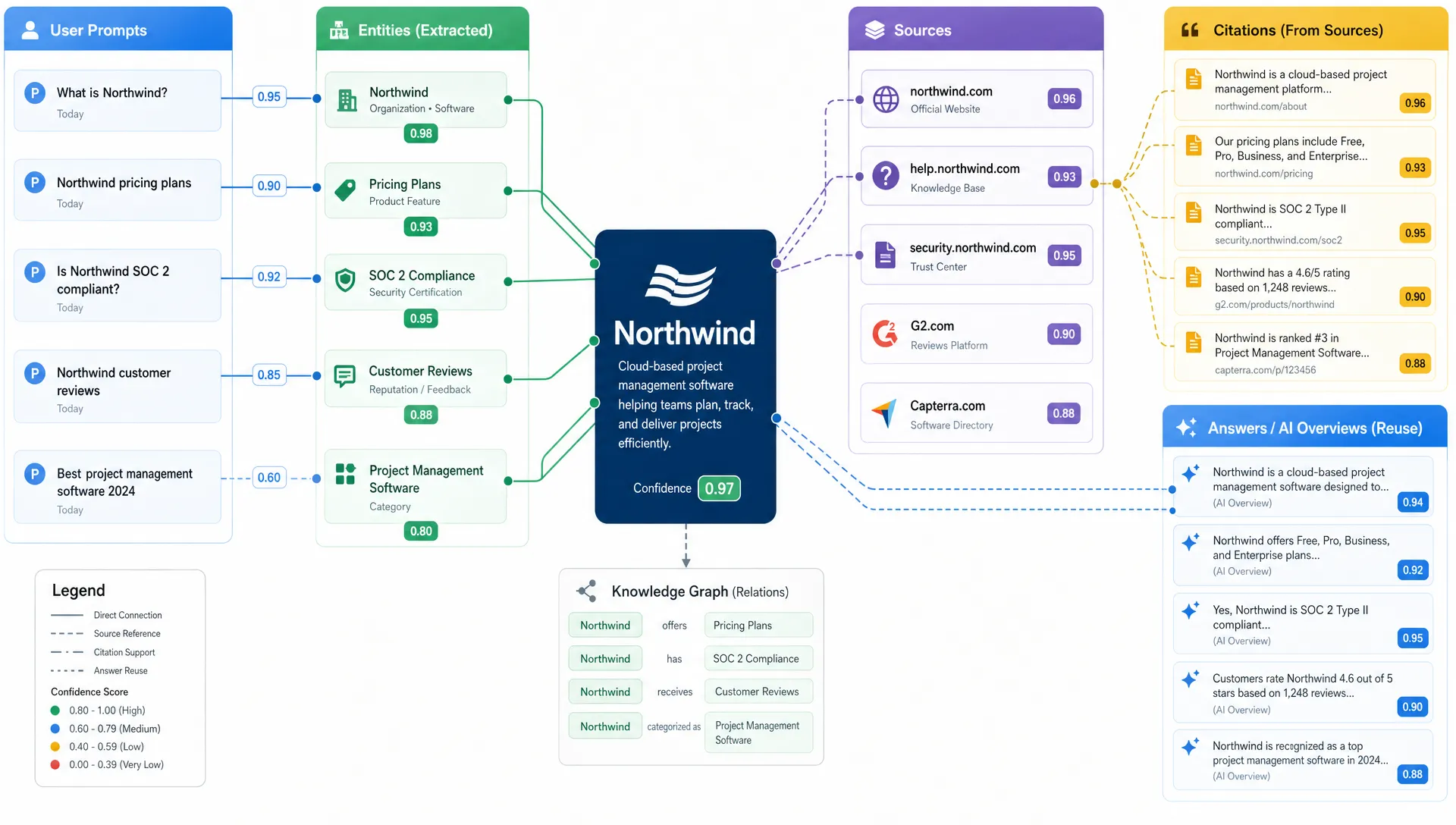
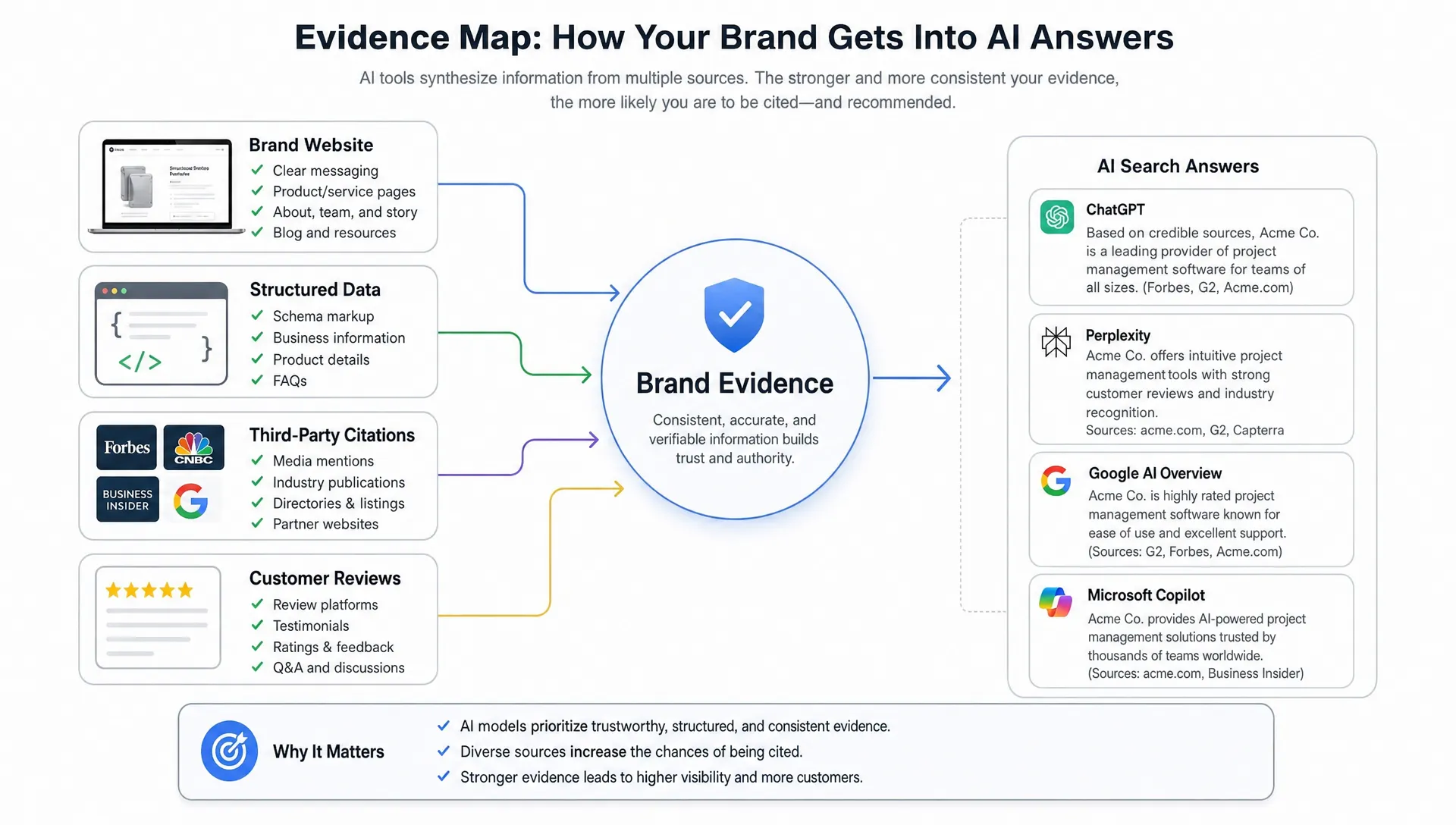
A credible brand citation in ChatGPT Web Search is earned when your business, page or third-party reference is useful enough to support an AI-generated answer. That requires more than ranking for a keyword. It requires entity clarity, crawlable evidence, answer-ready content, structured data, internal linking, citations from trusted sources and a way to measure whether the work actually changes AI visibility.
What counts as a credible citation in ChatGPT Web Search?
OpenAI describes ChatGPT search as a way for ChatGPT to provide timely answers with links to relevant web sources. In practice, citations appear in a few forms:
- A linked source used to support part of an answer
- A brand mention inside a recommendation or comparison
- A citation to a third-party page that mentions your brand
- A local, product or service reference pulled from structured information on the web
Those are not identical outcomes. A direct link to your booking page, category page or service page is usually more valuable than a generic brand mention. A third-party citation can still help, especially when the source is trusted and confirms what your own site says.
For a hotel group, a strong citation might point to a location page that clearly states amenities, policies, neighborhood relevance and current room types. For a healthcare franchise, it might cite a service page that answers eligibility, insurance and location questions without forcing users through several clicks. For an e-commerce store, it might cite a comparison page, product category or FAQ that explains fit, specs, returns and availability.
The business effect is simple: AI systems tend to cite what they can parse, verify and match to the user’s prompt. If your content is vague, blocked, duplicated or unsupported, ChatGPT has less reason to use it.
How ChatGPT Web Search appears to choose sources
No brand has access to the full source selection logic behind ChatGPT Web Search. The useful approach is to work from observable patterns across generative engines: ChatGPT, Google AI Overviews, Gemini, Perplexity, Claude and Copilot all favor sources that reduce uncertainty.
A page is more likely to become citation-worthy when it has:
| Signal | What it means | Business effect |
|---|---|---|
| Query fit | The page directly answers the prompt, not just the broad topic | More inclusion in commercial and informational answers |
| Entity clarity | The brand, locations, products and services are easy to identify | Fewer wrong associations and missed mentions |
| Crawlability | Search and AI systems can access the page content | Better odds of retrieval and citation |
| Structured data | Schema reinforces what the page is about | More machine-readable context for products, services, locations and FAQs |
| Independent corroboration | Other trusted pages confirm the same facts | Higher confidence in brand claims |
| Freshness | Dates, details and claims are maintained | Less risk that the system chooses a newer competitor source |
| Performance | Pages load fast and expose content cleanly | Better crawl efficiency and user experience |
If you want a deeper breakdown of source selection patterns across assistants, CapstonAI has a separate guide on how AI-driven search engines choose sources to cite. The key point for this article is narrower: credible citations come from reducing ambiguity at every layer.
Start with the prompts that matter to revenue
Many teams begin by optimizing pages. That is too early. First, define the prompts where a citation would matter.
A hotel chain does not only need to appear for its brand name. It needs visibility for prompts like “best hotels in Austin with meeting rooms,” “pet-friendly boutique hotels near downtown Nashville” or “family hotels with kitchenettes near Disney.” A franchise healthcare group may need prompts around symptoms, services, insurance, locations and comparisons. A WordPress agency may need visibility for WooCommerce performance, migration, Core Web Vitals or multisite support.
The goal is not to create hundreds of speculative prompts. Start with 30 to 50 prompts grouped by intent:
- Discovery prompts, where the user asks for options
- Comparison prompts, where the user evaluates providers
- Local prompts, where geography changes the answer
- Problem prompts, where the user describes a need
- Branded prompts, where the user asks about your company directly
Then measure what ChatGPT Web Search returns. Capture whether your brand is mentioned, whether it is cited, which page is cited, which competitors appear and what evidence the answer relies on.
That baseline matters because AI visibility is not binary. A brand can rank well in Google and still be absent from ChatGPT answers. Another brand can appear often but only through low-value third-party summaries. Measurement tells you whether the issue is visibility, citation quality, message accuracy or competitor share of voice.
CapstonAI’s article on how to track brand mentions in ChatGPT explains the measurement layer in more detail, including mention tracking, citation rate and competitor share.
Build pages that answer before they persuade
Traditional marketing pages often lead with positioning. AI citation pages need to lead with useful facts.
That does not mean stripping out brand voice. It means making the answer obvious. If a page is about “same-day appliance repair in Phoenix,” the page should state who provides the service, where it is available, what appliances are covered, what same-day means, how to book and what proof supports the claim.
The same principle applies across industries:
| Business type | Citation-worthy page elements |
|---|---|
| Hotels and travel groups | Room types, amenities, neighborhood context, transportation, policies, accessibility and FAQs |
| Multi-site healthcare | Services, accepted insurance guidance, practitioner credentials, appointment steps, locations and patient FAQs |
| Retail franchises | Store locations, inventory categories, services, hours, reviews and local differentiators |
| IT providers and MSPs | Service scope, supported platforms, response model, compliance experience, case studies and geographic coverage |
| WooCommerce stores | Product specs, use cases, compatibility, return policy, shipping details, reviews and comparison content |
| Agencies | Capabilities, CMS experience, performance results, case studies, team expertise and process explanations |
A useful test: if someone pasted your page into ChatGPT and asked “what does this company do, who is it for and why should I trust it?” the answer should be accurate without needing background knowledge.
Make your entity unmistakable
Generative engines rely on entities, meaning recognizable people, places, organizations, products, services and relationships. If your entity signals are inconsistent, AI systems may miss you or merge you with a similar name.
Brand entity clarity starts with the basics: consistent name, logo, location, service descriptions, social profiles and organization details across your website and authoritative profiles. For multi-location brands, each location should have its own clean entity footprint, not a duplicated page with only a city name swapped in.
A hotel location page, for example, should connect the property to the parent brand, address, nearby landmarks, amenities and booking journey. A clinic page should connect the local office to the healthcare brand, providers, services and patient journey. An agency page should connect capabilities to named case studies, technologies and vertical expertise.
Structured data helps here. Organization, LocalBusiness, Product, Service, FAQPage, BreadcrumbList and Review schema can clarify the page’s meaning when implemented accurately. Schema is not a shortcut to citations, but it gives AI and search systems a cleaner map of your site.
The same principle applies to the broader web. A B2B company working with software, logistics or operational AI partners should make those relationships visible through clear case studies and partner references. For example, a company that relies on operational AI and software development on EU servers would want its public project evidence to state the region, service type and production context clearly, because those details help AI systems understand why the reference is relevant.
Strengthen crawlability, speed and technical SEO
ChatGPT Web Search is not a replacement for technical SEO. It increases the penalty for weak technical foundations.
If a page cannot be crawled, renders important content only after complex JavaScript, hides key answers behind tabs that bots cannot parse or loads slowly, it is harder for any search or AI system to retrieve confidently. That affects Google AI Overviews, Gemini, Perplexity, Copilot and ChatGPT.
Focus on the technical elements that directly affect discovery and reuse:
- Keep important content in crawlable HTML
- Use descriptive title tags and meta descriptions that match the page intent
- Maintain clean canonical tags, XML sitemaps and robots.txt rules
- Add accurate schema, then validate it after deployment
- Fix broken internal links and redirect chains
- Improve Core Web Vitals where templates are slow or unstable
- Ensure location, product and service pages are not thin duplicates
For WordPress and WooCommerce teams, template-level fixes often have the largest effect. One schema improvement, breadcrumb pattern or internal linking component can improve hundreds of pages when implemented cleanly.
This is where GEO, AEO and classic SEO overlap. Generative Engine Optimization focuses on being selected and cited by AI systems. Answer Engine Optimization focuses on providing direct answers that engines can reuse. Technical SEO ensures those answers can be crawled, understood and trusted.
Use internal links to create evidence paths
Internal linking is not just a ranking tactic. It teaches relationships.
A strong internal link structure helps ChatGPT Web Search and other systems understand which pages support which claims. If your “enterprise WooCommerce development” page links naturally to performance case studies, migration guides, platform pages and team expertise, the service claim is easier to verify. If a hotel’s “meetings and events” page links to room layouts, catering, nearby airport information and local venue pages, the page becomes more useful for detailed prompts.
The anchor text matters. Avoid generic anchors like “learn more” when a descriptive phrase fits naturally. A sentence such as “Our Chicago physical therapy locations offer sports injury rehabilitation” gives clearer context than “Click here for locations.”
For multi-site brands, internal links should connect three layers:
- Brand-level pages that define the organization and core services
- Category or service pages that explain what you offer
- Local pages that prove where and how the service is delivered
This structure improves user navigation, crawl paths and AI comprehension at the same time.
Earn corroboration beyond your own site
ChatGPT Web Search does not have to cite your website to mention your brand. Sometimes it cites a directory, review site, news article, partner page, marketplace listing or professional profile. That can help or hurt depending on accuracy.
Strong third-party corroboration usually includes:
- Industry directories with complete profiles and correct categories
- Review platforms with consistent brand and location data
- Partner pages that describe the relationship precisely
- Case studies with named outcomes and real context
- Local business listings with accurate NAP data, meaning name, address and phone
- Press or trade coverage that explains why the brand is relevant
Do not chase random backlinks for AI visibility. A generic link from an unrelated site rarely helps a model understand your business. The better question is: would this source help a careful buyer verify that we are a credible option?
For agencies and MSPs, partner ecosystems can be especially important. Platform directories, certified partner pages and published implementation examples often carry clearer trust signals than a vague homepage claim. For hotels and retail locations, local tourism boards, maps, review platforms and event listings can provide context that your own site cannot fully establish on its own.
Add AI-ready FAQs without creating thin content
FAQs work well for AEO because they mirror how users ask questions. They also help AI systems extract concise answers from a page.
The problem is that many FAQ sections are generic. “Why choose us?” is rarely useful. “Do you offer airport shuttle service at your Denver hotel?” or “Does this clinic accept same-day appointments for back pain?” is much stronger because the answer is specific, factual and tied to business intent.
A good FAQ answer should be short, accurate and supported by the page around it. If the answer depends on policy, location or inventory, state the condition clearly. Do not use FAQ schema to mark up promotional copy or content that is not visible on the page.
Examples of AI-ready FAQ patterns include:
| Prompt type | Better FAQ angle |
|---|---|
| Local service | “Which neighborhoods do you serve?” |
| Booking or lead | “How do I schedule an appointment?” |
| Product fit | “Which model works for commercial use?” |
| Comparison | “How is this different from the standard plan?” |
| Trust | “What certifications or compliance standards apply?” |
The best FAQs reduce friction for both the buyer and the machine reading the page.
Treat llms.txt as a useful supplement, not a magic file
The llms.txt file is an emerging convention that gives AI systems a plain-text guide to important site content. It can point models toward key pages, documentation, policies and summaries.
It is not a formal replacement for robots.txt, XML sitemaps, schema or good internal linking. Not every AI crawler supports it and support may change over time. Still, for content-heavy sites, SaaS companies, agencies and multi-location brands, llms.txt can be useful as a discovery layer when it is kept accurate.
A practical llms.txt should highlight your most authoritative pages, not every URL on the site. Include pages that define your brand, services, products, locations, documentation, case studies and support policies. If the file becomes stale, it can reinforce outdated signals, so assign ownership the same way you would for sitemaps and schema.
Measure citation quality, not just presence
A brand mention is not always a win. ChatGPT may mention your company but describe it incorrectly, cite an outdated profile or position you below competitors for the wrong reason. Measurement should capture quality.
Track these metrics over time:
| Metric | What to measure | Why it matters |
|---|---|---|
| Mention rate | How often your brand appears for target prompts | Baseline AI visibility |
| Citation rate | How often ChatGPT links to your site or trusted sources about you | Evidence strength |
| Share of voice | How often you appear compared with competitors | Market position in AI answers |
| Citation quality | Whether the cited page is accurate, current and conversion-relevant | Lead and booking value |
| Message accuracy | Whether the answer describes your offer correctly | Brand trust |
| Prompt coverage | Which intent groups surface you or exclude you | Content and technical prioritization |
This is where before and after testing matters. If you improve schema, rewrite service pages or fix crawlability, rerun the same prompt set. Look for changes in mentions, citations, competitor order and answer accuracy.
A useful cadence for most brands is monthly tracking for stable categories and weekly tracking during major launches, migrations or content updates. Agencies managing site fleets may need automated alerts when a high-value brand disappears from AI answers or when a competitor gains share across priority prompts.
A practical 30-day plan to earn better citations
You do not need to rebuild your entire website to improve ChatGPT Web Search visibility. Start with the pages and prompts that already matter to revenue.
| Timeframe | Action | Output |
|---|---|---|
| Days 1 to 3 | Define 30 to 50 prompts by intent, location, product or service | AI visibility baseline |
| Days 4 to 7 | Audit citations, competitor mentions and source quality | Gap list by prompt group |
| Days 8 to 14 | Fix crawlability, titles, metadata, schema and internal links on priority pages | Cleaner technical foundation |
| Days 15 to 21 | Rewrite pages to answer buyer questions directly and add specific FAQs | More citation-ready content |
| Days 22 to 26 | Update third-party profiles, directories and partner references | Stronger corroboration |
| Days 27 to 30 | Rerun prompts and compare mention rate, citation rate and share of voice | Before and after evidence |
For broader strategy, CapstonAI’s guide on how to rank in ChatGPT covers complementary tactics such as authority building, prompt mapping and structured content improvements.
Common mistakes that prevent brand citations
The most common issue is not that a brand lacks content. It is that the content does not make a clear claim that AI systems can verify.
A location page with 200 words and no unique local detail is weak evidence. A product category that lists items but does not explain use cases, compatibility or buying criteria is hard to cite. A service page that says “custom solutions for modern businesses” without naming industries, deliverables or proof gives ChatGPT very little to reuse.
Other frequent problems include inconsistent brand names, outdated third-party profiles, blocked crawlers, missing schema, duplicate pages across locations, weak internal links and JavaScript-rendered content that hides key answers. For e-commerce sites, thin product descriptions and missing policy details can keep pages out of comparison-style answers. For agencies, case studies without concrete scope, platform context or client category may fail to support expertise claims.
The fix is usually practical: clarify the entity, expose the facts, support claims with evidence and measure whether citations improve.
Frequently Asked Questions
How do you get cited in ChatGPT Web Search? Create crawlable, specific pages that answer real prompts, add accurate structured data, strengthen internal links and build corroboration from trusted third-party sources. Then track whether ChatGPT actually mentions or cites you for target prompts.
Does schema guarantee ChatGPT citations? No. Schema helps machines understand your content, but it does not guarantee inclusion. It works best when the visible page content, internal links and external references all support the same facts.
Is ChatGPT Web Search optimization different from SEO? It overlaps with SEO but is not identical. Classic SEO improves crawlability, relevance and performance. GEO and AEO add a focus on entity clarity, answer extraction, citation quality and share of voice inside generated answers.
Should every business create an llms.txt file? Not every business needs one immediately. It can help content-rich sites and multi-location brands point AI systems toward authoritative pages, but it should supplement sitemaps, schema and internal linking rather than replace them.
How long does it take to improve AI visibility? It depends on crawl frequency, competition, technical issues and the strength of your existing authority. The best approach is to establish a prompt baseline, make targeted fixes and compare results on a consistent schedule.
Start with a free AI visibility audit
If ChatGPT Web Search cannot identify the right evidence about your business, it may recommend a competitor with clearer signals. The first step is not more content. It is measurement.
Start with a free AI visibility audit from CapstonAI to see how ChatGPT, Gemini, Claude, Perplexity, Copilot and Google AI Overviews mention your brand, which competitors appear for your priority prompts and which pages need technical or content fixes.
AI can only cite what it can understand and trust. CapstonAI helps make your business visible, measurable and easier for generative engines to use accurately.