Microsoft AI Search is not one search box. For B2B brands, it is the set of AI-assisted discovery surfaces across Bing, Copilot, Edge and Microsoft-connected search experiences that help buyers ask questions, compare vendors and shortlist options without opening ten blue links.
That shift changes the job of SEO. Ranking still matters, but AI visibility now depends on whether generative engines can identify your brand as a credible entity, connect it to the right services and cite trustworthy pages when buyers ask high-intent questions.
This guide explains how to make the Microsoft AI search engine work harder for your brand without abandoning the fundamentals that still drive traffic, leads and bookings.
What Microsoft AI Search Means in Practice
Microsoft AI Search usually refers to AI-powered search and answer experiences built around Bing and Copilot. In practical marketing terms, it includes:
- Bing search results with AI-enhanced summaries and answer formats
- Microsoft Copilot responses that may use web retrieval for current information
- Edge and Windows search experiences where Copilot can influence discovery
- Bing-connected brand, local and entity signals that help shape answer confidence
For brand teams, the important point is simple: AI answers are assembled from signals. Those signals include crawlable web pages, structured data, brand mentions, citations, reviews, third-party references, internal links and content clarity.
If those signals are inconsistent, thin or blocked, AI systems may skip your brand, describe it incorrectly or cite a competitor instead.
For a deeper look at the Microsoft-specific layer, CapstonAI has a separate guide on how Microsoft Bing AI influences brand mentions. This article focuses on the broader operating playbook for B2B teams.
Why B2B Brands Need a Different AI Search Playbook
B2B discovery is rarely one query followed by one click. A buyer may ask Copilot for a shortlist, check pricing pages through Bing, compare vendors in ChatGPT, validate claims in Perplexity and return to Google AI Overviews before booking a demo.
That means your goal is not only to rank. Your goal is to be understood, mentioned and cited across the questions that shape a buying decision.
A hotel group, for example, does not only want visibility for its brand name. It wants to appear for corporate travel, event space, extended stays, airport proximity and city-specific needs. An MSP does not only want to show up for managed IT services. It wants to be associated with healthcare compliance, Microsoft 365 support, cybersecurity response, endpoint management and local service coverage.
The same applies to healthcare, education, retail and e-commerce brands. A clinic offering comprehensive psychiatric services in NYC gives AI systems clearer service, location and specialty context when its pages explain conditions treated, care models, provider credentials and appointment pathways in crawlable language.
The business impact is concrete. When AI search answers include your brand with an accurate citation, you gain a new path into evaluation. When they omit you, the buyer may never reach your website.
Start With a Visibility Baseline
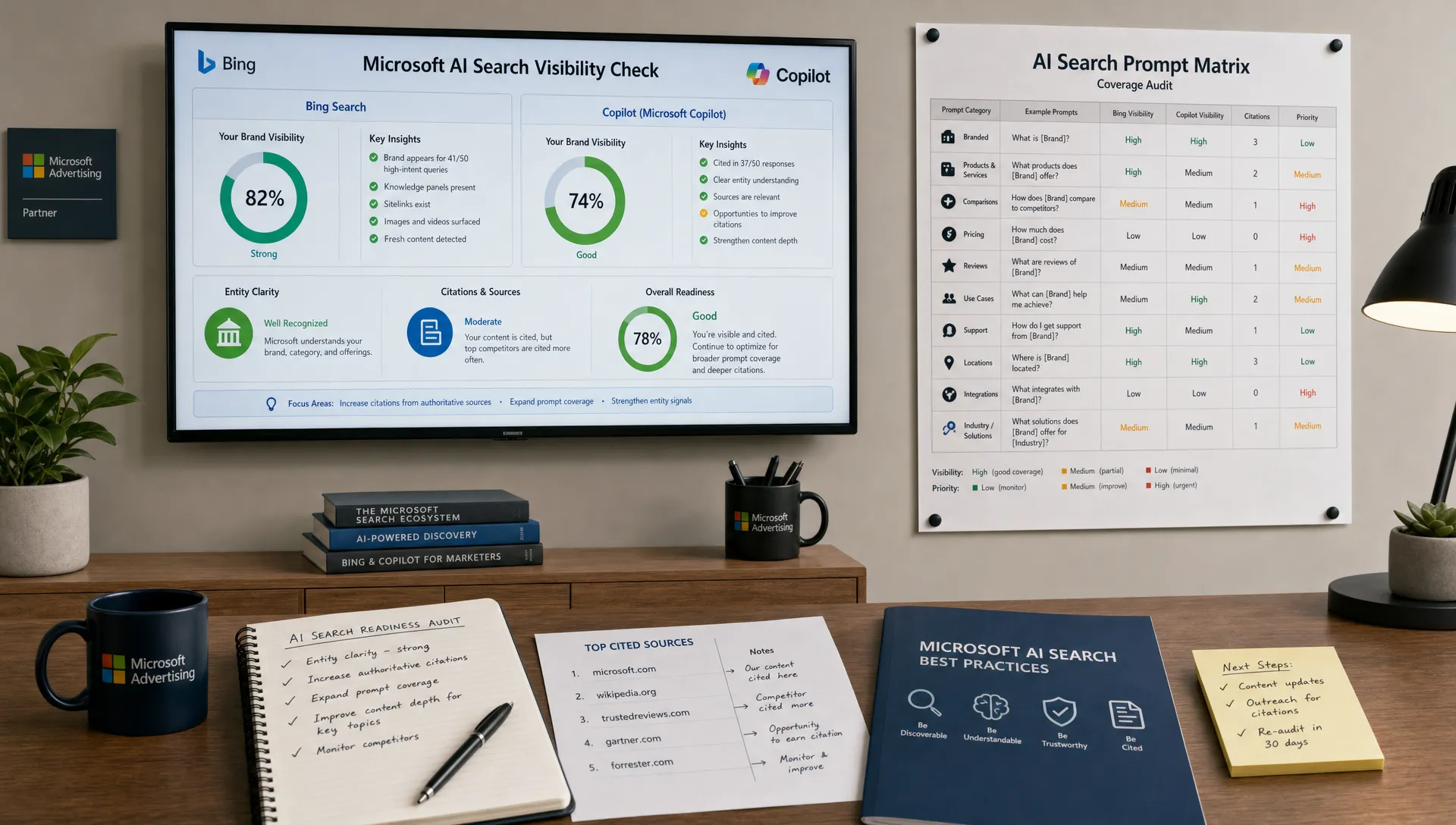
Before changing content or schema, measure how Microsoft AI Search currently sees your brand. A useful baseline tracks the prompts your buyers ask, the answers AI systems provide and the sources they cite.
Do this across Microsoft surfaces, then compare the same prompt set in ChatGPT, Google AI Overviews, Gemini, Perplexity and Claude. The goal is not to chase every model. It is to find repeatable gaps.
A practical prompt set should include four categories:
| Prompt category | Example prompt | What it reveals |
|---|---|---|
| Brand prompts | What does [brand] do? | Whether AI understands your core entity |
| Category prompts | Best managed IT provider for healthcare practices | Whether you appear in non-branded discovery |
| Comparison prompts | [Brand] vs [competitor] for mid-market e-commerce | Whether your positioning is clear |
| Location prompts | Corporate hotel group near [city] with meeting space | Whether location and service pages are usable |
Record each result in a simple matrix. For every prompt, note whether your brand is mentioned, whether it is cited, which page is cited and which competitors appear. This gives you a share-of-voice view, meaning how often your brand appears compared with rivals across the prompt set that matters.
A baseline also separates perception issues from technical issues. If AI answers describe your company incorrectly, you may have an entity clarity problem. If they understand your company but never cite your pages, you may have a content depth, authority or crawlability problem.
Make Your Brand Easier for Microsoft AI Search to Understand
Generative engines work better when your brand is a clear entity. An entity is a distinct thing the system can recognize and connect to attributes, such as company name, services, locations, people, products, certifications and market categories.
Start with the pages closest to your commercial value:
- Homepage and about page
- Service, product and industry pages
- Location pages for multi-site brands
- Pricing, demo or booking pages where appropriate
- Case studies, proof pages and customer stories
- FAQ pages that answer real buyer objections
Each page should make the basics explicit. Do not assume AI systems will infer what you do from slogans. State who you serve, what problems you solve, where you operate and what makes the offer credible.
For structured data, use schema that matches the page rather than adding markup for its own sake. Organization schema helps clarify the business entity. LocalBusiness schema can support location-based brands. Product, Service, FAQPage, BreadcrumbList and Article schema can help when used accurately.
The business effect is not abstract. Cleaner entity signals reduce misclassification, improve the odds of accurate brand mentions and make it easier for AI systems to cite the right page instead of a generic directory or outdated third-party listing.
Build Answer-Ready Pages, Not Just Ranking Pages
Traditional SEO pages often target a keyword and build around it. Answer Engine Optimization, or AEO, asks a slightly different question: can this page answer the exact questions a buyer would ask an AI assistant?
Generative Engine Optimization, or GEO, goes one step further. It focuses on making content easy for generative engines to retrieve, summarize and reuse with confidence.
For Microsoft AI Search, answer-ready pages usually have a few traits:
- A clear opening answer in the first few paragraphs
- Specific service, product or industry context
- Evidence such as examples, named integrations, certifications or case studies
- FAQ sections that address qualification and buying questions
- Internal links to deeper supporting pages
- Updated metadata that accurately summarizes the page
Avoid burying the answer under broad brand language. If a buyer asks Copilot for the best WooCommerce performance agency for a site with slow checkout, a page that clearly explains WooCommerce performance work, checkout optimization, hosting constraints, measurement and outcomes has a better chance than a generic digital services page.
The same logic applies to B2B travel, healthcare groups, franchise brands and MSPs. AI answers need facts that can be extracted, not just polished copy.

Technical SEO Still Does the Heavy Lifting
AI search is not a replacement for technical SEO. It depends on it.
If Microsoft cannot crawl, render or interpret your pages reliably, Copilot and Bing-connected experiences have less useful material to work with. The same is true for other generative engines that retrieve from the open web.
Focus on the technical items that affect both machines and buyers:
| Technical area | What to check | Business effect |
|---|---|---|
| Crawlability | Robots.txt, XML sitemaps, canonicals and blocked resources | Important pages can be discovered and refreshed |
| Page performance | Core Web Vitals, image weight and server response times | Faster pages improve user experience and conversion paths |
| Structured data | Schema accuracy, validation and page relevance | AI and search systems get clearer entity context |
| Internal linking | Links from hubs to services, locations and proof pages | Authority and context flow to revenue pages |
| Metadata | Titles, descriptions, headings and Open Graph data | AI systems and search results get cleaner summaries |
| llms.txt | A concise file pointing AI systems toward useful resources | Helps declare important content, without guaranteeing inclusion |
Treat llms.txt as an emerging discovery aid, not a magic ranking lever. It can help make key resources visible to AI crawlers and assistants, especially when paired with strong sitemaps, schema and internal linking.
For WordPress and WooCommerce teams, technical debt often hides in plugins, duplicate templates, slow product pages, faceted navigation and thin category content. For multi-location brands, the risks are usually inconsistent location data, duplicated page copy, missing schema and weak links between brand, service and location pages.
If you need a broader diagnostic process, use CapstonAI's AI Search Readiness Checklist for Brand Teams to structure the audit before you start editing pages.
Measure Share of Voice, Citations and Corrections
Microsoft AI Search optimization should be measured like a search channel, not like a one-time content project.
Track three layers:
| Metric | What it means | What to do with it |
|---|---|---|
| Brand mentions | Your brand appears in an AI answer | Check whether the description is accurate |
| Citations | The answer names or links to a source about your brand | Improve the cited page or strengthen better source pages |
| AI share of voice | Your visibility compared with competitors across prompts | Prioritize prompt clusters where buyers are active |
Corrections matter too. AI systems can surface stale locations, outdated product descriptions, wrong service areas or unsupported claims. Monitor those issues and fix the source of confusion. Sometimes that source is your own website. Sometimes it is an old directory, partner page or review profile.
CapstonAI is built around this measurement-first approach: scan multiple engines and assistants, map which prompts surface your brand or rivals, track mentions and citations, then prioritize content and technical fixes. That matters because AI visibility is hard to improve if you cannot see the before-and-after pattern.
A 30-Day Microsoft AI Search Action Plan
You do not need to rebuild your whole site to get started. A focused 30-day plan can expose the highest-value gaps.
| Timeframe | Action | Output |
|---|---|---|
| Days 1 to 5 | Build a prompt set across brand, category, comparison and location questions | A baseline of mentions, citations and competitors |
| Days 6 to 10 | Audit entity consistency across website, schema, profiles and key third-party listings | A list of conflicting or missing brand signals |
| Days 11 to 18 | Improve 3 to 5 revenue pages with clearer answers, proof, FAQs and internal links | More extractable content for AI answers |
| Days 19 to 24 | Fix crawlability, metadata, schema and page performance issues on priority pages | Stronger technical foundations |
| Days 25 to 30 | Rescan prompts in Microsoft AI Search and other generative engines | A before-and-after visibility report |
For agencies and in-house teams, repeat this cycle by segment: one product line, one market, one location cluster or one buyer journey at a time. That keeps the work tied to commercial outcomes instead of turning AI search into another vague content initiative.
Common Mistakes to Avoid
The most common mistake is treating Microsoft AI Search as a separate discipline from SEO. It is better to think of it as an expanded search surface. The same fundamentals still matter, but the outputs are different: summaries, recommendations, citations and conversational comparisons.
A second mistake is optimizing only for branded prompts. Branded prompts tell you whether AI understands your company. Non-branded prompts tell you whether buyers can discover you before they know your name.
A third mistake is publishing generic AI-generated FAQs that do not match real buyer questions. A useful FAQ answers operational and commercial concerns: implementation time, service area, integrations, compliance needs, booking process, support model, warranty, returns or proof of experience.
Finally, do not assume visibility in one engine means visibility everywhere. Copilot, ChatGPT, Google AI Overviews, Gemini, Perplexity and Claude can all cite different sources. Their answer styles and retrieval patterns vary, so cross-engine monitoring gives a more realistic view of market presence.
Frequently Asked Questions
Is Microsoft AI Search the same as Bing? Not exactly. Bing is a core part of Microsoft's search ecosystem, but Microsoft AI Search also includes AI-assisted experiences such as Copilot and search features in Microsoft-connected environments. For marketers, the key is how these systems retrieve, summarize and cite web information.
How is GEO different from classic SEO? Classic SEO focuses on crawlability, rankings, snippets and organic clicks. GEO focuses on how generative engines understand, mention and cite your brand in AI-generated answers. The strongest programs combine both.
What is the difference between a brand mention and a citation? A brand mention means your company appears in the AI answer. A citation means the answer references a source, often a page, profile or publication. Citations are especially useful because they show what the AI system used to support the answer.
Does schema guarantee better AI visibility? No. Schema helps clarify entities, services, products, locations and page meaning, but it does not guarantee inclusion in AI answers. It works best with crawlable pages, useful content, strong internal linking and credible third-party references.
Should B2B brands optimize only for Microsoft AI Search? No. Microsoft matters because Bing and Copilot influence discovery, but buyers use multiple generative engines. Track Microsoft alongside ChatGPT, Google AI Overviews, Gemini, Perplexity and Claude so you can see where your brand is visible, missing or misrepresented.
Start With a Free AI Visibility Audit
The practical next step is measurement. Before rewriting pages or adding schema everywhere, find out how AI systems currently describe your brand, which prompts surface competitors and which citations shape the answer.
CapstonAI helps B2B brands, agencies and multi-site teams track AI visibility, diagnose blind spots and publish AI-ready metadata, FAQ, schema and llms.txt improvements. If AI cannot see your business, CapstonAI helps make it visible.
Start with a free AI visibility audit and use the results to prioritize the Microsoft AI Search fixes most likely to affect discovery, credibility and qualified demand.