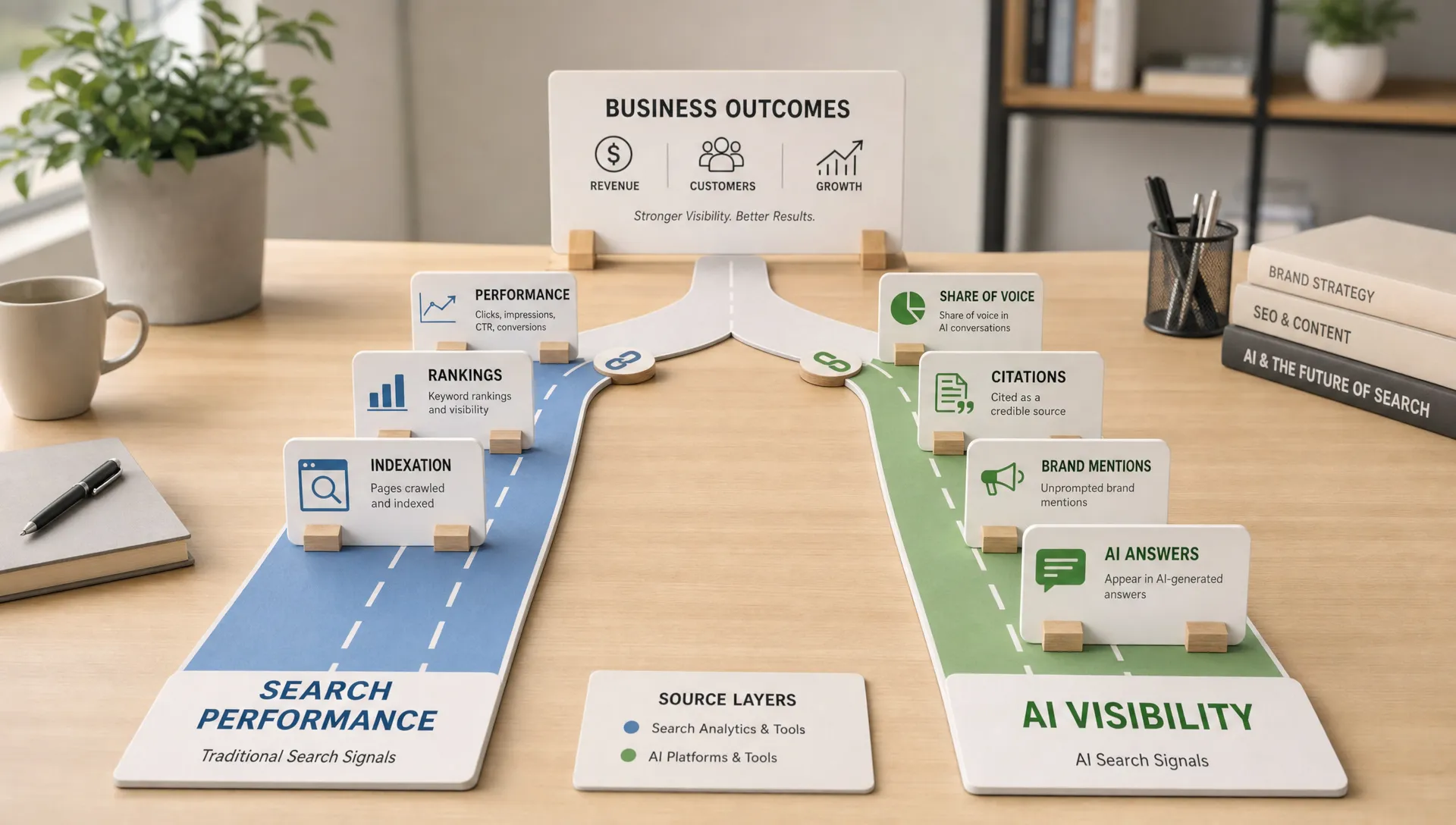
A website visibility checker is still useful. It can tell you whether Google can crawl your pages, whether your rankings moved and whether your site is technically slowing users down. For SEO teams, agencies and multi-location brands, that baseline matters.
It just does not tell the full story anymore.
Search behavior is moving into AI answers, where ChatGPT, Google AI Overviews, Gemini, Perplexity, Claude and Copilot summarize options before a buyer ever clicks a blue link. A classic checker might show that your hotel, clinic, retail location or WooCommerce store is indexed and ranking. It may not show that an AI assistant recommends three competitors and never mentions you.
That is the gap this article addresses: what a website visibility checker can measure, what it misses in AI search and how to build a visibility audit that connects technical SEO with GEO, AEO and business outcomes.
What a website visibility checker usually gets right
Most visibility checkers are built around classic search. They look at whether your pages can be found, crawled, indexed and ranked in search engines. Those signals are still the foundation. If a page is blocked by robots.txt, hidden behind poor internal linking or too slow to load reliably, AI systems that depend on web content may also struggle to use it.
A good checker may help you answer questions like:
- Are important pages indexed in Google?
- Which keywords generate impressions and clicks?
- Which pages have title tag, meta description or heading issues?
- Are Core Web Vitals or mobile performance limiting conversions?
- Is schema markup present and valid?
- Are broken links or redirect chains wasting crawl signals?
For a travel group, this might reveal that a “pet-friendly hotel near downtown Nashville” page is live but not indexed. For a franchise healthcare brand, it might show that 40 location pages use duplicate titles. For an agency managing a site fleet, it might surface a WordPress template issue affecting hundreds of pages.
Those are fixable problems with clear business effects. Better crawlability improves the chance that search engines can access priority pages. Clear metadata can improve click-through rate. Faster pages reduce friction for bookings, form fills and purchases.
If you need a broader process for the traditional and AI sides of the audit, CapstonAI has a separate guide on how to check site visibility across Google and AI engines. The key point here is narrower: a checker can validate your website, but AI search visibility depends on how generative systems interpret, cite and reuse your brand across many prompts.
Where AI search changes the measurement problem
Generative engines do not behave like a rank tracker. They assemble an answer from many signals, including web pages, structured data, known entities, citations, third-party mentions and the wording of the user’s prompt. The answer may include your brand, cite your page, summarize your services or omit you entirely.
That creates several new measurement layers.
GEO, or Generative Engine Optimization, is the work of making your content clear, trustworthy and reusable by AI systems. It focuses on entity clarity, source quality, answer-ready content and citation strength.
AEO, or Answer Engine Optimization, is the work of formatting content so direct questions can be answered accurately. FAQs, concise definitions, comparison sections, schema and clear service pages all support AEO.
Classic technical SEO still matters because AI systems need accessible source material. GEO and AEO build on that foundation. They do not replace crawlability, internal linking, structured data or page performance.
The business issue is simple. If a buyer asks an AI assistant, “best boutique hotel near the convention center with parking,” “top managed IT provider for dental offices” or “personal injury lawyer in Tampa for a truck accident,” the answer may shape the shortlist. A local legal site such as Personal Injury Lawyers of Tampa needs more than indexation. It needs clear practice area entities, local relevance, trustworthy citations and pages that answer the questions AI systems are likely to summarize.
A standard website visibility checker will not reliably show whether that kind of prompt returns your brand, a competitor or an outdated description of your services.
The AI search gaps a standard checker usually misses
A traditional checker can tell you what is happening on your site and in search results. AI visibility requires checking what happens inside the generated answer.
| AI search gap | What a website visibility checker may show | What you still need to measure | Business effect |
|---|---|---|---|
| Prompt-level absence | Page is indexed and technically healthy | Whether ChatGPT, Gemini, Claude, Perplexity, Copilot or Google AI Overviews mention the brand for high-intent prompts | Lost consideration before the buyer reaches your site |
| Citation weakness | Backlinks, schema or page status | Whether AI answers cite your pages or cite competitors and directories instead | Lower trust and fewer qualified visits |
| Share of voice | Keyword rankings for tracked terms | How often your brand appears compared with rivals across prompt clusters | Weak category presence in AI-assisted research |
| Entity confusion | Metadata and on-page content | Whether AI systems understand your brand, locations, services, products and relationships | Wrong descriptions, missed locations or irrelevant recommendations |
| Content reuse gaps | Page titles, headings and duplicate content | Whether page sections are structured as clear, quotable answers | Lower chance of being summarized accurately |
| Source freshness issues | Last crawl, status codes and performance | Whether AI answers reflect current offers, locations, services or inventory | Mismatched expectations and credibility loss |
Consider a simplified audit example. A 25-location healthcare brand tracks 50 high-intent prompts across Google AI Overviews, ChatGPT and Perplexity. Its pages are indexed and several location pages rank on page one in Google. Yet across 150 AI answer checks, the brand appears in 18 answers, one regional competitor appears in 61 and large directories are cited in 94.
The checker says the site is visible. The AI audit says the brand is underrepresented where prospects are asking for recommendations.
That difference matters for hotels, clinics, schools, retailers, MSPs and e-commerce brands because AI answers often compress the research journey. A prospect may not run ten separate searches. They may ask one assistant for a shortlist and act from there.
Why rank alone is not the same as AI visibility
Rank tracking is page-first. AI visibility is answer-first.
A page can rank well and still be absent from an AI answer if the system prefers another source, lacks confidence in your entity, finds your content too vague or cannot connect your page to the user’s exact intent. This is why website rank alone misses an AI visibility problem for many brands.
AI answers also vary by prompt wording. “Best family resort in Scottsdale” may produce a different set of brands than “Scottsdale hotel with kids club and suite rooms.” “Managed IT services for law firms” may surface different providers than “MSP with Microsoft 365 support for small legal practices.” A classic checker may group these under one keyword theme. AI systems treat the details as context.
For multi-location and franchise brands, this becomes more complex. AI systems must understand that each location belongs to the same brand, serves a specific area and offers specific services. If location pages are thin, inconsistent or isolated from the main site architecture, the model may rely on directories, review platforms or competitors instead.
The signals AI visibility audits need to add
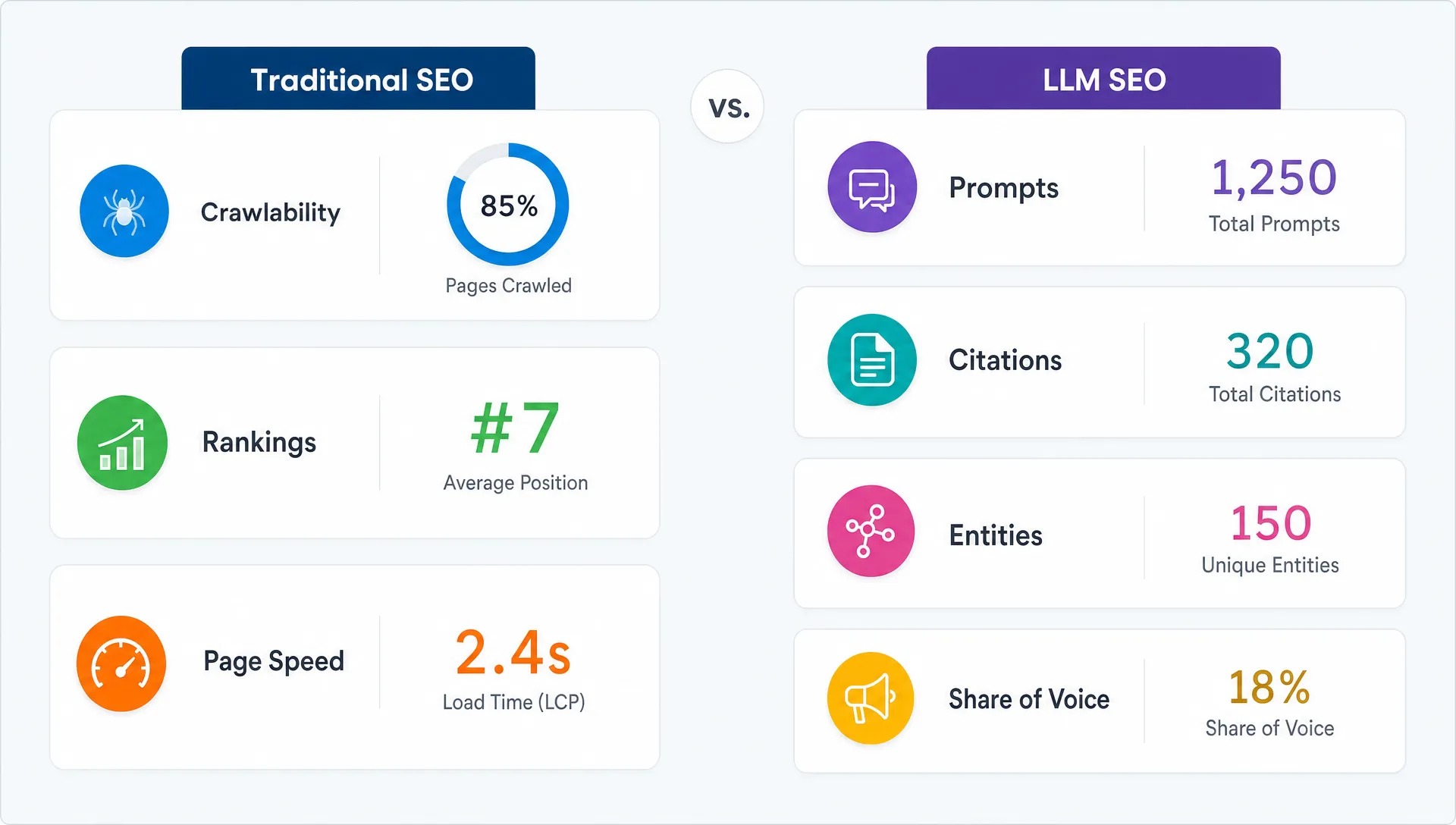
A more complete audit starts with the normal website visibility checker, then adds answer-level evidence. The goal is not to guess what an AI model “likes.” The goal is to observe where your brand appears, where it is cited, where competitors win and which page-level fixes can improve the underlying evidence.
1. Prompt and journey mapping
Prompt mapping identifies the questions buyers ask at each stage of the journey. A hotel group might track prompts around amenities, location, events, parking and family travel. An MSP might track prompts by industry, service need, compliance concern and software stack. An e-commerce team might track prompts around product comparisons, use cases, materials, sizing and delivery.
Start with 25 to 50 prompts per important market, product line or service cluster. Then expand once you see which prompts create business-relevant answers.
2. Brand mentions and citations
Mentions show whether the AI answer names your brand. Citations show whether it uses your site or another source as evidence. Both matter.
A mention without a citation can create awareness but may not send traffic. A citation without a strong description can drive low-quality visits. The strongest outcome is a relevant mention with a citation to a page that answers the buyer’s next question.
3. Share of voice across AI engines
Share of voice measures how often your brand appears compared with competitors across a defined prompt set. It is more useful than a single “visibility score” because it shows market context.
If your WooCommerce store appears in 12 percent of product comparison prompts and two competitors appear in more than 40 percent, the issue is not only technical. You may need stronger comparison content, better product schema, clearer entities and more authoritative supporting pages.
4. Entity clarity
Entities are the people, places, products, services and organizations that search systems try to understand. Your brand entity should connect cleanly to its locations, categories, service areas, products, leadership, reviews and authoritative references.
Entity confusion can show up as wrong service coverage, missing locations or outdated summaries. For example, an AI answer may describe a retail brand as online-only even though it has stores, or recommend a competitor for a service your franchise location actually provides.
5. Structured data, schema and llms.txt
Schema helps machines interpret page content. LocalBusiness, Organization, Product, FAQPage, Review and Service markup can all support clarity when used accurately. Schema does not guarantee AI inclusion, but it reduces ambiguity.
An llms.txt file is an emerging convention for giving AI systems a simple map of important content. It should not be treated as a magic switch. Used well, it can point AI crawlers toward canonical resources, documentation, FAQs and priority pages.
6. Internal linking and answer-ready content
Internal links help distribute context. A service page that is not linked from relevant category, location or FAQ pages is harder for crawlers and AI systems to interpret. For AI visibility, links should connect the buyer’s question to the clearest answer.
Answer-ready content is specific, factual and easy to extract. Instead of a vague paragraph saying “we offer comprehensive solutions,” a stronger section states who the service is for, where it is offered, what is included and what the next step is.
7. Page performance and crawl reliability
Performance is not only a user experience metric. Slow, unstable or script-heavy pages can make content harder to access consistently. For conversion, every extra delay can reduce completion rates for bookings, quote forms and checkout. For AI visibility, performance supports reliable discovery and reuse of your content.
A practical workflow for finding AI search gaps
A useful AI visibility workflow is evidence-based and repeatable. It should produce a prioritized fix list, not a vague report.
Use this sequence:
- Set the commercial scope: Choose the locations, products, services or markets that matter most to revenue.
- Build a prompt set: Include discovery, comparison, local, problem-based and decision-stage prompts.
- Scan multiple engines: Check ChatGPT, Google AI Overviews, Gemini, Perplexity, Claude and Copilot where relevant.
- Record mentions and citations: Track whether your brand appears, how it is described and which sources are cited.
- Compare competitors: Measure share of voice by prompt cluster, geography and buyer intent.
- Diagnose source issues: Review crawlability, metadata, schema, internal linking, content depth, entity clarity and page speed.
- Publish fixes: Add or improve FAQs, structured data, location content, comparison sections, llms.txt, metadata and internal links.
- Re-scan and document change: Compare before and after visibility, citations and answer accuracy.
The best teams keep this operational. Agencies can turn it into a monthly client deliverable. In-house content teams can use it to prioritize pages. MSPs managing site fleets can spot template-level issues before they spread across dozens of domains.
What CapstonAI adds beyond a checker
CapstonAI is built for the visibility layer that traditional checkers do not cover. It tracks how brands are mentioned and cited across AI search and generative engines, maps prompts that surface your business or your competitors and turns findings into prioritized recommendations.
For teams managing WordPress sites, multi-location brands or multi-brand portfolios, that matters because the work usually moves from diagnosis to publishing. CapstonAI combines AI visibility scans with technical SEO foundations, AI-ready FAQ and schema recommendations, metadata improvements, llms.txt support and CMS integration for faster fixes.
The point is not to abandon the website visibility checker. The point is to stop treating it as the whole picture. Your SEO stack should answer two questions:
- Can search engines and users access the right pages quickly and clearly?
- Do AI answers actually mention, cite and describe the brand when buyers ask commercially relevant questions?
If the second answer is unknown, you have an AI search gap.
Frequently Asked Questions
Is a website visibility checker still worth using? Yes. It remains useful for crawlability, indexation, rankings, metadata, broken links and performance checks. It should be the baseline, not the full AI visibility audit.
What is the difference between SEO visibility and AI visibility? SEO visibility usually measures how pages appear in search results. AI visibility measures how often a brand is mentioned, cited and accurately described inside generated answers from tools like ChatGPT, Gemini, Perplexity, Claude, Copilot and Google AI Overviews.
Can schema improve AI search visibility? Schema can help reduce ambiguity by defining products, services, locations, organizations and FAQs in a machine-readable format. It does not guarantee inclusion, but it supports clearer interpretation.
How many prompts should a brand track? Start with 25 to 50 high-intent prompts per major market, service line or product category. Expand once you identify where competitors appear, where citations come from and which prompts influence revenue.
What is llms.txt used for? llms.txt is an emerging way to point AI systems toward important site resources. Treat it as a supporting signal, not a replacement for crawlable pages, strong internal linking, schema and authoritative content.
Do AI citations always drive traffic? Not always. Some AI answers satisfy the user without a click. Citations still matter because they build credibility, influence shortlist formation and can send qualified visitors when the user wants detail.
Start with a free AI visibility audit
If your current checker says the site is healthy, the next question is whether AI engines can see, trust and reuse your business when buyers ask for recommendations.
Start with a free AI visibility audit. CapstonAI will help you see where your brand appears, where competitors win, which pages need AI-ready fixes and how to prioritize improvements across GEO, AEO and technical SEO. You can explore the CapstonAI AI visibility tool to see how mention tracking, citation analysis, prompt mapping and share-of-voice monitoring fit into a practical workflow.
AI cannot recommend what it cannot understand. Make the business visible, measurable and easier to cite.