AI can make SEO content faster, but speed is not the main advantage. The better use is precision: finding the questions buyers ask, structuring answers so search and AI systems can reuse them, and measuring whether your brand is actually mentioned when prospects ask ChatGPT, Gemini, Perplexity, Claude, Copilot, or Google AI Overviews for recommendations.
The best practices for using AI for SEO content start with one rule: do not treat AI as a writer you supervise at the end. Treat it as a research, structure, quality control, and measurement layer across the whole content workflow.
That matters because search behavior is fragmenting. A traveler may ask Perplexity for the best independent hotels near a conference center. A healthcare franchise buyer may ask Google AI Overviews what to compare before choosing a local provider. An IT director may ask Copilot for MSP options by city and specialty. If your content is generic, hard to crawl, or missing clear entity signals, AI may not see your business clearly enough to mention or cite it.
Start with the right model: SEO, AEO, and GEO work together
Using AI for SEO content is not only about ranking pages in traditional search results. It now includes three connected disciplines.
| Discipline | Simple definition | Business effect |
|---|---|---|
| Classic SEO | Making pages crawlable, indexable, relevant, internally linked, and fast | More qualified organic visibility and lower acquisition costs |
| AEO, or Answer Engine Optimization | Structuring content to answer specific questions directly | Higher chance of being used in answer boxes, assistants, and AI summaries |
| GEO, or Generative Engine Optimization | Making content easy for generative engines to understand, trust, cite, and reuse | More brand mentions, citations, and share of voice inside AI-generated answers |
These are not separate projects. A page that is slow, thin, or blocked from crawling is weak for classic SEO and weak for AI discovery. A page with a clear answer, strong evidence, structured data, and relevant internal links gives both search engines and generative systems more usable signals.
Google has also been clear that its systems focus on content quality rather than whether content was produced with AI or by humans. Its guidance on AI-generated content says appropriate use of automation is not against its guidelines, while scaled content created mainly to manipulate rankings remains risky. The practical takeaway is simple: AI is acceptable when it improves usefulness, accuracy, and coverage. It is a liability when it creates low-evidence pages at scale.
Use AI for research before you use it for writing
The weakest AI-assisted content usually starts with a prompt like write a blog post about this keyword. That skips the most valuable work: understanding the buyer, the query, and the evidence required to earn trust.
A better workflow starts with research prompts and source review. Ask AI to cluster customer questions, summarize recurring objections, compare competitor positioning, and map search intent. Then verify the output against real data from search results, analytics, CRM notes, support tickets, reviews, and sales calls.
For a hotel group, that might reveal that prospects are not only searching for hotel near airport. They may also ask AI assistants for quiet hotels with meeting space, pet-friendly extended stays near a hospital, or boutique hotels close to a specific convention venue. For an MSP, AI may surface content gaps around Microsoft 365 migration risk, cybersecurity compliance by industry, or response-time expectations by city.
Use AI to answer practical research questions such as:
- What questions does a buyer ask before comparing providers in this category?
- Which entities matter most, including services, locations, products, certifications, amenities, and integrations?
- Which competitor pages are cited or summarized most often in AI answers?
- Which queries show informational intent, commercial evaluation, or local decision intent?
- Which existing pages already deserve improvement before new content is created?
This is where AI can compress hours of manual synthesis into minutes. But the decision about what to publish should still be based on business value, search demand, conversion potential, and your ability to provide real evidence.
If your team is already automating parts of keyword research, briefs, or optimization, it is worth separating useful automation from blind publishing. CapstonAI has a related guide on AI-driven automation for SEO workflows that expands on where automation helps most without replacing editorial judgment.
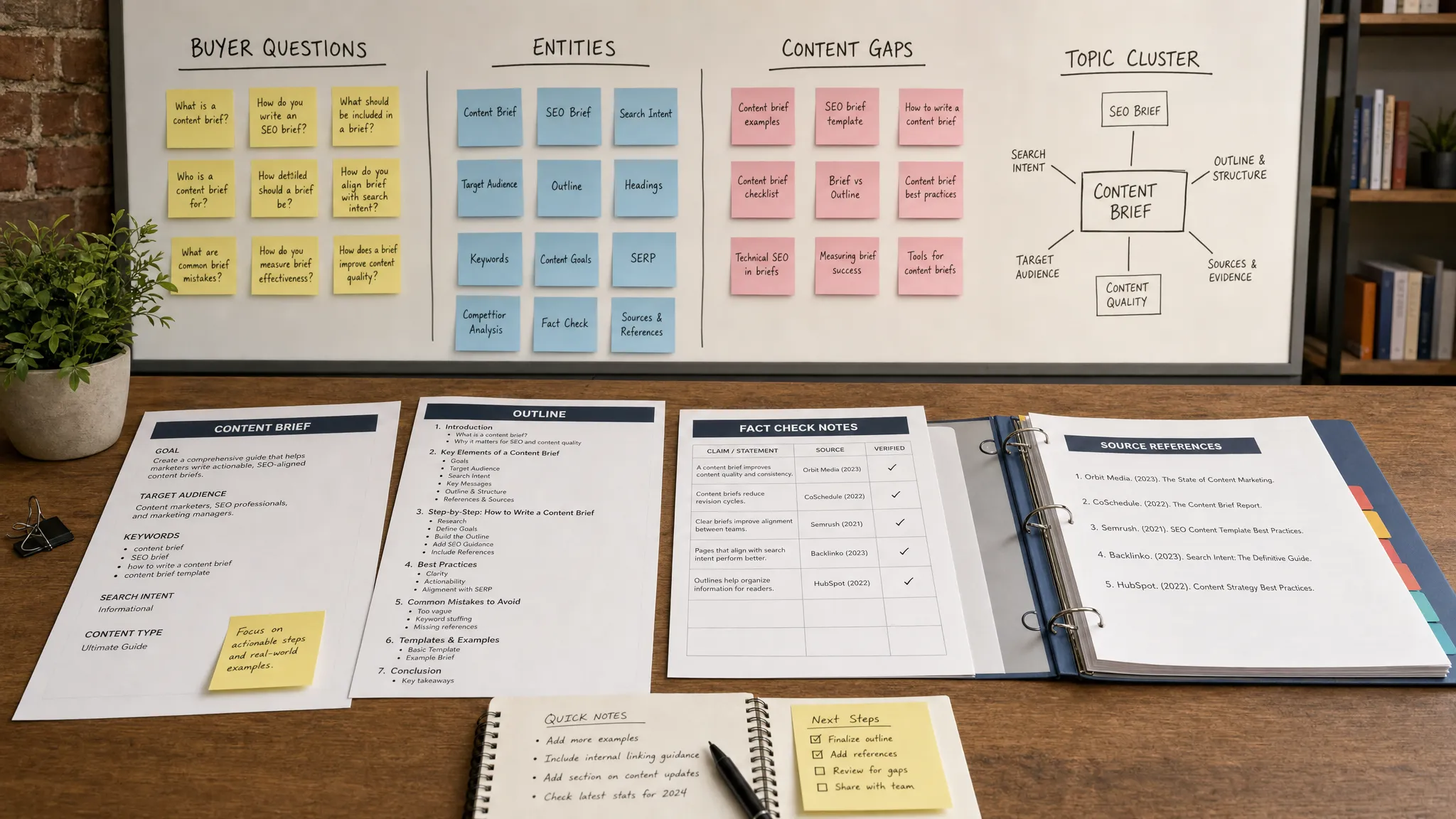
Build briefs around entities, intent, and proof
A strong SEO content brief should tell AI what the page must accomplish, not just what it should mention. This is especially important for multi-site brands, franchises, e-commerce stores, and agencies managing large content portfolios.
A useful AI-assisted brief includes five elements.
First, define the target reader and buying stage. A top-of-funnel guide should educate and clarify. A comparison page should reduce risk and help the reader evaluate options. A local landing page should prove relevance to a specific city, neighborhood, or service area.
Second, define the primary entity. The entity might be a hotel brand, location, product category, medical service, school program, MSP service, or retail store. Search and AI systems rely on entities to connect your page to known topics, places, organizations, and attributes.
Third, define the answer the page must give in the first section. If the query is best practices for using AI for SEO content, the page should immediately explain what good AI-assisted SEO content requires: clear intent, verified facts, structured answers, technical SEO, and AI visibility measurement.
Fourth, identify proof points. These can include first-party data, expert commentary, case examples, product specifications, location details, policies, pricing context, reviews, certifications, and cited third-party sources. AI-generated generalities do not create credibility. Verifiable specifics do.
Fifth, specify conversion context. A content page should not read like a sales pitch, but it should guide the next logical step. For CapstonAI’s audience, that may be an AI visibility audit, a technical SEO review, a location-page cleanup, or an agency workflow assessment.
Write for humans first, but structure for machines
AI systems prefer content they can parse. Readers do too. The overlap is larger than most teams think.
Good AI for SEO content should use short sections, descriptive headings, direct answers, and consistent terminology. A reader should be able to scan the page and understand the argument. A crawler should be able to identify the main topic, subtopics, entities, and supporting evidence without relying on hidden context.
A practical pattern is answer, explain, prove, and guide.
| Content element | What to include | Why it helps |
|---|---|---|
| Direct answer | A concise answer near the top of the section | Helps readers and answer engines extract the point quickly |
| Explanation | Two or three paragraphs with context | Prevents thin content and builds understanding |
| Proof | Sources, examples, data, or first-hand details | Improves trust and reduces generic AI output |
| Next step | A relevant internal link, CTA, or decision cue | Moves the reader toward action without forcing it |
For AI Overviews specifically, pages that make the answer obvious and support it with clear structure have a better foundation than pages that bury the answer under long introductions. If this is a priority channel, CapstonAI’s guide on how to optimize for AI Overviews covers the format and signals in more depth.
The same principle applies beyond Google. Perplexity often leans on citations. ChatGPT and Claude may summarize brands, categories, and recommendations from a mix of known web content and retrieved sources. Copilot may blend web results with Microsoft ecosystem context. No public formula guarantees inclusion, so the safest approach is to make every important page easy to understand, easy to cite, and easy to verify.
Keep human editorial control over facts and claims
AI can produce confident mistakes. That is not a moral flaw; it is a workflow risk. In SEO content, the cost of a wrong statement can be lost trust, legal exposure, or rankings that never convert.
Every AI-assisted page should pass an editorial review before publishing. The reviewer should check whether the page answers the real query, whether claims are accurate, whether sources support the statements, and whether the content reflects the brand’s actual offer.
For regulated or trust-heavy categories like healthcare, education, finance-adjacent services, and cybersecurity, this step is not optional. Even in hospitality or retail, incorrect location details, amenities, inventory, policies, or pricing context can create bad customer experiences.
A simple quality review can use four checks: accuracy, usefulness, originality, and actionability. Accuracy asks whether the facts are true. Usefulness asks whether the reader can make a better decision after reading. Originality asks whether the page adds information competitors do not. Actionability asks whether the next step is clear.
This is where first-party knowledge becomes a competitive advantage. AI can help organize what your business knows, but it cannot invent your actual guest experience, service standards, delivery area, product availability, customer proof, or operational expertise.
Build the technical layer AI can read
Content quality is necessary, but not enough. If generative engines and search crawlers cannot access or interpret your pages, good writing will underperform.
Start with crawlability and indexability. Important content should be available in HTML, not locked behind scripts, forms, tabs that fail to render, or blocked resources. Robots.txt, canonical tags, redirects, pagination, and XML sitemaps should all support the page’s role. For multi-location and franchise brands, this matters because duplicate templates, inconsistent canonicals, and thin location pages can blur the difference between branches.
Then strengthen structured data. Schema markup helps search engines understand page types, organizations, products, local businesses, reviews, FAQs, events, and breadcrumbs. Google’s structured data documentation is clear that structured data does not guarantee special display, but it does provide explicit machine-readable context. For AI search, that context can support entity clarity and content reuse.
Internal linking is just as important. Link from broad guides to service pages, from location hubs to branch pages, and from product categories to buying guides. Use descriptive anchor text that names the entity or decision point. An internal link that says enterprise WordPress SEO services is more useful than a vague link that says learn more.
Page performance also affects discovery and conversion. Core Web Vitals provide practical thresholds: Largest Contentful Paint should be 2.5 seconds or faster, Interaction to Next Paint should be 200 milliseconds or less, and Cumulative Layout Shift should stay at 0.1 or lower, according to web.dev’s Core Web Vitals guidance. Faster pages improve user experience and reduce the chance that important content is missed by rendering constraints.
Finally, consider AI-specific files and metadata. The llms.txt convention is emerging as a way to point AI systems toward important documentation and content, but it should not replace sitemaps, schema, canonical hygiene, or strong internal linking. Treat it as an additional signpost, not the foundation.
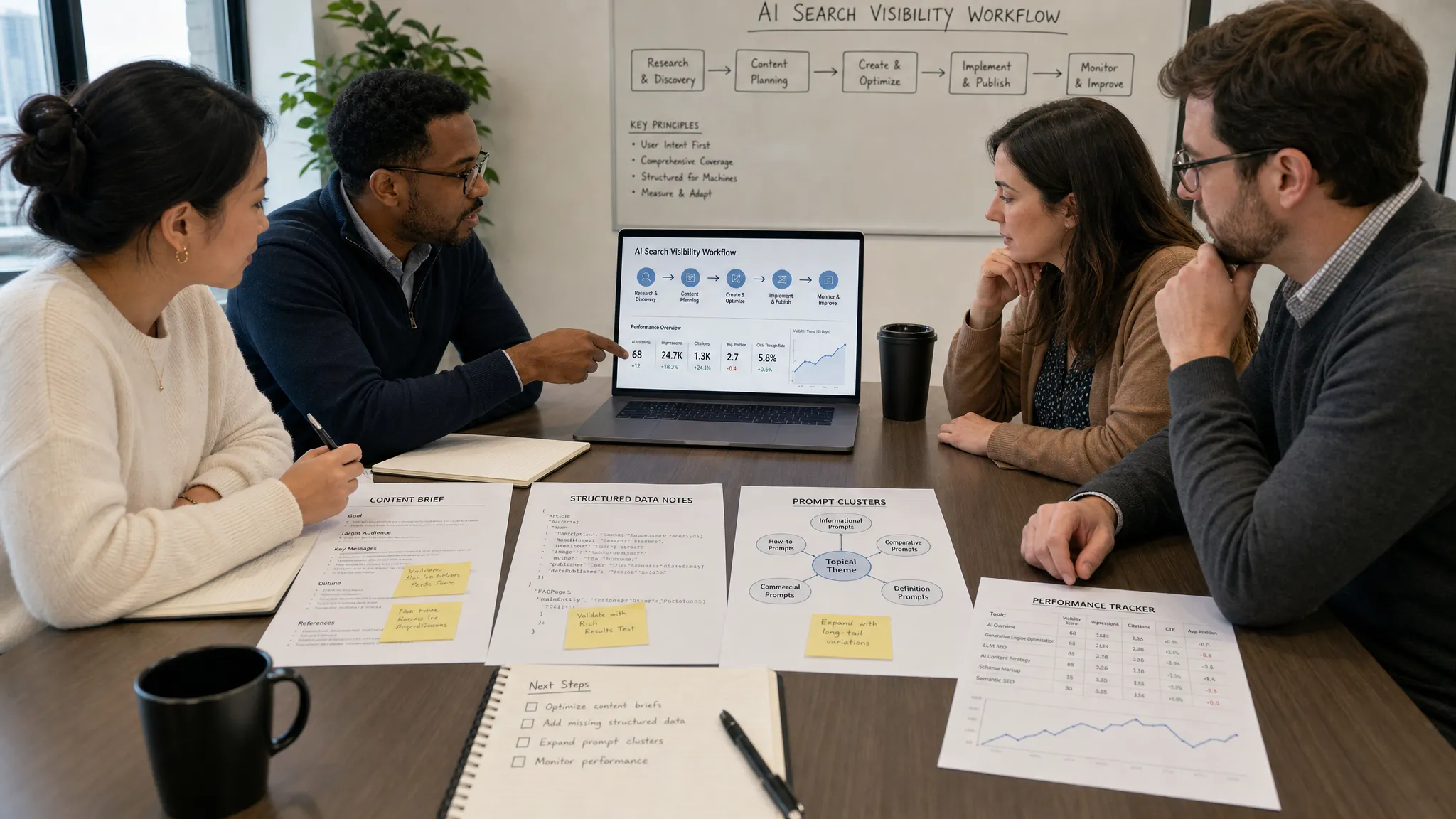
Optimize for brand mentions, citations, and share of voice
Traditional SEO reporting often focuses on rankings, impressions, clicks, and conversions. Those still matter. But AI search adds new visibility metrics.
A brand can be absent from a traditional top 10 ranking report and still appear in an AI answer. The reverse is also true: a page may rank well but never be cited by a generative engine for important decision prompts. That is why AI visibility measurement needs its own layer.
Track three signals:
- Brand mentions: How often your brand appears in AI-generated answers for relevant prompts.
- Citations: Whether AI systems link to your pages, competitor pages, directories, review sites, or publishers.
- Share of voice: How often you appear compared with competitors across prompt sets and engines.
For example, an independent hotel chain might test prompts around family-friendly hotels near a landmark, meeting venues with lodging, or pet-friendly hotels in a city. A WooCommerce retailer might test best product for a use case, comparison prompts, sizing questions, and warranty-related prompts. An MSP might test prompts by city, compliance requirement, vendor specialization, and emergency support need.
The goal is not to chase every AI answer. The goal is to identify where prospects are asking high-intent questions and where your brand is missing, misrepresented, or uncited.
CapstonAI is built for this measurement layer: AI visibility scans across engines, brand mention and citation tracking, prompt mapping, competitor monitoring, prioritized recommendations, and AI-ready metadata publishing. If your team is comparing tools, the guide on choosing an SEO platform for AI visibility explains what capabilities matter beyond traditional rank tracking.
Use AI to refresh existing content before creating more
Many teams do not need more pages first. They need better pages.
Before generating new content, run an AI-assisted audit of existing pages. Look for pages with outdated metadata, weak introductions, missing FAQs, thin sections, unclear entities, slow templates, duplicated location copy, missing schema, and poor internal links. These fixes often improve both search visibility and AI readability faster than publishing another generic article.
A practical refresh workflow looks like this:
- Select 10 to 25 high-value pages tied to leads, bookings, revenue, or strategic categories.
- Map each page to the prompts and traditional queries it should answer.
- Check whether the page gives a direct answer in the first 100 to 150 words.
- Identify missing proof, such as reviews, specifications, location details, screenshots, policies, or expert commentary.
- Add or validate schema, canonical tags, metadata, internal links, and performance fixes.
- Re-test the page against target prompts across AI engines and compare mentions and citations.
This workflow is especially useful for agencies and in-house teams managing large WordPress estates. AI can help detect patterns across many pages, while human teams prioritize fixes based on business impact.
Avoid the most common AI SEO content mistakes
Most AI content problems are not caused by AI itself. They are caused by weak inputs, weak review, or weak measurement.
The first mistake is publishing content that says what everyone else says. Generative models are good at summarizing common knowledge. If the page does not include first-hand experience, specific examples, original framing, or useful data, it will feel interchangeable.
The second mistake is using AI to expand word count instead of improving clarity. Longer content is not automatically better. A 900-word page that answers the question precisely can outperform a 2,500-word page that repeats the same point.
The third mistake is ignoring technical SEO. A well-written page with missing schema, poor internal links, blocked resources, or slow rendering is asking crawlers and AI systems to work harder than necessary.
The fourth mistake is measuring only Google rankings. If prospects ask AI assistants for recommendations, comparisons, or summaries, you need to know how your brand appears there too.
The fifth mistake is letting AI invent product, pricing, legal, medical, or operational claims. Do not ask AI to fill gaps with assumptions. If the information is important, source it from the business.
A practical governance model for AI-assisted SEO content
The best teams create rules before they scale output. Governance does not need to slow production. It prevents rework and protects credibility.
Define which content types AI may draft, which require subject-matter expert review, and which require legal or compliance review. For example, an agency might allow AI to create first drafts of glossary pages and metadata, but require expert review for healthcare service pages, cybersecurity claims, or franchise location content.
Create reusable prompt templates for briefs, outlines, fact-checking, metadata, schema suggestions, and content refreshes. Store approved terminology for brand names, services, products, locations, and competitor references. This reduces inconsistency across teams and sites.
Finally, track before-and-after results. For classic SEO, monitor rankings, impressions, clicks, conversions, and Core Web Vitals. For AI visibility, monitor mentions, citations, prompt coverage, and share of voice across engines. A page is not improved because AI helped create it. It is improved when more qualified buyers can find, trust, and act on it.
Frequently Asked Questions
Is AI-generated SEO content allowed by Google? Yes, when it is useful, accurate, and created for people rather than to manipulate rankings. Google’s guidance focuses on content quality and spam policies, not whether a human or AI tool assisted in production.
What is the best use of AI for SEO content? The best use is not mass drafting. AI is most valuable for research, intent clustering, content briefs, metadata testing, schema suggestions, content refreshes, and identifying gaps in AI visibility.
How does GEO differ from traditional SEO? Traditional SEO focuses on visibility in search results. GEO focuses on whether generative engines can understand, trust, mention, and cite your brand inside AI-generated answers.
Do schema and structured data help AI search visibility? They help by making page meaning more explicit. Schema does not guarantee citations or rich results, but it supports entity clarity, crawlability, and machine understanding.
What should teams measure beyond rankings? Measure brand mentions, citations, prompt coverage, share of voice, competitor visibility, and whether high-intent AI answers include accurate information about your business.
Start with a free AI visibility audit
If AI cannot see your business clearly, it cannot recommend it confidently. The next step is to measure what generative engines currently see, where competitors appear, and which pages need technical or content fixes first.
Start with a free AI visibility audit from CapstonAI. You will get a clearer view of how your brand appears across AI search and where to focus your SEO content improvements for measurable visibility, citations, and trust.