
AI in use has moved from an internal productivity topic to a brand visibility problem. Customers now ask ChatGPT, Gemini, Claude, Perplexity, and Google AI Overviews for product recommendations, vendor shortlists, local options, comparisons, and buying advice. If your brand is missing, misdescribed, or mentioned behind a competitor, the issue is not just SEO. It is discoverability inside AI-generated answers.
The good news: brands do not need to fix everything at once. AI visibility usually appears first in predictable places, where models can find clear facts, consistent entities, and trustworthy proof. The fastest wins come from making your brand easier to understand, verify, and recommend.
What “visibility first” means in AI search
In traditional SEO, visibility often means ranking for keywords and earning clicks. In AI search, visibility is broader. A brand can gain visibility when an AI system:
- Names the brand in an answer
- Recommends the brand for a use case
- Compares the brand against alternatives
- Cites or summarizes the brand's content
- Uses the brand's product, location, or service data accurately
- Mentions the brand in response to category, problem, or purchase-intent prompts
That means the first measurable wins may not show up as traffic spikes. They may show up as improved mention accuracy, better positioning in AI-generated shortlists, more citations from your own pages, or increased share of voice against competitors.
This is why AI visibility should be measured separately from organic rankings. Traditional SEO data still matters, but it does not tell you whether a model is recommending your brand when a buyer asks, “Which platform should I use for this problem?”
Where brands gain AI visibility first
AI engines tend to surface brands where the answer risk is lowest. If your brand has consistent facts, clear use cases, structured information, and third-party validation, the model has more confidence including you.
The first visibility gains typically happen across six surfaces.
| Visibility surface | Why it often improves first | First action to take | KPI to track |
|---|---|---|---|
| Branded prompts | The model already has a narrow entity to evaluate | Fix brand descriptions, About page copy, organization schema, and core metadata | Brand mention accuracy |
| FAQ and question pages | AI systems can extract direct answers more easily | Add concise answers, question-led headings, and FAQ schema where appropriate | Citation rate and answer inclusion |
| Product or service pages | Clear specs and use cases support recommendations | Improve product data, service descriptions, pricing context if public, and comparison details | Recommendation rate |
| Category and comparison pages | Buyers ask AI for “best,” “alternatives,” and “for X” recommendations | Publish honest comparison pages and use-case landing pages | AI share of voice by category |
| Local and multi-location pages | Geography narrows the answer set | Standardize NAP data, service areas, reviews, and location-specific content | Location mention rate |
| Third-party proof | Models often rely on corroboration beyond your site | Strengthen review profiles, partner pages, case studies, awards, and authoritative mentions | Citation diversity |
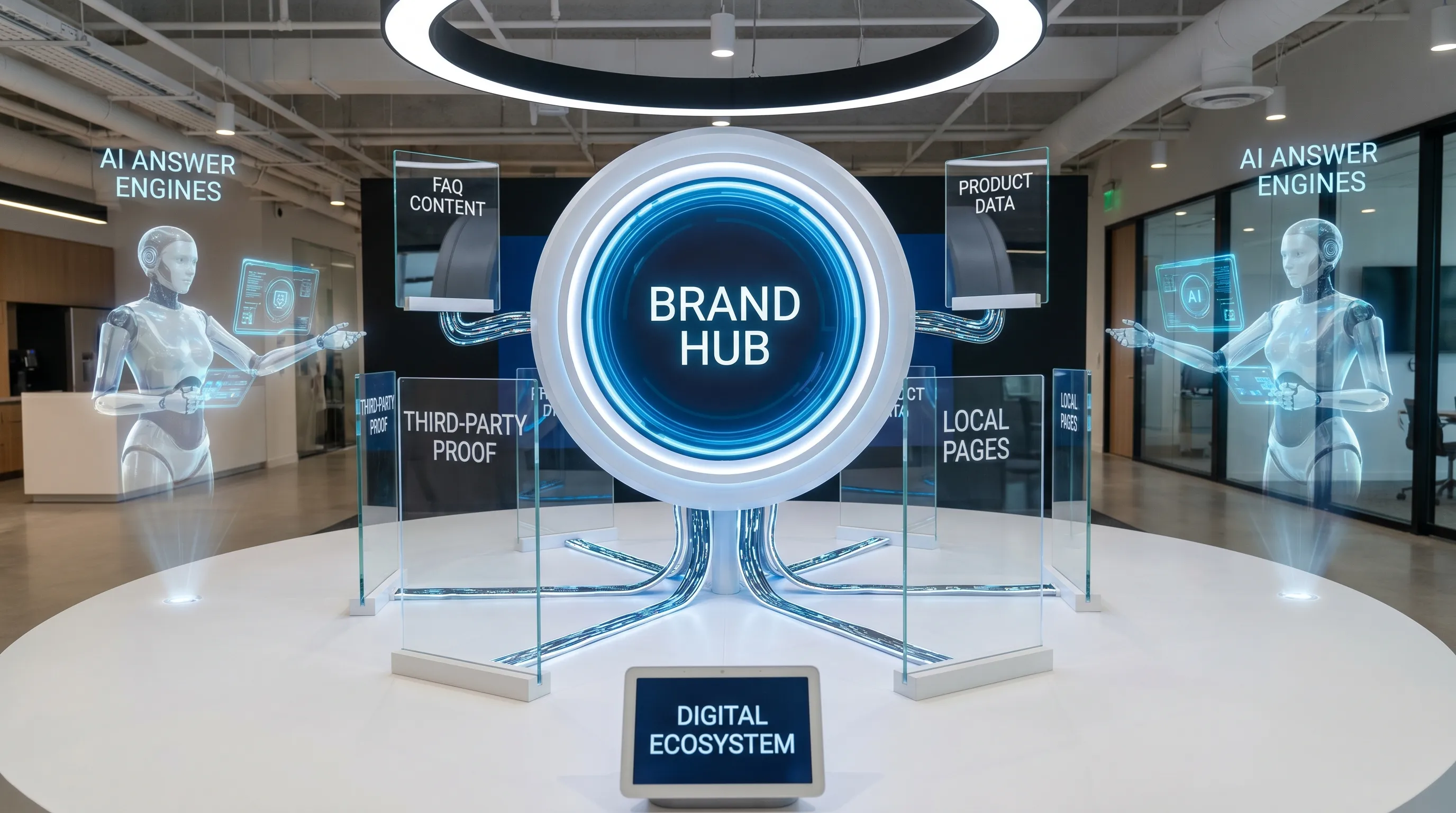
1. Branded prompts: the baseline every team should fix first
The fastest place to gain visibility is often your own brand name. That may sound obvious, but many companies discover that AI tools describe them with outdated positioning, wrong product categories, old locations, missing features, or competitor-adjacent language.
Start by testing prompts such as:
- “What is [Brand]?”
- “What does [Brand] do?”
- “Is [Brand] good for [use case]?”
- “Who are [Brand]'s competitors?”
- “Summarize [Brand] for a buyer evaluating [category].”
If answers are vague or inaccurate, the problem is usually entity clarity. Your website may not state who you serve, what you sell, where you operate, and why you are different in a way that is easy for machines to parse.
The first fixes are straightforward: tighten your homepage positioning, update your About page, make product and service naming consistent, add organization schema, and ensure your core metadata reflects your current business. For many brands, this alone improves how AI systems summarize them.
2. FAQ content: the easiest path to extractable answers
AI systems favor content that can be lifted into a concise answer. Long-form thought leadership helps build authority, but answer engines often need crisp, self-contained passages.
FAQ content works because it mirrors how users prompt AI tools. A buyer rarely asks, “Show me a 2,000-word article about procurement software.” They ask, “What is the best procurement software for a mid-sized manufacturer?” or “How do I compare vendor management tools?”
To make FAQ content AI-ready, write answers that are complete in the first few sentences. Avoid forcing the model to infer the answer from scattered paragraphs. When appropriate, support the page with FAQPage schema, but remember that schema does not compensate for weak content.
For deeper implementation guidance, CapstonAI's guide on how to optimize for AI Overviews explains why direct answers, structured pages, and freshness signals matter for AI-generated search results.
3. Product and service pages: where recommendations become commercially valuable
Many brands invest heavily in blog content while leaving product and service pages thin. That is a problem in AI search, because recommendation prompts often require specific facts: who the product is for, which problem it solves, how it compares, what integrations or locations are relevant, and what proof supports the claim.
A product or service page becomes more useful to AI systems when it answers buyer questions directly:
- Who is this for?
- What problem does it solve?
- What makes it different from alternatives?
- What are the most common use cases?
- What proof shows it works?
- What limitations or requirements should buyers know?
This does not mean overloading pages with generic AI-written copy. It means making commercial pages more specific. A clear product page with structured details, examples, FAQs, and proof points is more likely to be summarized correctly than a vague page full of slogans.
For e-commerce brands, the same principle applies to product feeds, category pages, reviews, specifications, and availability data. For B2B brands, it applies to solution pages, vertical pages, integrations, case studies, and implementation details.
4. Category and comparison pages: where buyers ask AI for shortlists
AI search compresses the consideration stage. Instead of visiting ten websites, a buyer may ask an AI assistant to create a shortlist. That makes category-level visibility essential.
Prompts like “best AI visibility tools,” “alternatives to [competitor],” or “top platforms for multi-location brand visibility” are not purely informational. They sit close to buying intent. If your brand is absent, AI may be shaping the shortlist before your sales or marketing team ever gets a chance.
To gain visibility here, create pages that help buyers compare honestly. Good comparison content is not a competitor attack. It explains fit, tradeoffs, strengths, limitations, and use cases. AI systems need that context to decide when a recommendation is appropriate.
This is also where Generative Engine Optimization becomes distinct from classic SEO. You are not only trying to rank. You are helping AI systems understand when your brand should be included in an answer.
5. Local and multi-location data: where constraints make AI more confident
For local businesses, retailers, healthcare networks, hospitality brands, and service franchises, visibility often improves first around location-specific prompts. Geography narrows the answer set, so AI systems can make recommendations with more confidence when location data is consistent.
A multi-location brand should pay close attention to:
- Location page completeness
- Name, address, and phone consistency
- Business hours and service areas
- Local reviews and ratings
- Local FAQs
- Store or branch-specific services
- Google Business Profile and other directory consistency
The risk is fragmentation. If one location page says a service is available, another directory says it is not, and reviews mention a different branch name, AI systems may avoid confident recommendations or present inconsistent information.
For brands with many branches, this becomes a governance problem. AI visibility is not just about publishing more content. It is about maintaining accurate, structured, location-specific facts at scale.
6. Third-party proof: the trust layer AI models look for
Your website is important, but AI systems often look for corroboration. Mentions on authoritative third-party sites, customer reviews, partner directories, analyst pages, podcasts, industry publications, and case studies can all reinforce the model's confidence.
This is especially important for newer brands or brands in competitive categories. If your site claims you are the best option, but the broader web barely mentions you, AI systems have less evidence to work with.
Third-party proof can include customer stories, awards, credible reviews, partnerships, integrations, media mentions, and expert citations. The goal is not to manufacture signals. The goal is to make real-world credibility visible and machine-readable.
This is why trust signals matter. Clear sourcing, expert review, author credentials, timestamps, and evidence-backed claims can make your brand easier to cite. CapstonAI has a dedicated guide on AI trust signals that make brands more citable if you want to strengthen that layer.
Turning AI in use into public visibility assets
There is another overlooked path to visibility: what your company is already doing with AI internally. AI in use inside sales, operations, customer support, manufacturing, analytics, or administration can create proof points that make your brand more visible externally.
For example, a manufacturer that uses AI to reduce process bottlenecks can turn that work into a case study, methodology page, FAQ, or industry insight. A retailer using AI to improve inventory planning can publish practical lessons for store teams. A SaaS company using AI to improve onboarding can create benchmark content around time-to-value.
For industrial mid-market companies still identifying where AI belongs operationally, partners focused on KI-Lösungen für den industriellen Mittelstand can help connect AI projects to process acceleration, data exploration, proof of concept work, and measurable ROI. The visibility opportunity comes after that: real AI deployments produce concrete expertise that answer engines can recognize and cite.
In other words, do not separate operational AI from marketing. The strongest AI visibility assets often come from real implementations, not generic trend commentary.
A 30-day plan to find your first AI visibility wins
Brands should not guess where to start. The right workflow is to measure current AI visibility, identify gaps, fix high-confidence surfaces, and track movement over time.
| Timeframe | Focus | What to do | Output |
|---|---|---|---|
| Days 1 to 3 | Baseline | Test branded, category, comparison, local, and problem-led prompts across major AI engines | Initial AI visibility map |
| Days 4 to 7 | Accuracy | Identify wrong descriptions, missing products, outdated facts, and competitor misalignment | Fix list by severity |
| Days 8 to 14 | Content fixes | Update About, product, FAQ, comparison, and location pages | AI-ready content improvements |
| Days 15 to 21 | Trust signals | Add proof, case studies, review references, author context, and structured data where relevant | Stronger citation layer |
| Days 22 to 30 | Monitoring | Re-test prompts, compare engines, and track competitor movement | Visibility trend report |
CapstonAI is built for this workflow. The platform helps brands, retailers, and agencies run AI visibility scans, map prompts and mentions, track competitors, analyze share of voice, and identify blind spots across major AI engines. Teams can also use automated content recommendations, CMS integrations, AI-ready FAQ and metadata publishing, multi-location management, and critical alert dashboards to turn AI search from a black box into a measurable growth channel.
Common mistakes that slow down AI visibility gains
The brands that struggle usually make one of four mistakes.
First, they optimize only for traffic. AI visibility can improve before clicks do, so teams that watch only sessions may miss early progress.
Second, they publish generic AI content. Models do not need more vague summaries. They need specific, verifiable, differentiated information.
Third, they ignore competitors. AI answers are comparative by nature. If you do not measure how often competitors appear in the same prompts, you cannot understand your true share of voice.
Fourth, they treat AI visibility as a one-time audit. AI answers change as models, indexes, sources, and competitor content change. Monitoring must be ongoing, especially for high-value prompts.
The real first win: being accurately understood
The first goal is not to dominate every AI answer. It is to be accurately understood. Once AI systems can identify your brand, describe it correctly, associate it with the right categories, and verify claims through trusted sources, recommendations become more likely.
That is the foundation of AI visibility. From there, brands can expand into category prompts, comparison prompts, local prompts, and commercial recommendation prompts.
AI in use is no longer just about how your team works faster. It is about whether your market can find, understand, and trust your brand inside the answer layer.
Frequently Asked Questions
What does AI in use mean for brand visibility? AI in use refers to AI being applied in real workflows, search experiences, and customer decision-making. For brand visibility, it means your company must be understandable and recommendable inside AI-generated answers, not just searchable in traditional results.
Where should brands optimize first for AI visibility? Start with branded prompts, FAQ content, product or service pages, comparison pages, local data, and third-party proof. These surfaces usually produce the fastest gains because they give AI systems clear facts and trusted context.
Is AI visibility replacing SEO? No. AI visibility builds on SEO, but it adds new metrics such as AI mention rate, citation rate, prompt coverage, answer accuracy, and AI share of voice. Brands still need strong technical SEO, content quality, and authority.
How quickly can a brand improve AI visibility? Some accuracy improvements can appear quickly after fixing metadata, FAQs, and entity information. Broader recommendation gains usually take longer because they depend on content quality, third-party proof, and how often AI systems refresh sources.
How do you measure AI visibility across search engines? Track a fixed set of prompts across ChatGPT, Gemini, Claude, Perplexity, and Google AI experiences. Measure whether your brand is mentioned, how it is described, where it ranks in recommendations, which sources are cited, and how competitors appear.
Find your first AI visibility wins
If you are not sure where your brand appears in AI answers today, start with measurement. CapstonAI helps you scan major AI engines, diagnose blind spots, track competitors, and publish AI-ready improvements that make your brand easier to find and recommend.
Start with a free AI visibility audit and see where your brand can gain visibility first.