Search is no longer limited to ten blue links, map packs and product grids. Your buyers now ask ChatGPT, Gemini, Claude, Perplexity, Copilot and Google AI Overviews for recommendations, comparisons and next steps. For many digital teams, ai search engine gpt monitoring has become the practical shorthand for tracking how ChatGPT-style answer engines mention, cite and compare a brand. The business problem is specific: AI may know your competitors, cite third-party pages about them and skip your strongest pages entirely. That gap can affect bookings, demo requests, store visits, support deflection and credibility long before a prospect reaches your website.
Brand citation gaps are now a measurable search problem
A brand citation gap exists when an AI answer engine should reasonably cite or mention your business but does not. The gap may appear in a direct brand query, a category query such as "best boutique hotels in Charleston" or an evaluation query such as "compare managed IT providers for healthcare clinics."
Classic SEO tools can show rankings, impressions, backlinks and crawl errors. They usually do not show whether Perplexity cites your buyer guide, whether ChatGPT recommends a rival for your service area or whether Google AI Overviews summarize your page without naming your brand. That is why AI visibility needs its own measurement layer.
The goal is not to chase every generated answer. The goal is to find repeatable gaps in high-value prompts, diagnose why they happen and fix the underlying page, entity or authority issue.
What ai search engine gpt monitoring actually measures
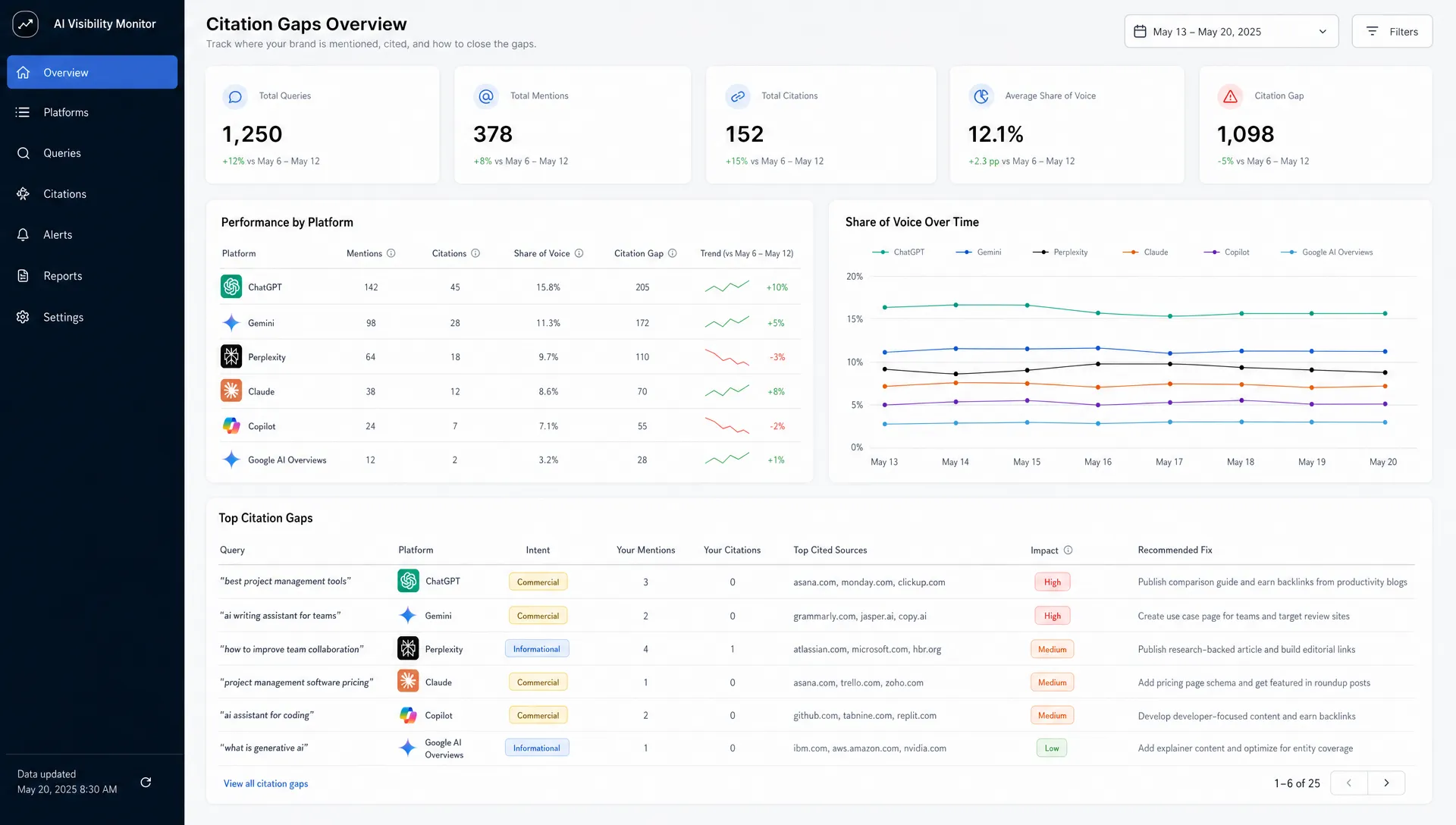
At its core, ai search engine gpt monitoring measures how generative engines represent your brand across prompts that matter commercially. It looks at mentions, citations, ranking position inside an answer, sentiment, accuracy and share of voice against named competitors.
A good monitoring program separates three signals that are often mixed together. A mention is when the brand appears in the answer. A citation is when the answer links to a source. Share of voice is the percentage of tracked prompts where your brand appears compared with competitors.
| Signal | What it tells you | Business effect |
|---|---|---|
| Brand mention | Whether AI systems associate you with the topic | Awareness and recall |
| Citation | Whether your owned or earned source supports the answer | Referral traffic and trust |
| Prompt coverage | Which questions surface you, rivals or neither | Funnel gaps and content priorities |
| Accuracy | Whether facts about locations, services, pricing or policies are correct | Lead quality and customer confidence |
| Share of voice | How often you appear compared with competitors | Competitive visibility |
A useful ai search engine gpt monitoring setup should track the same prompt set over time, not just run one-off tests. Single checks are noisy because generative answers can vary by model, location, freshness, user wording and whether browsing or citations are enabled.
Why brand citation gaps happen
Citation gaps usually come from several small problems rather than one obvious failure. Here is what we observe most often when brands are visible in Google but weak in AI-generated answers.
The entity is unclear
Generative engines rely on entities, meaning recognizable people, places, organizations, products and concepts. If your brand has inconsistent names, outdated local pages, thin About content or mixed third-party profiles, the model may not connect your business to the right category.
For a multi-location healthcare group, that can mean AI sees the parent brand but misses individual clinics. For a hotel collection, it can mean AI understands the destination but not which property fits "family-friendly," "pet-friendly" or "near the convention center."
The best source is not citable
When ai search engine gpt monitoring shows that competitors are cited and you are not, the issue is often source quality. AI systems need pages that are crawlable, specific and easy to summarize. A beautiful landing page with sparse copy, blocked scripts or vague claims may convert humans well but give answer engines little to reuse.
Support-heavy e-commerce brands face a similar pattern. AI can only summarize policies, workflows and product support if the source material is explicit and governed. The same evidence-first approach applies to customer experience automation, where Ridgeline Agency's analysis of what Gorgias AI can and can't do yet shows why human oversight, workflow design and clear knowledge sources still matter.
Technical SEO still sets the floor
Generative Engine Optimization, or GEO, is the practice of making content understandable and reusable by generative engines. Answer Engine Optimization, or AEO, focuses on structuring concise answers to common questions. Neither replaces technical SEO.
If a page is slow, hard to crawl, missing canonical signals or buried six clicks deep, it has a weaker chance of becoming a trusted source. Structured data, internal linking, clean metadata and stable page performance help engines discover the page, understand the entity and decide whether it supports the answer.
A practical framework for finding citation gaps
Start with a prompt map, not a tool export. The prompt map should reflect how prospects actually research, from discovery to comparison to action. For example, a hotel group might track prompts around "best hotels near venue," "hotel with meeting rooms in city" and "compare hotel brand vs competitor."
Run ai search engine gpt monitoring across a fixed prompt set in multiple engines: ChatGPT, Google AI Overviews, Gemini, Perplexity, Claude and Copilot. Keep the prompt wording stable, then record changes weekly or monthly depending on the sales cycle.
For each prompt, capture four fields: who is mentioned, who is cited, which source URL appears and whether the answer is accurate. If you need a deeper metric model, CapstonAI's guide on how to measure AI performance across search engines breaks down mention rate, citation rate and competitive share of voice in more detail.
Segment prompts by business value
Not every missing citation deserves immediate work. A gap on "history of the brand" may matter less than a gap on "best urgent care near me open Saturday" or "top WooCommerce agency for performance optimization."
Use three simple tiers:
- High priority: prompts tied to bookings, quotes, appointments, demos or product selection
- Medium priority: prompts tied to category education, local discovery or comparison research
- Low priority: prompts with low commercial intent or weak relevance to your offer
From monitoring to fixes: GEO, AEO and technical SEO
The best ai search engine gpt monitoring programs do not stop at screenshots of missing mentions. They turn each gap into a specific fix that a content, SEO or web team can ship.
For GEO, strengthen the source page so a generative engine can extract a factual answer. That means clear service definitions, location details, eligibility rules, product specs, comparison points and visible authorship where relevant. Avoid vague copy such as "leading solutions" when a more useful sentence would state who the service is for, what it includes and where it is available.
For AEO, add concise question-led sections that answer real buyer questions in one or two paragraphs. FAQ schema can help search systems understand the question and answer relationship, but schema should reflect visible page content. Do not mark up claims that users cannot see.
For technical SEO, check crawlability, indexability, canonical tags, page performance, internal links and structured data. Schema for Organization, LocalBusiness, Product, FAQPage, Article and BreadcrumbList can clarify entity relationships when used accurately. An llms.txt file can also point AI crawlers and systems toward important documentation, though support varies and it should not be treated as a replacement for crawlable HTML.
If you want to understand why some pages are selected as sources more often than others, CapstonAI's article on how AI-driven search engines choose sources to cite explains the role of authority, specificity, freshness and corroboration.
How to prioritize citation gaps by business impact
Use ai search engine gpt monitoring to build a fix queue that balances revenue impact with implementation effort. A mid-market e-commerce team might start with product comparison gaps. A franchise education brand might focus on local program pages. An MSP managing multiple client sites might prioritize technical fixes that can be repeated across templates.
| Citation gap | Likely cause | First fix to test |
|---|---|---|
| Competitors cited for category prompts, your brand absent | Weak category entity and thin comparison content | Build or improve a category proof page with specific use cases |
| AI mentions your brand but cites a third-party profile | Owned page lacks enough structured detail | Add clear facts, schema and internal links to the relevant page |
| Local prompts surface the parent brand only | Location pages are duplicate or underdeveloped | Add unique services, staff, service areas and local FAQs |
| Product prompts cite reviews but not product pages | Product content is not detailed or crawlable enough | Improve specs, FAQs, availability and review signals |
| Answer contains outdated brand facts | Inconsistent sources across the web | Update owned pages first, then key third-party profiles |
This is where measurement prevents wasted effort. If 50 high-intent prompts produce 120 competitor mentions and only 12 brand mentions, you have a baseline. After publishing fixes, you can rerun the same prompt set and see whether mention rate, citation rate or accuracy changed. The number is not a guarantee of leads, but it is a stronger operating metric than guessing.
What CapstonAI adds to the process
CapstonAI treats ai search engine gpt monitoring as an operational workflow, not a one-time visibility check. The platform scans across major AI engines and assistants, tracks brand mentions, citations and share of voice, then maps which prompts surface your business and which surface rivals.
That measurement layer matters because AI visibility problems are rarely owned by one team. Content teams need prompt and page recommendations. SEO teams need structured data, metadata, crawlability and internal linking fixes. Agencies need repeatable reporting across clients. Multi-location brands need visibility by market, property, clinic, campus or store.
CapstonAI connects Generative Engine Optimization, Answer Engine Optimization and classic technical SEO foundations. It can help teams identify blind spots, prioritize fixes and publish AI-ready FAQ, schema, metadata and llms.txt updates through CMS workflows, with a WordPress-first approach and extensibility for more complex stacks.
For teams that want to see the visibility layer before committing to a workflow, the CapstonAI AI visibility tool is the natural place to start.
Frequently Asked Questions
What is a brand citation gap in AI search? A brand citation gap is a missed opportunity where an AI answer engine mentions or cites competitors, third-party sources or incomplete information when your brand has a relevant page that should support the answer.
Is AI visibility the same as SEO visibility? No. SEO visibility measures performance in search results, while AI visibility measures how generative engines mention, cite, summarize and compare your brand inside generated answers. The two overlap, but they are not identical.
Which engines should brands monitor? Most teams should monitor ChatGPT, Google AI Overviews, Gemini, Perplexity, Claude and Copilot. The right mix depends on where your buyers research and which engines influence your category.
How often should citation gaps be checked? For active campaigns, weekly or biweekly checks can reveal movement after content and technical fixes. For stable categories, a monthly scan is often enough to monitor trend direction and catch accuracy issues.
Can structured data alone fix AI citation gaps? Structured data helps clarify entities and page meaning, but it is not enough by itself. The page still needs crawlable content, credible detail, strong internal links, fast performance and consistency across the web.
Start with a free AI visibility audit
AI cannot recommend, cite or defend what it cannot see clearly. Start by measuring where your brand appears today, where competitors are being cited instead and which pages need the smallest credible fix first.
A free CapstonAI visibility audit gives your team a baseline across AI engines, prompt coverage and brand citation gaps, so the next step is based on evidence rather than assumptions.