SEO prompts are no longer just a faster way to draft title tags. Used well, they are diagnostic tools that help you see where your site is thin, unclear or invisible before ChatGPT, Google AI Overviews, Gemini, Perplexity, Claude or Copilot choose a competitor instead.
That matters because AI search does not behave like a classic ranked results page. A generative engine can summarize five sources, mention one brand, cite another and ignore the page that ranks well in traditional search if it cannot understand the entity, verify the claim or extract a clear answer.
This is where content gaps become AI visibility gaps.
Generative Engine Optimization, or GEO, is the work of making your content easy for AI systems to find, understand, cite and reuse. Answer Engine Optimization, or AEO, focuses on shaping pages so they answer specific questions clearly. Both still depend on classic technical SEO: crawlability, internal links, schema, metadata and page performance.
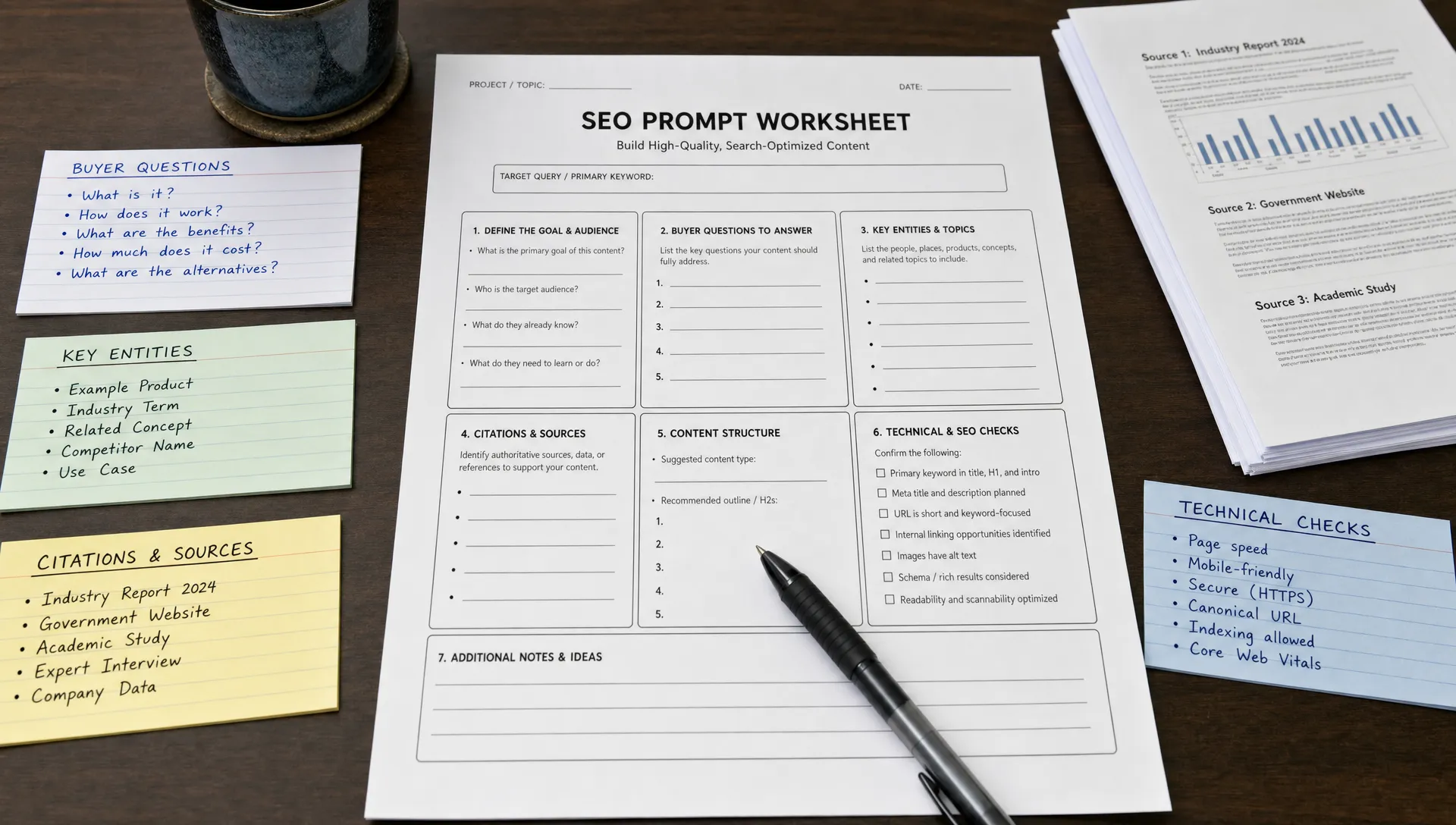
The seven SEO prompts below are designed for brands, agencies and in-house teams that need a repeatable way to identify those gaps. They work best when paired with real evidence: pages, queries, customer questions, competitor URLs and AI answer samples.
Why AI search changes the definition of a content gap
A classic content gap usually means, “We do not have a page targeting this keyword.” That is still useful, but it is not enough for AI search.
AI systems assemble answers from entities, citations, structured facts, topical coverage and page-level clarity. They may also rely on sources that are not your direct competitors, such as guides, marketplaces, local directories, documentation pages, review sites or comparison articles.
For a hotel group, the gap might not be “best hotel in Austin.” It might be the absence of a clear answer to “Which downtown Austin hotel has meeting rooms, parking and walkable restaurants for a 40-person company offsite?” For an MSP, the gap might be missing proof around response times, service areas, compliance coverage or vendor certifications. For a WooCommerce retailer, the gap might be weak product entity data, thin comparison copy or missing FAQs that answer pre-purchase objections.
A standard rank tracker can miss these signals. If you want the deeper distinction, CapstonAI has a useful breakdown of why a standard visibility checker misses AI search gaps.
| Gap type | What classic SEO may see | What AI search may expose | Business effect |
|---|---|---|---|
| Query coverage | Missing keyword page | Missing answer for a specific buying scenario | Lower qualified traffic and fewer leads |
| Entity clarity | Page title and headings | Unclear brand, location, service, product or audience relationship | Weaker brand mentions in AI answers |
| Citation strength | Backlinks and rankings | Competitors cited because their claims are easier to verify | Lost credibility at the decision stage |
| Technical readability | Indexation and crawl status | Important content hidden, slow or hard to parse | Lower chance of being used in answers |
| Journey continuity | Individual page performance | No internal path from question to proof to conversion | More drop-off before booking, buying or inquiry |
Before you use these prompts, prepare better inputs
The biggest mistake is asking an AI tool to “find content gaps” with no evidence. It will produce plausible ideas, but not necessarily useful ones.
Before running the prompts, gather a compact evidence pack. This does not need to be perfect. A strong starting set includes your top commercial pages, your Search Console queries, three to five competitor URLs, common sales or support questions, representative AI answer samples and any crawl data you have on schema, canonical tags, indexability and page speed.
If you manage a multi-location brand, include location pages and service-area pages. If you run an agency, create one evidence pack per client segment or business unit. If you manage e-commerce, separate category pages, product pages and buying guides because each has a different role in AI answers.
Use the prompts as a gap-finding layer, not as a publishing engine. AI can help detect patterns, but a human still needs to verify facts, claims, pricing, local details, compliance language and brand positioning. That balance is also the core point in CapstonAI’s guide to where automation helps and human review matters.
1. Prompt for buyer-journey content gaps
This prompt finds unanswered questions across the path from problem awareness to conversion. It is especially useful for hotels, healthcare groups, education brands, local service businesses and B2B service providers because buyers rarely ask one clean keyword before making a decision.
You are an SEO strategist and AI search analyst. Review the evidence below for [brand], which serves [audience] and wants more [bookings, leads or sales]. Use only the supplied evidence. Build a content gap table across these stages: Awareness, Evaluation, Decision and Post-purchase. For each stage, list the questions our pages answer well, the questions we do not answer, the missing entities or proof points, the page or section that should fill the gap and the likely business risk if we leave it unresolved. Evidence: [paste page summaries, top queries, sales questions and competitor snippets].
The output should tell you whether your content supports the actual decision, not just the first search.
For example, a relocation advisory site might need one page to cover eligibility, cost of living, housing, local orientation and decision risks. A resource such as a UK to Poland relocation guide is useful because it does not only target a destination keyword. It helps the reader decide whether the move is right, which is the type of complete context AI systems can summarize more confidently.
Apply the same logic to your business. A hotel page should not only list rooms. It should answer who the property is best for, what is nearby, what constraints matter and why a traveler would choose it over another option. A franchise healthcare page should not only name a service. It should clarify conditions treated, location details, appointment paths, insurance considerations where applicable and trust signals.
2. Prompt for AI answer and prompt-mapping gaps
Prompt mapping means identifying which user prompts surface your brand, which surface competitors and which produce no brand mentions at all. It connects GEO to measurable share of voice.
Act as a neutral AI answer engine evaluating possible responses to customer prompts. Based on the evidence below, predict which brands or pages are most likely to be mentioned or cited for each prompt. For every prompt, score [brand] as Strong, Partial or Missing. Explain the reason using page evidence, entity clarity, citation quality and answer completeness. Then suggest the smallest content or technical fix that could improve our chance of being included. Prompts to test: [paste 10 to 25 high-intent prompts]. Evidence: [paste our page summaries, competitor summaries and AI answer samples].
Use this prompt with real examples that prospects might ask in ChatGPT, Gemini, Perplexity, Claude, Copilot or Google AI Overviews.
Good prompts are specific. “Best MSP” is too broad. “Which MSP supports Microsoft 365 security for a 75-person law firm in Chicago?” reveals entity, use case, location, buyer size and compliance context. “Hotels in Denver” is too generic. “Which Denver hotel is best for a two-night corporate retreat with parking and walkable restaurants?” is closer to a booking decision.
The business output is a prompt-to-page map. If high-intent prompts do not connect to a page with clear answers and proof, that is a gap worth prioritizing.
3. Prompt for competitor citation gaps
AI visibility is not just about being mentioned. Citations matter because they shape trust. If Perplexity, Google AI Overviews or another answer surface cites a competitor page but not yours, the question is not only “How do we rank higher?” It is “Why is that page easier to cite?”
Compare our page with the competitor pages below. Identify why an AI answer engine might cite the competitor instead of us. Evaluate answer clarity, source specificity, structured facts, first-party evidence, freshness, author or organization credibility, internal links, schema and page performance signals. Return a table with Citation Advantage, Evidence, Our Gap and Recommended Fix. Our page: [paste URL and extracted copy]. Competitor pages: [paste URLs and extracted copy]. AI answer sample if available: [paste answer and citations].
Look for concrete differences. Competitors may have better location details, clearer service definitions, comparison tables, expert-reviewed content, product specs, original data, stronger FAQs or more direct internal links from authority pages.
For agencies, this prompt helps turn a vague client complaint into an action plan. Instead of “Competitor X is everywhere in AI answers,” you can show the specific citation reasons: their page names the entity clearly, answers the query in the first screen, uses relevant schema and links to supporting proof.
4. Prompt for entity and schema gaps
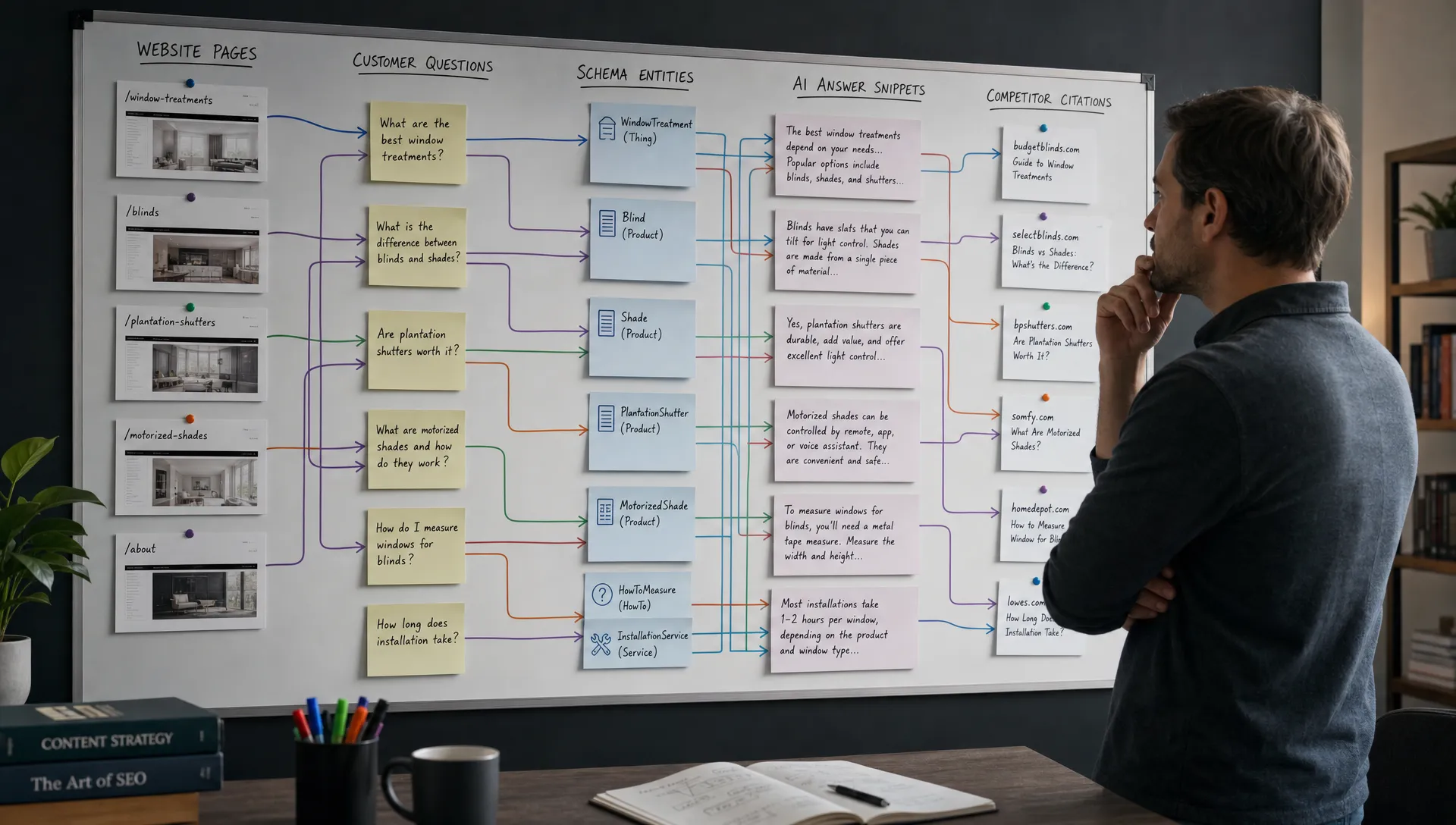
Entities are the people, places, products, services, organizations and concepts that help machines understand what a page is about. Schema is structured data that labels some of those facts in a machine-readable format.
This prompt finds places where your page may be semantically clear to a human but under-specified for crawlers and AI systems.
Review the page evidence below for entity clarity and structured data opportunities. Identify the primary entity, supporting entities, missing entity relationships and any ambiguity that could make the page harder for AI systems to understand. Recommend schema types only when they match visible page content. Consider Organization, LocalBusiness, Hotel, Product, Service, FAQPage, BreadcrumbList, Article and Review schema where appropriate. Also flag metadata or llms.txt entries that could help AI crawlers identify canonical, high-value content. Page evidence: [paste extracted copy, current schema, title tag, meta description, breadcrumbs and internal links].
The key phrase is “only when they match visible page content.” Schema is not a place to add claims that users cannot see. It is a way to clarify facts already present on the page.
For a multi-location retail brand, entity gaps often appear when all location pages use similar copy but do not clearly identify services, nearby areas, staff, inventory, hours or local proof. For e-commerce, the gaps often sit in product attributes, compatibility details, size data, shipping questions and comparison criteria. For hotels, look at amenities, neighborhood entities, event spaces, policies and nearby landmarks.
llms.txt can also support AI discovery by pointing crawlers toward important content, but it does not replace crawlability, canonical accuracy or clean internal linking. Treat it as a guide, not a fix for a weak information architecture.
5. Prompt for internal linking and crawlability gaps
Internal links help search engines and AI systems understand relationships between pages. They also help users move from an answer to a conversion path. A technically valid page can still be underused if it sits in a dead end.
Analyze the internal linking evidence below. Identify pages that should be connected because they share entities, buyer intent, locations, products, services or proof points. Flag orphaned or weakly linked pages, missing breadcrumb relationships and pages that do not link to the next logical step in the buyer journey. Recommend anchor text that is natural, specific and useful to the reader. Evidence: [paste sitemap sections, navigation, breadcrumbs, internal link exports and priority page list].
This prompt is practical for site fleets. A franchise brand may have strong national service pages but weak links to local pages. A hotel group may publish strong destination guides but fail to connect them to relevant properties, meeting spaces or packages. An IT service provider may have useful security articles that never link to the managed service page that converts demand.
The fix is rarely “add more links everywhere.” Better internal linking means adding the right links where they make sense: from informational pages to proof pages, from proof pages to service pages, from service pages to location pages and from comparison pages to conversion pages.
For AI search, these links reinforce entity relationships. For users, they reduce friction. Both effects matter.
6. Prompt for technical SEO and page performance gaps
Generative engines still depend on retrievable, readable content. If important copy is blocked, hidden behind scripts, duplicated through messy canonicals or slowed by heavy pages, it is harder to trust and reuse.
This prompt connects technical SEO to AI visibility instead of treating it as a separate checklist.
Review the technical evidence below and identify issues that could reduce search visibility or AI answer inclusion. Evaluate crawlability, indexability, canonical tags, redirects, rendered content, robots directives, XML sitemap coverage, structured data validity, mobile usability, Core Web Vitals indicators and page speed. For each issue, explain the likely business effect and classify the fix as Content, Technical, Template or Governance. Evidence: [paste crawl export, status codes, canonical data, robots rules, performance data and examples of affected URLs].
The most useful output is a prioritized table. A noindex tag on a revenue page is more urgent than a missing image dimension on an old blog post. A broken canonical pattern across hundreds of location pages is more urgent than a single slow article with no commercial role.
Tie every technical issue to a business effect. “Largest Contentful Paint is weak” is a web performance observation. “The mobile booking page is slow enough to create friction before users compare room options” is a business problem. That phrasing helps teams act.
7. Prompt for answer-ready content gaps
AEO is about helping answer engines extract a complete, accurate response. That does not mean writing robotic paragraphs. It means making sure each key page has concise answer blocks, credible supporting detail and a clear next step.
Convert the content gaps below into answer-ready improvements. For each priority page, recommend concise answer blocks, FAQ questions, comparison sections, proof elements, metadata updates, schema opportunities and internal links. Keep recommendations aligned with visible facts and avoid unsupported claims. For each recommendation, explain which AI prompt or customer question it supports. Evidence: [paste content gap table, priority pages, customer questions, current FAQs and conversion goals].
Good answer-ready content often includes a direct answer near the top, followed by details that help the buyer decide. For a hotel, that might mean a section answering who the property is best for. For an MSP, it might be a plain-language breakdown of onboarding, coverage, escalation and supported platforms. For a retailer, it might be compatibility guidance, return policy context and product comparisons.
Do not create FAQs just because schema exists. Create FAQs because customers ask those questions and because the answers reduce uncertainty. Then mark them up where appropriate.
How to prioritize the gaps you find
Not every gap deserves the same urgency. A missing FAQ on a low-traffic awareness article may be useful, but a missing answer on a high-intent location page can affect leads or bookings much sooner.
Use this prioritization model after running the seven prompts.
| Signal | Why it matters | Priority |
|---|---|---|
| High-intent AI prompts mention competitors but not you | Your brand is absent during evaluation | High |
| AI answers cite competitor pages for facts you also provide | Your evidence is harder to extract or trust | High |
| Revenue pages have crawlability, canonical or rendering problems | AI and search systems may not see the page correctly | High |
| Key entities are unclear or missing from schema | Models may not connect your brand to the right service or location | Medium to high |
| Internal links do not connect guides to conversion pages | Users and crawlers lose the path from research to action | Medium |
| Metadata and FAQs are thin but page content is strong | The page may need packaging more than rewriting | Medium |
| Low-value articles are missing minor long-tail questions | Useful only if tied to a larger content hub | Low |
For most teams, the fastest wins come from pages that already have business value but are not AI-ready. Rewrite only after you fix clarity, crawlability, internal links, structured data and answer formatting.
Turning SEO prompts into a repeatable workflow
The value of these SEO prompts increases when you run them on a schedule. A one-time audit gives you a snapshot. A monthly or quarterly workflow shows whether fixes change brand mentions, citations and share of voice across AI search surfaces.
A practical workflow looks like this: choose priority journeys, test real prompts across AI engines, compare your pages against competitors, identify gaps, ship fixes, then re-test. CapstonAI supports this measurement-first approach with AI visibility scans, prompt and mention mapping, competitor monitoring, content recommendations, structured data support and WordPress-first publishing workflows.
The important part is before/after evidence. If you update a hotel meeting page, you should be able to see whether meeting-related prompts begin to surface that property more often. If you improve schema and content on service-area pages, you should be able to monitor whether brand mentions and citations improve for those local prompts.
AI search is not a reason to abandon SEO fundamentals. It is a reason to make them more explicit. Pages need to load quickly, be crawlable, define entities clearly, answer real questions, earn citations and connect through clean internal links.
Frequently Asked Questions
Are SEO prompts enough to find every content gap? No. SEO prompts are useful for diagnosis, but they should be paired with Search Console data, crawl data, competitor research, customer questions and live AI visibility scans. Prompts help you see patterns. Measurement confirms whether the gap affects visibility.
Which AI search engines should we test? Test the systems your customers are likely to use, including ChatGPT, Google AI Overviews, Gemini, Perplexity, Claude and Copilot. Do not assume they will surface the same brands or citations. Prompt results can vary by engine, query phrasing and available sources.
How do content gaps affect share of voice in AI search? If your pages do not answer important prompts, define entities clearly or provide citeable evidence, AI systems may mention competitors more often. Share of voice tracking shows how frequently your brand appears compared with rivals across a defined set of prompts.
What is the difference between GEO and AEO? GEO focuses on making your content usable by generative engines. AEO focuses on structuring content so it answers specific questions clearly. In practice, strong AI visibility needs both, plus technical SEO foundations such as crawlability, schema, internal linking and page performance.
Should every site add llms.txt? llms.txt can help point AI crawlers toward important resources, but it is not a substitute for clean site architecture, accessible content, accurate metadata or valid structured data. Use it as part of a broader AI visibility strategy.
How often should teams run a content gap workflow? For stable sites, quarterly is a reasonable starting point. For multi-location brands, active e-commerce catalogs or agencies managing fast-moving clients, monthly reviews are more practical because prompts, competitors and AI answer patterns can change quickly.
Start with a free AI visibility audit
If AI cannot see your business clearly, it cannot recommend it confidently. CapstonAI makes that visibility measurable.
Start with a free AI visibility audit to see how your brand appears across generative engines, where competitors are being mentioned or cited instead and which technical or content fixes should come first. From there, you can turn SEO prompts into a managed GEO and AEO workflow with clear priorities, before/after proof and fewer blind spots.