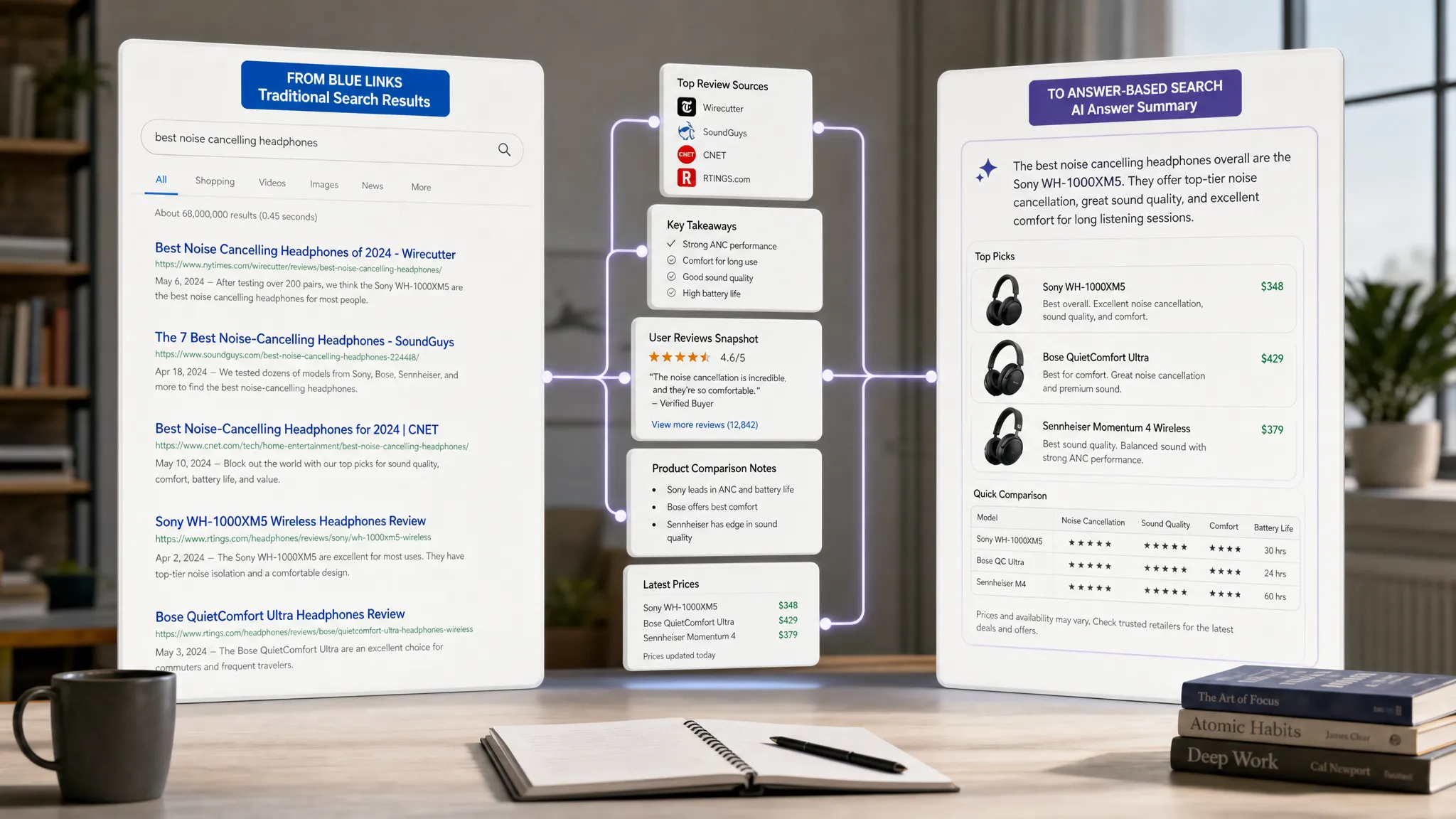
For years, search ranking meant one thing: where your page appeared among Google’s blue links. If you were position one, you owned attention. If you were buried on page two, you barely existed.
That model is no longer enough.
Search results now include AI summaries, featured snippets, map packs, shopping modules, video results, forum discussions, product comparisons, and direct answers. At the same time, buyers are asking ChatGPT, Gemini, Claude, Perplexity, and other AI engines for recommendations before they ever visit a traditional search results page.
The result is a major shift for marketers: visibility is no longer only about ranking a page. It is about whether your brand is mentioned, cited, recommended, understood, and trusted across the places where users ask questions.
What “search ranking” means in 2026
Traditional rankings still matter. Google organic traffic remains valuable, especially for commercial pages, high-intent queries, local search, and product discovery. But the ranking landscape has become multi-layered.
A brand can rank number one organically and still lose influence if an AI answer recommends competitors. A product can appear in a shopping result but be absent from a conversational comparison. A local business can perform well in maps but be invisible when users ask an AI assistant for “the best option near me.”
Search ranking now includes three connected layers:
| Ranking layer | What it measures | Why it matters |
|---|---|---|
| Traditional rank | Your position in organic search results | Still drives traffic, clicks, and demand capture |
| SERP feature visibility | Presence in snippets, AI Overviews, maps, images, video, shopping, and forums | Captures attention before users scroll to blue links |
| AI search visibility | Mentions, citations, recommendations, and accuracy in AI-generated answers | Influences buyers during research, comparison, and decision-making |
In other words, the question is no longer just “Where do we rank?” It is also “Where do we appear when search engines answer?”
Why blue links are losing their monopoly on attention
The blue link model was built around a simple user journey: type a query, scan results, click a page, evaluate the content, then take action. That journey still exists, but it is increasingly compressed.
Google has added more answer-style experiences directly into the search results. Its rollout of AI Overviews signaled a wider move toward synthesized answers, where users can get a summary before choosing whether to click. Featured snippets, People Also Ask boxes, local packs, and product modules were already moving search in this direction.
AI assistants accelerate the shift further. A user may ask, “What are the best project management tools for a remote marketing team?” or “Which skincare brand is safest for sensitive skin?” Instead of reviewing ten pages, they receive a shortlist, a comparison, and sometimes citations. If your brand is missing from that answer, your traditional ranking may not save you.
This does not mean SEO is dead. It means SEO has expanded. Search engines and AI systems still need content, authority signals, structured data, reviews, citations, and reliable entities. The difference is that those signals are now used not only to order links, but also to generate answers.
The new signals behind modern search visibility
Modern search visibility is shaped by how well machines can identify, trust, and reuse your information. A page that ranks well for humans but is hard for AI systems to parse may underperform in answer engines. A brand with strong third-party validation may be recommended even when its own site is not the top organic result.
Entity clarity
AI systems need to understand who you are, what you offer, where you operate, and how you differ from alternatives. Entity clarity comes from consistent naming, clear About pages, structured organization data, product descriptions, author bios, and accurate external profiles.
If your brand is described differently across your website, LinkedIn, review platforms, directories, and partner pages, AI systems may struggle to connect the signals. That can lead to weak mentions, inaccurate summaries, or no mention at all.
Answer-ready content
AI-generated answers favor content that is easy to extract and summarize. Dense marketing copy can be persuasive for humans, but it may not answer specific questions clearly enough for AI systems.
Strong answer-ready content usually includes concise definitions, comparison tables, FAQs, step-by-step explanations, use cases, pricing or availability context when appropriate, and direct answers near the top of relevant sections.
This is especially important for mid-funnel queries, such as “best CRM for small agencies,” “Shopify SEO automation tools,” or “how to choose an AI visibility platform.” These searches are not just informational. They influence vendor shortlists.
Structured data and machine-readable context
Structured data helps search engines interpret content more confidently. It does not guarantee ranking or AI citation, but it improves machine readability when implemented correctly.
Google’s structured data documentation explains how schema can help search systems understand page meaning and eligibility for rich results. For brands adapting to AI search, schema is part of a broader clarity strategy: products, reviews, organizations, FAQs, articles, locations, and breadcrumbs should all be marked up where relevant.
Third-party corroboration
AI systems do not rely only on what you say about yourself. They look for corroboration across the web: media mentions, review sites, customer discussions, analyst pages, partner directories, marketplace profiles, and industry resources.
This is one reason brand visibility can vary dramatically across AI engines. One model may rely heavily on recent web retrieval. Another may lean more on its training data or specific citation sources. A brand with strong, consistent external proof is more likely to be surfaced accurately.
Freshness and topical authority
Search ranking has always rewarded relevance, but AI search makes freshness more visible. If your category changes quickly, outdated pages can weaken your credibility. This is especially true in software, e-commerce, healthcare, finance, travel, and local services.
Freshness does not mean changing a date without improving substance. It means updating examples, adding new comparisons, clarifying product changes, refreshing FAQs, and reflecting current customer questions.
How to optimize when ranking is no longer a single position
The best approach is not to abandon traditional SEO. It is to layer AI visibility work on top of a strong SEO foundation.
Start by identifying where your brand appears today. Search your priority topics in Google, Bing, ChatGPT, Gemini, Claude, and Perplexity. Ask the same questions your customers ask. Compare the answers across engines. Look for mentions, citations, recommendation language, competitors, inaccuracies, and missing use cases.
Then build an optimization workflow around the gaps.
- Audit your current AI search visibility across branded, category, competitor, and problem-based prompts.
- Map the prompts that matter most to your buyer journey, from early research to vendor comparison.
- Improve pages that AI systems should cite, including product pages, comparison pages, FAQs, location pages, and educational guides.
- Strengthen structured data, metadata, internal links, and entity consistency across your site.
- Build third-party proof through reviews, partnerships, digital PR, directories, and customer evidence.
- Monitor changes over time because AI answers can shift as models, indexes, and source preferences change.
For a deeper tactical framework, CapstonAI’s guide on how to measure AI performance across search engines explains the metrics brands should track across ChatGPT, Gemini, Claude, Perplexity, and Google AI experiences.
Metrics that matter beyond traditional rankings
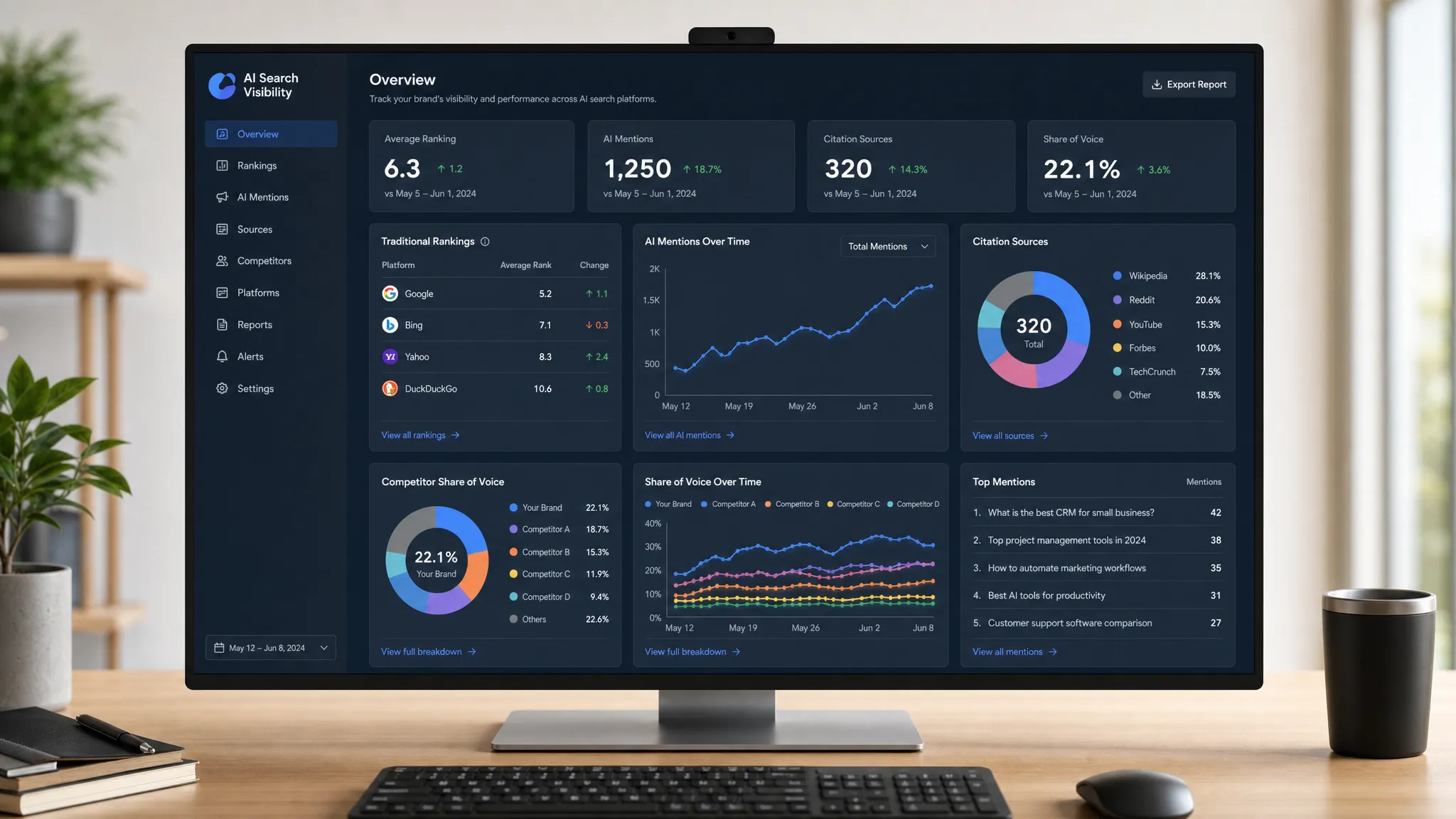
Ranking reports are still useful, but they are no longer complete. If your dashboard only tracks keyword positions, you may miss where attention is moving.
Modern search measurement should combine traditional SEO metrics with AI visibility metrics. This gives teams a more accurate picture of discovery, influence, and risk.
| Metric | What it tells you | Example question it answers |
|---|---|---|
| Organic rank | Where your page appears in traditional results | Are we still competitive for target keywords? |
| AI mention rate | How often your brand appears in AI responses | Are AI engines aware of us for this topic? |
| Recommendation rate | How often your brand is suggested as a solution | Are we making the shortlist? |
| Citation rate | How often your website or content is cited | Are AI engines using our pages as sources? |
| AI share of voice | Your visibility compared with competitors | Who dominates AI-generated answers in our category? |
| Accuracy score | Whether AI responses describe your brand correctly | Are users receiving correct information about us? |
| Prompt coverage | How many priority prompts include your brand | Which buyer questions are we missing? |
| Volatility | How much AI visibility changes over time | Are model updates or content changes affecting us? |
This is where many SEO teams need a reporting reset. A keyword can hold steady while AI mentions decline. A competitor can gain AI share of voice before their organic rankings improve. A brand can receive citations for educational content but fail to appear in commercial recommendations.
The winners will be the teams that detect these shifts early.
What this means for brand, SEO, and agency teams
The evolution of search ranking changes responsibilities across the marketing organization.
SEO teams need to think beyond page optimization and track how content is used in answers. Content teams need to write for both human persuasion and machine extraction. Brand teams need to maintain consistent positioning across owned and third-party channels. PR teams need to secure credible external proof that AI systems can discover. Agencies need to show clients not only rankings and traffic, but also AI visibility, competitive mentions, and recommendation share.
This also changes how teams prioritize content.
In the past, a content calendar might begin with keyword volume. Today, it should also consider prompt frequency, buyer questions, AI answer gaps, competitor visibility, and citation potential. A low-volume question can be commercially valuable if it appears in AI-assisted vendor evaluation.
For example, a B2B software company may not see huge search volume for “best compliance workflow tool for regional banks,” but that prompt could matter if buyers ask AI assistants for shortlist recommendations. Similarly, a retailer may need to optimize product data and review signals so AI shopping experiences can understand which products fit which customer needs.
If your team is already optimizing for AI Overviews, the same discipline applies. Clear answers, structured content, credible sources, and updated pages improve your odds of being selected. CapstonAI’s guide on how to optimize for AI Overviews breaks down practical steps for Google’s AI-generated search experiences.
Common mistakes brands make in the post-blue-link era
The first mistake is assuming that high Google rankings automatically translate into AI recommendations. They help, but they are not the whole picture. AI systems may cite other sources, summarize competitor pages, or recommend brands with clearer third-party validation.
The second mistake is only checking branded prompts. Asking “What is our company?” is useful, but it does not reveal whether you appear in category searches, comparison prompts, local recommendations, or problem-based queries. Most discovery happens before the user knows your brand name.
The third mistake is treating AI visibility as a one-time audit. AI answers are dynamic. They can change when source pages update, competitors publish new content, models refresh, or retrieval systems choose different citations. Ongoing monitoring is essential.
The fourth mistake is creating generic AI content at scale without improving authority. More content does not automatically mean more visibility. AI systems need clear, trustworthy, corroborated information. Thin pages can weaken trust rather than improve it.
The fifth mistake is ignoring accuracy. A brand mention is not always a win. If an AI engine describes your pricing, locations, product features, or target audience incorrectly, that misinformation can affect demand. Tracking and correcting inaccurate AI results should become part of reputation management.
A practical framework for evolving your search strategy
The shift beyond blue links can feel complex, but the operational model is straightforward: measure, diagnose, improve, and defend.
Measure where your brand appears across traditional search and AI engines. Diagnose gaps by prompt type, competitor, location, product line, and source. Improve the content and metadata that AI systems can use. Defend your visibility with alerts, regular audits, and ongoing authority building.
A strong 90-day plan might look like this:
| Timeframe | Priority | Outcome |
|---|---|---|
| Days 1 to 30 | Establish baseline visibility across search engines and AI assistants | Know where you are mentioned, cited, ignored, or misrepresented |
| Days 31 to 60 | Fix entity, metadata, FAQ, schema, and content gaps | Make your site easier for search and AI systems to understand |
| Days 61 to 90 | Build external proof and monitor competitor movement | Improve recommendation likelihood and protect share of voice |
This approach turns search ranking from a static report into a visibility system. Instead of reacting to traffic drops after they happen, teams can identify missing prompts, weak citations, and competitor gains before they become revenue problems.
For brand teams starting from scratch, the AI search readiness checklist is a useful way to organize the first round of fixes.
The future of search ranking is influence, not just position
The phrase “search ranking” will not disappear. Marketers will still care deeply about keyword positions, organic traffic, and conversion rates. But the meaning of ranking is expanding.
The future belongs to brands that are visible wherever answers are formed. That includes blue links, AI Overviews, ChatGPT responses, Perplexity citations, Gemini summaries, shopping recommendations, local results, and comparison content.
Winning search now means earning machine-readable trust across the full discovery journey. It means being present when users ask questions, being accurate when AI systems summarize you, and being recommended when buyers compare options.
Blue links are still part of the game. They are no longer the whole field.
Frequently Asked Questions
Is traditional search ranking still important? Yes. Traditional organic rankings still drive valuable traffic and conversions. The change is that rankings are now only one part of visibility. Brands also need to track AI mentions, citations, recommendations, and answer accuracy.
What is the difference between SEO and AI search visibility? SEO focuses on improving visibility in traditional search results, while AI search visibility measures how AI engines mention, cite, summarize, and recommend your brand. The two overlap because AI systems still rely on web content, authority, metadata, and structured information.
Can a brand rank well in Google but be invisible in AI answers? Yes. A strong organic ranking does not guarantee inclusion in AI-generated answers. AI engines may prefer clearer sources, stronger third-party proof, more structured content, or more recent information.
How do you measure search ranking beyond blue links? Track traditional keyword positions alongside AI mention rate, recommendation rate, citation rate, AI share of voice, prompt coverage, and accuracy. Comparing these metrics against competitors gives a more complete visibility picture.
How often should brands monitor AI search visibility? High-priority categories should be monitored regularly because AI answers can change as models, sources, and competitor content evolve. Weekly or monthly tracking is often a practical starting point for marketing teams.
Turn AI search visibility into a measurable growth channel
If your team is still measuring search ranking only through blue links, you may be missing where buyers are already making decisions.
CapstonAI helps brands, retailers, and agencies scan AI visibility, map prompts and mentions, track competitors, publish AI-ready FAQs and metadata, and monitor share of voice across major AI engines. Start with a free AI visibility audit to see how ChatGPT, Gemini, Claude, Perplexity, and Google AI experiences understand your brand today.