Quality control for SEO and AI can no longer live in one spreadsheet. Traditional SEO asks whether a page can rank, earn clicks and satisfy a searcher. AI search asks a different question: can a model understand, trust, summarize and cite the business accurately when a prospect never reaches the website?
That difference matters for hotel groups, franchises, e-commerce teams, MSPs and agencies because the business outcome is no longer only organic sessions. It is also visibility inside ChatGPT, Google AI Overviews, Gemini, Perplexity, Claude, Copilot and other answer surfaces where prospects compare options before they click.
Where SEO and AI Need Different Quality Controls
Classic SEO quality control is still the base layer. If a page is blocked from crawling, slow to load, internally orphaned or unclear about search intent, it will struggle in both Google results and AI-generated answers. Technical debt still becomes commercial debt.
AI search adds a second layer: answer reliability. A generative engine may mention your brand without linking to you, cite a competitor instead of you or summarize your offer using outdated third-party information. That is not a title-tag problem. It is a visibility, entity and citation problem.
The practical answer is to separate SEO and AI quality controls while keeping them connected. One set of checks protects discoverability in search engines. The other tests whether generative systems can read your pages, connect them to the right entities and reuse the information with confidence.
If your team needs a broader baseline before building controls, CapstonAI has a separate guide on how AI SEO differs from traditional SEO. This article focuses on the quality gates that should change in your workflow.
| Quality area | Traditional SEO control | AI search control | Business effect |
|---|---|---|---|
| Discovery | Crawl status, indexability, canonical tags | Whether AI crawlers and answer engines can access and parse key pages | More complete brand coverage |
| Relevance | Keywords, intent match, headings and content depth | Entity clarity, answer completeness and prompt-topic fit | Better inclusion in comparative answers |
| Authority | Backlinks, internal links and topical coverage | Citations, third-party corroboration and brand consistency | Higher credibility when models summarize options |
| Measurement | Rankings, impressions, clicks and conversions | Mentions, citations, share of voice and prompt coverage | Visibility beyond the click |
| Governance | Editorial review and technical QA | Human review of AI-generated recommendations and model outputs | Lower risk of inaccurate updates |
Quality Control 1: Can Search Engines Crawl, Index and Evaluate the Page?
The first gate is not new, but it has higher consequences now. If a location page, service page or category page is hard for a search engine to discover, it is also harder for AI systems to treat as a trustworthy source.
For SEO and AI programs, technical quality control should start with the pages that create revenue: hotel property pages, healthcare location pages, product category pages, franchise pages and high-intent service pages. These pages need clean indexation, useful internal links, fast rendering and a clear relationship to the broader site architecture.
The checks are familiar, but they should be interpreted through business impact. A page buried five clicks deep may still exist, but it is less likely to be found, refreshed and reused. A slow page with poor Core Web Vitals can reduce conversions after the click, even if it earns an AI citation. A canonical error on a location page can make the wrong branch, clinic or storefront appear authoritative.
A practical crawlability gate should confirm that key pages are indexable, internally linked from relevant hubs, supported by XML sitemaps and free from conflicting canonical, noindex or redirect signals. For implementation detail, CapstonAI explains how to build a website that AI engines can understand without treating technical SEO as a separate silo.
Quality Control 2: Can AI Engines Understand the Entity Behind the Page?
Ranking systems evaluate pages. Generative engines also evaluate entities. A brand, hotel, clinic, school, retailer or MSP must be clearly connected to its services, locations, credentials, products, policies and audience.
This is where structured data and schema become quality controls, not decorative markup. Organization, LocalBusiness, Product, FAQPage, BreadcrumbList and Service schema can help machines identify what each page represents. Schema does not guarantee visibility, but weak or inconsistent structured data makes the page harder to interpret.
Entity QA should compare what the business says on its site with what the web says elsewhere. If your hotel amenities differ between the property page, booking platforms and review profiles, AI systems may choose the more frequently repeated source. If your MSP service area is vague, a model may not include you in location-based recommendations.
A useful SEO and AI control is to ask one blunt question: if a model only saw this page and a few corroborating sources, would it know exactly who we are, where we operate, what we offer and why we should be trusted?
Quality Control 3: Can the Page Be Reused as an Answer?
AEO, or Answer Engine Optimization, is the discipline of structuring content so it can answer specific questions clearly. GEO, or Generative Engine Optimization, extends that idea to how generative systems synthesize and cite content across multiple sources.
This does not mean every page should become a FAQ dump. It means the page should contain extractable answers to the questions prospects actually ask. For a hotel group, that may include parking, pet policies, airport distance, accessibility, meeting space and local attractions. For an MSP, it may include compliance coverage, response model, supported platforms and industries served.
The quality control is simple: each priority page should have answer-ready sections that are accurate, specific and easy to lift without losing context. A paragraph that says the company offers comprehensive solutions is weak. A paragraph that names the service, audience, geography, constraints and next step is much stronger.
For example, a logistics company targeting AI infrastructure buyers should not publish a generic article about technology trends. A page about freight management and logistics for AI data centers earns relevance by naming air, ocean, drayage, customs, warehousing, transloading and staged delivery, the concrete entities an assistant must connect to the buyer’s problem.
Quality Control 4: Are Mentions, Citations and Share of Voice Measured?
Traditional reporting often stops at impressions, rankings, clicks and conversions. Those metrics still matter, but they miss a growing part of discovery: AI answers that influence the buyer before a website visit happens.
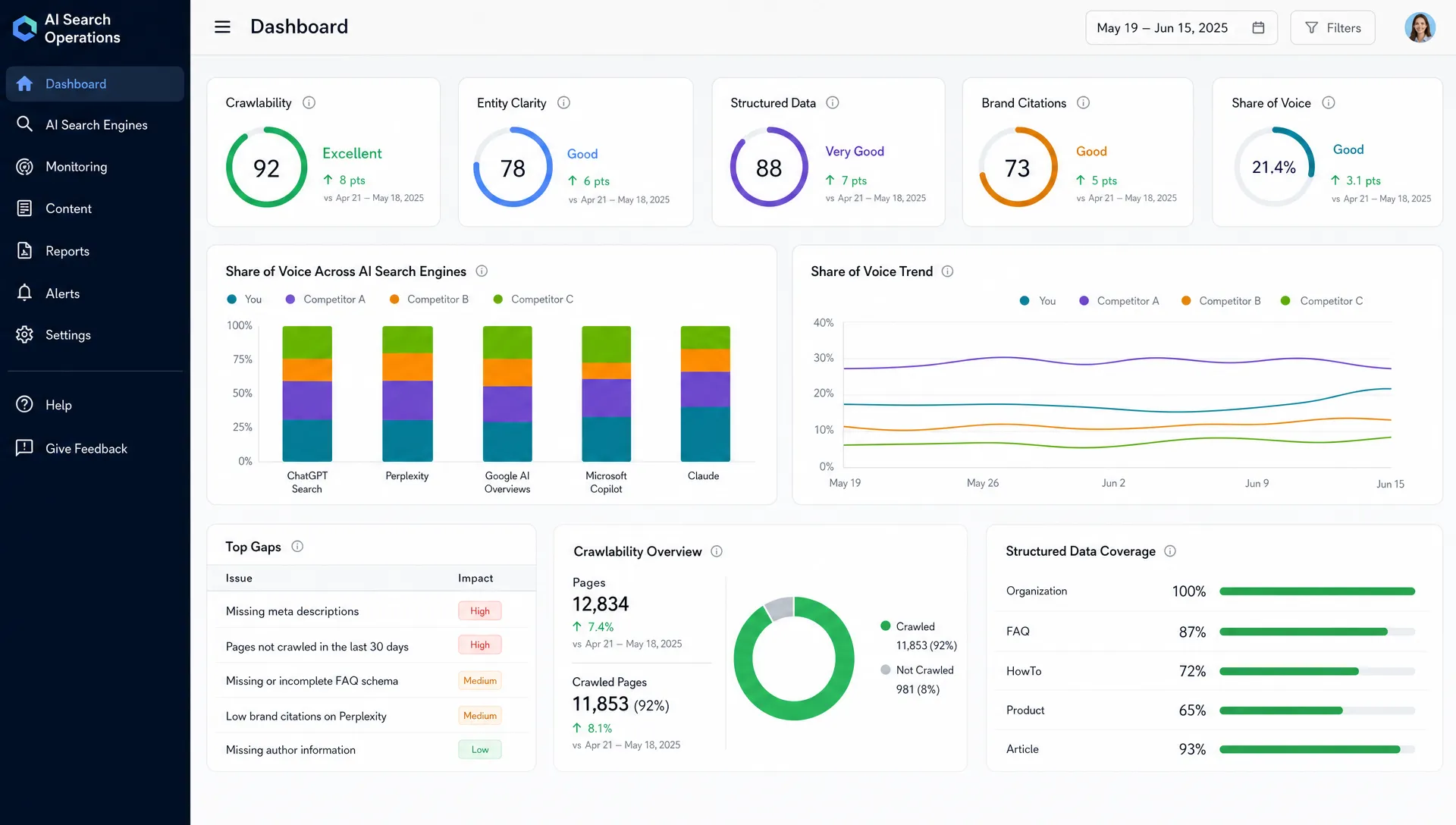
For SEO and AI, measurement should include prompt coverage, brand mentions, citation frequency and competitive share of voice. If a prospect asks Perplexity for the best boutique hotels near a destination, does your property appear? If someone asks ChatGPT for WooCommerce agencies that improve performance and SEO, does your agency get named? If Google AI Overviews summarizes a product category, are you cited or ignored?
The quality control is not a one-time test. Prompts change, model behavior changes and competitors publish new content. A solid process tracks a representative set of commercial, informational and comparison prompts over time, then maps which prompts surface your brand, which surface rivals and which cite sources you can influence.
This is also where blind spots become actionable. If AI engines mention your competitor because their location pages have clearer policies, the fix is not a generic blog post. It is a structured update to the pages that models should be using.
Quality Control 5: Is AI-Assisted Work Reviewed Before It Ships?
AI can speed up audits, schema drafts, metadata improvements, content briefs and reporting. It can also multiply weak assumptions if nobody checks the work. The quality control is not whether AI was used. The control is whether the output was verified against the page, the brand, the audience and the business goal.
A durable SEO and AI workflow separates automation from approval. Automation can surface missing schema, thin answers, duplicate metadata and prompt gaps. Human reviewers should confirm factual accuracy, compliance requirements, tone, claims, local details and whether the recommendation would help a real buyer make a decision.
This distinction is especially important for regulated or distributed businesses. A healthcare franchise cannot let an AI-generated paragraph imply services are available at every clinic if they are not. A travel group should not allow a model-generated amenity list to invent parking, shuttle service or accessibility features. An e-commerce team should not publish product schema that conflicts with stock, pricing or variant data.
CapstonAI covers the division of labor in more detail in its article on where automation helps and human review matters. The short version is that automation should accelerate detection and drafting, not remove accountability.
A Practical Quality Control Checklist
The strongest teams treat quality control as a release process, not a quarterly clean-up. Before a high-value page goes live or gets updated, it should pass search, answer and governance checks.
Use this checklist for priority pages:
- Confirm the page is crawlable, indexable and linked from a relevant hub.
- Check page speed and rendering, especially for JavaScript-heavy templates.
- Validate schema against the visible content and business reality.
- Clarify the main entity, supporting entities, location signals and service scope.
- Add concise answer sections for high-intent questions.
- Review internal links so related pages reinforce the same entity graph.
- Test representative prompts in ChatGPT, Gemini, Perplexity, Claude, Copilot and Google AI Overviews where available.
- Track whether the brand is mentioned, cited and accurately described.
- Compare AI answers against competitors to identify missing proof or clearer claims.
- Approve changes through a human review step before publishing.
The emerging llms.txt convention can also belong in this process. It is not a replacement for crawlability, schema or content quality, and it should not be treated as a guaranteed ranking signal. Used carefully, it can help point AI systems toward important resources and clarify which pages are designed to be read and reused.
Common Failure Patterns Across Multi-Site Brands
The same problems appear often in franchise, hospitality, retail, healthcare and education sites. The homepage may be strong, but the local pages are thin. The brand may have rich product information, but structured data is incomplete. The blog may publish frequently, but internal linking does not connect educational content to booking, lead or purchase pages.
Another pattern is source conflict. AI systems often have to reconcile your website, directories, marketplace listings, reviews, social profiles and third-party articles. If those sources disagree, the model may produce a cautious answer, omit the brand or cite a stronger competitor.
This is why SEO and AI quality control should include market monitoring. Your own site is only one input. The engines also observe the wider web, and your competitors can become the default answer when their pages are more consistent, better structured or more frequently cited.
What CapstonAI Adds to the Process
CapstonAI is built for teams that need measurement before they decide what to fix. The platform scans AI visibility across multiple engines and assistants, tracks brand mentions, citations and share of voice, maps the prompts that surface you or your competitors and turns findings into prioritized recommendations.
For teams managing many pages, brands or locations, that matters because manual spot-checking does not scale. A hotel group may need to know why one property appears in AI answers and another does not. An agency may need proof that schema, FAQ or metadata changes improved visibility. A retailer may need alerts when competitors start appearing for prompts tied to revenue categories.
CapstonAI also supports AI-ready FAQ, schema, metadata and llms.txt publishing, with WordPress-first CMS integration and extensibility for more complex environments. The point is not to replace SEO fundamentals. It is to make AI visibility measurable enough that teams can fix the right pages first.
Frequently Asked Questions
Do SEO quality controls still matter for AI search? Yes. Crawlability, indexation, internal linking, page performance and structured data still help AI systems discover and interpret your content. AI search adds more controls, but it does not remove the base layer.
What is the biggest quality control difference between ranking and AI visibility? Ranking checks whether a page appears in search results. AI visibility checks whether a generative engine mentions, cites and summarizes the brand accurately across relevant prompts.
How often should teams test prompts in generative engines? Priority prompts should be checked on a regular schedule and after major site changes. The right cadence depends on competition, seasonality and revenue impact, but one-off testing is rarely enough.
Is llms.txt required for SEO and AI performance? No. llms.txt is an emerging convention, not a replacement for technical SEO or structured content. It can support clarity, but it should be used alongside crawlable pages, schema, internal links and accurate content.
Can agencies use AI quality controls across many client sites? Yes, but the process needs standard metrics and client-specific review. Agencies should track prompt coverage, citations, share of voice, technical fixes and human approvals so reporting is consistent without becoming generic.
Start With a Free AI Visibility Audit
If you do not know how ChatGPT, Gemini, Claude, Perplexity, Copilot and Google AI Overviews describe your brand, the first quality control is measurement. Guessing from rankings alone leaves too many blind spots.
Start with a free AI visibility audit from CapstonAI. You will see where your brand appears, where competitors are being cited instead and which technical or content fixes are most likely to improve AI search presence. AI cannot use what it cannot see. CapstonAI helps make your business visible, measurable and easier to trust.