Choosing a search engine with AI for brand research is not the same as choosing a place to type questions. For a brand team, the real question is whether the engine can show how buyers, journalists, partners and prospects might see your company when AI summarizes a market. The right choice should help you understand citations, brand mentions, competitor visibility and gaps you can fix.
Classic search tells you who ranks. AI search tells you who gets used as evidence. By 2026, that distinction matters for independent hotel groups, multi-site franchises, MSPs, ecommerce teams and agencies because many prospects now compare options inside ChatGPT, Google AI Overviews, Gemini, Perplexity, Claude and Copilot before they visit a website.
Use the criteria below to choose the right engine for the research job, then connect the findings to Generative Engine Optimization, Answer Engine Optimization and technical SEO improvements.
What a search engine with AI can and cannot tell you
An AI search answer is a generated response based on model knowledge, retrieved web sources, user context and the wording of the prompt. In simple terms, the engine is not just listing links. It is deciding which entities, pages and sources are useful enough to synthesize into an answer.
That makes AI search useful for brand research because it shows what the public web strongly says about your business. It can reveal whether your hotel is recommended for a family trip, whether your MSP is associated with a specific security service, or whether your WooCommerce store is cited for a product category.
It cannot tell you private conversion data, guarantee the same answer for every user or replace analytics. Treat each result as an observable signal. If Perplexity cites three competitor guides for best managed IT providers in Dallas and your company is absent, the research question is not only why did we not appear. It is also which sources, entities and page signals made those competitors easier to cite.
The best search engine with AI for this work is the one that exposes enough evidence to turn an answer into a fixable marketing problem.
Start with the research job, not the logo
Before comparing engines, define the business decision the research needs to support. A travel group auditing visibility for boutique hotels needs different evidence than an ecommerce team checking product comparison answers. An agency managing 50 client sites needs repeatability and reporting more than a single impressive answer.
Most brand research falls into five practical jobs:
- Discovery research: which brands are suggested for a category, location, use case or audience?
- Citation research: which pages, review sites, directories, articles or product pages are used as evidence?
- Message accuracy: does the answer describe your services, locations, pricing model or differentiators correctly?
- Competitive share of voice: how often do you appear compared with direct competitors across the same prompt set?
- Technical opportunity: which missing schema, crawlability issues, metadata gaps or weak internal links could make your pages harder to reuse?
Choose the engine based on the job. A search engine with AI that is strong for citation trails may be better for content diagnostics, while one embedded into a large search ecosystem may be better for understanding commercial discovery at scale.
Compare the engines your buyers actually use
No single engine represents the entire AI search market. Brand research is stronger when you test the answer environments your audience is most likely to use. For many teams, that means a mix of ChatGPT, Google AI Overviews, Gemini, Perplexity, Claude and Copilot.
| Engine or answer environment | Strongest brand research signal | Watch for | Best business use |
|---|---|---|---|
| ChatGPT | Broad synthesis, comparison prompts and conversational follow-ups | Answers can vary by mode, source access and prompt wording | Testing how buyers frame options, objections and shortlist questions |
| Google AI Overviews and Gemini | Visibility inside Google’s search and AI ecosystem | Coverage changes by query type, location and result availability | Local discovery, ecommerce research, travel planning and service comparisons |
| Perplexity | Citation-forward answers with visible source paths | Cited sources may still omit important brand context | Finding which third-party pages influence AI answers |
| Claude | Long-form reasoning and document-heavy analysis when source access is available | Public web behavior may differ from other engines | Reviewing complex positioning, RFP-style comparisons and expert content |
| Copilot | Microsoft and Bing-connected discovery contexts | Results may reflect Microsoft ecosystem behavior | B2B research, professional services and workplace technology queries |
A healthcare franchise may prioritize Google AI Overviews and Gemini because local and category searches are critical to appointment demand. A B2B MSP may add Copilot because Microsoft-connected workflows influence IT buyers. A direct-to-consumer brand may start with ChatGPT and Perplexity to understand comparison prompts and citation gaps.
Your shortlist should include more than one search engine with AI because buyers rarely use one answer environment only. Cross-engine testing also helps separate a real brand visibility problem from a one-off model response.
Score each option against five criteria
Once you have candidate engines, compare them with the same prompt set. Do not rely on casual searches like best hotels or top ecommerce agency. Build prompts from actual buyer journeys, including category discovery, local modifiers, comparison language, problem statements and decision-stage questions.
A search engine with AI is valuable for brand research only if it helps you move from observation to action. Use a simple 1 to 5 score for each criterion, then keep notes on what evidence supported the score.
| Criterion | What to check | Business effect |
|---|---|---|
| Citation transparency | Can you see sources, citations, URLs or named evidence? | Helps identify which pages and publications influence recommendations |
| Prompt repeatability | Can you rerun comparable prompts by market, persona or category? | Makes before/after reporting more credible |
| Coverage depth | Does it handle local, commercial, technical and comparison prompts? | Reduces blind spots across the buyer journey |
| Data safety | Can your team avoid exposing confidential strategy, client data or unreleased products? | Lowers privacy and governance risk |
| Actionability | Can findings map to content, schema, internal links, metadata, crawlability or performance fixes? | Turns research into traffic, leads, bookings or credibility improvements |
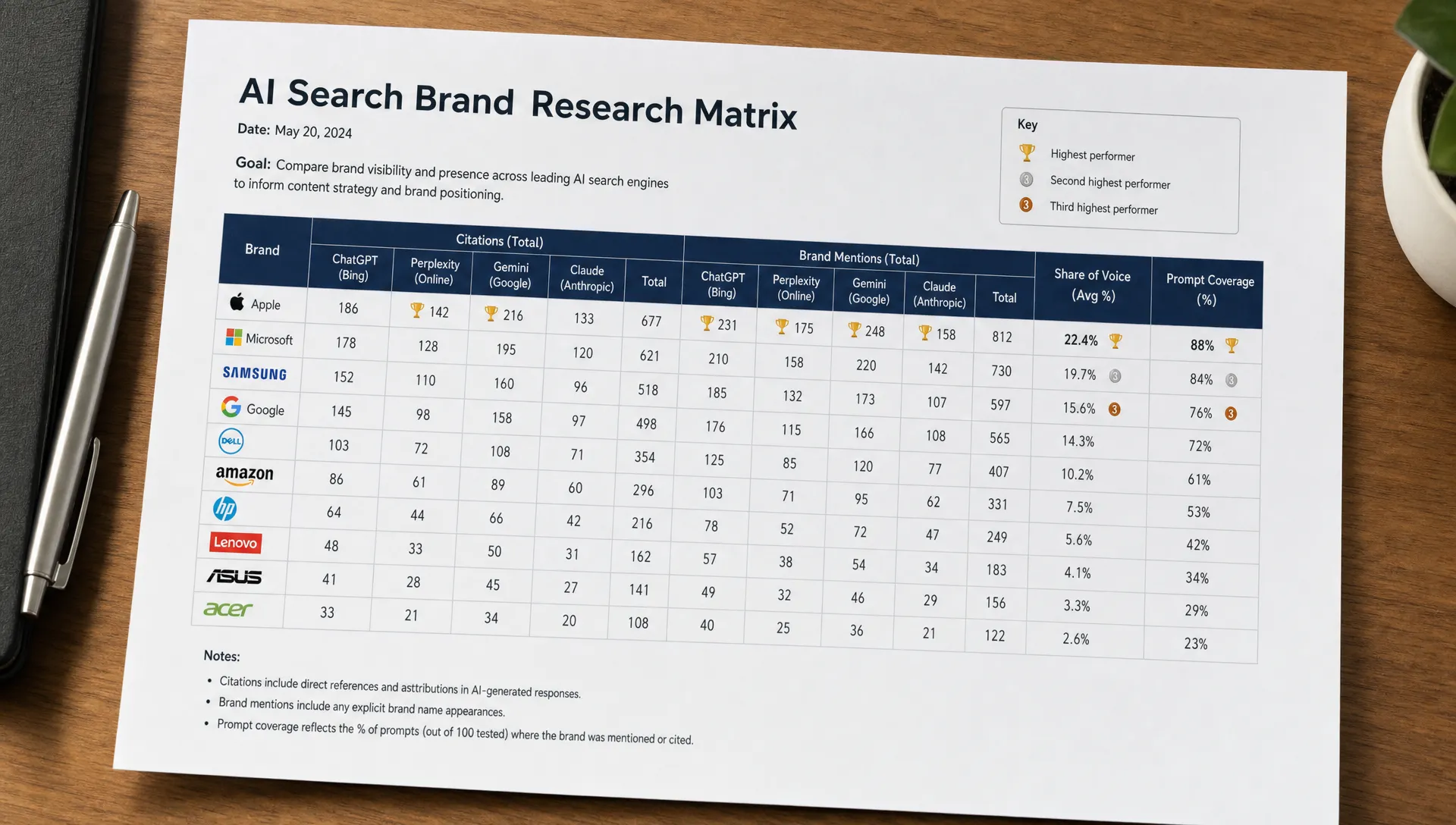
If you run 40 prompts and your brand appears in 6, while a competitor appears in 22, you have a working share-of-voice baseline. If your brand is mentioned but never cited, you may have awareness without machine-readable proof. If you are cited for old content, you may need to update pages that AI systems already trust.
Check safety, source quality and repeatability
Brand research often touches sensitive information: campaign ideas, expansion markets, client names, acquisition plans, unpublished product details and competitive strategy. Do not paste confidential data into consumer AI tools unless your organization has reviewed the terms, account settings and data handling policies.
If you use a free search engine with AI, treat it as useful for exploration rather than as your source of record. CapstonAI covers this distinction in more depth in its guide to whether free AI search engines are safe for brand research, including privacy risks, accuracy limits and practical guardrails.
Repeatability matters just as much as safety. Run the same prompt set on a schedule, keep the exact wording and record the answer, citations, date, market, device context and visible sources. For agencies and multi-location brands, this is the difference between an interesting finding and a report clients can act on.
Connect engine choice to GEO, AEO and technical SEO
Choosing the tool is only useful if the findings improve your web footprint. Generative Engine Optimization, or GEO, makes your content easier for AI systems to discover, trust and reuse. Answer Engine Optimization, or AEO, structures pages so they answer specific questions clearly. Technical SEO makes sure search systems can crawl, render and understand the page in the first place.
The right search engine with AI should help you see which of those layers is weak. A missing brand mention may be a content gap. A wrong description may be an entity problem. A competitor citation may point to better structured data, stronger third-party validation or faster pages.
Common fixes include:
- Clarifying entity information such as brand name, locations, services, products and parent company relationships
- Publishing concise FAQ sections that answer buyer questions directly
- Adding relevant structured data and schema markup where it accurately describes the page
- Improving crawlability, indexability, internal linking and page performance
- Maintaining AI-ready metadata and an llms.txt file as part of a broader machine-readability strategy
Do not treat schema or llms.txt as magic visibility switches. They help machines interpret your site, but they work best when paired with accurate content, useful pages, strong internal links and credible external references. If you need a practical starting point, use CapstonAI’s AI Search Readiness Checklist for brand teams to audit the foundations before chasing advanced tactics.
Use agencies and platforms that measure before they optimize
Many vendors now describe themselves as AI-powered. That label tells you very little. For brand research, look for a system that measures the current state, identifies gaps, prioritizes fixes and proves whether visibility improved after changes are published.
This is especially important for ecommerce and WooCommerce teams choosing outside support. A useful agency conversation should include measurement, governance, platform expertise and how AI improves the operating model rather than just the sales pitch. Space Dinosaurs makes a similar point in its guide to choosing a next-gen ecommerce agency based on systems, measurement and governance.
The same principle applies to AI visibility platforms. CapstonAI starts with scans across multiple engines and assistants, then tracks brand mentions, citations, competitor visibility, prompt coverage and share of voice. From there, teams can prioritize content recommendations, AI-ready FAQ and metadata work, structured data, CMS fixes and monitoring dashboards.
A search engine with AI should feed that operating system. It should not become another disconnected place where someone occasionally checks if the brand appears.
Build a repeatable brand research workflow
A lightweight process is often enough to move from scattered observations to useful evidence. The goal is not to test every possible prompt. The goal is to test the prompts that map to revenue, reputation and decision-making.
- Define the journey: separate discovery, comparison, validation and decision-stage prompts.
- Build a prompt set: include category terms, local modifiers, audience needs, service problems, product comparisons and competitor names.
- Run across engines: test ChatGPT, Google AI Overviews, Gemini, Perplexity, Claude and Copilot where relevant.
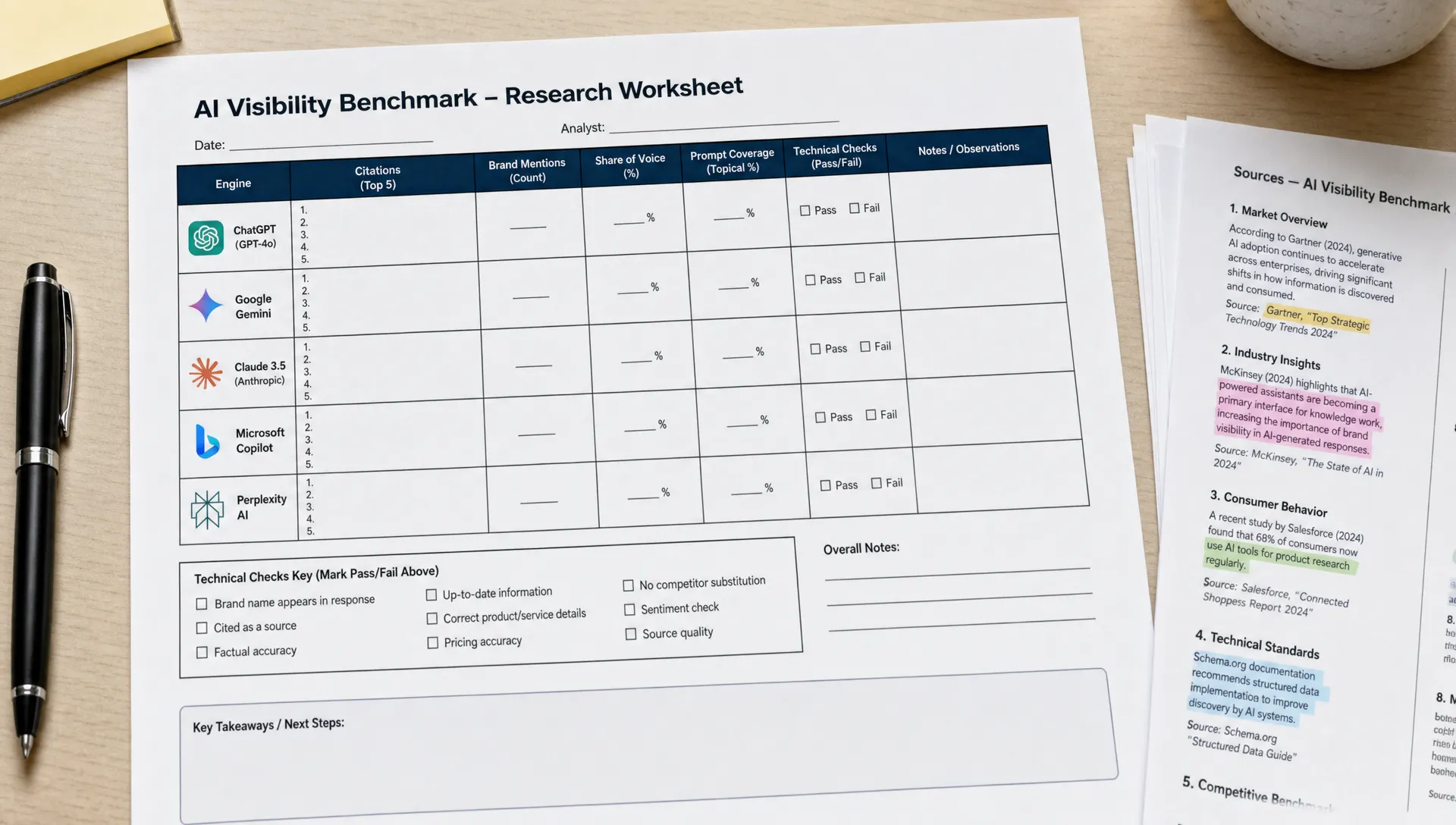
- Record the evidence: capture answer text, brand mentions, competitor mentions, citations, URLs and missing context.
- Score visibility: calculate how often your brand is mentioned or cited across the prompt set compared with competitors.
- Map fixes: connect gaps to pages, schema, internal links, performance, FAQs, directory profiles or third-party content.
- Rerun after changes: compare before and after results on the same prompt set.
This turns a search engine with AI from a research toy into a visibility measurement input. For an independent hotel chain, that might reveal missing local experience pages. For a franchise brand, it might show inconsistent location data. For an MSP, it might expose weak service pages that answer engines cannot confidently cite.
Frequently Asked Questions
What is the best search engine with AI for brand research? The best choice depends on the research job. Use Perplexity when citation trails matter, Google AI Overviews and Gemini for Google-connected discovery, ChatGPT for conversational comparison prompts, Claude for long-form analysis and Copilot for Microsoft-connected B2B contexts.
Should brand teams rely on one AI engine? No. AI answers vary by engine, prompt, location, source access and user context. Cross-engine research gives a more reliable view of brand visibility and competitor share of voice.
How many prompts should we test? Start with 30 to 50 prompts per market or business line. Include discovery, comparison, problem-based and decision-stage prompts. A smaller set run consistently is more useful than a large set you cannot repeat.
What is the difference between a brand mention and a citation? A mention means the AI answer names your brand. A citation means it points to a source supporting the answer. Citations are especially useful because they show which pages or publications AI systems use as evidence.
Can structured data or llms.txt guarantee AI visibility? No. They improve machine readability, but they do not guarantee inclusion. AI visibility also depends on content quality, entity clarity, crawlability, internal linking, page performance and credible sources across the web.
Start with a free AI visibility audit
Before standardizing your brand research process, establish a baseline. CapstonAI shows what ChatGPT, Gemini, Claude, Perplexity, Copilot and Google AI Overviews see, what they miss and where competitors are being cited instead.
Start with a free AI visibility audit to measure your current mentions, citations, prompt coverage and share of voice. AI cannot act on what it cannot see. CapstonAI makes your business visible, then helps your team fix the pages, metadata and structured signals that influence AI answers.