Searching “ai search free” can uncover useful tools for hotel accessibility research, but a confident answer is not proof that a room will meet a guest’s needs. The deciding evidence is usually more specific: a measured doorway, a confirmed shower configuration or a step-free route that remains available after reception closes.
For travelers, the goal is to shortlist suitable properties without relying on vague labels. For hotel groups and their marketing teams, the goal is to publish facts that AI systems can retrieve accurately and guests can verify before booking. This guide covers both sides, starting with how to choose a free tool.
What AI search can and cannot establish
AI search combines a conversational interface with information retrieved from the web. Some answers also draw on a model’s stored knowledge, which may not reflect a hotel’s current rooms, renovations or operating arrangements.
Use AI to find evidence, not to certify accessibility. A hotel described as “wheelchair friendly” might have an accessible entrance but no suitable bathroom in the room category currently available. An elevator listing does not establish its dimensions or whether every guest area has a step-free route.
Separate three kinds of information:
- Published facts: A property’s accessibility page lists specific features for an identified room category.
- Reported experiences: A guest review describes a stay, with a date and circumstances that may differ from yours.
- Unverified conclusions: An AI answer calls the entire property accessible without evidence supporting that conclusion.
Free AI search is useful for locating the first two and exposing gaps. It should not turn either into a blanket guarantee. Keep unresolved requirements visible throughout the research process rather than allowing a fluent summary to hide them.
Choosing tools from “ai search free” results
Start with a tool that retrieves web sources and makes its citations easy to inspect. Then use a second search method to check important claims. There is no need to test every assistant before researching one trip.
The services below are candidates to evaluate, not a verified ranking of their October 2026 free allowances. Availability, account requirements and quotas can change by region and product version.
| Candidate | Useful role in accessibility research | What to check before relying on free access |
|---|---|---|
| ChatGPT search | Turning detailed requirements into a sourced shortlist | Whether web search is active and what usage limits apply |
| Perplexity | Exploring answers with source references | Which search modes are included and whether citations support each claim |
| Google AI Overviews | Discovering properties alongside conventional Google results | Whether an overview appears and which sources support it |
| Gemini | Asking follow-up questions about retrieved hotel information | Whether the response actually used current web sources |
| Claude | Comparing evidence and identifying unanswered questions | Whether web search is enabled for the account and session |
| Copilot | Researching options through conversational web search | Current access conditions and the usefulness of linked evidence |
Check the official ChatGPT search documentation, Perplexity service and Copilot offering before committing to a workflow. Google explains the availability and operation of AI Overviews in Search.
My practical recommendation is to begin with ChatGPT search or Perplexity if the available version provides inspectable sources. Cross-check those findings through conventional search and the property’s own website.
Decide what “free” actually includes
A permanent free tier, a daily allowance, promotional credits and a time-limited trial are different offers. An answer quota may also differ from the allowance for deeper research, file uploads or advanced models.
Before comparing free AI search tools, record whether you need an account, whether current web retrieval is included and what happens when the allowance runs out. A tool that silently changes modes can make two apparently similar research sessions difficult to compare.
Mobile usability matters too. Open a citation on your phone and check whether you can reach the relevant room information without losing the conversation. Voice input can help express a detailed request, but confirm that the transcript preserves critical terms and measurements.
If you prefer to search without AI, use conventional web results and open the original pages directly. A query such as site:hotel-domain.com accessibility bathroom can expose details that an AI summary omitted.
Start with the guest’s actual requirements
“Accessible hotel” is too broad to serve as a reliable research specification. Accessibility can involve mobility, hearing, vision, sensory needs or several requirements together. Two guests using similar mobility equipment may still need different room arrangements.
Create a short requirements sheet before entering a prompt. Focus on functional needs rather than sharing a diagnosis.
| Area | Examples of facts to request |
|---|---|
| Arrival | Step-free entrance, parking location and assistance hours |
| Bedroom | Clear doorway width, bed height and transfer space |
| Bathroom | Shower configuration, grab-bar placement and toilet transfer space |
| Shared facilities | Routes to breakfast, meeting rooms, restaurants and the pool |
| Communication | Available visual alerts, hearing assistance and accessible contact options |
| Booking | Exact room category and confirmation of required features |
Specify units when requesting measurements. A number without units, or a doorway measurement that includes the frame rather than the clear opening, can create a costly misunderstanding.
For independent hotel chains, this requirements sheet also becomes a content checklist. It reveals what a guest needs to know before committing to a booking, not merely what amenities the property wants to promote.
Use a prompt that preserves uncertainty
Try this with your preferred free AI search service:
Find hotels in [destination] for [dates] that publish evidence of [specific requirements]. Prioritize official property pages. For each hotel, identify the exact property and room category, quote the supporting passage and link to its source. Separate confirmed facts from missing information. Do not infer bathroom accessibility from an accessible entrance or a general accessibility label. List questions I should ask before booking.
Add a budget and location preference only after the essential access requirements. Otherwise, the response may prioritize attractive rates while treating missing accessibility evidence as a minor caveat.
Compare tools using identical hotel questions
A useful comparison tests evidence quality, not which assistant produces the longest answer. Choose three properties with different information quality: one with detailed accessibility documentation, one with a brief statement and one with conflicting descriptions.
Run the same four tasks for each property. That produces 12 research tasks per tool. Testing two tools requires 24 responses, which you can spread across sessions if free allowances are restrictive.
| Task | Identical question to ask each tool |
|---|---|
| Discover evidence | “Find the official accessibility information for this exact property.” |
| Check room specificity | “Which room category has the requested bathroom features, and what evidence supports that?” |
| Find contradictions | “Do the official page and third-party listings disagree? Show both sources.” |
| Preserve unknowns | “Which requirements remain unverified, and what should I ask the hotel?” |
Save the prompt, answer, source URLs, date, language and whether web search was active. Record the property’s address so a similarly named branch does not slip into the comparison.
This is a proposed test protocol, not a claim that any named product has passed it. Repeating it after a week can reveal variability that a single polished response would miss.
Score evidence rather than writing style
Give each response zero, one or two points for five criteria: correct property identification, direct source support, room-level specificity, handling of dates and preservation of unknowns. The maximum is 10 points.
Use zero for absent or incorrect evidence, one for partial support and two for clear support. Keep the scoring notes beside the original response so another researcher can understand the decision.
An eight-point answer is not automatically safe to act on. A material unsupported claim overrides the total score. If the assistant invents a roll-in shower or confuses two properties, reject that answer as a basis for booking and investigate directly.
For a small team, this comparison shows which free AI search workflow creates less verification work. Count how often you must replace a citation, correct a room category or reopen a question the assistant marked as resolved. Those corrections matter more than how quickly it generated a shortlist.
Verify the room before making a reservation
Open each cited source and locate the actual supporting passage. A citation to the hotel homepage does not support a claim about shower access. A booking platform’s accessibility filter may help discovery, but it does not establish every feature a particular guest needs.
Check whether photos show the relevant room category. Ask when they were taken if renovations or conflicting descriptions raise doubts. Where dimensions matter, request measurements rather than estimating from photographs.
Then contact the property with a concise, written list of essential requirements. Ask staff to confirm the room category, the relevant features and how those requirements will be recorded with the reservation. Keep that correspondence with the booking details.
In the US, covered lodging reservation systems have specific obligations to identify and describe accessible features so guests can reasonably assess suitability. The applicable federal reservation provisions provide the legal detail. Requirements elsewhere differ.
Free AI search can prepare the questions, but the reservation still needs a property-specific confirmation. An unanswered requirement should remain “not verified,” not become “probably available.”
Check the journey beyond the bedroom
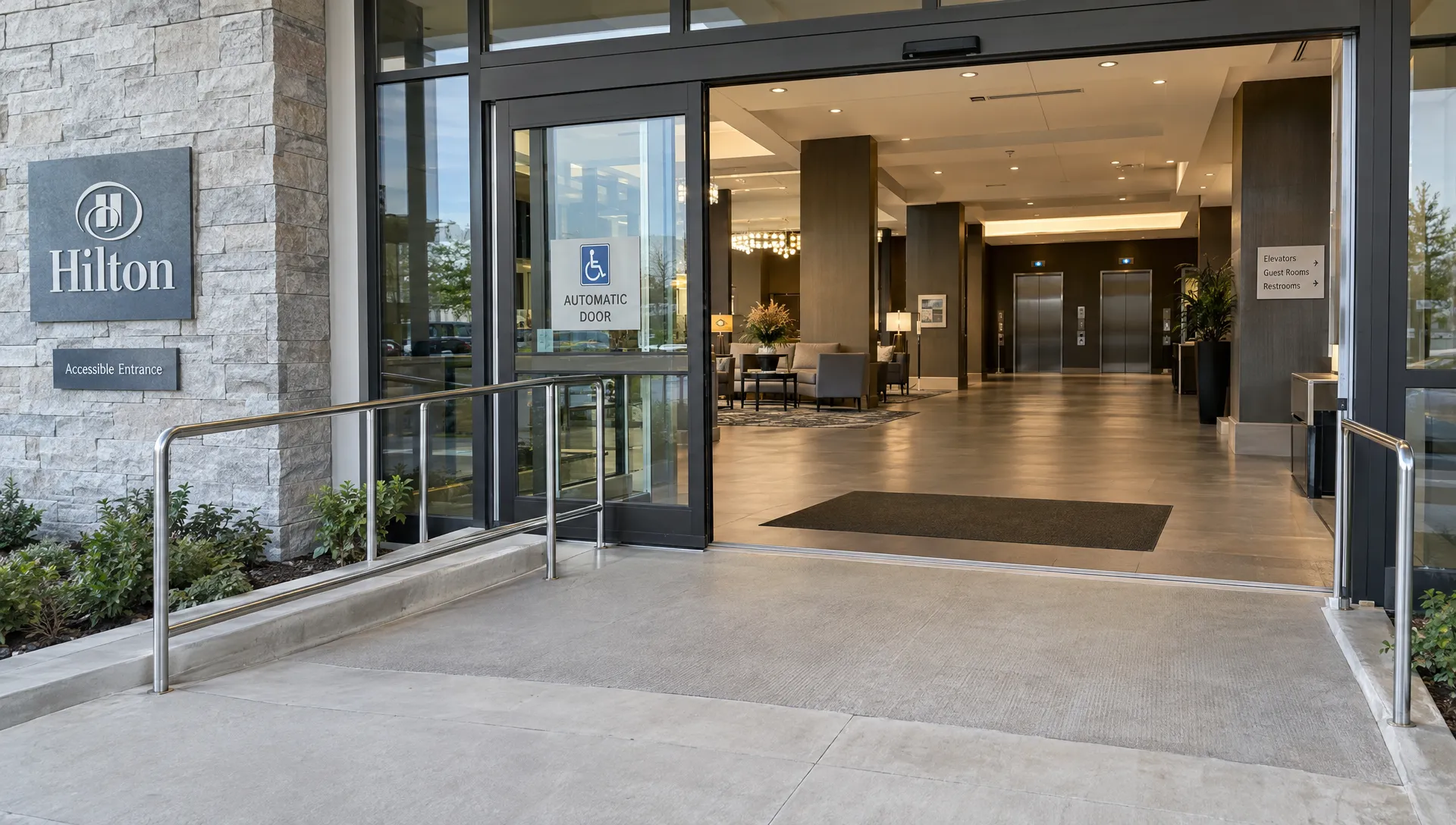
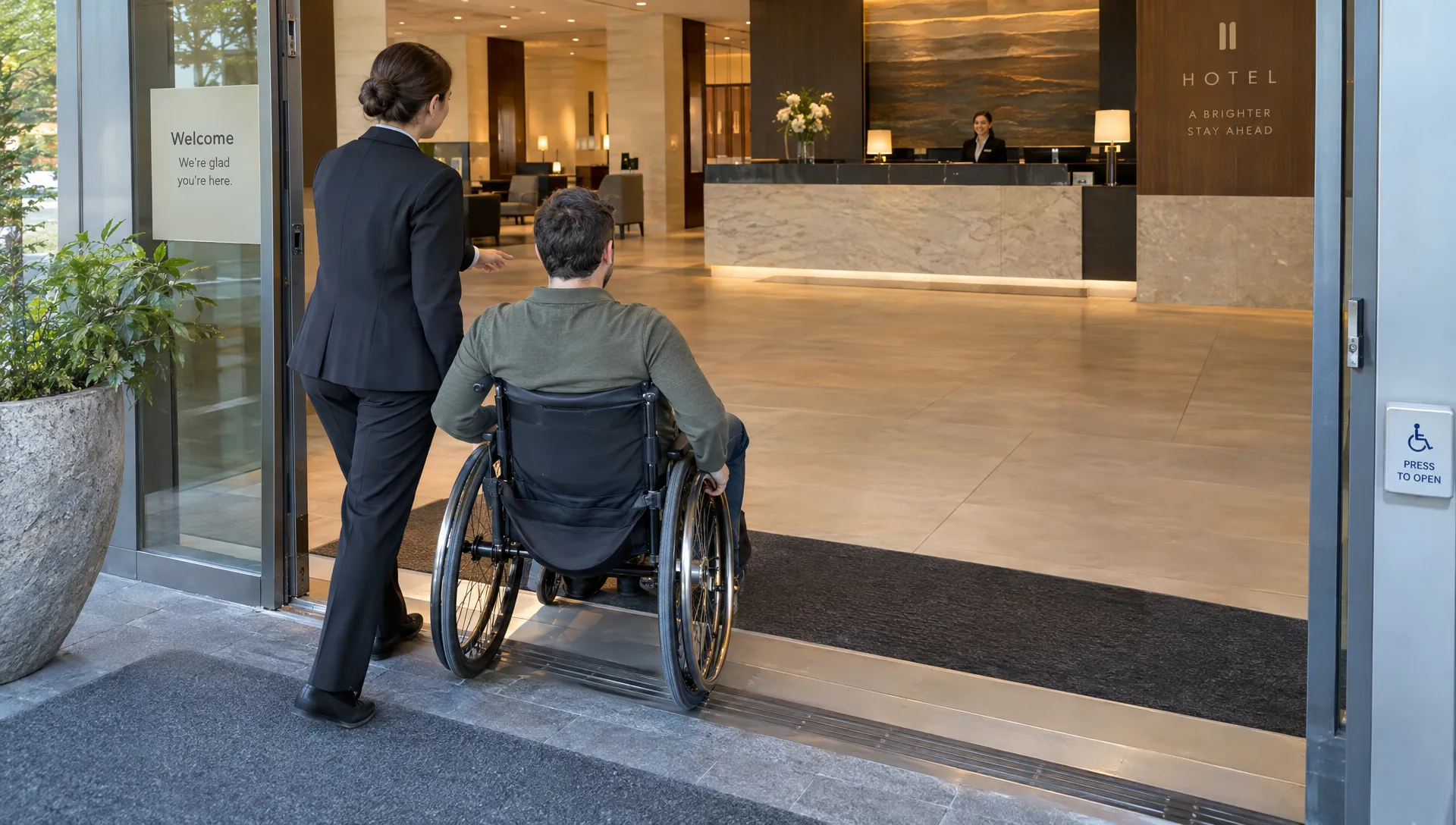
A suitable room does not resolve the entire stay. Verify the route from arrival to reception, the elevator, breakfast and any venue essential to the trip. Ask about alternative entrances, locked doors and after-hours arrangements rather than assuming daytime access continues overnight.
If the trip includes healthcare, check the destination separately. For example, someone visiting Integrated Dental Care in Pakenham should ask the clinic about entrance access and relevant treatment arrangements, then verify transport from the hotel. A healthcare provider’s service listing is not evidence of physical accessibility.
Apply the same principle to conference venues and attractions. AI may assemble an appealing itinerary while missing a single inaccessible connection. Verify each essential destination instead of treating proximity on a map as proof of a usable route.
Protect personal information during research
Describe the access requirement, not the person’s full medical history. “Needs step-free access and a shower seat” is usually more appropriate for initial research than uploading medical records or an identifiable care plan.
Do not paste payment details, reservation credentials or private guest correspondence into a consumer assistant. Hotel teams should anonymize support cases before using them to investigate recurring information gaps.
Review the service’s current privacy controls, retention terms and training settings before sharing anything sensitive. A free plan is not automatically private or unsafe; the relevant question is how that specific service handles the information you provide.
CapstonAI’s guide to using free AI search safely for brand research covers the broader research risks. For accessibility work, data minimization also keeps the task focused on the facts that determine suitability.
What hotel teams should publish to improve answers
The same gaps that frustrate guests also create AI visibility problems. If accessibility details exist only in a private staff document, an assistant cannot reliably retrieve them from the public web.
The fix starts with verified property information, then makes that information easy to find, interpret and maintain.
Publish property-level and room-level facts
Give every property a stable accessibility page linked from its location page and relevant room pages. Describe features for each room category instead of applying one broad label across the building.
Identify the hotel consistently by name, address and contact details. These identifiers help systems distinguish entities, meaning the specific real-world businesses and places an answer refers to. For hotel chains, this reduces the risk of one branch’s accessible bathroom being attributed to another.
Include verified measurements, photographs, assistance arrangements and a clear contact route for questions. State when information was checked and assign responsibility for updates after renovations or operational changes.
For free AI search research, explicit limitations are useful evidence too. “The rooftop terrace is reached by stairs only” helps guests make a decision and prevents an assistant from extending a ground-floor accessibility statement to every facility.
Fix crawlability, internal linking and page performance
Technical SEO helps search systems discover and interpret pages. Check that accessibility information returns a successful response, is not unintentionally blocked and appears in readable page content rather than only inside images or interactive booking widgets.
Crawler access differs across search providers. Review the rules for the services you intend to support instead of assuming one robots.txt setting covers every AI crawler.
Use descriptive internal links such as “bathroom features for accessible king rooms.” They help guests and crawlers reach the right evidence without guessing which generic “learn more” button to follow.
Page performance matters because guests need to inspect evidence and complete a booking, often on mobile connections. Compress large photographs, avoid unnecessary scripts and keep essential information available when decorative elements load slowly.
These changes improve usability and information retrieval. They do not guarantee inclusion in an AI answer, and faster loading does not validate an inaccurate accessibility claim.
Add structured data without replacing visible evidence
Structured data, often implemented using Schema.org vocabulary, gives machines explicit labels for information on a page. Use appropriate hotel and organization markup, with accurate addresses, identifiers and URLs.
Any accessibility-related properties must match visible, verified content. Schema cannot make an unsupported claim trustworthy, and adding FAQ markup does not guarantee a search feature or AI citation.
An llms.txt file is an optional approach to pointing AI tools toward useful content. Do not treat it as a universally supported instruction mechanism or a substitute for crawlable pages, internal linking and accurate metadata.
Generative Engine Optimization (GEO) focuses on how content is surfaced and reused in generated answers. Answer Engine Optimization (AEO) focuses on making answers discoverable and understandable. Here, both depend on the same foundation: specific facts that a guest can check.
Measure visibility and accuracy separately
A brand mention, a citation and a correct recommendation are different outcomes. An assistant can name your property without linking to it, cite a page while misstating its contents or omit a suitable hotel entirely.
Track accessibility prompts by destination, property and requirement across ChatGPT, Google AI Overviews, Gemini, Perplexity, Claude and Copilot where relevant. Record the date, language and search conditions because responses vary.
Define share of voice before reporting it. If your hotel receives six of 24 tracked brand mentions, counting each brand once per answer, its share is 25% for that sample. That is not market share, booking share or proof of accurate accessibility information.
Keep a separate accuracy measure for supported room and access claims. Compare both before and after a content correction, without promising that one edit caused every subsequent change.
CapstonAI supports brand mention, citation, competitor and prompt tracking alongside prioritized content recommendations. A useful starting point is understanding what a free AI SEO audit should actually reveal, then investigating the specific pages behind missing or incorrect answers.
Frequently asked questions
Which free AI search tool is best for hotel accessibility research? Start with one that retrieves current web sources and exposes citations clearly. ChatGPT search and Perplexity are candidates, but test the available free version against identical hotel questions. Choose based on supported facts and fewer verification errors, not writing style.
Can an AI answer confirm that a hotel is accessible? It can summarize published evidence, but it cannot establish suitability from a general label. Verify essential room features, routes and booking arrangements with the property. Different guests may need different configurations within the same hotel.
What if the hotel website and booking platform disagree? Save both descriptions and ask the hotel to resolve the conflict for the exact room category. Do not assume the newer-looking page is correct. Request written confirmation of the features essential to the stay.
Do hotel teams need a paid platform before improving accessibility content? No. Teams can begin with verified facts, clear room pages and manual checks using free AI search. A visibility platform becomes useful when monitoring multiple properties, competitors, prompts and engines consistently exceeds a manageable manual workflow.
Start with a free AI visibility audit
Start with a free AI visibility audit from CapstonAI to identify where your hotel brand appears and where information gaps need investigation.
Then choose one property, one accessible room category and the four-question test above. Verify the underlying facts, publish missing details and rerun the same prompts. The practical goal is not simply more mentions. It is giving prospective guests an accurate, traceable basis for deciding whether to book.