If you searched for “ai seo free,” you are probably not looking for another crawler score. You want to know whether ChatGPT, Google AI Overviews, Gemini, Perplexity, Claude and Copilot can find your business, understand what you sell and trust your pages enough to mention or cite them when prospects ask buying questions.
A free AI SEO audit should answer that in plain language. It should not stop at title tags, keyword density or a generic site health score. Those signals still matter, but AI search adds a second layer: your brand has to be machine-readable as an entity, present in relevant answers and supported by pages that generative engines can parse, summarize and cite.
What a Free AI SEO Audit Is Really Testing
Classic SEO asks, “Can search engines crawl, index and rank this page?” AI SEO asks an added question: “Can an answer engine confidently reuse this information in a generated response?”
That is where Generative Engine Optimization (GEO) and Answer Engine Optimization (AEO) fit. GEO focuses on how generative engines interpret and surface your brand. AEO focuses on making your content clear enough to answer specific user questions. Both still depend on technical SEO basics such as crawlability, internal linking, structured data, metadata and page performance.
A useful “ai seo free” audit begins by separating visibility from readiness. Visibility shows whether your brand already appears in AI answers. Readiness shows whether your pages give AI systems enough trustworthy context to include you more often.
For a hotel group, that might mean checking whether AI answers mention your properties for “family-friendly hotels near downtown Austin.” For an MSP, it might mean testing prompts like “best managed IT provider for healthcare clinics in Chicago.” For a WooCommerce retailer, it might mean checking whether product category pages are strong enough to support buying comparisons.
The Core Signals Your Audit Should Reveal
A free audit does not need to crawl every page or solve every problem. It should reveal the highest-value gaps that affect revenue outcomes: missed bookings, fewer qualified leads, weaker category visibility or loss of credibility when competitors are cited instead.
For many teams, an “ai seo free” scan is valuable because it creates a baseline before investing in deeper GEO, AEO or technical SEO work.
| Audit signal | What it should reveal | Why it matters to the business |
|---|---|---|
| AI answer presence | Whether your brand appears in ChatGPT, Gemini, Perplexity, Claude, Copilot or AI Overviews for priority prompts | Shows if prospects can discover you inside AI answers |
| Brand mentions | How often your business is named compared with competitors | Measures early share of voice in AI search |
| Citations | Whether AI engines link to or reference your pages as sources | Builds credibility and referral potential |
| Prompt mapping | Which customer questions surface you, rivals or nobody relevant | Connects visibility gaps to real buying journeys |
| Entity clarity | Whether your brand, locations, services, categories and products are clearly connected | Reduces ambiguity when models summarize your business |
| Schema and metadata | Whether structured data supports pages, products, FAQs, locations and organizations | Helps crawlers interpret page meaning faster |
| Crawlability | Whether important pages are accessible, indexable and internally linked | Prevents strong content from being invisible |
| Page performance | Whether slow or unstable pages weaken discovery and user conversion | Protects rankings, UX and lead capture |
| llms.txt readiness | Whether you provide AI systems with useful guidance about important content | Supports controlled, AI-ready discovery |
Visibility: Mentions, Citations and Share of Voice
The first thing an audit should show is whether AI engines already mention your brand. A mention is not the same as a ranking. AI answers synthesize sources, so your business can be absent even when your website ranks well in traditional search.
A strong audit should test prompts across the buyer journey. Top-of-funnel prompts might ask for options or advice. Middle-of-funnel prompts compare vendors. Bottom-of-funnel prompts ask for nearby, available, compliant or specialized providers.
A strong “ai seo free” review should also compare your visibility against named competitors. If a healthcare franchise appears in 2 out of 20 location-based prompts while two rivals appear in 12, the issue is not just content volume. It may be entity weakness, missing local schema, thin service pages or lack of trusted third-party citations.
Citations matter because they show what an AI system uses as supporting evidence. Perplexity often exposes citations directly. Google AI Overviews and other assistants may surface links differently, but the principle is the same: if your site is never used as evidence, your content is not carrying enough authority, structure or specificity for that query set.
Entity Clarity: Can AI Understand What You Are?
Search engines and AI systems do not only read keywords. They connect entities: brands, people, products, services, locations, industries and relationships. If those connections are unclear, your business is harder to retrieve in generated answers.
A free audit should identify basic entity gaps. These include inconsistent business names, unclear service categories, missing location relationships, weak author or organization signals and pages that talk around a topic without naming the specific audience or use case.
For example, a travel group with 18 properties should make it easy to connect each hotel to amenities, neighborhoods, booking intent and parent brand. An MSP should connect services to industries, compliance needs and regions served. A vertical software company, such as a drone operations management and flight planning platform, needs clear entity relationships around users, workflows, compliance tasks and operational outcomes.
When AI can classify your business accurately, you become more eligible for specific answers. That is the practical value of entity work: not abstract semantic tidiness, but better retrieval for the questions your prospects actually ask.
Content Gaps an Audit Should Prioritize
Not every thin page deserves immediate work. A useful audit should prioritize gaps where improved content can influence demand, conversion or trust.
For hotels, that might be pages for meetings, pet-friendly stays, parking, airport access or local attractions. For franchises, it might be location pages that repeat boilerplate without answering local questions. For ecommerce, it might be category pages that list products but do not explain fit, compatibility, delivery, returns or comparison criteria.
The audit should flag pages that lack answer-ready sections. Answer-ready content is concise, specific and structured around a real question. It usually includes short definitions, comparison points, eligibility criteria, FAQs, proof elements and internal links to the next useful step.
If you want a deeper view of why classic tools miss these gaps, CapstonAI’s article on why a traditional website visibility checker can’t show every AI search gap explains the difference between rank-based visibility and AI answer visibility.
If You Searched “ai seo free,” Check the Technical Layer Too
AI visibility still depends on a clean technical foundation. If important pages are blocked, buried, slow or poorly structured, generative engines have less reliable material to work with.
A free audit should check indexability, canonical tags, robots directives, sitemap coverage and internal links to priority pages. For multi-site brands, it should also look for duplicate templates that prevent locations from standing out. For WordPress and WooCommerce teams, it should identify missing schema, bloated pages and plugin conflicts that affect performance or structured data output.
Structured data deserves specific attention. Organization, LocalBusiness, Product, FAQPage, BreadcrumbList and Article schema can all help machines interpret your pages. Schema is not a guarantee of AI visibility, but it reduces uncertainty. That matters when an answer engine is deciding which source to trust.
The technical review should also include page performance. Google’s Core Web Vitals thresholds include Largest Contentful Paint at 2.5 seconds or faster, Interaction to Next Paint at 200 milliseconds or less and Cumulative Layout Shift at 0.1 or less. These numbers are not AI-specific, but faster, more stable pages improve crawl efficiency, user experience and conversion.
The practical value of an “ai seo free” technical review is prioritization. A 500-page site does not need 500 equal recommendations. It needs a short list of fixes that help the pages tied to revenue, bookings or lead generation become easier to crawl, understand and cite.
What the Deliverable Should Look Like
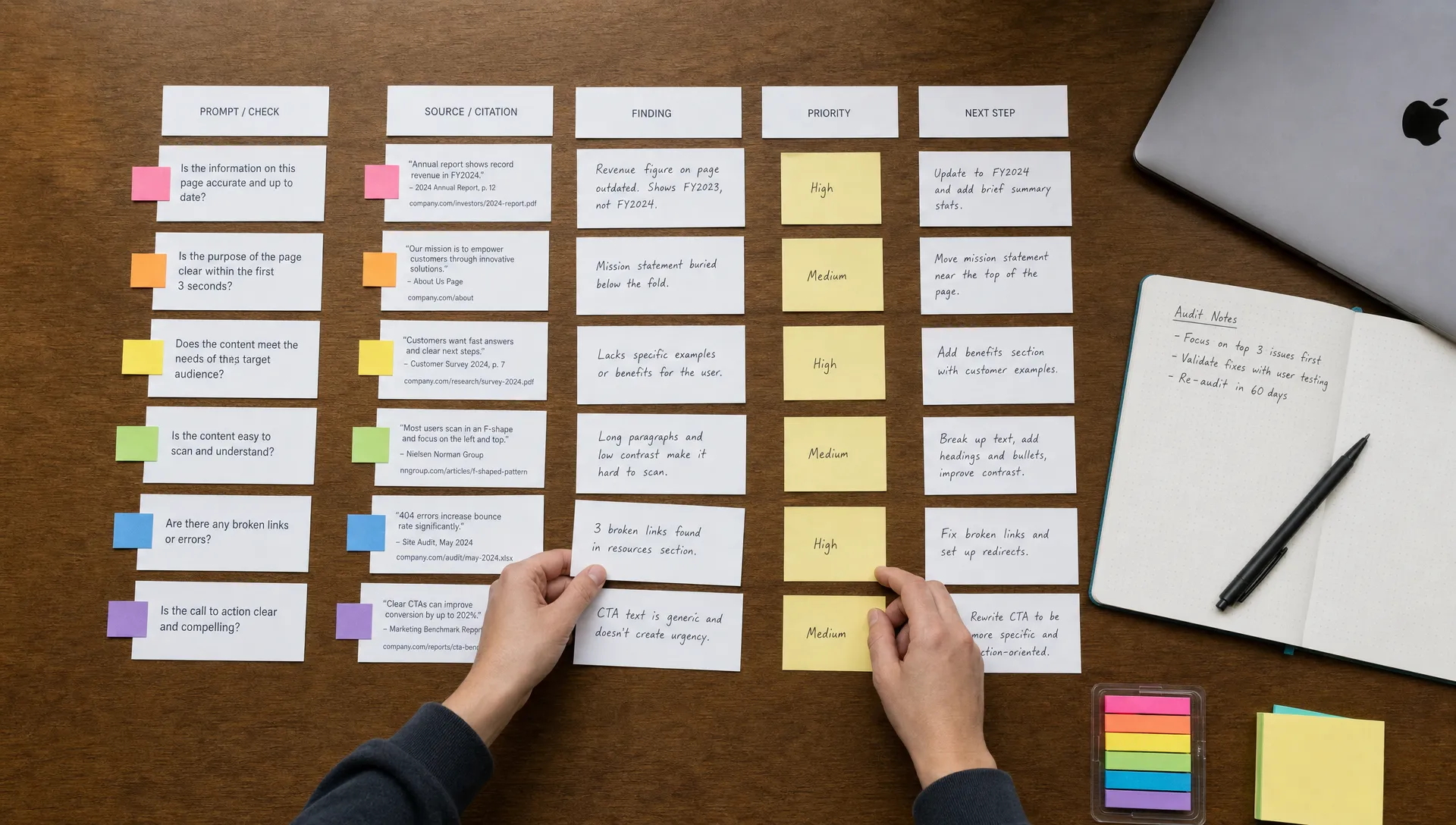
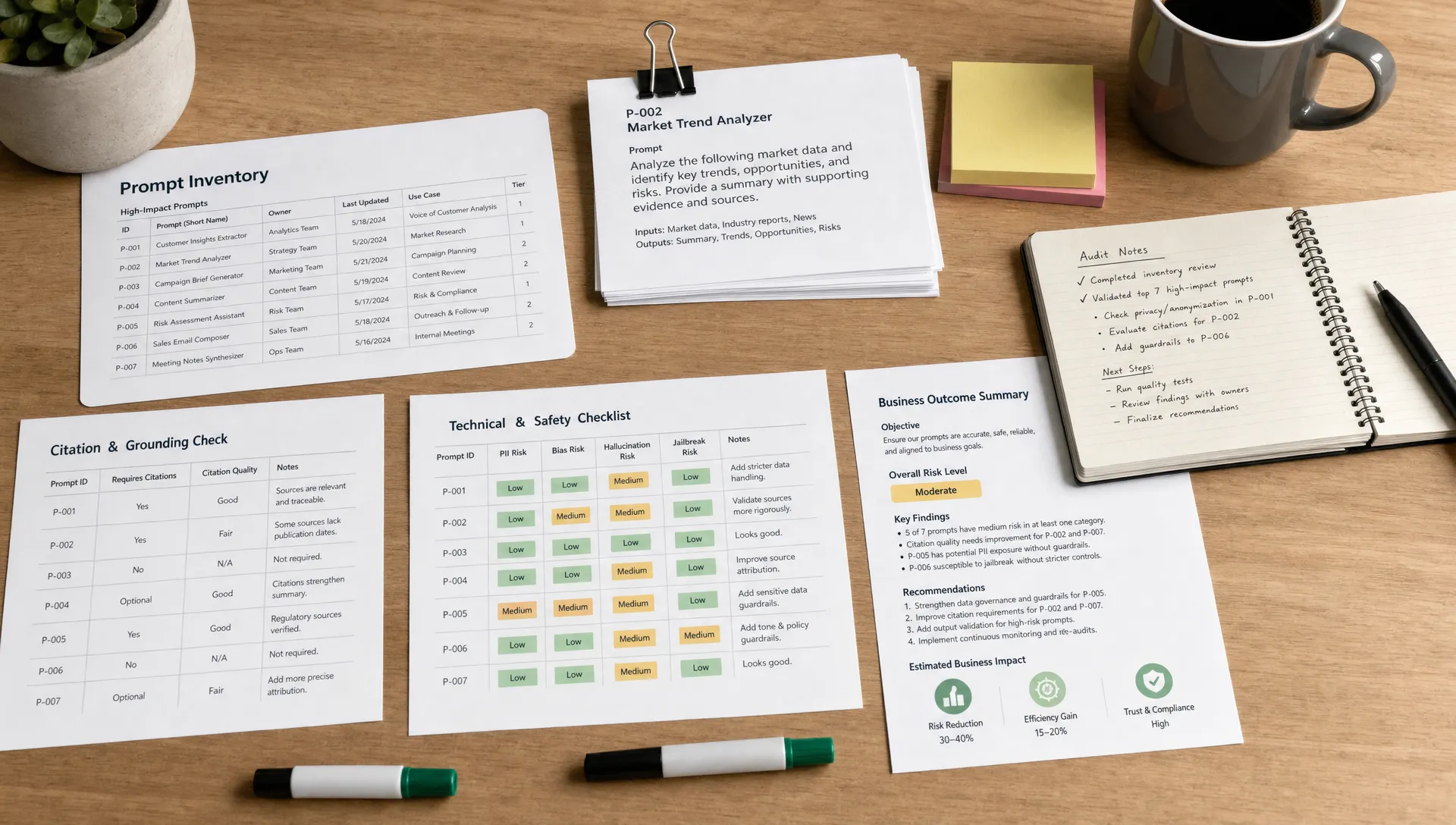
The output matters as much as the scan. A free audit should not bury the team in screenshots or unexplained scores. It should give a clear baseline, explain the evidence and identify the first actions to take.
At the end, an “ai seo free” deliverable should include four things: where you appear, where competitors appear, why AI systems may be missing you and what to fix first.
A practical report usually includes:
- A tested prompt set grouped by business intent
- Engine-by-engine visibility results across ChatGPT, Gemini, Perplexity, Claude, Copilot and Google AI Overviews where available
- Brand mention and citation examples, including competitor comparisons
- Priority technical issues affecting crawlability, schema, metadata, internal linking or performance
- Page-level recommendations for answer-ready content and entity clarity
- A short implementation plan ranked by likely business impact and effort
This is where automation helps, but human review still matters. AI can scan prompts, classify pages and draft recommendations quickly. A skilled SEO or content lead still needs to validate the market context, remove false positives and decide which fixes support commercial goals. CapstonAI covers that balance in its guide to where automation helps and human review matters.
Free vs. Paid: What Is Fair to Expect?
A free audit should be diagnostic, not exhaustive. It should give enough evidence to decide whether AI visibility is a real growth gap for your business. It should not claim to fully optimize every page, rebuild schema, rewrite content and monitor every competitor at no cost.
A realistic “ai seo free” report can show a representative sample of prompts, engines, pages and competitors. A paid program should expand that into ongoing monitoring, deeper technical fixes, CMS implementation, content production, alerting and before-after reporting.
The distinction is important for agencies and in-house teams. A free audit should help you make the business case. A full platform or engagement should help you improve the system over time.
If you are comparing platforms, look for engine coverage, repeatable prompt tracking, citation monitoring, competitor benchmarking, CMS workflows and reporting that connects AI visibility to business outcomes. CapstonAI’s guide on how to choose an SEO platform for AI visibility gives a more detailed evaluation framework.
Red Flags in a Free AI SEO Audit
Some audits look impressive but reveal very little. Be careful with reports that reduce AI SEO to a single opaque score. A score can be useful as a summary, but it should be backed by prompt examples, engine results, citations and page-level evidence.
Other red flags include generic recommendations that could apply to any site, no competitor context, no distinction between mentions and citations, no technical crawl review and no explanation of which pages should be fixed first.
An audit should also avoid alarmism. AI search is changing discovery, but the right response is not panic. The right response is measurement, then structured improvement. You need to know what AI can see, what it misses and how to make your best pages easier to trust.
FAQ
What should a free AI SEO audit include? It should include prompt testing, AI answer visibility, brand mentions, citations, competitor comparisons, entity gaps, schema issues, crawlability checks, internal linking review, page performance signals and prioritized recommendations.
Is AI SEO different from traditional SEO? Yes, but it does not replace traditional SEO. AI SEO adds GEO and AEO practices that help generative engines understand, summarize and cite your content, while traditional SEO keeps your site crawlable, fast and indexable.
How many prompts should a free audit test? A free audit can use a representative sample rather than a full market map. The prompt set should cover real customer intent, including discovery, comparison, local or category-specific questions and bottom-of-funnel buying prompts.
Can an “ai seo free” audit prove ROI? It can establish a baseline and highlight likely revenue gaps, but ROI proof usually requires ongoing monitoring, implemented fixes and before-after reporting across AI visibility, leads, bookings or sales.
Do structured data and llms.txt guarantee AI visibility? No. They help machines interpret and access your content, but visibility also depends on entity clarity, content quality, citations, authority, internal linking and how well your pages answer specific prompts.
Start With a Free AI Visibility Audit
A good audit should leave you with a sharper question than “Are we doing SEO?” The better question is, “Can AI see our business clearly enough to recommend it when customers ask?”
CapstonAI helps brands, retailers, agencies and multi-site teams measure how they appear across AI search, diagnose blind spots and turn key pages into AI-ready assets. If you want a practical baseline, start with a free AI visibility audit and review where your brand is mentioned, cited, missed and fixable first.