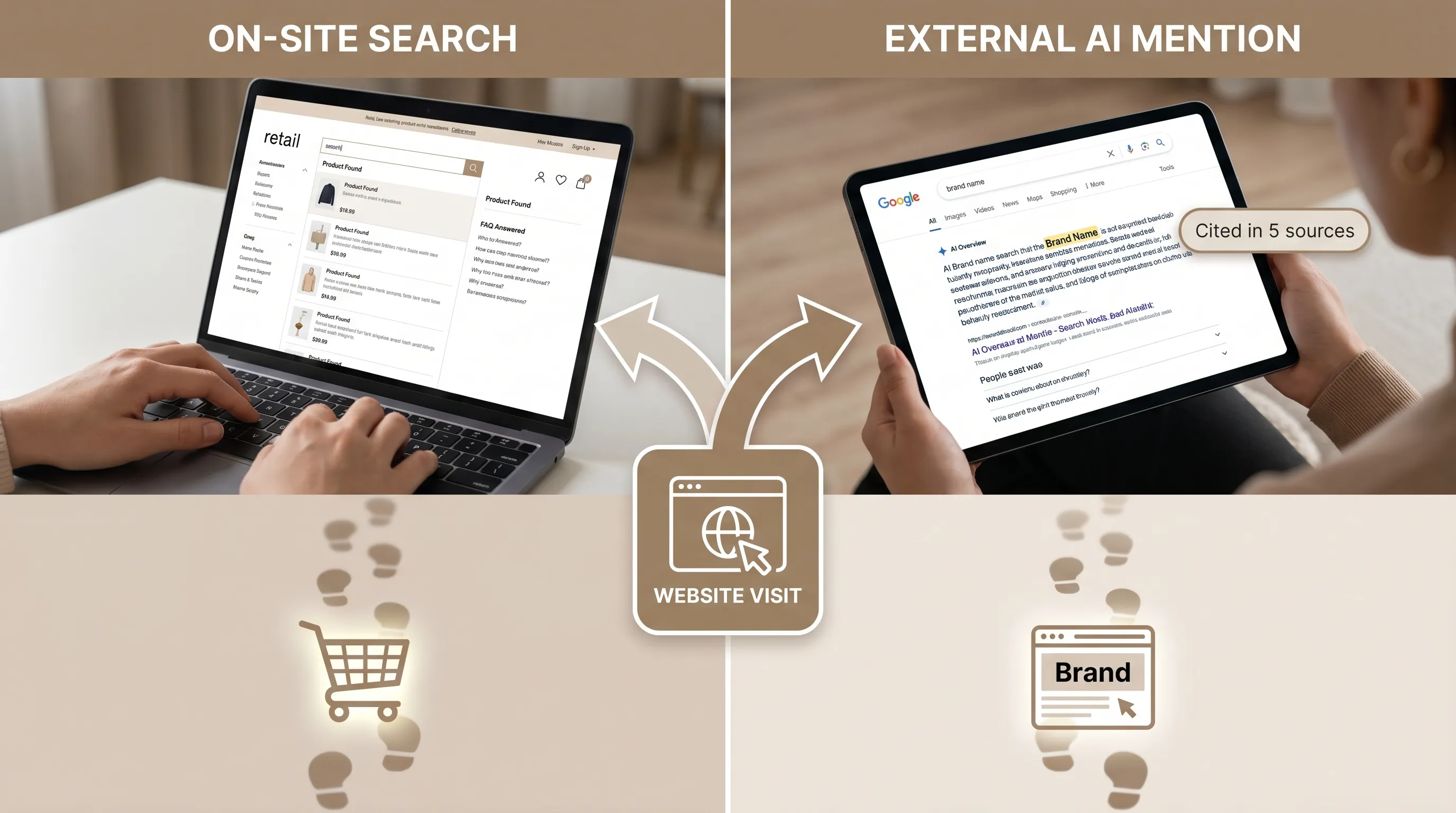
AI site search and AI search visibility sound similar, but they solve very different business problems. AI site search helps visitors find the right product, page, article, or answer after they arrive on your website. AI search visibility determines whether external AI engines mention, cite, and recommend your brand before someone ever clicks through.
That difference matters because teams often invest in the wrong fix. A better internal search bar will not automatically make ChatGPT recommend your company. Strong visibility in AI answers will not help much if visitors land on your site and cannot find what they need. The smartest brands treat both as connected, but separate, systems.
What is AI site search?
AI site search is the search experience inside your own website, app, store, marketplace, or help center. It is the search box visitors use when they are already on your digital property.
Traditional site search relied heavily on exact keyword matching. If a shopper typed running jacket but your product title said lightweight windbreaker, the search engine might miss the match. AI site search improves this by understanding semantic meaning, related concepts, natural language questions, typos, synonyms, product attributes, and user behavior.
For an e-commerce brand, AI site search might help shoppers find waterproof trail shoes even if they search for shoes for muddy hikes. For a SaaS company, it might help a customer find billing permissions when they type how do I give finance access. For a publisher, it might surface the most relevant guide even when the query does not match the article title exactly.
The goal is simple: reduce friction after a user arrives. Better AI site search can improve product discovery, content engagement, support deflection, and conversion rates.
What is AI search visibility?
AI search visibility is your brand’s presence in external AI-powered answer environments. This includes how platforms such as ChatGPT, Gemini, Claude, Perplexity, and Google AI Overviews mention, summarize, cite, compare, or recommend your business.
This is not the same as ranking number one on a traditional search results page. In AI search, a user might ask, what are the best tools for tracking AI search performance, or which apparel manufacturer can help with small-batch activewear production. The answer may summarize several brands, cite sources, compare options, or recommend a short list. If your brand is missing, misrepresented, or outranked by competitors in that answer, you have an AI visibility problem.
Google’s own Search Central documentation on AI features reinforces that the fundamentals still matter, including making content accessible, useful, and eligible to appear in Google Search. But AI visibility goes further than classic SEO reporting because it asks a different question: when AI engines generate answers in your category, are you part of the answer?
This is where disciplines like generative engine optimization, answer engine optimization, entity optimization, structured content, and AI-ready metadata converge. If you need the broader foundation, CapstonAI’s guide to Generative Engine Optimization explains how brands can adapt content for AI-generated answers.
AI site search vs AI search visibility: the quick comparison
| Category | AI site search | AI search visibility |
|---|---|---|
| Core question | Can visitors find what they need on our site? | Do AI engines mention, cite, and recommend our brand? |
| Where it happens | Your website, app, store, help center, or portal | ChatGPT, Gemini, Claude, Perplexity, Google AI Overviews, and other AI answer experiences |
| User stage | After the visitor reaches your property | Before, during, or instead of a website visit |
| Main goal | Improve discovery, engagement, support, and conversions | Improve brand presence, share of voice, citations, and recommendation frequency |
| Typical data | Internal queries, click behavior, product data, content metadata, user sessions | Prompts, AI answers, brand mentions, citations, competitors, third-party sources |
| Primary owners | Product, UX, e-commerce, support, search engineering | SEO, content, PR, brand, demand generation, agencies |
| Common fixes | Better synonyms, vector search, ranking rules, filters, product attributes, zero-result handling | AI-ready FAQs, clearer entity data, better metadata, citation-worthy content, competitor gap fixes |
| Main risk if ignored | Visitors leave because they cannot find relevant pages or products | AI engines recommend competitors or describe your brand inaccurately |
The simplest way to remember it: AI site search optimizes discovery inside your website. AI search visibility optimizes discovery of your website and brand inside AI engines.
Why marketers confuse the two
The confusion is understandable. Both involve AI, search, relevance, and customer intent. Both can use natural language processing. Both benefit from structured content, clear metadata, and well-labeled products or services.
But the operating model is completely different.
With AI site search, you control the interface, data sources, ranking logic, filters, and conversion path. You can see what users type, which results they click, where they abandon, and what they buy or read afterward.
With AI search visibility, you do not control the interface. You are trying to influence how external AI systems interpret your brand based on the content, entities, citations, reviews, pages, and third-party references they can access. You need to monitor answers across many prompts and engines because each model may summarize the market differently.
This is why traditional SEO dashboards can miss a major visibility shift. Your rankings might look stable while AI answers begin citing a competitor more often. CapstonAI’s guide to AI Overviews and CTR impact covers this broader shift: brands now need to track not only clicks, but also presence in AI-generated answers.
The workflows are different
How AI site search is improved
Improving AI site search starts with understanding what visitors do once they are on your site. Teams usually analyze query logs, zero-result searches, click-through behavior, filters, search refinements, conversion paths, and support deflection.
A practical AI site search workflow often looks like this:
- Review internal search queries and identify high-volume searches, failed searches, and repeated reformulations.
- Map common queries to products, categories, help articles, or landing pages.
- Improve synonyms, redirects, product attributes, filters, and content labels.
- Test semantic search or vector retrieval for long-tail and natural language queries.
- Measure whether search users click, convert, self-serve, or abandon at a higher rate.
The emphasis is usability. You are reducing the gap between what visitors ask for and what your site returns.
How AI search visibility is improved
Improving AI search visibility starts with understanding how people ask AI engines about your market. Instead of tracking only keywords, you track prompts, questions, comparisons, and decision scenarios.
A practical AI search visibility workflow often looks like this:
- Build a prompt set that reflects real buyer, shopper, or customer questions in your category.
- Scan major AI engines to see where your brand appears, where it is absent, and how competitors are framed.
- Map mentions, citations, sentiment, recommendation language, and source patterns.
- Diagnose gaps in your content, metadata, entity clarity, FAQs, location pages, and third-party proof.
- Publish AI-ready improvements, then re-scan to measure changes over time.
The emphasis is market representation. You are reducing the gap between what your brand actually offers and what AI engines understand or recommend.
CapstonAI is built for this second workflow. The platform helps brands, retailers, and agencies run AI visibility scans, map prompts and mentions, track competitors, publish AI-ready FAQ and metadata improvements, and monitor changes across major AI engines.
KPIs: what to measure for each system
If you use the same KPIs for both, you will misread performance. AI site search metrics focus on on-site behavior. AI search visibility metrics focus on external AI answers and brand presence.
| KPI | Best for | What it tells you |
|---|---|---|
| Search usage rate | AI site search | The percentage of sessions where visitors use your internal search |
| Zero-result rate | AI site search | How often your site fails to return useful results for visitor queries |
| Search click-through rate | AI site search | Whether users find the search results compelling enough to click |
| Search conversion rate | AI site search | Whether users who search are more likely to buy, sign up, or complete a goal |
| Query reformulation rate | AI site search | How often users must change their query because the first result set was poor |
| AI mention rate | AI search visibility | The percentage of tracked prompts where your brand is mentioned |
| AI citation rate | AI search visibility | How often AI answers cite your owned content or trusted third-party sources |
| AI share of voice | AI search visibility | Your brand’s presence compared with competitors across prompt categories |
| Recommendation accuracy | AI search visibility | Whether AI engines describe your products, services, locations, and strengths correctly |
| Prompt coverage | AI search visibility | Which buyer questions and use cases your brand appears for, and which ones you miss |
A mature dashboard should not replace SEO metrics like rankings, traffic, and conversions. It should expand them. CapstonAI’s SEO KPI dashboard guide shows how AI mention rate and AI visibility data can sit alongside traditional revenue-driving SEO metrics.
Where AI site search and AI search visibility overlap
Although they are different, the two systems reinforce each other when your content is structured well.
If your product attributes, service pages, location data, FAQs, and metadata are messy, your internal AI search may struggle to retrieve the right result. External AI engines may also struggle to understand what you do, where you operate, and why you are relevant.
For example, imagine an apparel business wants to be discovered for small-batch activewear manufacturing, pattern development, sourcing, or swimwear production. Clear public pages that describe services, categories, location, production capabilities, and proof points help both users and AI systems understand the business. A company like Arcus Apparel Group’s apparel development and manufacturing site is a useful example of how specific service language can make a complex offering easier to parse for visitors and external discovery systems.
The overlap is not magic. It is information quality.
| Shared asset | How it helps AI site search | How it helps AI search visibility |
|---|---|---|
| Clear product and service pages | Gives internal search better documents to retrieve | Helps AI engines understand offerings and use cases |
| FAQ content | Matches natural language visitor questions | Creates extractable answers for AI engines and overviews |
| Structured metadata | Improves filtering, grouping, and result relevance | Clarifies entities, categories, and page purpose |
| Location pages | Helps users find the nearest service or store | Supports local and multi-location AI recommendations |
| Third-party proof | Helps visitors trust what they find | Gives AI engines corroborating signals beyond your own site |
This is why AI-ready content should be written for both humans and machines. It should answer questions clearly, define entities consistently, and make important details easy to extract.
Which should you prioritize first?
The right priority depends on where growth is leaking.
| Business symptom | Likely priority | Why |
|---|---|---|
| Visitors use search but often leave without clicking | AI site search | Your on-site retrieval or result quality is likely weak |
| Shoppers search for products you sell but get no results | AI site search | Product data, synonyms, or category mapping may be incomplete |
| Organic traffic is flat while AI answers cite competitors | AI search visibility | Your brand may be losing discovery before users reach your site |
| AI engines describe your company incorrectly | AI search visibility | Your entity data, content, or third-party signals may be unclear |
| You have many stores, dealers, or service areas | AI search visibility | Multi-location accuracy is critical for AI recommendations |
| You have a large catalog and long buying journey | Both | Users need discovery before and after they arrive |
For many brands, the answer is not either/or. A retailer, for example, may need AI search visibility to appear in external product recommendations and AI site search to convert visitors once they arrive. An agency may need AI visibility monitoring for clients while also helping them improve the on-site experience after those recommendations turn into traffic.
Common mistakes to avoid
Mistake 1: Assuming AI site search improves external AI visibility
Upgrading your internal search experience can improve conversions, but it does not guarantee that ChatGPT, Gemini, Claude, Perplexity, or Google AI Overviews will mention your brand. External AI systems need accessible, authoritative, well-structured information about your business across the web.
Mistake 2: Treating AI search visibility as vanity reporting
AI visibility is not just about whether your brand name appears in an answer. The deeper questions are whether you appear for commercial prompts, whether competitors appear more often, whether AI engines cite credible sources, and whether your brand is described accurately.
Mistake 3: Optimizing only for prompts you already rank for in Google
AI prompts are often more conversational than keywords. A user may not ask for project management software. They might ask, what is the best tool for a remote marketing team that needs approval workflows and client reporting. If you only monitor short keywords, you miss the decision context.
Mistake 4: Publishing generic FAQ content
FAQ pages can support AI visibility, but only when they answer real questions with specific, verifiable details. Thin, repetitive FAQs add little value. The best AI-ready FAQs clarify pricing models, service areas, product fit, comparisons, limitations, implementation steps, and use cases where appropriate.
For Google-specific answer formats, the CapstonAI guide on how to optimize for AI Overviews provides a more detailed tactical framework.
A practical 30-day plan
You can start separating AI site search from AI search visibility in one month.
Week 1: Audit both discovery layers
Review your internal search logs if you have them. Look for zero-result queries, high-volume searches, repeated refinements, and searches that lead to exits. At the same time, run an AI visibility scan across important buyer prompts to see whether AI engines mention your brand, competitors, or neither.
Week 2: Fix obvious information gaps
For AI site search, clean up product attributes, categories, synonyms, and content labels. For AI search visibility, improve your most important pages with clearer entity language, concise answers, updated metadata, and FAQ sections that reflect real prompts.
Week 3: Publish AI-ready content improvements
Create or update pages that answer category-level and comparison-style questions. Strengthen service pages, product pages, location pages, and support content. Make sure your brand name, offering, audience, location, and proof points are consistent across the site.
Week 4: Re-measure and prioritize
Compare internal search behavior before and after the fixes. Then re-scan AI engines for the same prompt set. The goal is to learn which changes improved on-site results, which improved external AI visibility, and where competitors still have an advantage.
Frequently Asked Questions
Is AI site search the same as semantic search? Not always. Semantic search is a method that helps systems understand meaning, not just exact words. AI site search may use semantic search, vector retrieval, personalization, autocomplete, ranking rules, and analytics together to improve the on-site search experience.
Does AI site search help SEO? Indirectly, yes. Better site search can improve engagement, conversions, and customer satisfaction. However, it does not directly control how external AI engines mention or cite your brand. For AI search visibility, you need to monitor external answers and improve the content and signals those engines use.
What is the main difference between AI site search and AI search visibility? AI site search helps users find information inside your website. AI search visibility measures and improves how external AI engines represent your brand in generated answers, citations, comparisons, and recommendations.
Which matters more for e-commerce brands? Both often matter. AI search visibility helps products and categories appear in AI-assisted discovery before a shopper reaches your store. AI site search helps shoppers find the right product once they arrive, especially across large catalogs.
How often should brands track AI search visibility? Competitive categories should track it continuously or at least weekly. AI answers can change as models update, new content is published, competitors improve their pages, and source patterns shift. Alerts are especially useful when a brand loses visibility or is described inaccurately.
Make AI search visibility measurable
AI site search is about improving the experience you own. AI search visibility is about understanding and improving the AI answers you do not control. Brands need both, but they need different data, workflows, and KPIs.
CapstonAI helps teams measure, improve, and defend AI search visibility across major AI engines. Use it to run AI visibility scans, track competitor share of voice, map prompts and mentions, identify blind spots, publish AI-ready FAQ and metadata improvements, and monitor critical changes over time.
Start with a free AI visibility audit and see how your brand appears across the AI search journeys your customers are already using.