An AI SEO agency should not be measured by how many AI-written articles it can publish in a month. That is activity, not evidence.
The useful question is simpler: can the agency prove that your brand is easier for ChatGPT, Google AI Overviews, Gemini, Perplexity, Claude, Copilot, and traditional search engines to understand, cite, and recommend?
That requires more than content production. It combines classic technical SEO, Generative Engine Optimization (GEO), Answer Engine Optimization (AEO), structured data, entity clarity, crawlability, internal linking, and a reporting model that shows what changed before and after the work.
For hotels, franchise networks, MSPs, ecommerce teams, and agencies managing multiple sites, the stakes are practical. If an AI assistant names a competitor when someone asks for a local service, product recommendation, or booking option, that answer can shape demand before the user ever reaches a search results page.
Here is what an AI SEO agency should actually deliver.
The short version: deliverables, not vague optimization
A serious AI SEO agency should give you concrete assets, measurable baselines, and implementation support. The deliverables should connect directly to visibility, credibility, leads, bookings, or revenue.
| Deliverable | What it should include | Business effect |
|---|---|---|
| AI visibility baseline | Prompt testing across AI engines, brand mentions, citations, competitor comparisons, share of voice | Shows where your brand is visible, missing, or misrepresented |
| Entity and citation map | Brand, location, product, service, and author entities, plus supporting sources | Helps AI systems understand who you are and when to include you |
| Technical SEO audit and fixes | Crawlability, indexability, rendering, page speed, canonicals, structured internal links | Makes key pages easier for search engines and AI systems to access |
| AEO and GEO content plan | Answer-ready sections, FAQs, comparison content, location pages, proof points | Increases the chance that your content can be quoted or summarized |
| Schema and metadata implementation | Valid structured data, improved titles and descriptions, FAQ/schema where appropriate, llms.txt where useful | Improves machine readability and search result clarity |
| Ongoing monitoring | Repeat prompt sets, alerts, competitor tracking, before and after reporting | Turns AI visibility into a managed channel, not a one-time audit |
If an agency cannot explain these outputs in plain language, it is likely selling AI activity rather than AI visibility.
Why traditional SEO is still the foundation
AI search is new in format, but not detached from the web. Generative engines still depend on accessible, trustworthy, well-structured information. A page that is blocked from crawling, thin on facts, slow on mobile, or disconnected from related pages is harder to use in both search results and AI-generated answers.
GEO focuses on how brands appear in generated responses. AEO focuses on structuring content so it can answer specific questions clearly. Classic SEO ensures the content can be found, crawled, indexed, and trusted.
The agency you want does not replace SEO with AI. It connects the two.
For example, a hotel group might already rank for its brand name but not appear when a traveler asks Perplexity for family-friendly boutique hotels near a specific neighborhood. A healthcare franchise might rank for some location pages but be absent when Gemini summarizes providers for a service category. An ecommerce store might have thousands of product pages but weak schema, duplicate descriptions, and no comparison content, leaving AI assistants to cite marketplaces or review sites instead.
The problem is not always content volume. Often, AI cannot see the business clearly enough.
1. A measurable AI visibility baseline
The first deliverable should be a baseline. Without it, there is no way to prove improvement.
A useful baseline tests a defined set of prompts across multiple generative engines. It should not rely on one casual ChatGPT search. The prompt set should reflect real buyer journeys, from informational research to comparison and purchase intent.
For a hotel group, that may include prompts about neighborhoods, amenities, pet policies, business travel, event space, and direct booking. For an MSP, it may include prompts around managed security, Microsoft 365 support, backup and recovery, compliance, and local service coverage. For ecommerce, it may include product comparisons, use cases, best alternatives, and category-specific questions.
The report should track metrics such as:
- Brand mention rate: how often your brand appears in relevant AI answers.
- Citation rate: how often your site is used as a cited source where citations are shown.
- Share of voice: how often you appear compared with competitors in the same prompt set.
- Prompt coverage: which customer questions surface your brand and which do not.
- Source mix: whether AI engines cite your site, directories, review sites, marketplaces, publishers, or competitors.
- Answer accuracy: whether descriptions, locations, offerings, and claims are correct.
This matters because AI visibility is not the same as ranking. A brand can rank well in Google and still be missing from AI answers. Another brand can be mentioned frequently but cited through third-party sources that contain outdated or incomplete information.
A strong AI SEO agency should show both patterns.
2. Entity clarity and citation repair
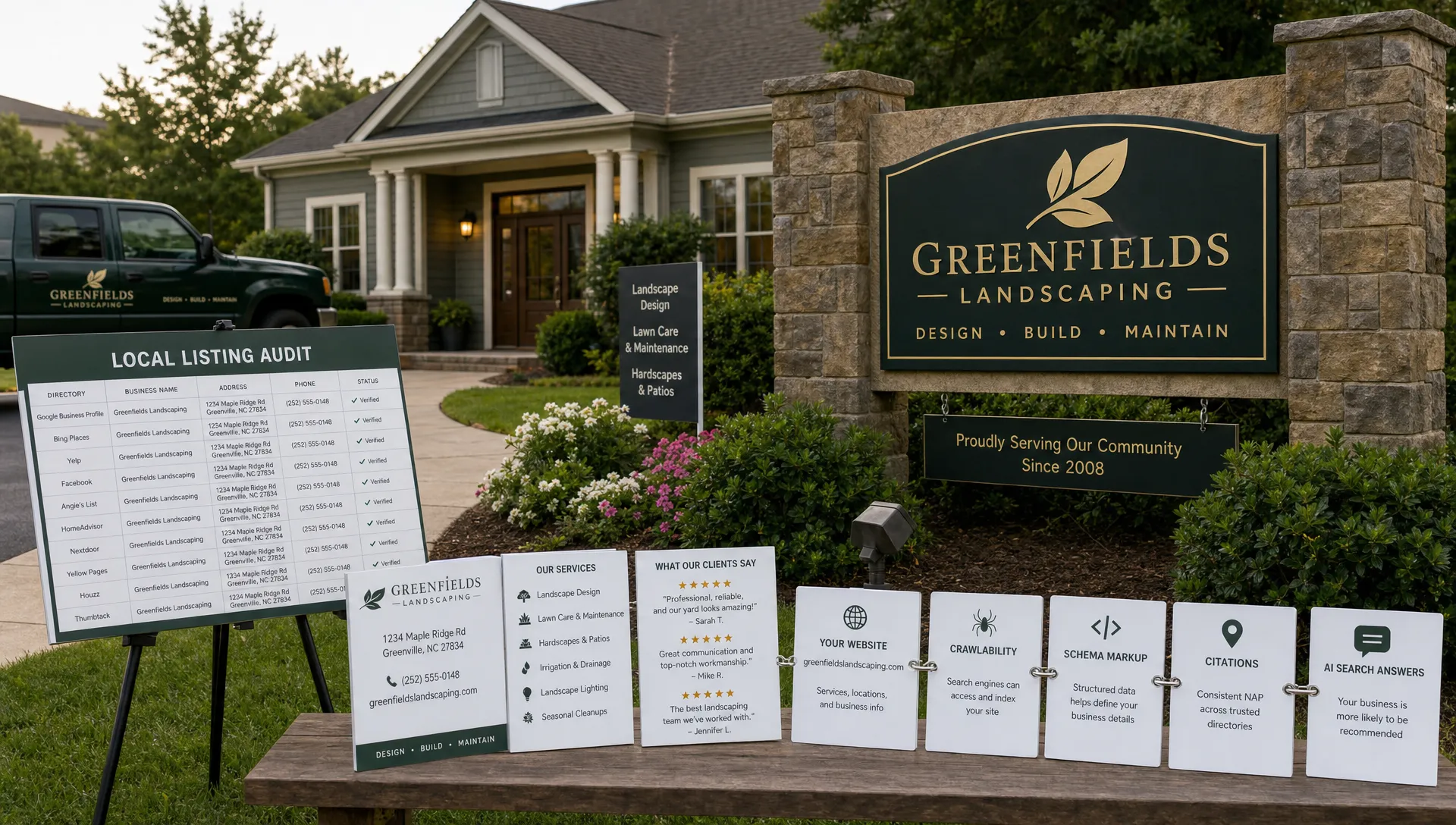
Generative engines work with entities, not just keywords. An entity is a distinct thing, such as a brand, hotel, clinic, school, product, location, founder, service, or category. If your entity signals are fragmented, AI systems may struggle to connect the dots.
This is where an AI SEO agency should deliver an entity and citation map. That map identifies the primary entities your business needs to be known for, then checks whether those entities are consistent across your website and trusted external sources.
For a multi-location brand, that means each location page should make the essentials clear: business name, address, service area, hours, phone number, services, booking path, local context, and relationship to the parent brand. For ecommerce, it means product names, categories, variants, availability signals, reviews when valid, and supporting buying guides should align. For agencies managing client portfolios, it means entity standards can be reused across sites.
This work often uncovers simple but costly gaps. A clinic may use different service names on location pages and directory profiles. A hotel may have amenity details buried in image carousels rather than crawlable text. A software provider may describe the same offer three different ways across its homepage, comparison pages, and knowledge base.
The fix is not to stuff more keywords into pages. The fix is to make the business legible.
3. Technical SEO that supports AI visibility
Technical SEO is not glamorous, but it is where many AI visibility problems begin. If important content is hard to crawl, rendered only after heavy JavaScript, duplicated across pages, or separated from internal links, AI systems have weaker material to work with.
A qualified agency should audit and help fix the technical layer before scaling content.
| Technical issue | What the agency should check | Why it matters |
|---|---|---|
| Crawlability gaps | Robots directives, XML sitemaps, blocked resources, server errors | Search and AI systems cannot reuse content they cannot access |
| Indexation waste | Thin pages, duplicates, parameter URLs, outdated pages | Wasted crawl paths dilute the pages that matter most |
| Rendering problems | Content hidden behind scripts, tabs, widgets, or client-side rendering | Important facts may not be visible to crawlers |
| Weak internal linking | Orphaned pages, poor anchor text, disconnected location or product pages | AI systems need clear relationships between entities and topics |
| Slow page performance | Core Web Vitals, image weight, script bloat, mobile experience | Faster pages improve user experience and can support search performance |
Google's SEO starter guide still gives a useful principle: make content helpful, accessible, and understandable. For performance checks, tools like PageSpeed Insights can help identify issues that affect real users and crawlers.
The business effect is straightforward. Technical problems reduce the usable surface area of your site. Fixing them gives your content, schema, and internal links a better chance to be discovered and trusted.
4. Content systems built for answers, not just rankings
An AI SEO agency should not simply produce a calendar of AI-generated posts. Content should be tied to the questions customers ask and the evidence AI engines need to include your brand with confidence.
Answer-ready content usually has a few traits. It defines terms clearly. It gives concise answers near the top of relevant sections. It includes specific proof, such as policies, locations, product attributes, service capabilities, pricing context when appropriate, certifications, case examples, or first-party data. It uses internal links to connect related pages. It avoids vague claims that cannot be verified.
For a travel group, this might mean pages that answer practical questions about parking, airport transfers, event capacity, accessibility, and nearby attractions. For a franchise brand, it might mean consistent service explanations across every location, with local details that are not duplicated blindly. For an MSP, it might mean explainers that connect technical services to business risks, such as downtime, compliance, or account security.
AI can help with research, clustering, summaries, and drafts. But human editorial review is not optional. If your team uses AI in production, the process should include source checks, expert edits, brand voice review, and measurement after publication. CapstonAI has a deeper guide on best practices for using AI for SEO content if you need a governance model for that workflow.
The agency should be able to show how each content asset supports a prompt cluster, entity, or conversion path. If the answer is only that the article targets a keyword, the strategy is incomplete.
5. Schema, metadata, and llms.txt where they help
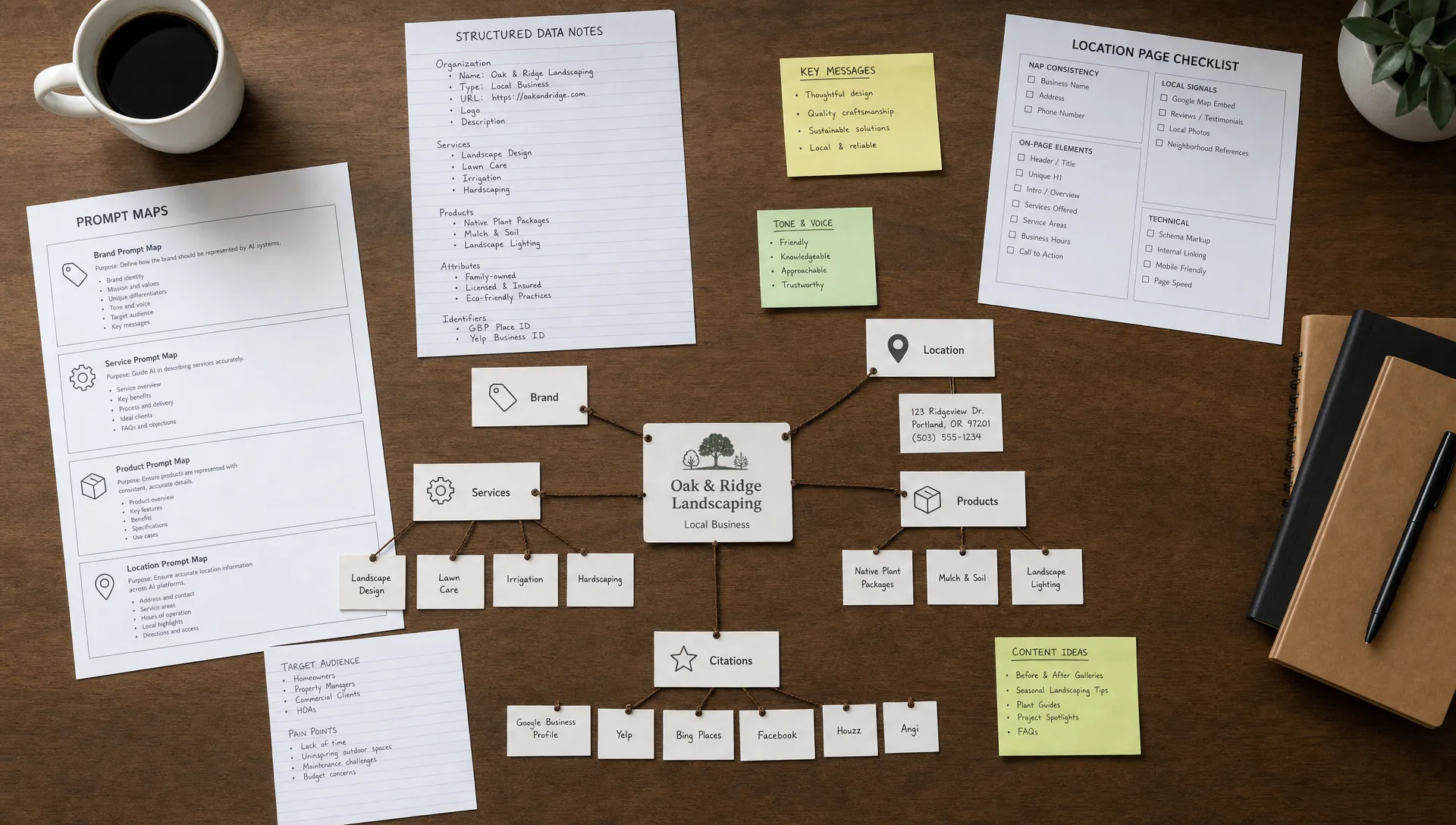
Structured data is a clarity layer. It does not guarantee inclusion in AI answers, and it should never be used to mark up claims that are not visible on the page. But when implemented correctly, schema helps search systems understand the type of content and its relationships.
Google's structured data guidance explains that structured data can help Google understand a page and make it eligible for certain search features. The vocabulary comes from Schema.org, which supports common types such as Organization, LocalBusiness, Product, Article, BreadcrumbList, FAQPage, and Review, when the content qualifies.
An AI SEO agency should audit schema for validity and accuracy, then implement it where it supports real content. For multi-location brands, LocalBusiness or relevant subtype markup can clarify location details. For ecommerce, Product markup can clarify attributes, offers, and reviews when they are present and compliant. For publishers and service brands, Article, FAQPage, and BreadcrumbList can support content structure.
Metadata still matters too. Title tags and meta descriptions shape how pages are understood and clicked in search. They also create a concise summary layer for your pages. Good metadata should reflect the page accurately, distinguish similar pages, and avoid boilerplate repetition across large site fleets.
Then there is llms.txt. This is an emerging convention for helping AI systems identify important content, not a universal standard like robots.txt. A responsible agency should treat it as a supporting file, not a magic lever. If used, it should summarize priority pages, documentation, policies, and authoritative resources in a way that matches the actual site.
6. Reporting that proves movement over time
AI visibility reporting should be repeatable. If the agency cannot rerun the same prompt set and compare outcomes, the work becomes anecdotal.
A useful report should separate three things: what AI engines say, what sources they cite, and what your website changed. That distinction prevents false conclusions. A visibility gain may come from better technical access, stronger content, a new citation source, or a competitor losing freshness. You need to know which lever moved.
At minimum, reporting should include:
- Prompt-level results by engine and market.
- Brand mentions, competitor mentions, and share of voice.
- Citation sources and whether your site is included.
- Accuracy issues and missing information.
- Pages changed, schema added, content improved, and technical fixes completed.
- Business metrics connected to the work, such as organic sessions, branded demand, referral traffic from AI platforms where visible, booking starts, leads, or assisted conversions.
This is especially important for in-house teams and agencies that must justify budget. Traditional rankings are still useful, but they do not explain whether your brand is showing up inside generated answers.
If you are comparing software and services, this is also where platform selection matters. A helpful evaluation framework is available in CapstonAI's guide on how to choose an SEO platform for AI visibility.
7. A practical 90-day operating plan
A credible AI SEO engagement should have a staged plan. The exact scope depends on site size, CMS, market, and internal resources, but the sequence should be clear.
| Timeframe | Focus | Expected outputs |
|---|---|---|
| Days 0-30 | Baseline and diagnosis | AI visibility audit, prompt library, competitor map, technical crawl, schema review, priority page list |
| Days 31-60 | Implementation | Metadata fixes, schema updates, internal linking improvements, location or product page upgrades, FAQ and answer sections |
| Days 61-90 | Measurement and scaling | Repeat prompt scans, before and after reporting, content expansion plan, alert setup, operational playbook |
The first 30 days should not be spent guessing. They should produce a clear view of what AI engines currently see, what they miss, and which fixes are most likely to improve visibility.
The next 30 days should ship improvements. These might include schema corrections, stronger internal links, rewritten service summaries, improved location pages, crawl fixes, or AI-ready FAQs. The final 30 days should prove what moved and decide what to scale.
This approach works because it limits opinion. The baseline defines the problem. The implementation changes the asset. The repeat scan measures the effect.
What an AI SEO agency should not sell as proof
Some services sound modern but do not create durable visibility. Be cautious if the agency leads with outputs that are easy to produce but hard to connect to business outcomes.
Warning signs include:
- A promise to publish large volumes of AI-written content with little expert review.
- Reports focused only on keyword rankings, with no AI visibility, citations, or prompt tracking.
- One-time prompt screenshots that cannot be reproduced.
- Schema markup added without matching visible page content.
- Generic recommendations that do not reflect your CMS, locations, products, or market.
- No plan for competitor monitoring or share-of-voice changes.
- No technical SEO review before content production.
The issue is not that AI-assisted work is bad. The issue is that automation without measurement can make a messy site larger, not clearer.
How deliverables change by business type
The best agencies adapt AI SEO deliverables to the buyer journey. A hotel chain, franchise network, MSP, ecommerce store, and agency portfolio do not need the same playbook.
| Business type | Highest-value AI visibility problem | Deliverables that matter most |
|---|---|---|
| Independent hotels and travel groups | AI assistants recommend competitors for destination and amenity prompts | Location entity cleanup, amenity content, booking path clarity, travel FAQ, local citations |
| Multi-site franchises | Inconsistent location data and duplicated service pages weaken trust | Location schema, internal linking, service standardization, local proof, monitoring by market |
| IT service providers and MSPs | Technical buyers ask AI for vendors before contacting sales | Service explainers, comparison pages, security and compliance proof, citation building |
| Mid-market ecommerce and WooCommerce | Product and category pages are hard to distinguish or cite | Product schema, category guides, comparison content, review compliance, performance fixes |
| SEO and performance agencies | Client reporting must include AI search, not just rankings | Repeatable prompt libraries, dashboards, CMS workflows, scalable schema and metadata fixes |
This is where an AI SEO agency should show industry judgment. The core disciplines are similar, but the priority pages, prompt sets, and proof points differ.
Questions to ask before hiring an AI SEO agency
Use these questions to separate capable partners from vendors selling generic AI output.
- Which AI engines do you monitor, and how do you keep prompt tests consistent over time?
- How do you measure brand mentions, citations, and share of voice against competitors?
- What technical SEO checks do you complete before recommending content?
- How do you decide which pages need schema, metadata, FAQs, or internal links?
- Can you show before and after reporting from repeat scans rather than screenshots?
- How do you handle multi-location or multi-brand sites without duplicating thin content?
- What role does human editorial review play in AI-assisted content?
- How will your recommendations be implemented in our CMS?
The best answers will be specific. They will mention engines, prompt libraries, page types, schema validation, crawl data, implementation workflows, and business metrics.
Agency, platform, or both?
Some teams need an agency to set strategy, write content, fix technical issues, and manage implementation. Others need a platform that gives their in-house team or existing agency better visibility data. Many mid-market and enterprise teams need both.
The key is to avoid a blind spot. If an agency has strong editorial talent but no way to measure AI visibility, it may optimize without proof. If a platform detects issues but no one implements fixes, the insights sit unused.
CapstonAI is built for the measurement and optimization layer. It helps teams track how brands appear across AI search and generative engines, monitor mentions and citations, map prompts, compare competitors, prioritize recommendations, and publish AI-ready metadata, schema, FAQs, and llms.txt where appropriate. For a deeper budget and value discussion, see CapstonAI's article on whether AI SEO services are worth it for enterprise brands.
The right operating model is the one that closes the loop: measure, fix, publish, monitor, and repeat.
Frequently Asked Questions
What is an AI SEO agency? An AI SEO agency helps a business improve how it appears in AI-generated answers and traditional search. The work usually combines GEO, AEO, technical SEO, structured data, content strategy, and visibility monitoring across engines such as ChatGPT, Gemini, Perplexity, Claude, Copilot, and Google AI Overviews.
How is AI SEO different from traditional SEO? Traditional SEO focuses heavily on rankings, clicks, crawlability, content relevance, and authority signals. AI SEO adds measurement for brand mentions, citations, prompt coverage, answer accuracy, and share of voice inside generative engines. The two disciplines should work together.
Should an AI SEO agency create llms.txt? It can, but llms.txt should be treated as a supporting signal, not a guaranteed visibility driver. A responsible agency will first fix crawlability, content clarity, schema, metadata, and internal linking, then use llms.txt to point AI systems toward authoritative resources where it makes sense.
How long does AI SEO take to show results? The first useful result should be a baseline audit within the first month. Visibility changes depend on site quality, competition, implementation speed, crawl patterns, and how AI systems refresh their sources. The important requirement is repeatable before and after measurement.
What should a free AI visibility audit include? A useful audit should show which prompts surface your brand, which competitors appear instead, which sources are cited, where key facts are missing or inaccurate, and which technical or content fixes should be prioritized first.
Start with a free AI visibility audit
If you are evaluating an AI SEO agency, start with measurement before committing to a large content or technical program.
CapstonAI can show what AI engines currently see, where your brand is missing, which competitors are being surfaced, and which pages need fixes first. From there, your team can decide whether to implement internally, work with an agency, or combine both.
Start with a free AI visibility audit from CapstonAI and turn AI search from a blind spot into a channel you can measure and improve.